1) the three basic legal forms of business enterprise are:
a.monopolists, competitors, and enterprises.
b.proprietorships, partnerships, and corporations.
c.vertical, horizontal, and conglomerate corporations.
d.conglomerates, multinationals, and partnerships.
2) which of the following nations is not a member of the euro zone?
a.italy
b.spain
c.germany
d.great britain
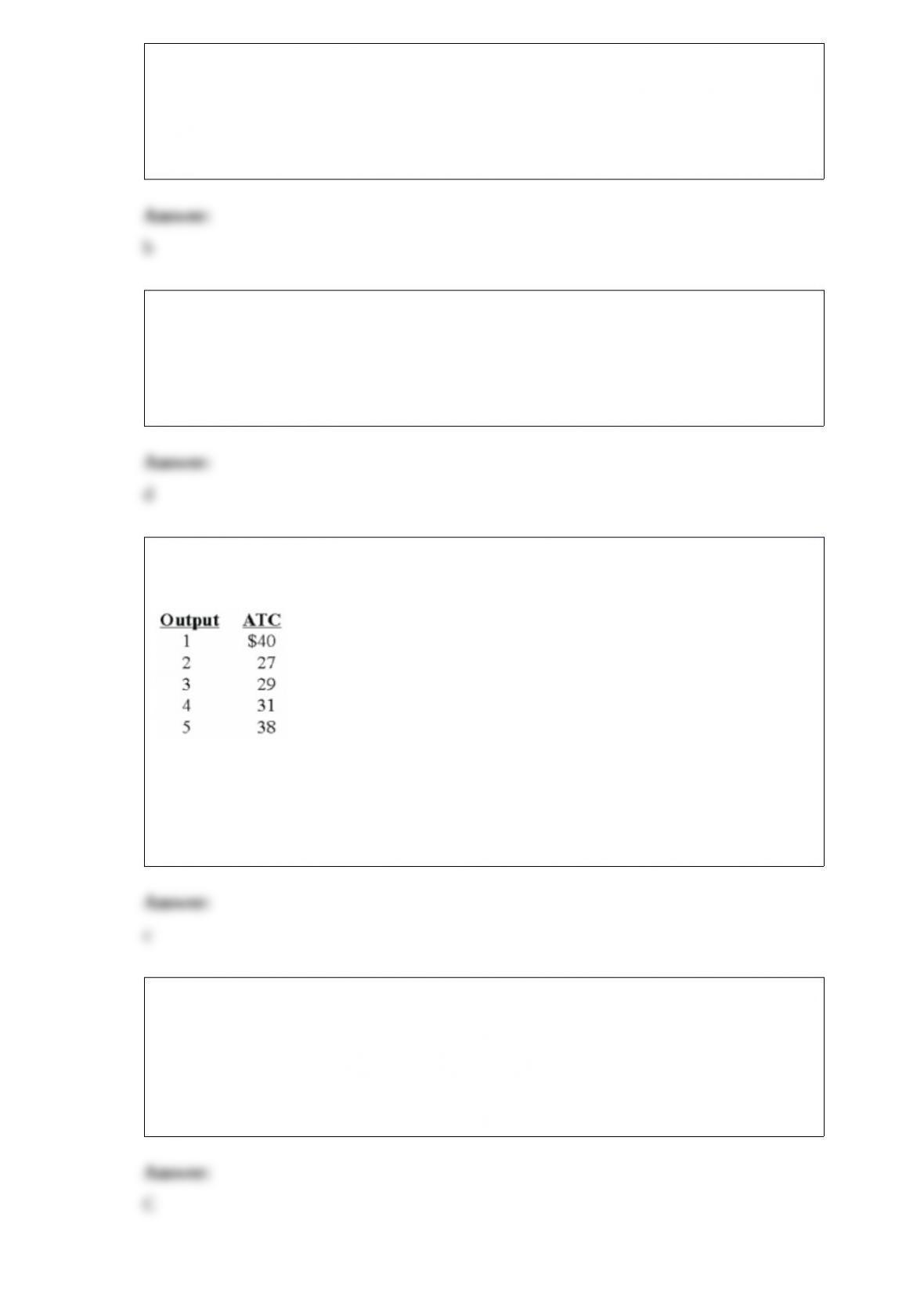
3) the accompanying table that shows average total costs (atc) for a manufacturing firm
whose total fixed costs are $10:
refer to the above data. the total cost of producing 4 units of output is:
a.$31.
b.$87.
c.$124.
d.$108.
4) The TANF program:
A.is a form of social insurance.
B.has been found to be unconstitutional by the Supreme Court.
C.limits total lifetime welfare benefits to 5 years and requires people to work after
receiving benefits for 2 years.
D.perpetuates the so-called culture of poverty.

5) Answer the next question(s) on the basis of the following information: An economy
is employing 2 units of capital, 5 units of raw materials, and 8 units of labor to produce
its total output of 640 units. Each unit of capital costs $10, each unit of raw materials,
$4, and each unit of labor, $3.
Refer to the above information. If the per unit price of raw materials rises from $4 to $8
and all else remains constant, the per-unit cost of production will rise by about:
A.100 percent.
B.50 percent.
C.40 percent.
D.30 percent.
6) Critics of supply-side economics:
A.argue that a tax cut will increase aggregate supply by more than it increases
aggregate demand.
B.contend that the relationship between tax rates and economic incentives is small and
of uncertain direction.
C.believe that a decline in tax rates will increase tax revenues.
D.point out that tax cuts enable households to “buy more leisure” by working less.
7) Near-monies:
A.include all financial and real assets that can be easily converted into currency.
B.are certain highly liquid financial assets that do not function directly as a medium of
exchange but can be readily converted into M1.
C.are excluded from M2 because they are highly liquid.
D. are defined as monetary balances that are immediately available, at zero cost, for
household and business transactions.
8) the relationship between marginal cost and average fixed cost is such that:
a.declines in mc cause afc to decline as output increases.
b.increases in mc cause afc to increase as output increases.
c.mc intersects afc at that output where afc is at a minimum.
d.mc may either rise or fall as afc declines.

9) if a variable input is added to some fixed input, beyond some point the resulting extra
output will decline. this statement describes:
a.economies and diseconomies of scale.
b.x-inefficiency.
c.the law of diminishing returns.
d.the law of diminishing marginal utility.
10) which of the following would most likely move the economy into a recession in the
short term?
a.invention of a new product that most consumers will want to buy.
b.innovations in management that enhance worker productivity.
c.the central bank printing less money than was anticipated.
d. congress passing a reduction in personal income tax rates.
11) which of the following is correct?
a.when ap is rising, avc is rising.
b.when ap is rising, avc is falling.
c.when ap is rising, ap exceeds mp.
d.there is no relationship between ap and avc.