
1) Economist Arthur Laffer equated Robin Hood to:
A.government and equated the people passing through Sherwood Forest to taxpayers.
B.charitable organizations and equated the people passing through Sherwood Forest to
poor people.
C.businesses and equated the people passing through Sherwood Forest to consumers.
D.government and equated the people passing through Sherwood Forest to importers of
goods and services.
2) american critics of the wto argue that free international trade and investment will:
a.reduce u.s. imports.
b.reduce employment in developing nations.
c.undermine environmental and labor protections in the united states.
d.increase immigration from low-income to high-income nations.
3) government rather than private firms must provide economically desirable public
goods because:
a.high marginal costs preclude their production in the private sector.
b.public goods have characteristics that make it difficult or impossible for private firms
to produce them profitably.
c.public goods have marginal costs that exceed marginal benefits.
d.the law of increasing opportunity costs applies only to private goods.
4) Alex and Ben are both loggers wanting to harvest timber from the same forest. Alex
prefers to harvest and replant at a sustainable rate; Ben wants to harvest as many trees
as possible to maximize short-run profit, and then move on. They face the same
production costs.
Refer to the information above. If property rights are poorly enforced or non-existent:
A.Ben will choose to harvest as quickly as possible, but Alex will choose to harvest
more slowly and replant.
B.both will harvest trees as quickly as possible, before the other one does.
C.both now have an incentive to harvest and replant in a sustainable manner.
D.we would expect them to form an agreement on harvesting and replanting.
5) in 2005, tatum’s nominal income rose by 4.6 percent and the price level rose by 1.6
percent. we can conclude that tatum’s real income:
a.may have either increased or decreased.
b.rose by approximately 6.2 percent.
c.rose by approximately 3 percent.
d.fell by approximately 13 percent.
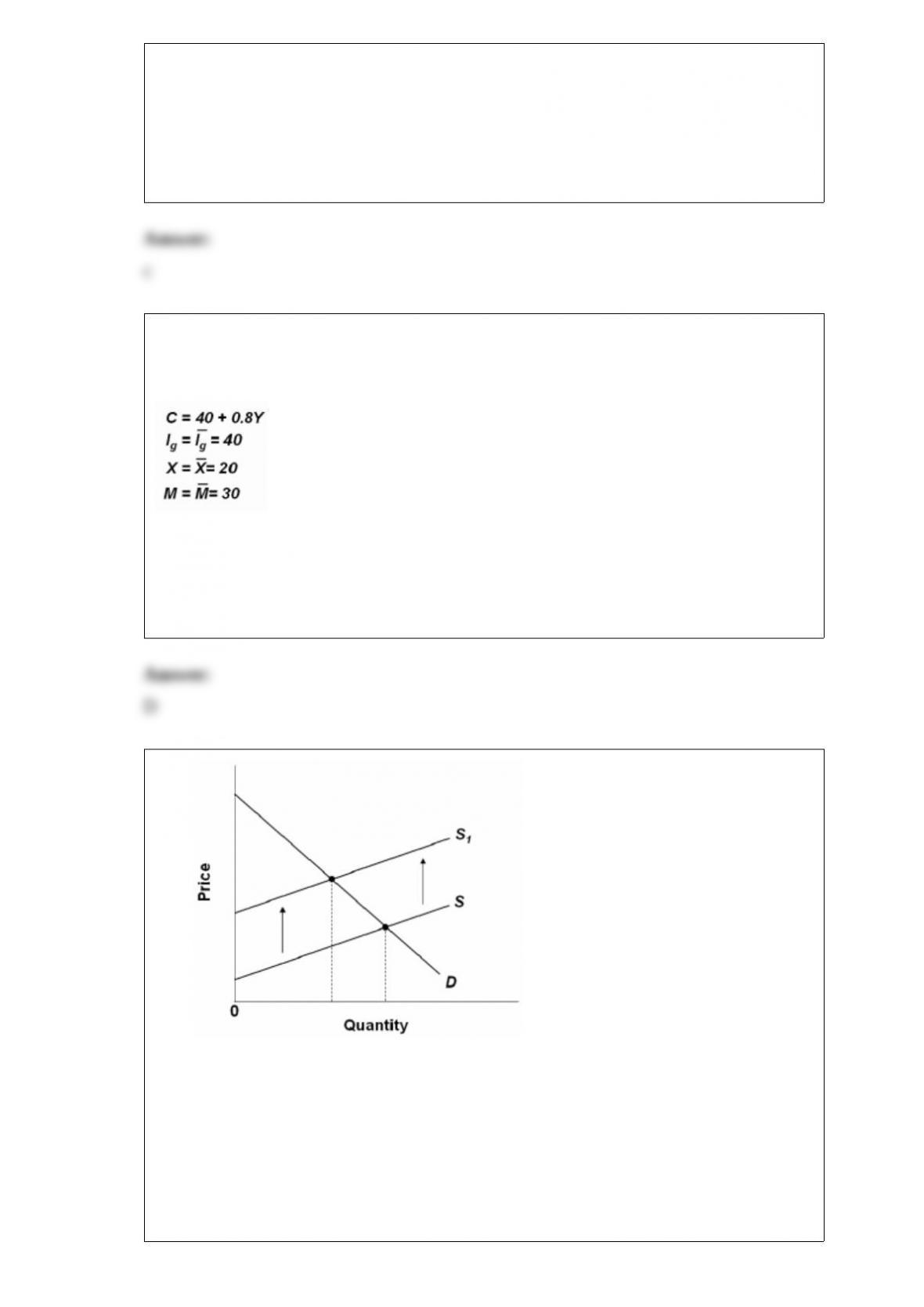
6) (Advanced analysis) Answer the next question(s) on the basis of the following
information for a private open economy:
The equilibrium GDP (=Y) in the above economy is:
A.$200.
B.$245.
C.$320.
D.$350.
7)
Refer to the above diagram in which S is the market supply curve and S1 is a supply
curve comprising all costs of production, including external costs. Assume that the
number of people affected by these external costs is large. Without government
interference, this market will reach:
A.an optimal allocation of society’s resources.
B.an underallocation of resources to this product.
C.an overallocation of resources to this product.
D.a higher price than is consistent with an optimal allocation of resources.
8) Overall, the U.S. tax system (combined Federal, state, and local) is:
A.highly progressive.
B.slightly progressive.
C.slightly regressive.
D.highly regressive.
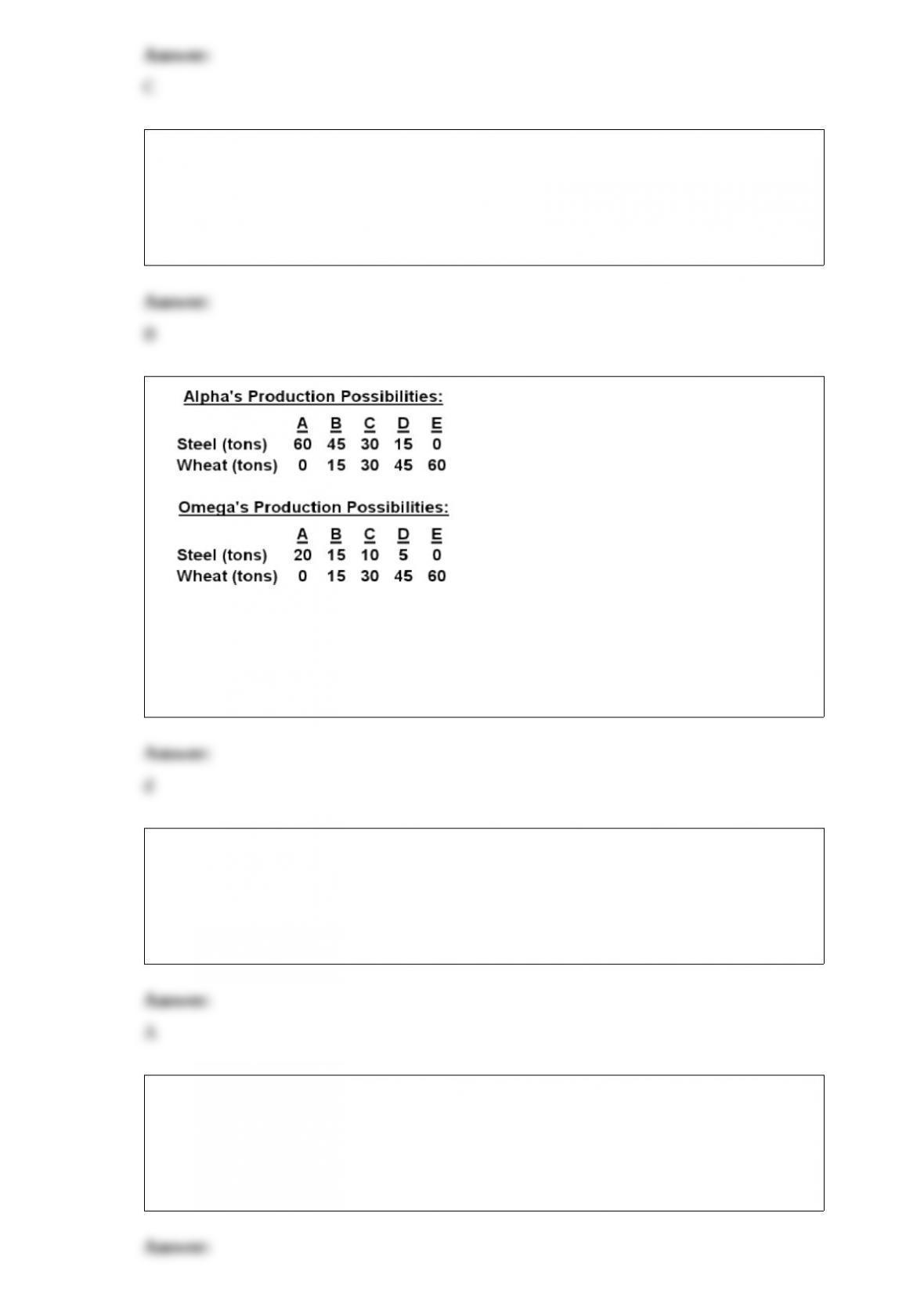
9)
refer to the above data. on the basis of the above information:
a.alpha should export both steel and wheat to omega.
b.omega should export both steel and wheat to alpha.
c.omega should export steel to alpha and alpha should export wheat to omega.
d.alpha should export steel to omega and omega should export wheat to alpha.
10) An economy’s infrastructure refers to its:
A.public capital goods, such as roads, schools, and power facilities.
B.financial and banking institutions.
C.land and natural resources.
D.surplus supplies of unskilled labor.
11) If an exclusive union is successful in restricting the supply of labor, the:
A.wage rate will rise.
B.the quantity of labor demanded will rise.
C.the number of job opportunities in the firm or industry will increase.
D.the demand for labor curve will shift leftward.
12)
Suppose that a firm’s legal staff concludes that a new production process which a firm is
developing is patentable. Graphically, this new information would shift the firm’s
expected rate of return curve on R&D to the:
A.right and reduce its optimal amount of R&D.
B.right and increase its optimal amount of R&D.
C.left and increase its optimal amount of R&D.
D.left and reduce its optimal amount of R&D
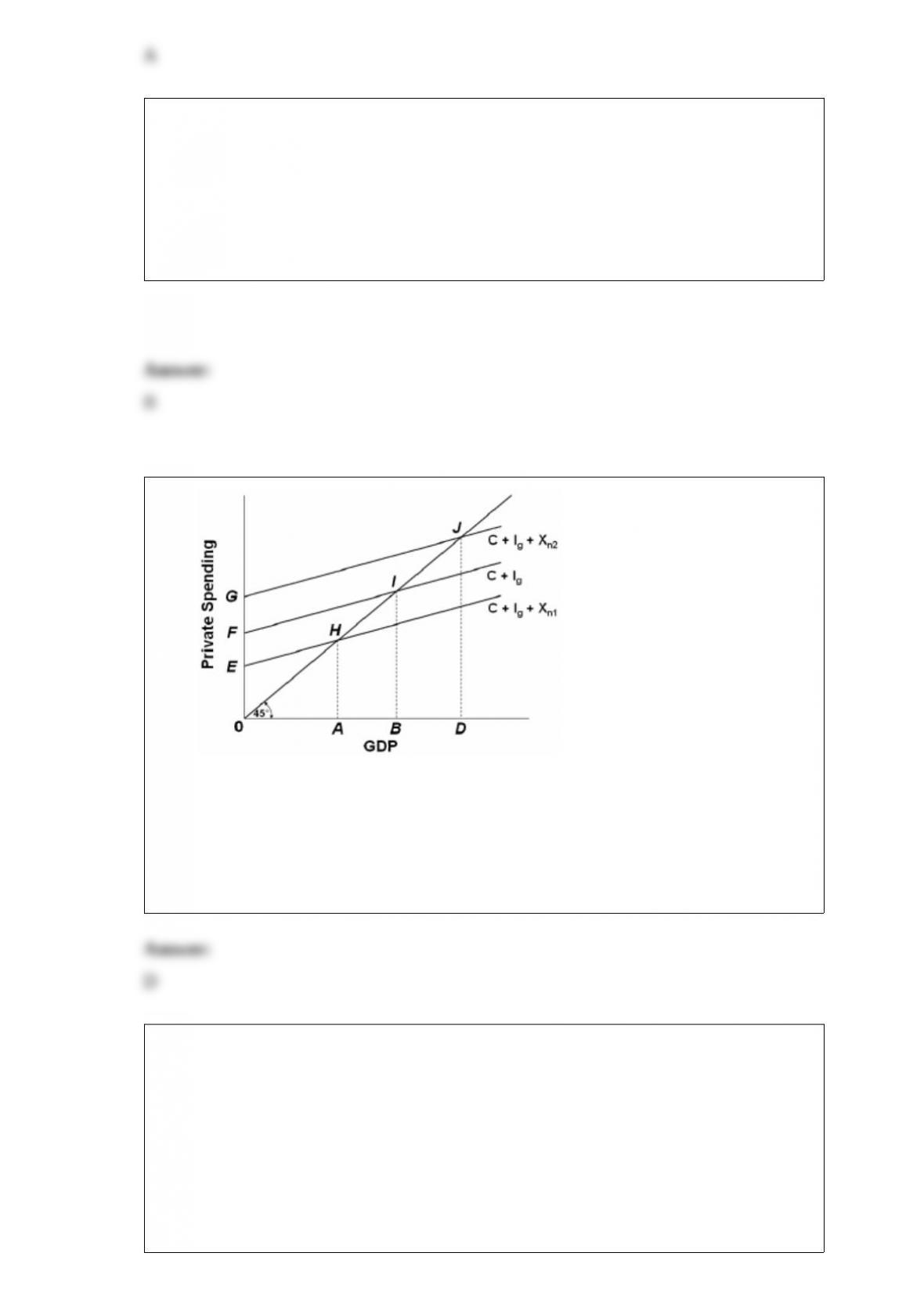
13)
Refer to the above diagram. The change in aggregate expenditures as shown from (C +
Ig + Xn1) to (C + Ig + Xn2) will produce:
A.a decrease in real GDP.
B.an inflationary expenditure gap if 0D is this nation’s full-employment level of GDP.
C.an increase in real GDP if 0A is this nation’s full-employment level of GDP.
D.an inflationary expenditure gap if 0B is this nation’s full-employment level of GDP.
14) Monetarist say:
A.that, because P is stable, a change in M will change Q proportionately in the opposite
direction.
B.a change in the money supply will change aggregate demand and therefore the
nominal GDP.
C.a change in the money supply will change velocity, which in turn will change
nominal GDP.
D.a change in the money supply will change the interest rate, which will change
investment spending and nominal GDP.
15) Which one of the following will not directly affect the U.S. balance on current
account?
A.an increase in U.S. goods imports
B.a decrease in U.S. net investment income
C.an increase in U.S. purchases of assets abroad
D.an increase in U.S. imports of services
16) the entry of generic drugs into a previously monopolized pharmaceutical market
will:
a.discourage the development of new drugs.
b.increase efficiency by increasing consumer surplus.
c.create inefficiency by introducing chemically-inferior medications.
d.not affect the market price because pharmaceutical firms are “price takers.”
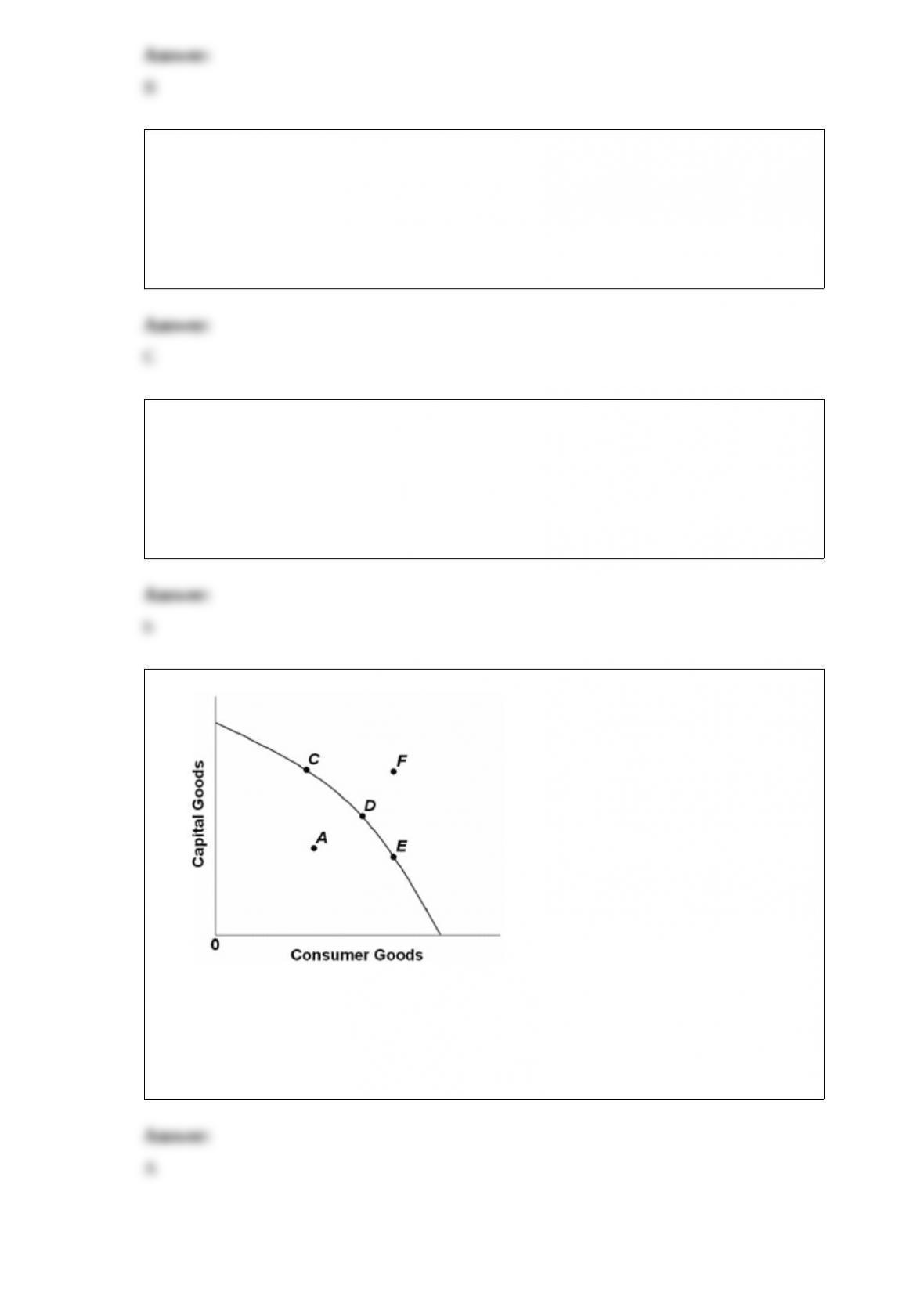
17)
In the above diagram, economic discrimination is best represented by point:
A.A.
B.C rather than D or E.
C.E rather than D or C.
D.F.

18)
refer to the above diagram. flow (3) represents:
a.wage, rent, interest, and profit income.
b.land, labor, capital, and entrepreneurial ability.
c.goods and services.
d.consumer expenditures.
19) offshoring often results from:
a.diminished human capital of american workers.
b.overly restrictive trade policies.
c.a change in comparative advantage.
d.a desire to help out workers in low income economies.