1)
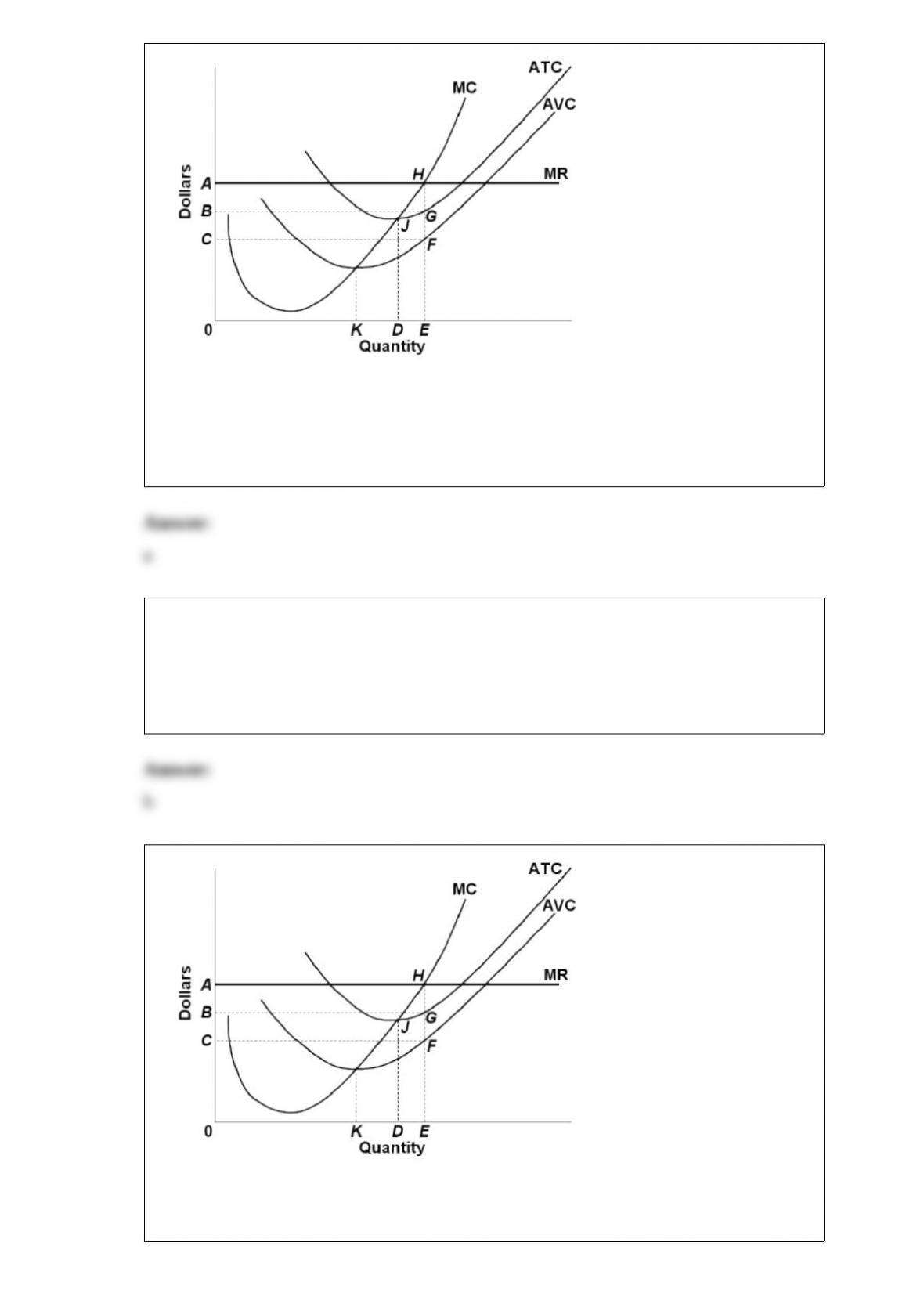
refer to the above diagram. at the profit-maximizing output, total revenue will be:
a.0ahe.
b.0bge.
c.0cfe.
d.abge.
2) the law of diminishing returns results in:
a.an eventually rising marginal product curve.
b.a total product curve that eventually increases at a decreasing rate.
c.an eventually falling marginal cost curve.
d.a total product curve that rises indefinitely.
3)
refer to the above diagram. to maximize profit or minimize losses this firm will
produce:
a.k units at price c
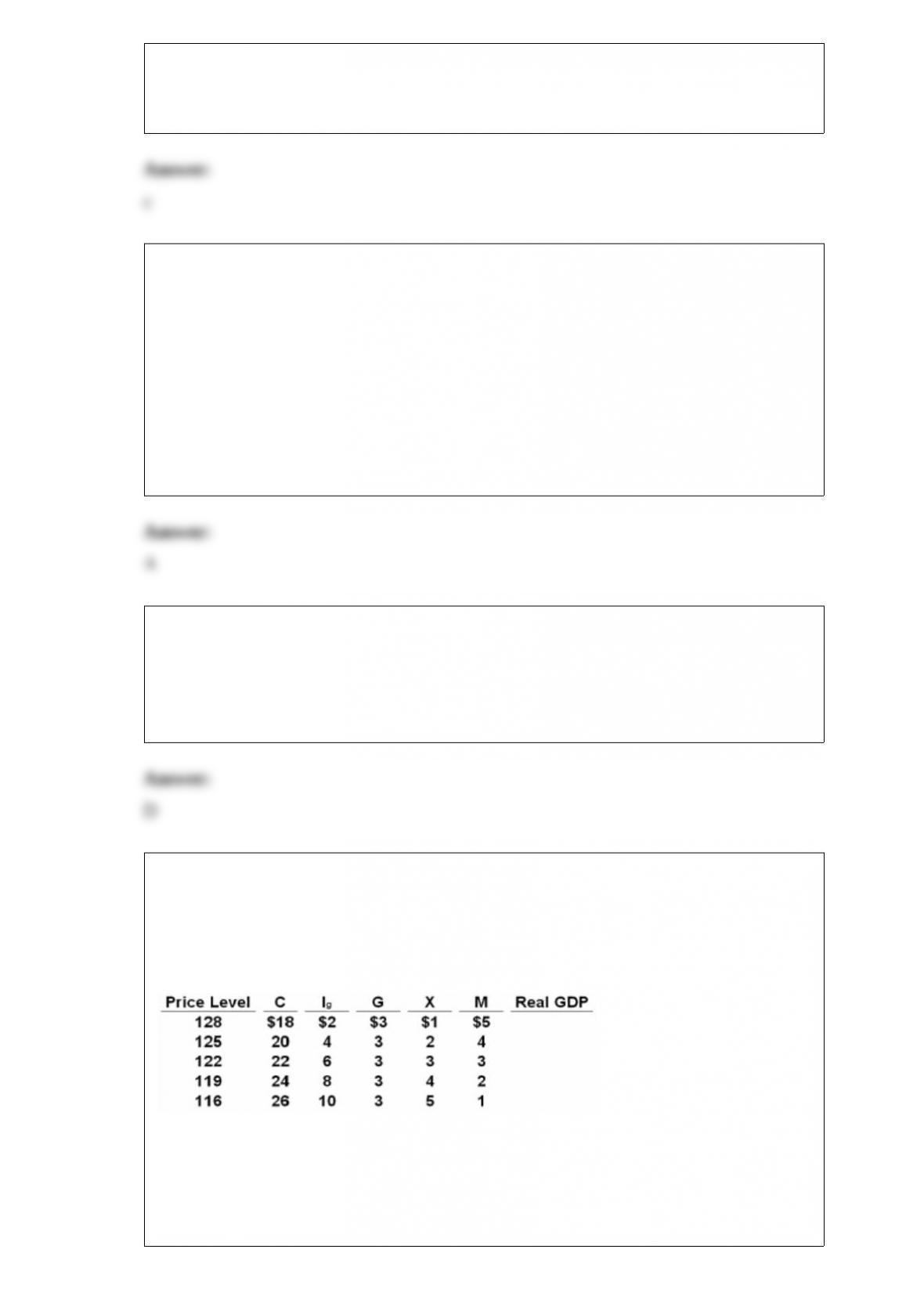
b.d units at price j
c.e units at price a
d.e units at price b
4) The crowding model of discrimination suggests that:
A.women and selected minorities are systematically excluded from high-paying
occupations and crowded into low-paying occupations, decreasing their wages and
reducing domestic output.
B.employers having high discrimination coefficients will be crowded out by
nondiscriminating employers in the long run.
C.firms will base hiring decisions on group averages, rather than on individual
characteristics and productivity.
D.occupational segregation is largely the result of freely made rational choices of
women and minorities.
5) A commercial bank can add to its actual reserves by:
A.lending money to bank customers.
B.buying government securities from the public.
C.buying government securities from a Federal Reserve Bank.
D.borrowing from a Federal Reserve Bank.
6) Answer the next question(s) on the basis of the following table for a particular
country in which C is consumption expenditures, Ig is gross investment expenditures, G
is government expenditures, X is exports, and M is imports. All figures are in billions of
dollars. Each question is independent of the other questions.
Refer to the above table. If the equilibrium level of real GDP is $43 billion, its level of
consumption will be:
A.$20 billion.
B.$22 billion.
C.$24 billion.
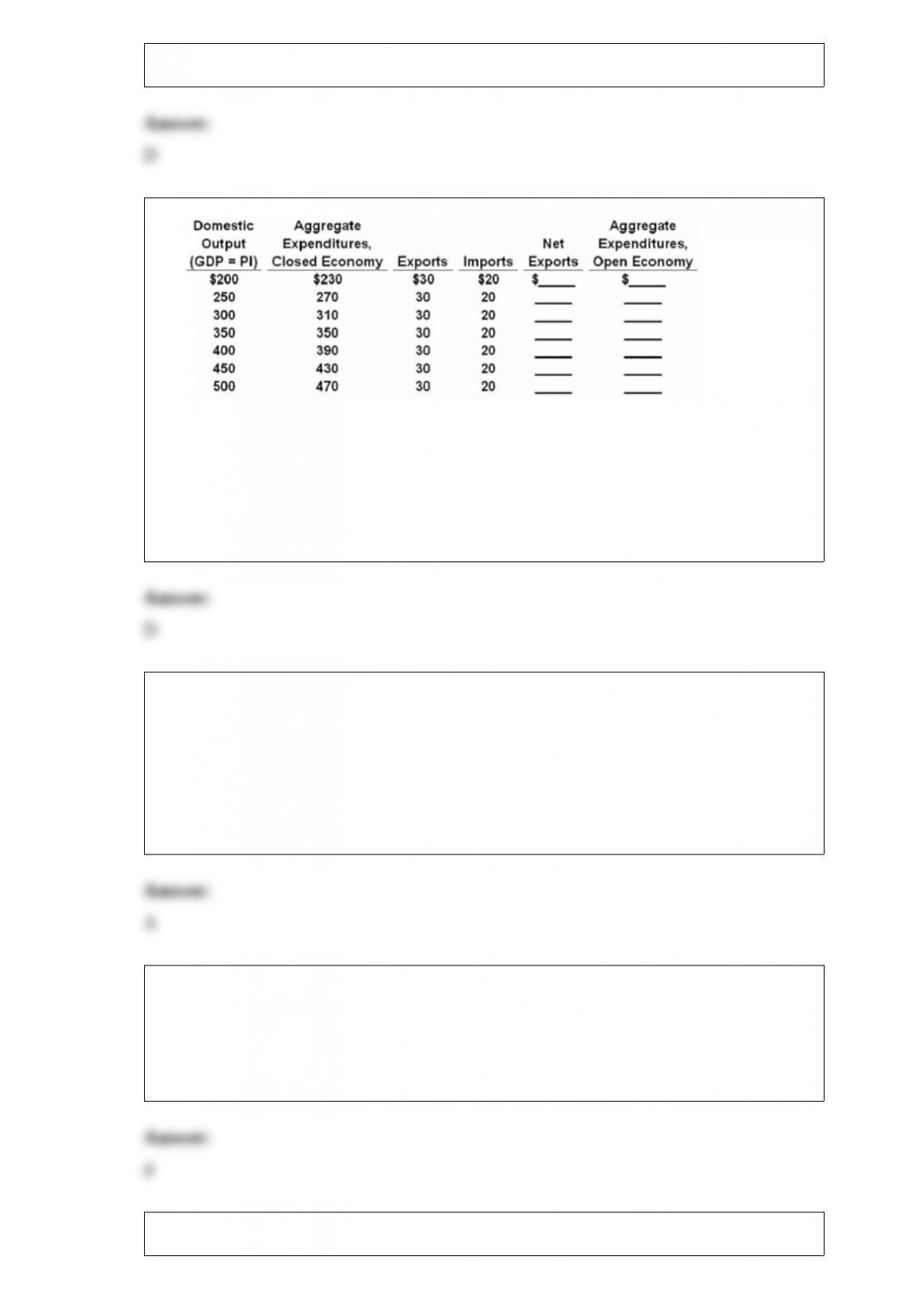
D.$26 billion.
7)
Refer to the above table. For the open economy the equilibrium GDP and the multiplier
are:
A.$300 and 2.5.
B.$450 and 5.
C.$400 and 4.
D.$400 and 5.
8) Suppose that Steve and Susie each perceive $200 of marginal benefit from a
proposed new park, whereas Elizabeth perceives $800. If the proposed tax levied on
each for the park would $300, a majority vote will:
A.defeat this project and resources will be underallocated to it.
B.pass this project and resources will be efficiently allocated.
C.pass the this project and resources will be underallocated to it.
D.pass this project and resources will be overallocated to it.
9) the utility-maximizing rule:
a.is inconsistent with the law of demand.
b.implies a perfectly elastic demand curve.
c.implies a leftward shifting demand curve.
d.is consistent with the law of demand.
10) Which of the following statements is correct?

A.There is clear evidence that unions have increased the average level of real wage
rates for all workers.
B.When fringe benefits are taken into account, the overall compensation of union and
nonunion workers is equal.
C.Approximately 10 percent of all work time is lost annually because of strikes.
D.Featherbedding means that unions may require employers to hire unneeded workers.
11) Each of the following contributes to income inequality except:
A.differences in ability and training.
B.differences in job tastes.
C.differences in wealth ownership.
D.government transfers.
12) In recent decades:
A.all countries classified as DVCs have had little or no economic growth.
B.some nations classified as DVCs have grown rapidly while others have grown very
slowly or not at all.
C.all countries classified as DVCs have experienced rapid economic growth and rising
living standards.
D.all countries classified as low-income DVCs have had declining per capita GDPs.
13) the mr = mc rule:
a.applies only to pure competition.
b.applies only to pure monopoly.
c.does not apply to pure monopoly because price exceeds marginal revenue.
d.applies both to pure monopoly and pure competition.