
1) The low per capita outputs of the DVCs are explained by:
A.insufficient saving and investment.
B.over investment in human capital.
C.slow population growth.
D.excessively rapid technological advance.
2) Suppose the firms in a five-firm industry have market shares of 60, 20, 10, 5, and 5
percent, respectively. The Herfindahl index for the industry is:
A.3,600
B.9,025
C.95
D.4,150
3) in which one of the following market models is x-inefficiency least likely to be
present?
a.pure competition
b.oligopoly
c.monopolistic competition
d.pure monopoly
4) The aggregate supply curve:
A.is explained by the interest rate, real-balances, and foreign purchases effects.
B.gets steeper as the economy moves from the top of the curve to the bottom of the
curve.
C.shows the various amounts of real output that businesses will produce at each price
level.
D.is downsloping because real purchasing power increases as the price level falls.
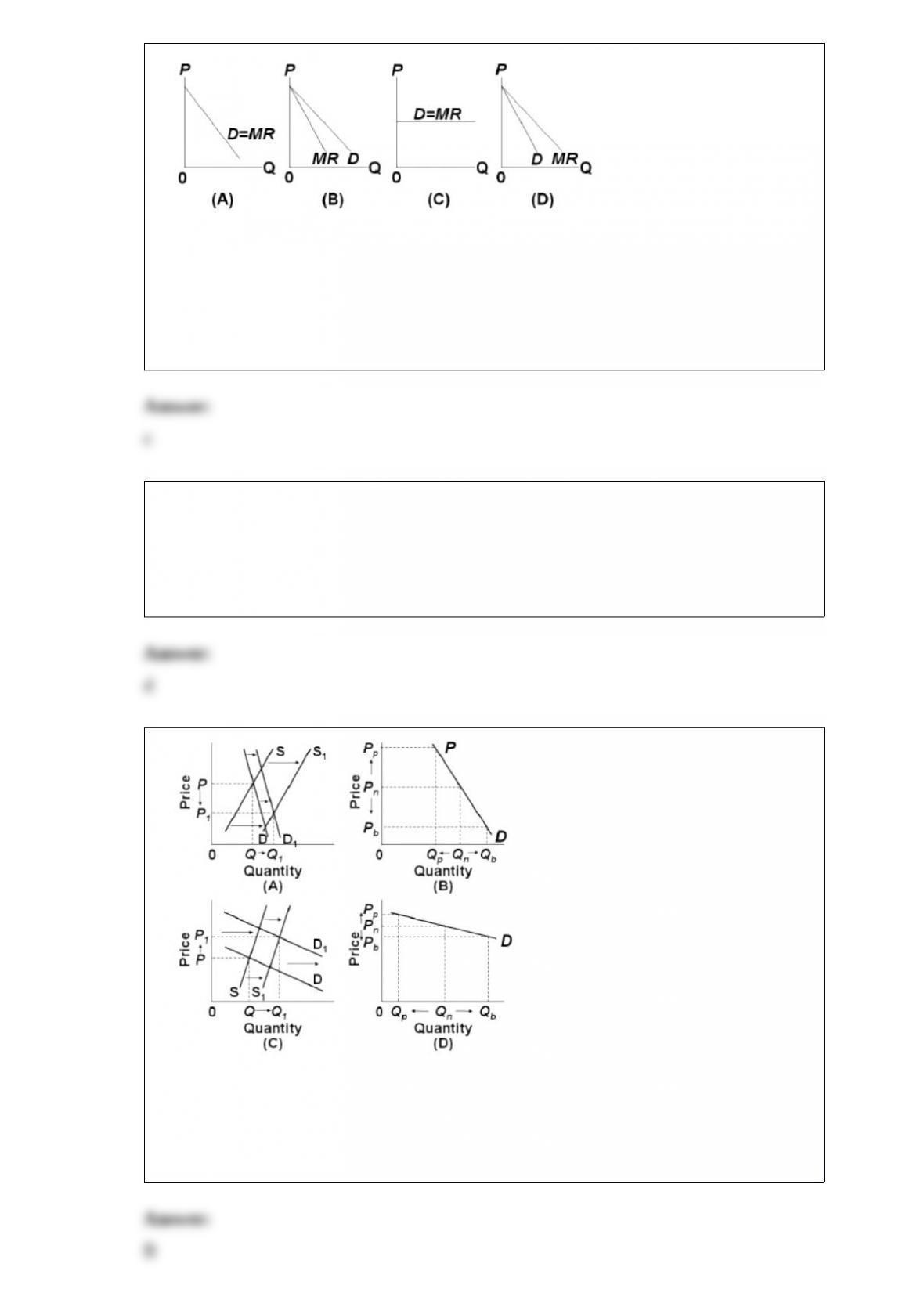
5)
which of the above diagrams correctly portray the demand (d) and marginal revenue
(mr) curves of a purely competitive seller?
a.a
b.b
c.c
d.d
6) which of the following is a capital resource?
a.a computer programmer
b.a corporate bond issued by a computer manufacturer
c.silicon (sand) used to make computer chips
d.a piece of software used by a firm
7)
Which diagram above best represents the problem faced by farms in the short-run?
A.A
B.B
C.C
D.D

8)
The problem faced by farms in the long run as portrayed in the above diagram would
involve price and quantity changes from:
A.P2 to P3 and Q1 to Q4.
B.P1 to P4 and Q1 to Q4.
C.P2 to P1 and Q1 to Q2.
D.P4 to P1 and Q4 to Q1.
9) the amount of calendar time associated with the long run:
a.is less than that associated with the immediate market period.
b.varies from industry to industry.
c.is the same for all firms.
d.is one year by definition.
10) The principal-agent problem arises in labor markets because:
A.a firm may realize excessively large profits.
B.workers may provide less-than-expected work effort.
C.compensating wage differences do not pay for differences in the nonmonetary aspects
of jobs.
D.human capital investments vary among workers.
11) the physical export of motorcycles from the united states to mexico best illustrates
a:
a.trade flow.
b.resource flow.

c.financial flow.
d.technology flow.
12) Increases in the total real output of many DVCs do not increase the nation’s
standard of living because:
A.diminishing returns may be encountered in increasing total output.
B.population increases may dissipate the increase in real output.
C.disguised unemployment in agriculture will persist.
D.surplus farm labor may move from rural areas to industrial areas, causing
unemployment.
13) the number of years required for real gdp to double can be found by:
a.dividing the annual growth rate by .07.
b.multiplying the annual growth rate by 70.
c.dividing 70 by the annual growth rate.
d.adding 14 to annual growth rate.
14) In a mixed open economy the equilibrium GDP exists where:
A.Ca + Ig + Xn intersects the 45-degree line.
B.Ca + Ig = Sa + T + X.
C.Ca + Ig + Xn + G = GDP.
D.Ca + Ig + Xn = Sa + T.
15) approximately how many workers are employed in the u.s. health care industry?
a.800,000
b.2 million
c.9 million
d.14 million