
1) Assume that a firm’s production technique is such that varying combinations of labor
and capital can be used to produce output. If the price of labor falls relative to the price
of capital and the firm decides to use more labor in the production process, this decision
is:
A.solely the result of the substitution effect.
B.solely the result of the output effect.
C.probably the result of both the substitution and output effects.
D.the result of neither the substitution nor the output effect.
2) Under a system of freely floating exchange rates, an increase in the international
value of a nation’s currency will:
A.cause an international surplus of its currency.
B.contribute to disequilibrium in its balance of payments.
C.cause gold to flow into that country.
D.cause its imports to rise.
3) in the united states real gdp:
a.has grown faster than real gdp per capita.
b.has grown faster in recent years than has nominal gdp.
c.per capita has grown faster than real gdp.
d.and real gdp per capita have grown at nearly identical rates.
4) ticket scalping refers to:
a.the surplus of tickets that occurs when price is set below equilibrium.
b.the shortage of tickets that occurs when price is set above equilibrium.
c.pricing tickets so high that an athletic or artistic event will not be sold out.
d.reselling a ticket at a price above its original purchase price.
5) If you write a check on a bank to purchase a used Honda Civic, you are using money
primarily as:
A.a medium of exchange.
B.a store of value.
C.a unit of account.
D.an economic investment.
6) In the table below are statistics showing the labor force and total employment during
year 1 and year 5. Make the computations necessary to complete the table. (Number of
persons is in thousands.)
(a)How is it possible that both employment and unemployment increased?
(b)Would you say that year 5 was a year of full employment?
(c)Why is the task of maintaining full employment over the years more than just a
problem of finding jobs for those who happen to be unemployed at any given time?
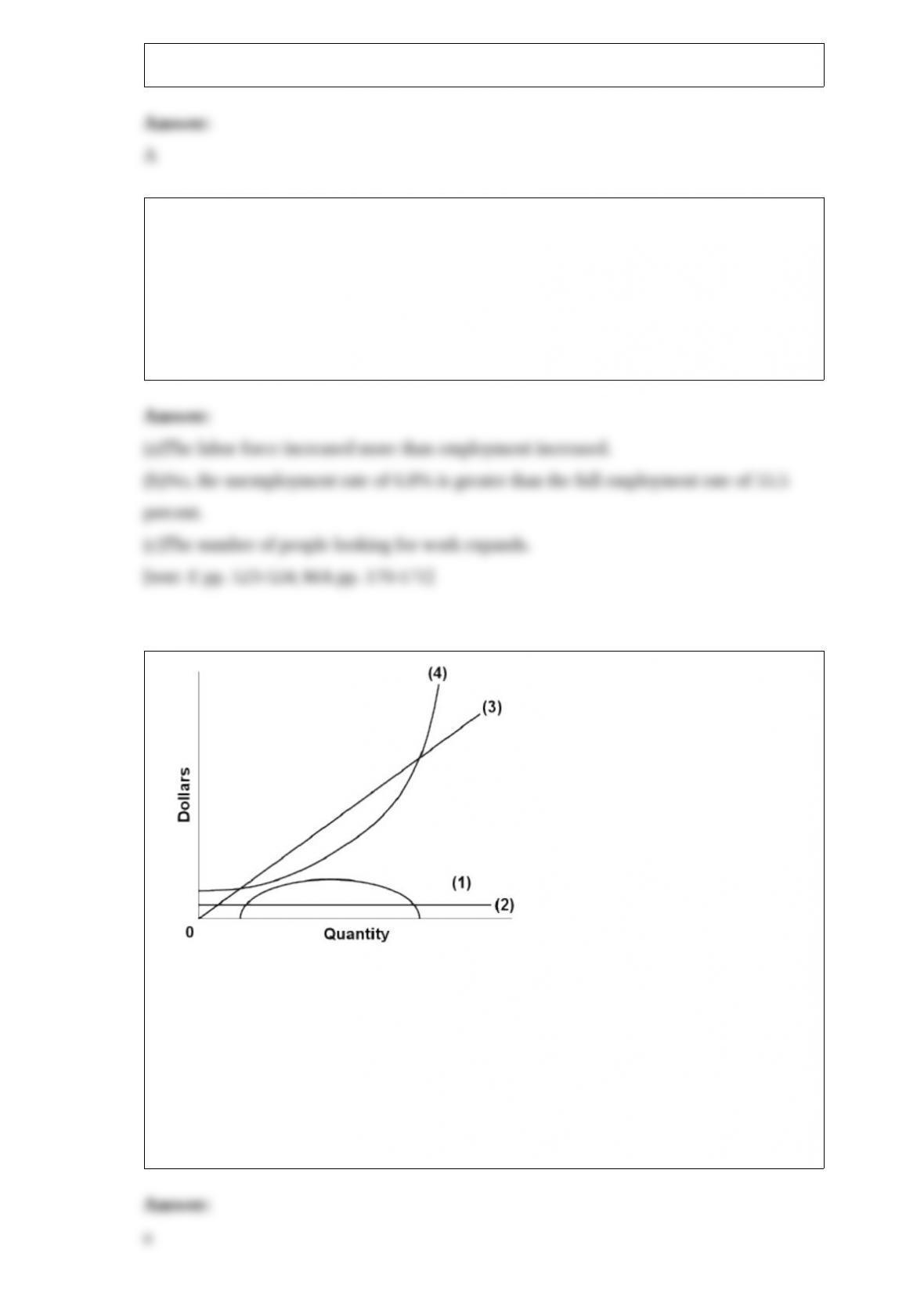
7)
refer to the above diagram. other things equal, an increase of product price would be
shown as:
a.an increase in the steepness of curve (3), an upward shift in curve (2), and upward
shift in curve (1).
b.a decrease in the steepness of curve (3), a downward shift in curve (2), and an upward
shift in curve (1).
c.an downward shift in curve (4) and an upward shift in curve (1), with no changes in
lines (2) and (3).
d.an upward shift in line (2) only.
8) Annual budget deficits gave way to annual budget surpluses beginning in:
A.1982.
B.1989.
C.1993.
D.1998.
9) Which one of the following acts declared “Every contract, combination … or
conspiracy, in restraint of trade or commerce among the several states … to be illegal”?
A.the Wheeler-Lea Act
B.the Federal Trade Commission Act
C.the Sherman Act
D.the Interstate Commerce Act
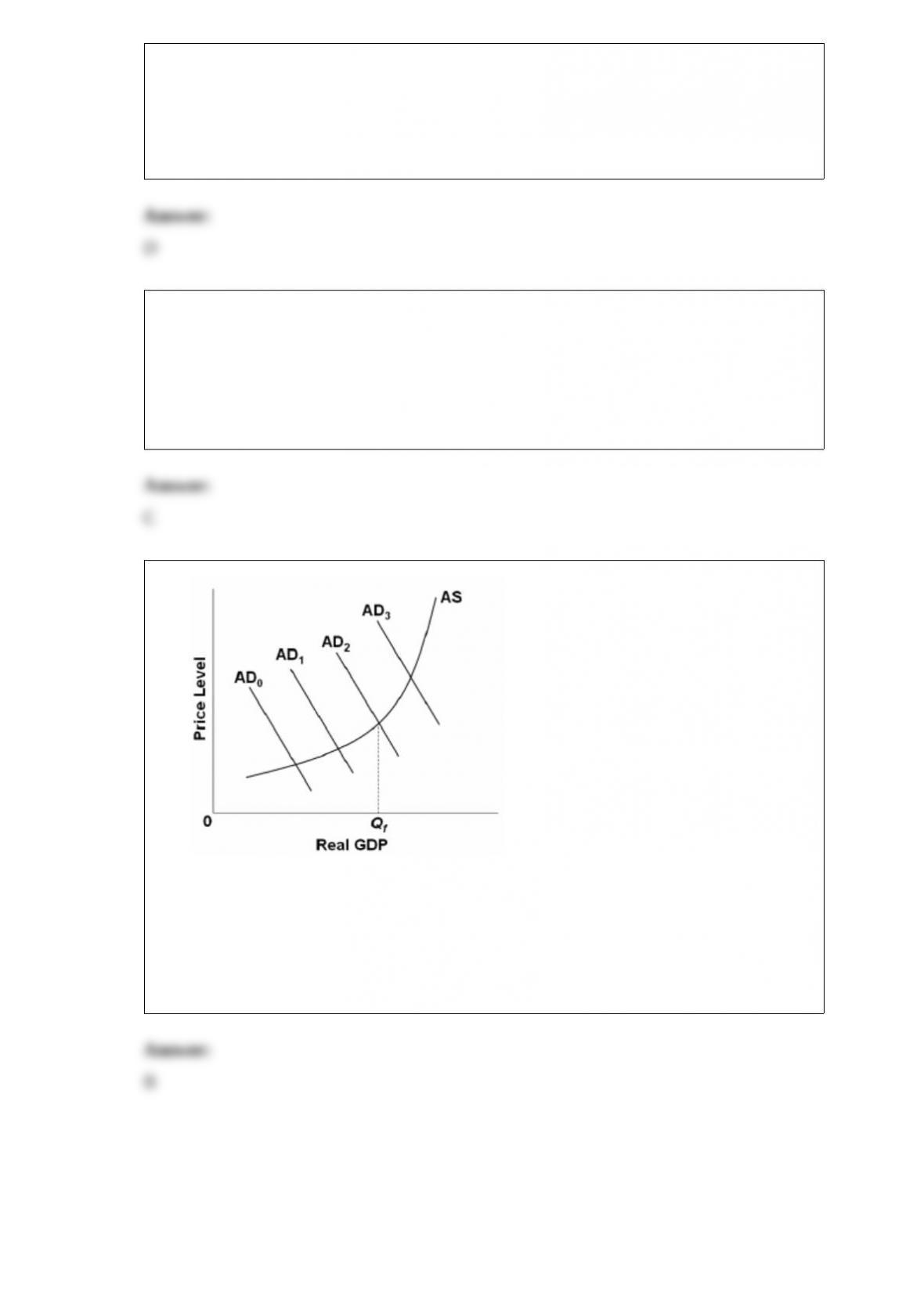
10)
Refer to the above diagram, in which Qf is the full-employment output. If the
economy’s current aggregate demand curve is AD0, it is experiencing:
A.a positive GDP gap.
B.a negative GDP gap.
C.inflation.
D.an adverse supply shock.