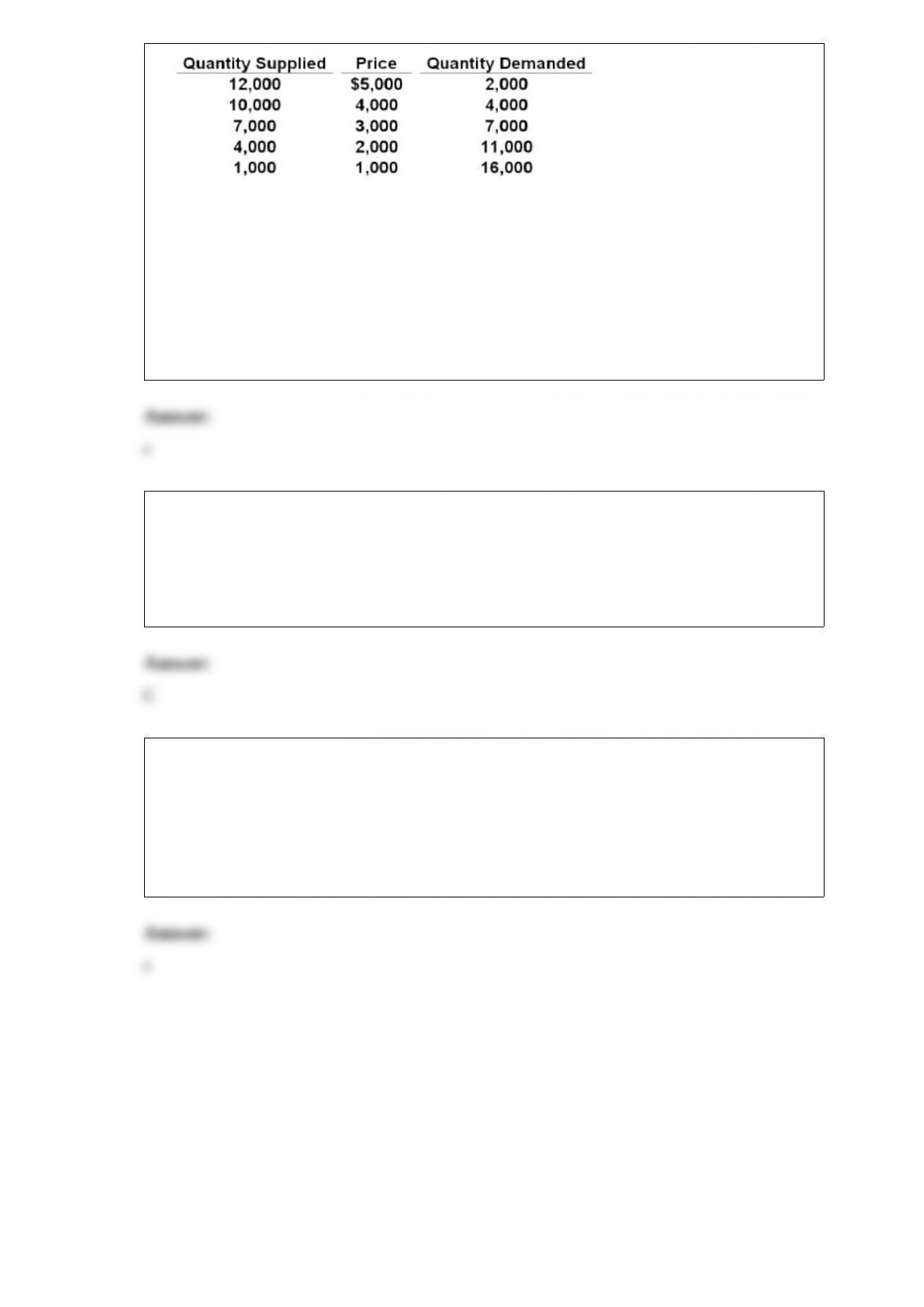
1)
refer to the above supply and demand data for a certain elective surgical procedure. if
suppliers provide the quantity of health care demanded and insurance pays 50 percent
of the remaining equilibrium price after a $1000 deductible is satisfied, the quantity of
health care consumed will be:
a.4,000.
b.7,000.
c.11,000.
d.16,000.
2) If the price index rises from 100 to 120, the purchasing power value of the dollar:
A.may either rise or fall.
B.will rise by one-sixth.
C.will fall by one-sixth.
D.will rise by 20 percent.
3) rosenbaum is purchasing products c and d in utility-maximizing amounts. if the price
of c is $4 and the price of d is $2, then:
a.the marginal utility of d is twice that of c
b.the marginal utility of d is the same as that of c
c.the marginal utility of c is twice that of d
d.the marginal utility of c is four times that of d
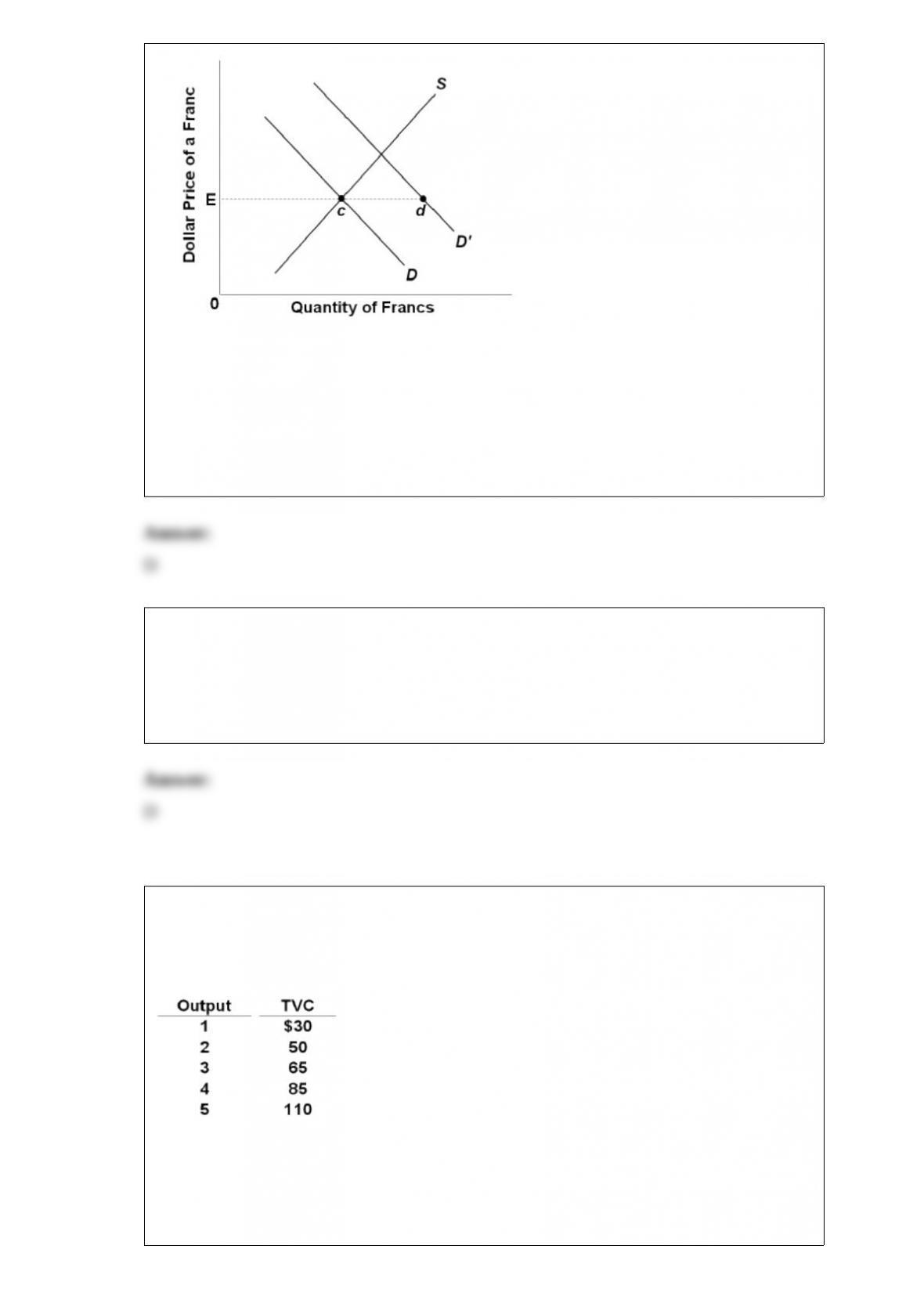
4)
Refer to the above diagram where D and S are the United States’ demand for and supply
of Swiss francs. At the equilibrium exchange rate, E, the United States’ balance of
payments is in equilibrium. A shift of the demand curve to D’ might be the result of:
A.a relative decline in interest rates in Switzerland.
B.a reduction in the United States’ relative price level.
C.a recession in the United States which slows its rate of growth.
D.a relative decline in interest rates in the United States.
5) Between 1995 and 2004 in the United States:
A.average U.S. household wealth increased and median household declined.
B.average U.S. household wealth declined and median household wealth increased.
C.both average and median U.S. household wealth declined.
D.both average and median U.S. household wealth increased.
6) the sunshine corporation finds that its costs are $40 when it produces no output. its
total variable costs (tvc) change with output as shown in the accompanying table. use
this information to answer the following question(s).
refer to the above information. the average total cost of 3 units of output is:
a.$65.
b.$21.67.
c.$40.
d.$35.

7) the loss of a purely competitive firm which shuts down in the short run:
a.is equal to its total variable costs.
b.is zero.
c.is equal to its total fixed costs.
d.cannot be determined.
8) The distribution of wealth in the United States is such that it:
A.is randomly distributed among income classes.
B.has no perceptible impact on the distribution of income.
C.reduces income inequality.
D.contributes to income inequality.
9) other things equal, the greater the degree of complementarity between potential
immigrants and native-born workers, the:
a.lower the optimal quantity of immigrants.
b.lower the marginal benefit of additional immigrants.
c.greater the marginal cost of additional immigrants.
d.greater the optimal quantity of immigrants.
10) determine, other things equal, the effects of a given change in a determinant of
demand or supply for product x upon (1) the demand (d) for, or supply (s) of, x, (2) the
equilibrium price (p) of x and (3) the equilibrium quantity (q) of x.
refer to the above. an increase in the price of a product that is a complement to x will:
a.decrease s, decrease p, and decrease q.
b.decrease d, decrease p, and decrease q.
c.increase d, increase p, and increase q.
d.increase d, increase p, and decrease q.
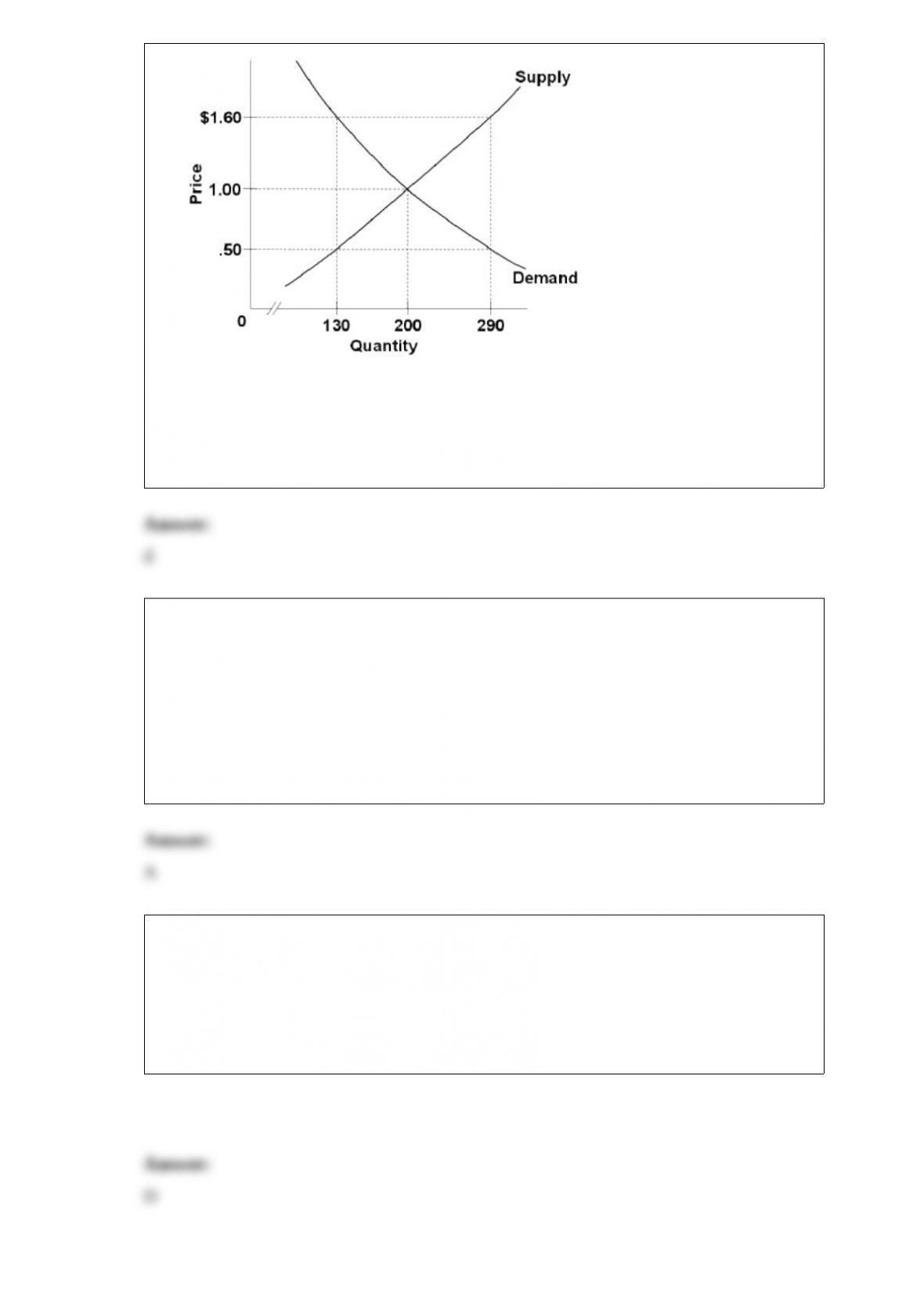
11)
refer to the above diagram. a shortage of 160 units would be encountered if price was:
a.$1.10, that is, $1.60 minus $.50.
b.$1.60.
c.$1.00.
d.$.50.
12) A firm that is motivated by self interest should:
A.employ the combination of resources that will produce the profit-maximizing output
at the minimum cost.
B.hire each input so the productivity of each is equal at the margin.
C.always use large amounts of the most productive inputs and small amounts of the
least productive inputs in producing its output.
D.always use large amounts of cheap inputs and small amounts of expensive inputs in
producing its output.
13)
Effective usury laws cause:
A.a surplus of money in money markets.
B.the quantity of money demanded to be brought into balance with the quantity
supplied.
C.the quantity of money supplied to exceed the quantity demanded.
D.a shortage of money in money markets.

14) If net exports decline from zero to some negative amount, the aggregate
expenditures schedule would:
A.shift upward.
B.shift downward.
C.not move (net exports do not affect aggregate expenditures).
D.become steeper.