1) An international agreement reached in 1994 by the world’s trading nations provides
for:
A.an increase in export subsidies on agricultural products.
B.an increase in agricultural price supports.
C.a reduction of tariffs on agricultural products.
D.an international research organization designed to discover nonfood uses of
agricultural output.
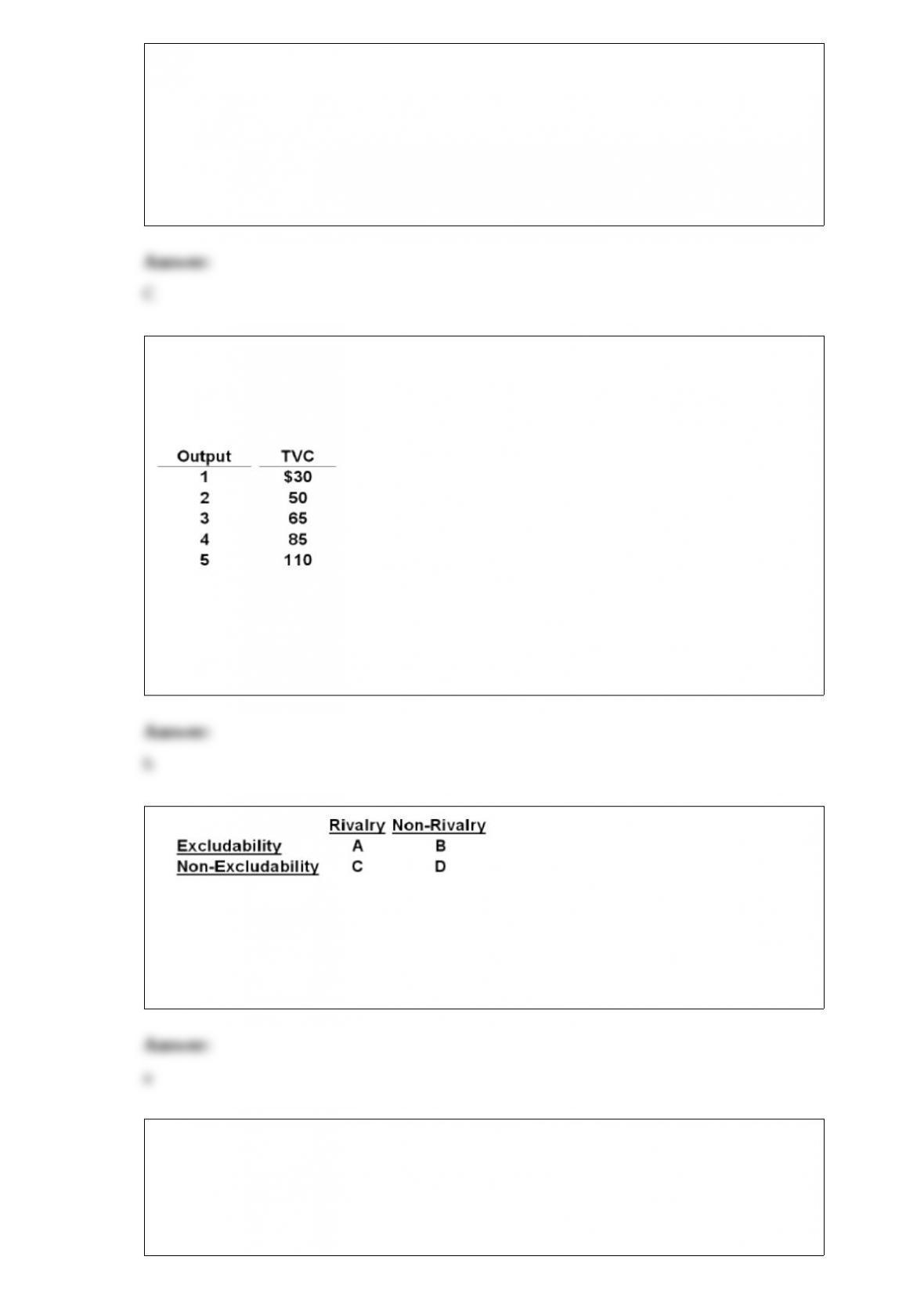
2) the sunshine corporation finds that its costs are $40 when it produces no output. its
total variable costs (tvc) change with output as shown in the accompanying table. use
this information to answer the following question(s).
refer to the above information. the total cost of producing 3 units of output is:
a.$65.
b.$105.
c.$145.
d.$185.
3)
refer to the above matrix. a private good is characterized by combination:
a.a.
b.b.
c.c.
d.d.
4) Compensation paid in proportion to the number of units of personal output best
describes:
A.royalties.
B.profit-sharing.
C.bonuses.
D.piece rates.
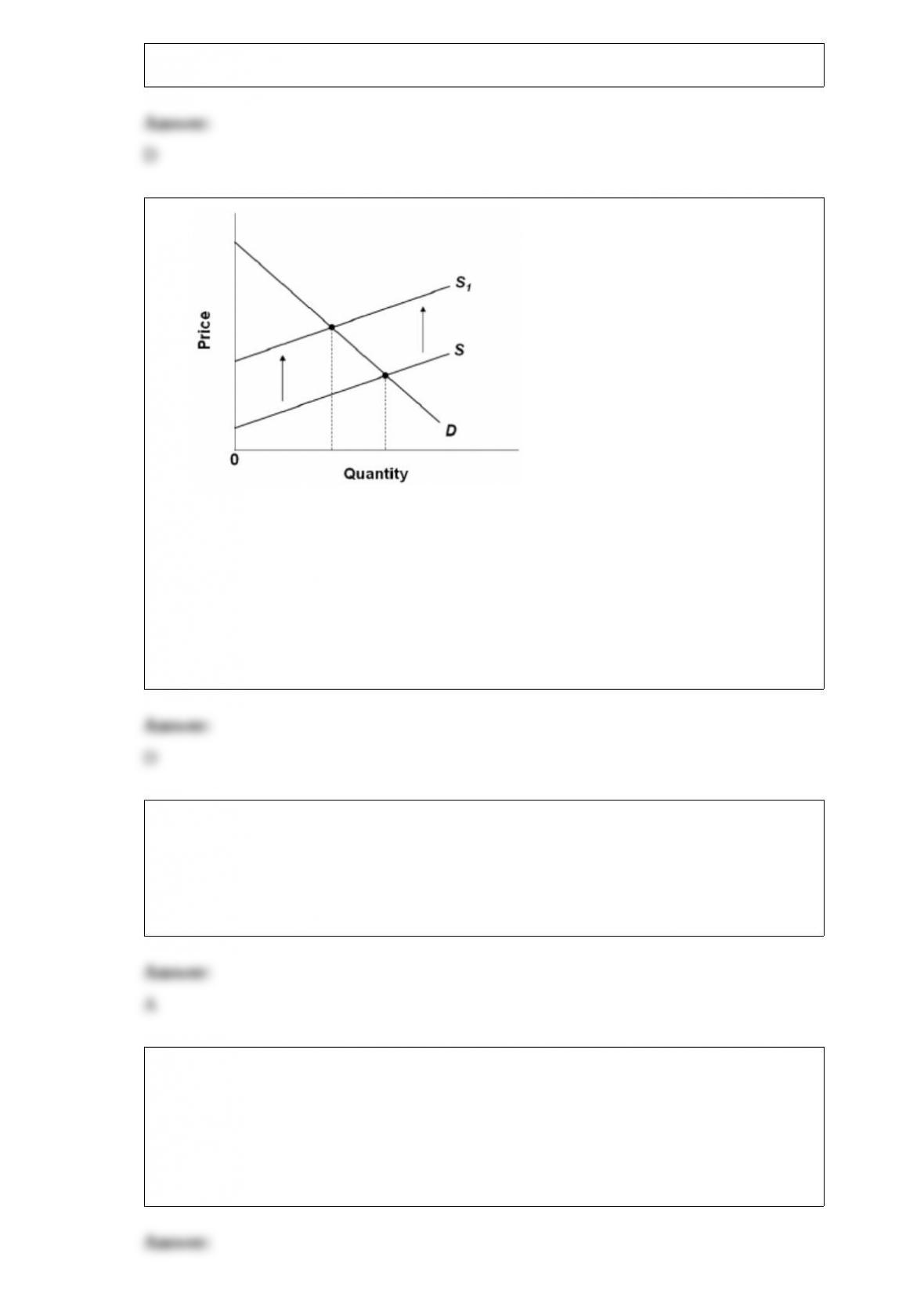
5)
Refer to the above diagram in which S is the market supply curve and S1 is a supply
curve comprising all costs of production, including external costs. Assume that the
number of people affected by these external costs is large. If the government wishes to
establish an optimal allocation of resources in this market, it should:
A.not intervene because the market outcome is optimal.
B.subsidize consumers so that the market demand curve shifts leftward.
C.subsidize producers so that the market supply curve shifts leftward (upward).
D.tax producers so that the market supply curve shifts leftward (upward).
6) To achieve economic efficiency in energy use, an economy:
A.often uses a variety of energy sources.
B.must use the single energy source in which it can achieve economies of scale.
C.should use all energy sources in equal proportion.
D.should only use domestically produced energy.
7) According to Congressional Budget Office projections made in March 2006, the
Federal budget is expected to remain in deficit until when?
A.2010
B.2012
C.2015
D.2020
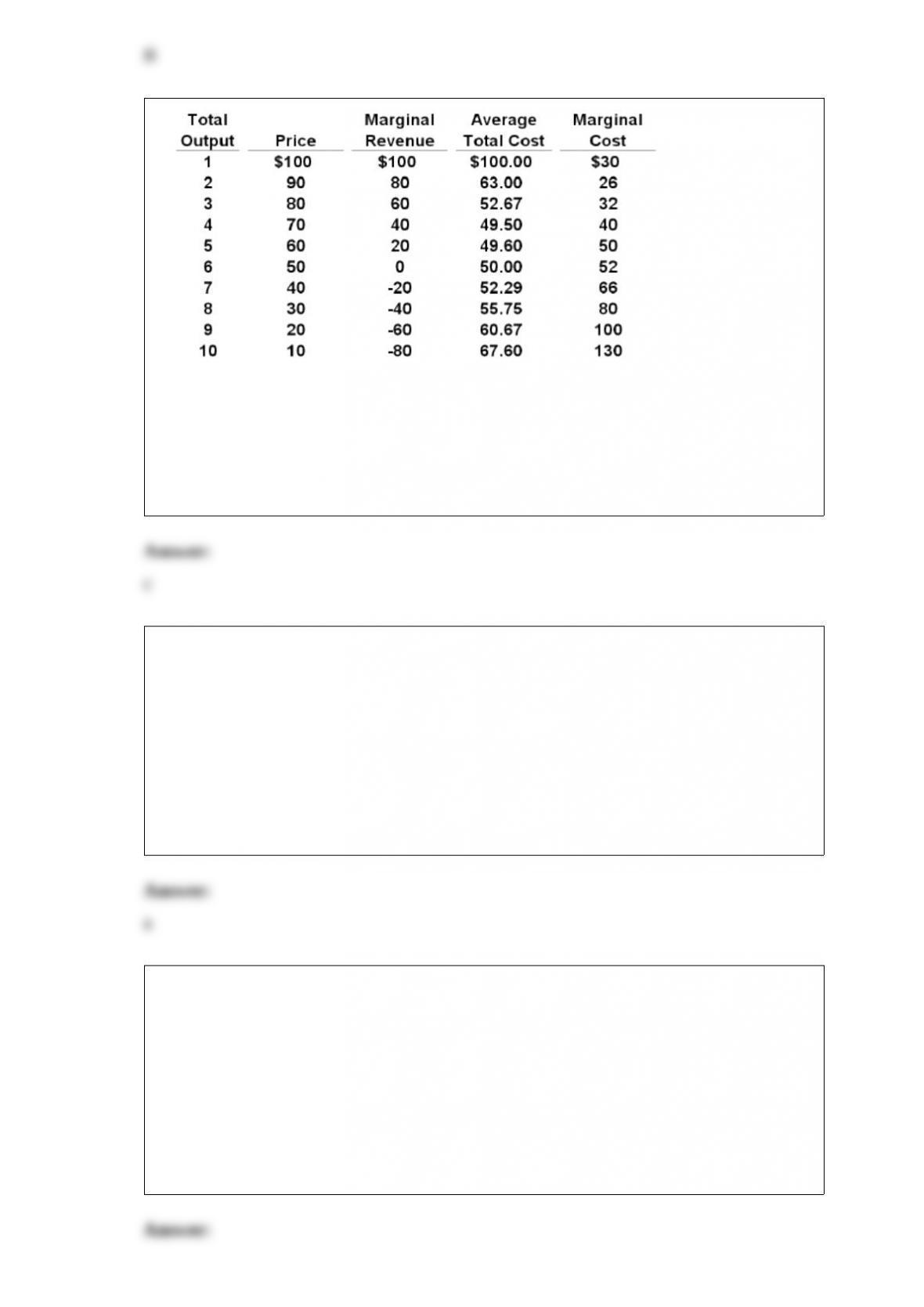
8)
refer to the above data for a nondiscriminating monopolist. at its profit-maximizing
output, this firm’s total costs will be:
a.$300.
b.$248.
c.$198.
d.$126.
9) which of the following best describes the invisible-hand concept?
a.the desires of resource suppliers and producers to further their own self-interest will
automatically further the public interest.
b.the nonsubstitutability of resources creates a conflict between private and public
interests and calls for government intervention.
c.the market system is the best system for overcoming the scarce resources-unlimited
wants problem.
d.central direction by the government will improve resource allocation in a capitalistic
economy.
10) which of the following statements is correct?
a.the value of the independent variable is determined by the value of the dependent
variable.
b.the value of the dependent variable is determined by the value of the independent
variable.
c.the dependent variable designates the “cause” and the independent variable the
“effect.”
d.dependent variables graph as upsloping lines; independent variables graph as
downsloping lines.

11) assume that a manufacturer of stereo speakers purchases $40 worth of components
for each speaker. the completed speaker sells for $70. the value added by the
manufacturer for each speaker is:
a.$110.
b.$30.
c.$40.
d.$70.
12) the supply of product x is perfectly inelastic if the price of x rises by:
a.5 percent and quantity supplied rises by 7 percent.
b.8 percent and quantity supplied rises by 8 percent.
c.10 percent and quantity supplied stays the same.
d.7 percent and quantity supplied rises by 5 percent.
13) Suppose that in a series of paired-choice votes a new park is preferred to new
recreation center and a new recreation center is preferred to street widening. Also
suppose that street widening is preferred to a new park. This set of votes is an example
of the:
A.principal-agent problem.
B.benefits-received principle.
C.median-voter model.
D.paradox of voting.
14) The rational expectations perspective suggests that:
A.fiscal policy is more powerful than monetary policy.
B.monetary policy is more powerful than fiscal policy.
C.fiscal and monetary policy are not likely to achieve their stated aims.
D.fiscal policy works only to the extent that it is accompanied by fully anticipated
changes in the money supply.

15) Which one of the following is true about the U.S. Federal Reserve System?
A.There are 10 regional Federal Reserve Banks.
B.The head of the U.S. Treasury also chairs the Federal Reserve Board.
C.There are seven members of the Federal Reserve Board of Governors.
D.The Open Market Committee is smaller in size than the Federal Reserve Board.