1) if an economy produces its most wanted goods but uses outdated production
methods, it is:
a.achieving productive efficiency, but not allocative efficiency.
b.not achieving productive efficiency.
c.achieving both productive and allocative efficiency.
d.engaged in roundabout production.
2) globally, on average test scores of eighth-grade math and science students, the u.s.
ranks
a.15th and 9th, respectively.
b.1st and 1st, respectively.
c.11th and 5th, respectively.
d.8th and 6th, respectively.
3) The assumption that the legal reserve ratio is 20 percent. Suppose that the Fed sells
$500 of government securities to commercial banks (paid for out of commercial bank
reserves) and buys $500 of securities from individuals, who deposit the cash in
checking accounts.
As a result of the above transactions, excess reserves in the banking system will:
A.remain unchanged.
B.rise by $100.
C.fall by $100.
D.rise by $1,000.
4) Compare pure competition, pure monopoly, monopolistic competition, and oligopoly
on each of the following points:
(a)Ability to manipulate price.
(b)Flexibility of prices.
(c)Expenditures on advertising and sales promotion.
(d)Efficiency in allocation of resources.
5) Which of the following characterizes the labor sector of most DVCs?
A.educational levels are low
B.a large proportion of the labor force is in agriculture
C.labor productivity is low
D.all of these
6)
refer to the above diagram in which the downsloping linear lines are budget lines and
i1, i2, and i3 comprise an indifference map. the combinations of products m and n
indicated by points 1, 3, and 5 are such that:
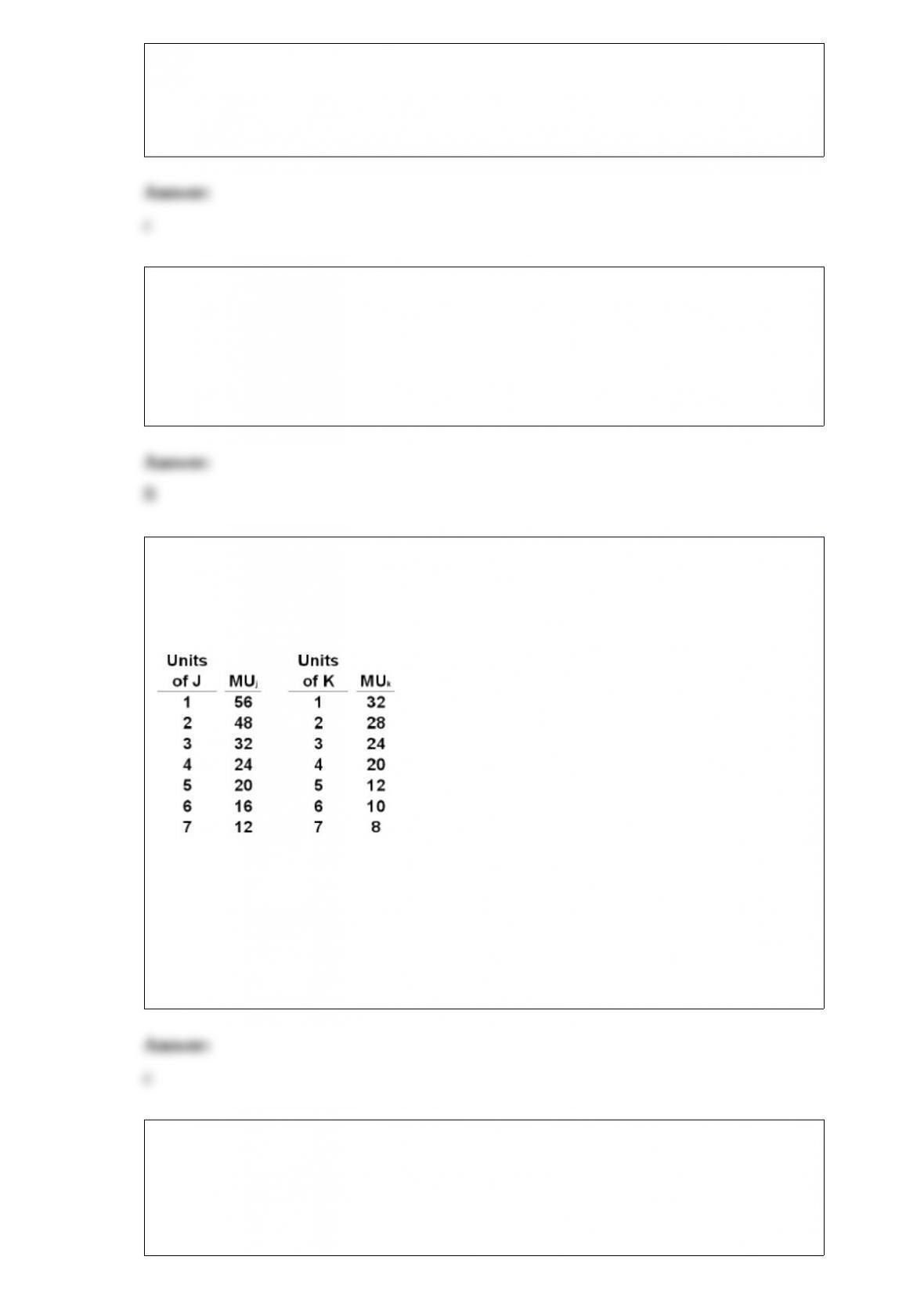
a.all three imply the same level of utility.
b.1 and 5 imply a higher level of utility than does 3.
c.3 implies a higher level of utility than does 1 or 5.
d.the person is indifferent among the three combinations.
7) The effect of a government surplus on the equilibrium level of GDP is substantially
the same as:
A.a decrease in saving.
B.an increase in saving.
C.an increase in consumption.
D.an increase in investment.
8) the following two schedules which show the amounts of additional satisfaction
(marginal utility) which a consumer would get from successive quantities of products j
and k.
refer to the above data. what level of total utility is realized from the equilibrium
combination of j and k, if the consumer has a money income of $52 and the prices of j
and k are $8 and $4 respectively?
a.156 utils
b.124 utils
c.276 utils
d.36 utils
9) diminishing returns begin to occur with the hiring of the _________ unit of labor.
a.first
b.second
c.third
d.seventh
10) Which one of the following is concerned with industrial regulation, as distinct from
social regulation?
A.Occupational Safety and Health Administration
B.Consumer Products Safety Commission
C.Federal Communications Commission
D.Environmental Protection Agency
11) if real gdp falls from one period to another, we can conclude that:
a.deflation occurred.
b.inflation occurred.
c.nominal gdp fell.
d.none of these necessarily occurred.
12) If we both have checking accounts in the same commercial bank and I write a check
in your favor for $200, the bank’s:
A.balance sheet will be unchanged.
B.reserves and checkable deposits will both decline by $200.
C.liabilities will decline by $200, but its net worth will increase by $200.
D.assets and liabilities will both decline by $200.
13) the process of producing and accumulating capital goods is called:
a.money capital.
b.depreciation.
c.investment.
d.consumption.
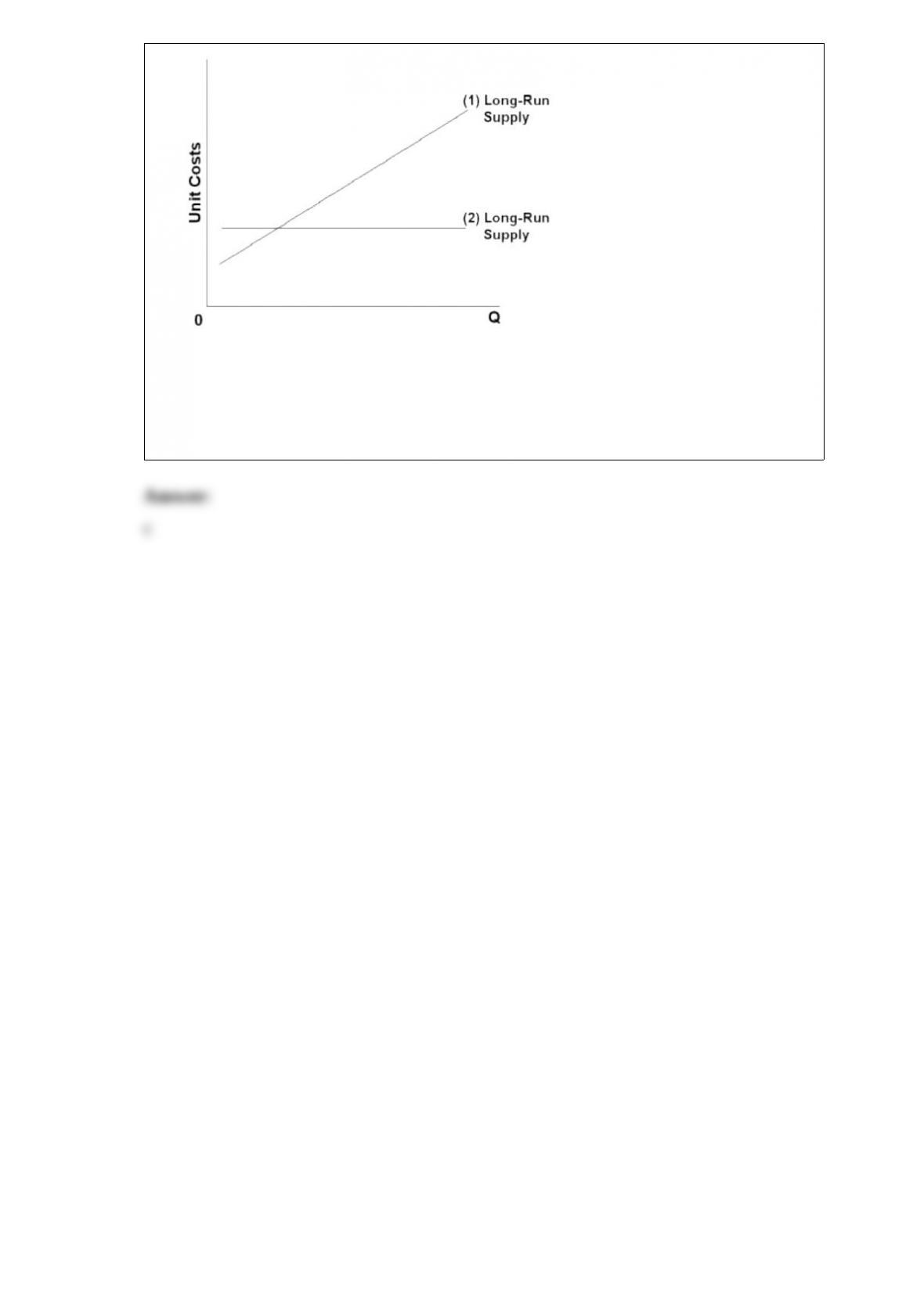
14)
refer to the above diagram. line (1) reflects the long-run supply curve for:
a.a constant-cost industry.
b.a decreasing-cost industry.
c.an increasing-cost industry.
d.a technologically progressive industry.