
1)
refer to the above diagram. flow (2) represents:
a.wage, rent, interest, and profit income.
b.land, labor, capital, and entrepreneurial ability.
c.goods and services.
d.consumer expenditures.
2) Which of the following is correct?
A.Government expenditures and taxes both increase GDP.
B.Government expenditures and taxes both decrease GDP.
C.Government expenditures increase, but taxes decrease, GDP.
D.Government expenditures decrease, but taxes increase, GDP.
3) Other things equal, an increase in productivity will:
A.reduce aggregate supply and increase real output.
B.reduce both the interest rate and the international value of the dollar.
C.increase both aggregate supply and real output.
D.increase net exports, increase investment, and reduce aggregate demand.
4)
5) a price discriminating pure monopolist will attempt to charge each buyer (or group of
buyers):
a.different prices to compensate for differences in the characteristics of the product.
b.the same price if per unit cost is constant for each unit of the product.
c.that price which equals the buyer’s marginal cost.
d.the maximum price each would be willing to pay.
6)
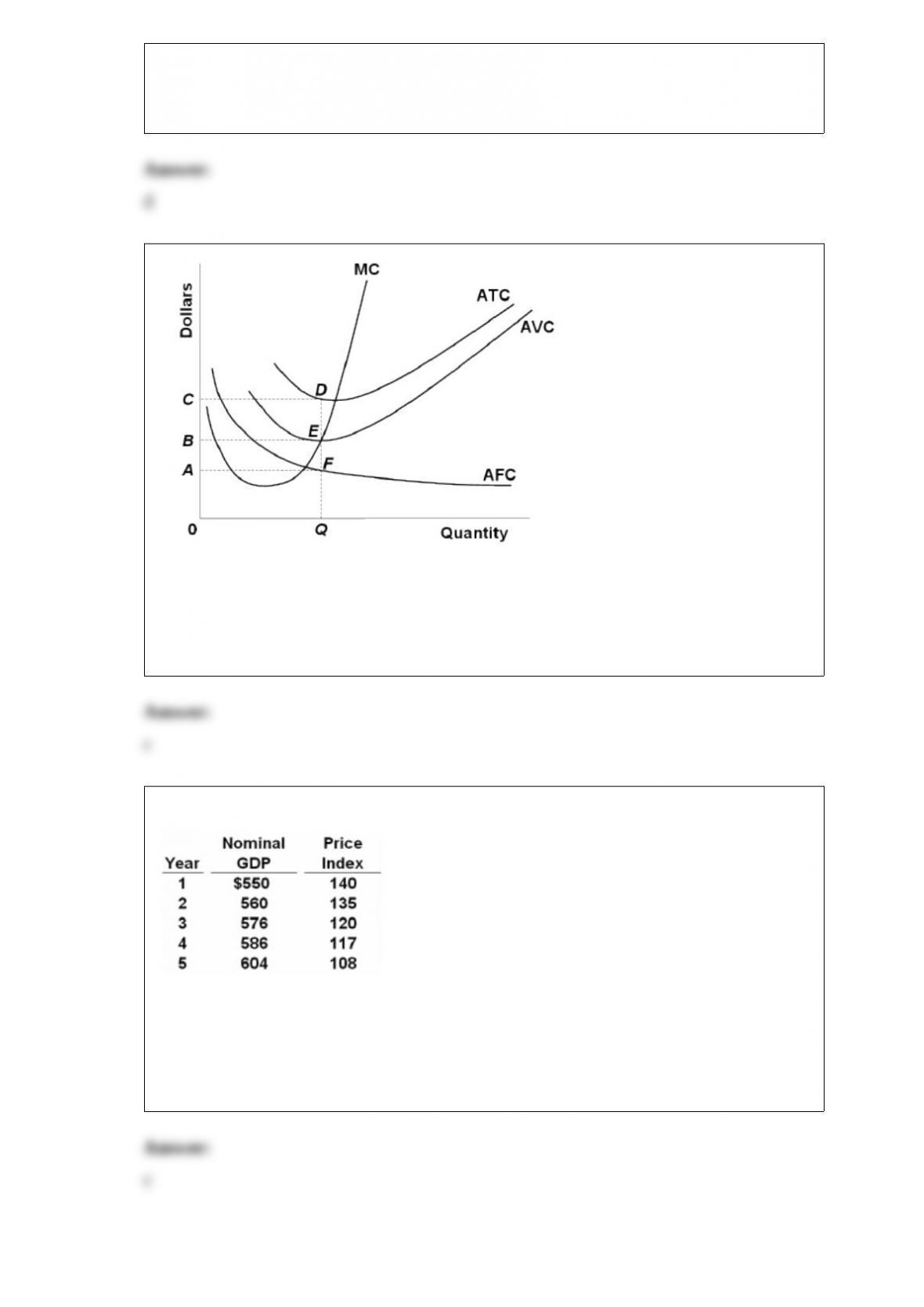
refer to the above diagram. at output level q total cost is:
a.0beq
b.bcde
c.0beq plus bcde
d.0afq plus bcde
7) answer the next question(s) on the basis of the following information:
in the economy above:
a.the price level is rising faster than nominal gdp.
b.nominal and real gdp are growing at the same rate.
c.the growth of nominal gdp understates the growth of real gdp.
d.the growth of nominal gdp overstates the growth of real gdp.

8) if potential gdp is $330 billion and there is a positive gdp gap of $30 billion, real gdp
is:
a.$300 billion.
b.$30 billion.
c.$360 billion.
d.$630 billion.
9) the largest functional share of the national income consists of:
a.wages and salaries.
b.interest and rental income.
c.proprietors’ income, that is, the income of unincorporated businesses.
d.corporate profits.
10) the law of supply indicates that:
a.producers will offer more of a product at high prices than they will at low prices.
b.the product supply curve is downsloping.
c.consumers will purchase less of a good at high prices than they will at low prices.
d.producers will offer more of a product at low prices than they will at high prices.
11) the upward slope of the supply curve reflects the:
a.principle of specialization in production.
b.law of supply.
c.fact that price and quantity supplied are inversely related.
d.law of diminishing marginal utility.
12)
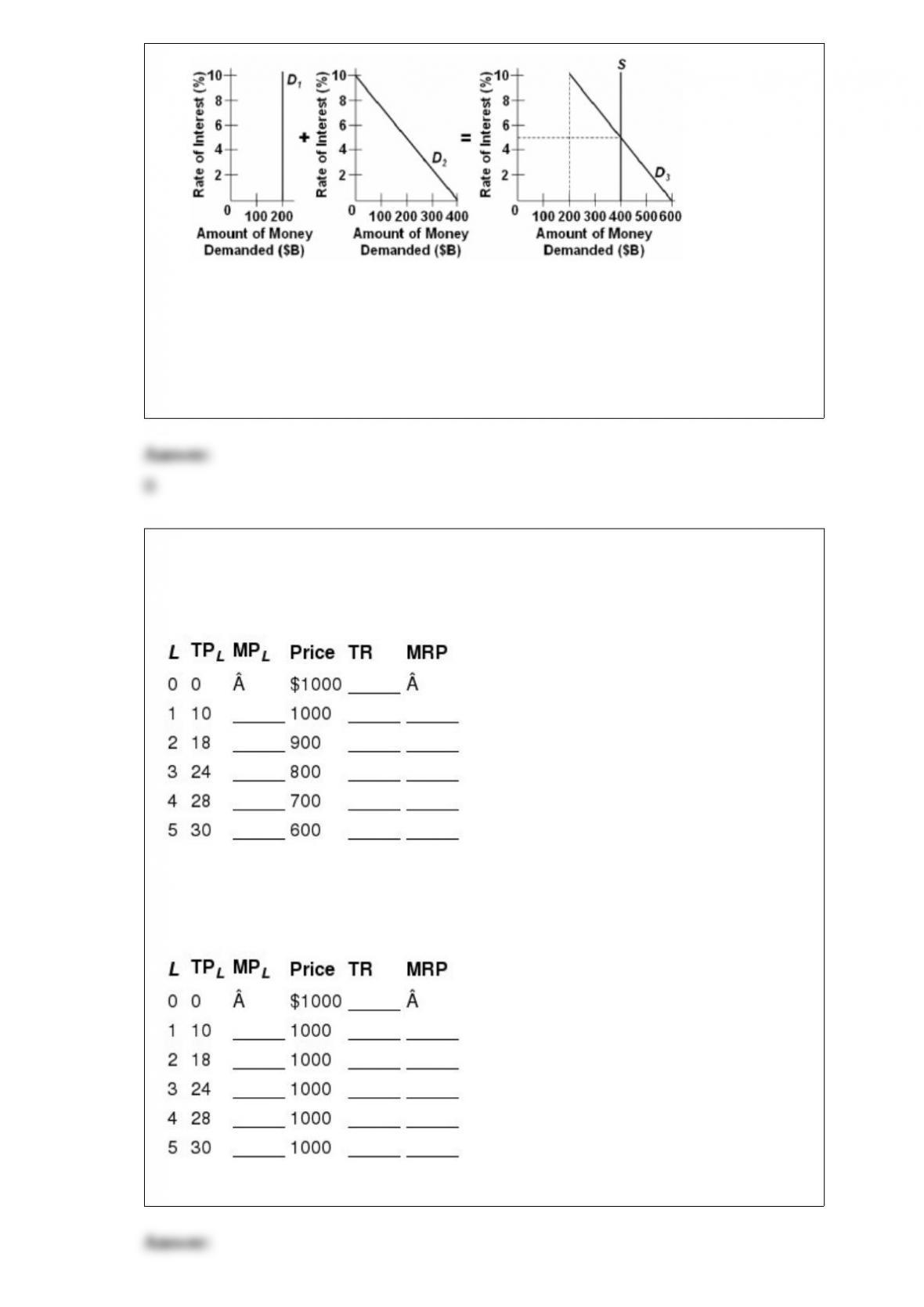
Refer to the above market for money diagrams. If each dollar held for transactions is
spent four times per year on the average, we can infer that the:
A.real GDP is $800.
B.nominal GDP is $800.
C.money supply must be $800.
D.nominal GDP is $1200.
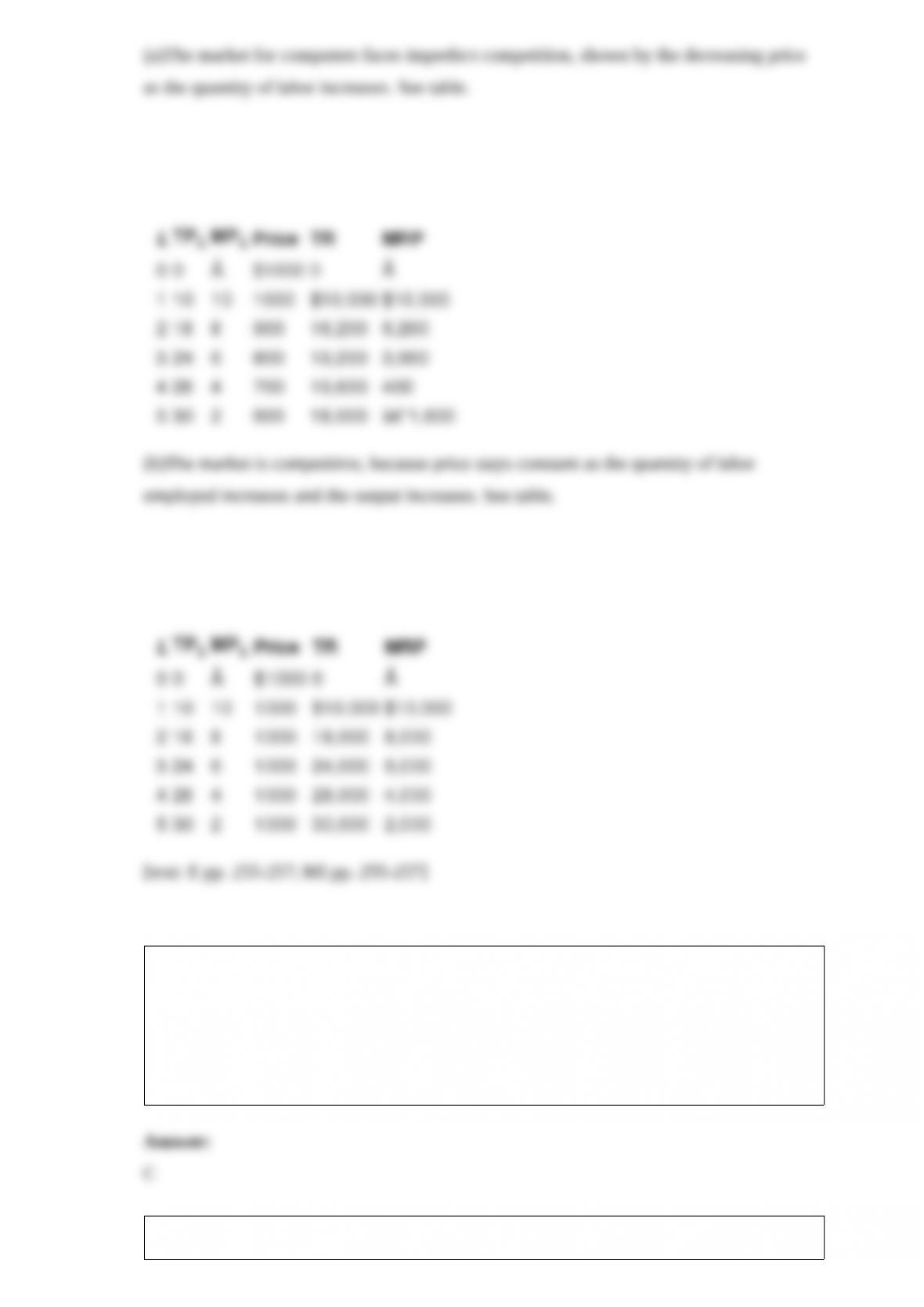
13) The table below summarizes the marginal product data for labor in producing
personal computers. Assume the other quantities employed by the firm remain constant.
Compute the MPL, TR, and MRP and answer the following questions.
(a)What type of market is the one for personal computers?
Now look at the table below showing a different market situation for the demand for
personal computers. Fill in the table and answer the following questions.
(b)What type of market does the firm face for personal computers?
14) Economists regard expenditures on education as investments because:
A.they are subject to tax deductions at the same rate as are expenditures on machinery
and equipment.
B.education is economically beneficial at the same time it is being acquired.
C.such expenditures are current costs that are intended to enhance future earnings.
D.they differ from expenditures on health and worker mobility.
15) A “national bank holiday” that closed all banks for a week and resulted in Federal

deposit insurance occurred in the United States in:
A.1903, following the “Louisiana stampede.”
B.1987, following the collapse of numerous savings and loan associations.
C.1945, following the end of the Second World War.
D.1933, following the bank panics of 1930-1933.