1) The Sherman Act:
A.was declared unconstitutional in 1895.
B.provided for government regulation of the railroads.
C.declared monopoly and restraints of trade to be illegal.
D.exempted the railroad and communications industries from the antitrust laws.
2) in the simple circular flow model:
a.households are buyers of resources.
b.businesses are sellers of final products.
c.households are sellers of final products.
d.there are real flows of goods, services, and resources, but not money flows.
3) which of the following statements is correct?
a.limited access to the health care system is a major cause of rising health care costs.
b.rising health care costs are a major cause of limited access to the health care system.
c.rising health care costs have forced employers to raise real wages above labor
productivity.
d.the tax subsidy which government provides for health care causes health care to be
underconsumed.
4) Which of the following arguments comes closest to constituting a legitimate
economic exception to the case for free trade?
A.the increase-domestic-employment argument
B.the cheap-foreign-labor argument
C.the diversification-for-stability argument
D.the infant-industry argument
5) which of the following best illustrates the circular flow model in action?
a.bobbie goes to work and builds cars, and uses the income she receives to buy food at
the grocery store.
b.evan buys a new couch; the owner of the furniture store uses some of the money from
the sale to pay her supplier, and uses the rest to take her family out to dinner.
c.boeing experiences a surge in orders for new airplanes, prompting the company to
hire more workers.
d.all of the above.
6) A fishery collapse:
A.necessarily happens when harvesting rates increase.
B.necessarily happens when reproduction rates fall.
C.occurs when harvesting outpaces reproduction for an extended period.
D.is irreversible.
7) dash airlines is considering the addition of a flight from red cloud to david city. the
total cost of the flight would be $1,100, of which $800 are fixed costs already incurred.
expected revenues from the flight are $600. dash should:
a.not add this flight because only flights which cover their full costs are profitable.
b.not add this flight because it is not profitable at the margin.
c.add this flight because marginal revenue exceeds marginal costs.
d.not add this flight because total costs exceed total revenue.
8)
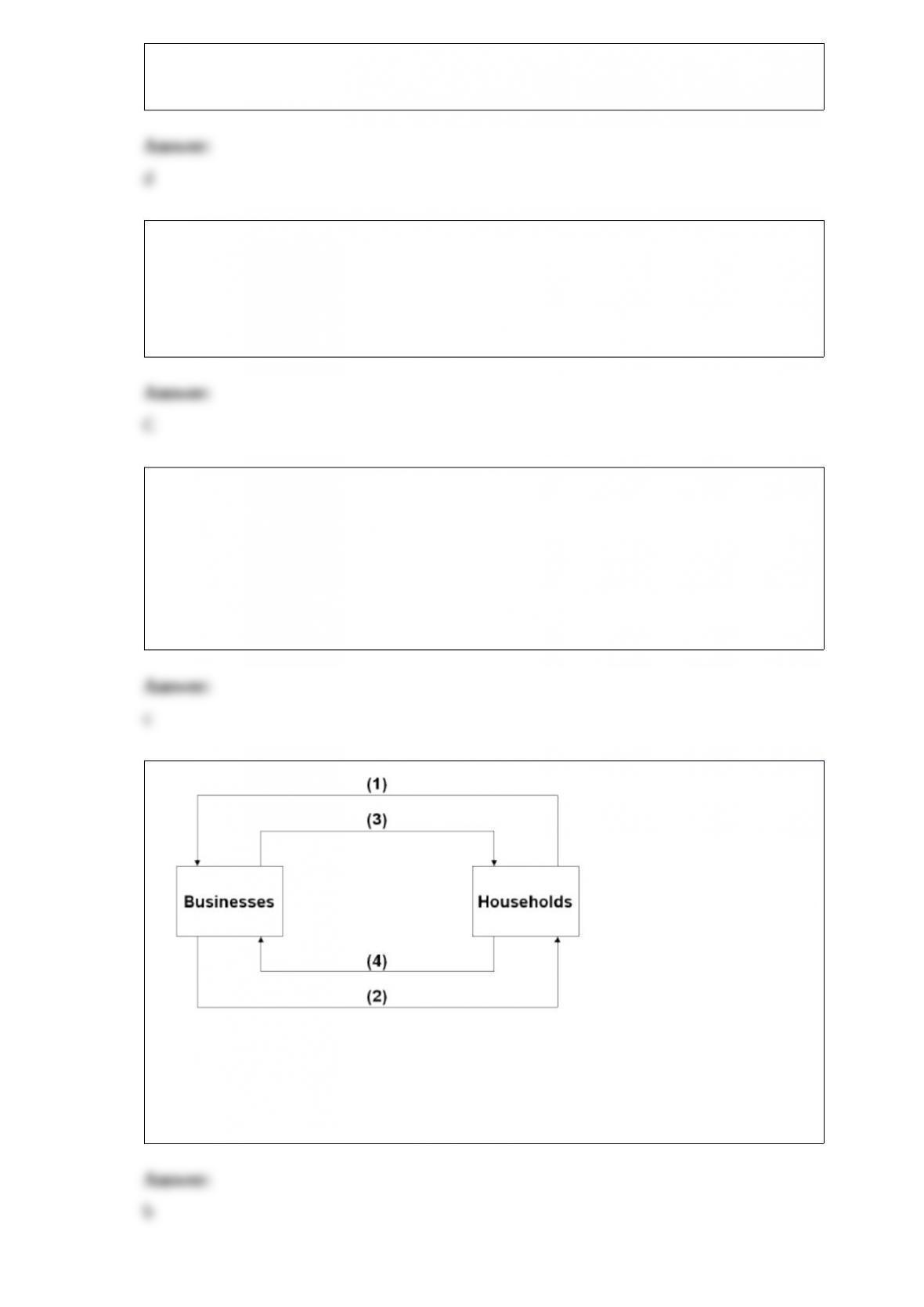
refer to the above diagram. arrows (1) and (3) are associated with:
a.the money market.
b.the resource market.
c.the product market.
d.international trade.
9) The velocity of money measures the:
A.proportion of the money supply held as an asset.
B.ratio of the transactions demand to the asset demand for money.
C.average annual rate of increase in the money supply.
D.number of times per year the average dollar is spent on final goods and services.
10) (consider this) a direct cost of going to college is:
a.tuition, while an indirect cost (opportunity cost) is books and other supplies.
b.forgone income while in college, while an indirect cost (opportunity cost) is tuition.
c.tuition, while an indirect cost (opportunity cost) is forgone income while in college.
d.books and supplies, while an indirect cost (opportunity cost) is food and housing.
11) Consider the following payoff matrix in which the numbers indicate the profit in
millions of dollars for a duopoly based either on a high-price or a low-price strategy.
(a)What will be the result when each firm chooses a high-price strategy?
(b)What will be the result when Firm A chooses a low-price strategy while Firm B
maintains a high-price strategy?
(c)What will be the result when Firm B chooses a low-price strategy while Firm A
maintains a high-price strategy?
(d)What will be the result when each firm chooses a low-price strategy?
(e)What two conclusions can you draw about collusion?
12) according to the concept of the “invisible hand,” if susie opens and operates a
profitable childcare center, then:
a.government should regulate the business to ensure quality.
b.the profit susie earns indicates that she is overcharging for her services.
c.she has served society’s interests by providing a desired good or service.
d.this demonstrates that consumer sovereignty is not present in this market.
13) Suppose an employer is considering hiring either a white worker or an
African-American worker for a position. Consider the following conditions and decide
which worker the employer is likely to hire.
(a)The employer is prejudiced against African-Americans and it costs him a disutility of
$3/hour to hire the African-American. Suppose the African-American is willing to work
for $9/hour, while the white worker will work for $11/hour. Whom will the employer
hire?
(b)The employer is prejudiced against African-Americans and it costs him a disutility of
$2/hour to hire the African-American. Suppose the African-American is willing to now
work for $8/hour, while the white worker will work for $11/hour. Whom will the
employer hire?
(c)The employer has no preference between the white and African-American workers.
Suppose the African-American and the white workers are both willing to work for $12
an hour. Whom will the employer hire?
14) Which of the following occupations is projected to be the fastest growing in the
U.S. in terms of percentage increases?
A.medical assistants
B.network systems and data communication analysts
C.home health aides
D.software engineers
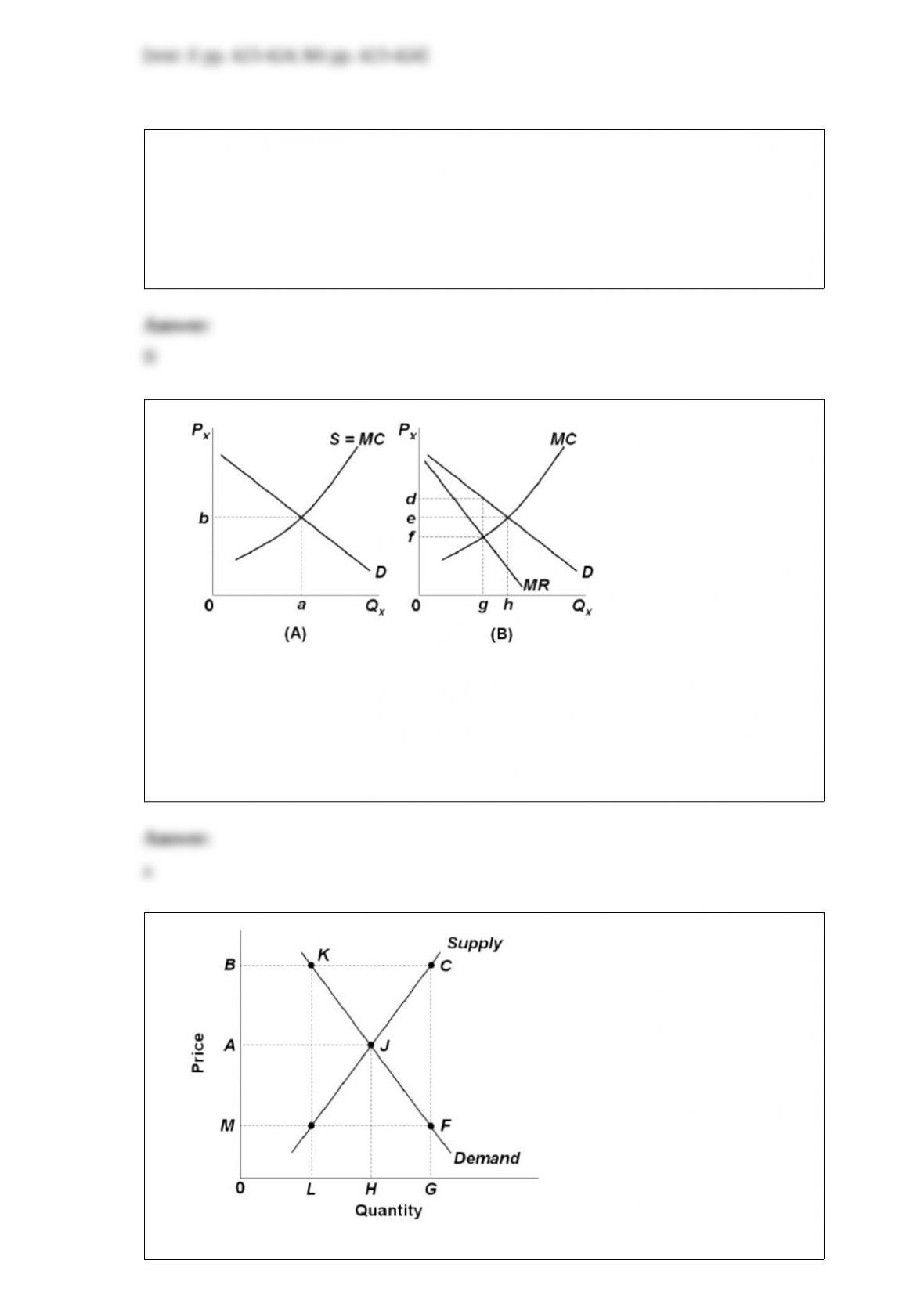
15)
refer to the above diagrams. with the industry structure represented by diagram:
a.(a) there will be only a normal profit in the long run, while in (b) an economic profit
can persist.
b.(a) price exceeds marginal cost, resulting in allocative inefficiency.
c.(b) price equals marginal cost, resulting in allocative efficiency.
d.(b) equilibrium price and quantity will be e and h, respectively.
16)
Refer to the above diagram for the corn market. A price support of B will cause a
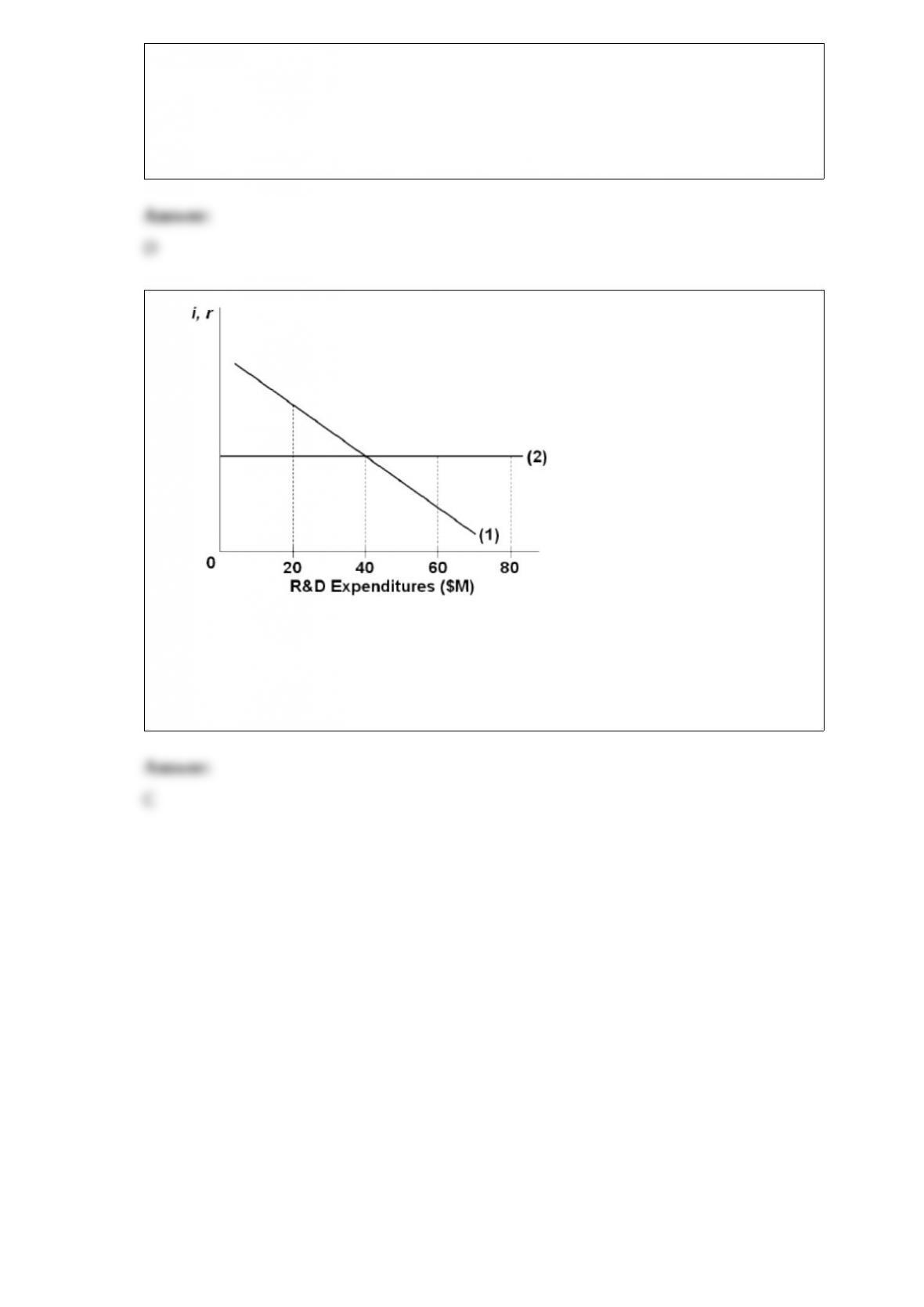
transfer from taxpayers to farmers of:
A.0BKL.
B.MAFG.
C.0MFG.
D.LKCG.
17)
In the above diagram, the optimal amount of R&D is:
A.$20 million.
B.$80 million.
C.$40 million.
D.$60 million.