1) An increase in net exports will shift the AD curve to the:
A.left by a multiple of the change in investment.
B.left by the same amount as the change in investment.
C.right by the same amount as the change in investment.
D.right by a multiple of the change in investment.
2) In 2005, the top 1 percent of all taxpayers in the United States faced an overall
Federal tax rate of:
A.31.2 percent.
B.27.4 percent.
C.38.8 percent.
D.60.7 percent.
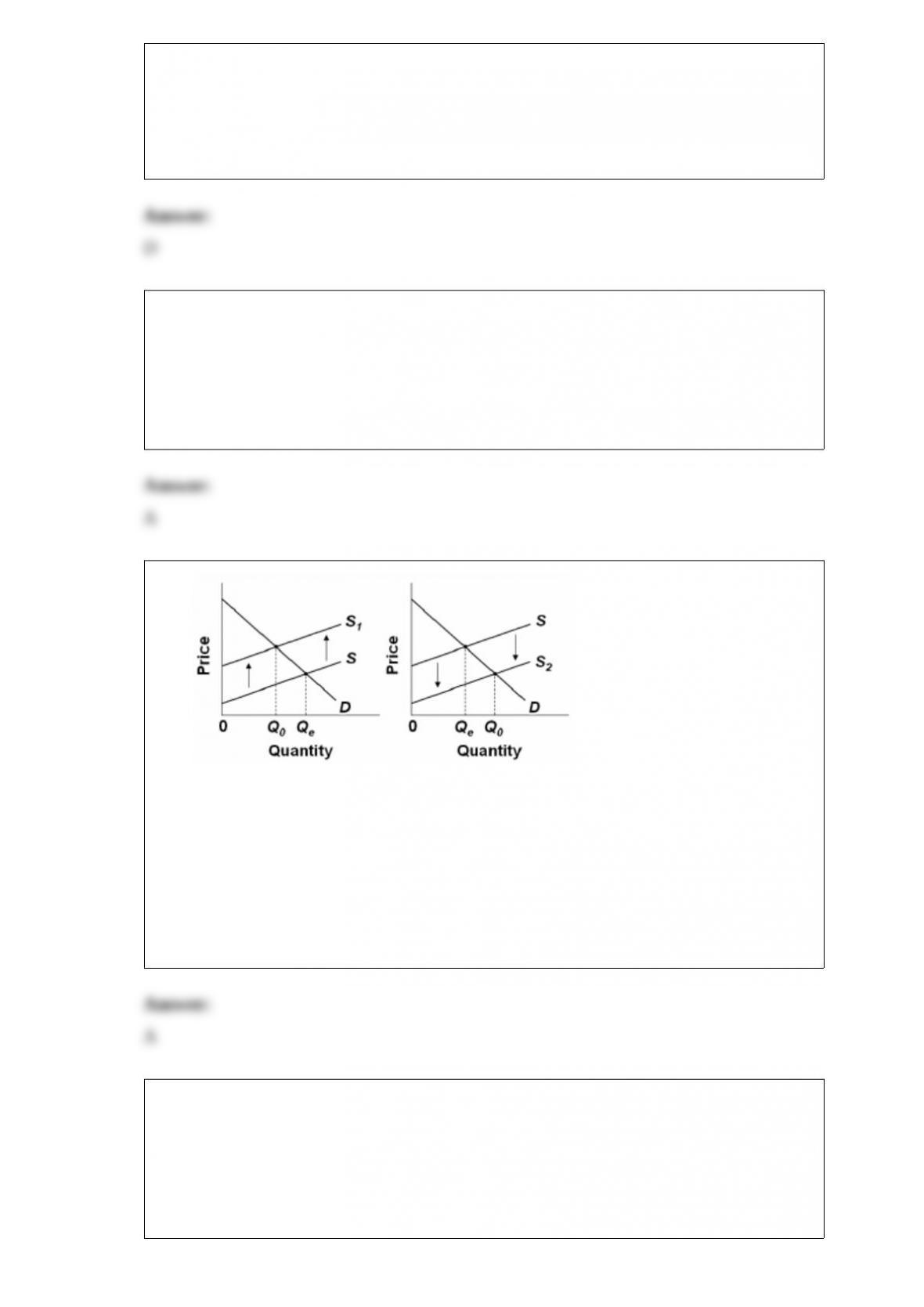
3)
Refer to the above diagrams for two separate product markets. Assume that society’s
optimal level of output in each market is Q0 and that government purposely shifts the
market supply curve from S to S1 in diagram (a) and from S to S2 in diagram (b). We
can conclude that the government is correcting for:
A.negative externalities in diagram (a) and positive externalities in diagram (b).
B.positive externalities in diagram (a) and negative externalities in diagram (b).
C.negative externalities in both diagrams.
D.positive externalities in both diagrams.
4) Suppose that Alpha’s real output rose from $400 billion in year 1 to $428 billion in
year 2. Its growth rate for this period was:
A.14 percent.
B.12 percent.
C.9 percent.
D.7 percent.
5) the term “ceteris paribus” means:
a.that if event a precedes event b, a has caused b.
b.that economics deals with facts, not values.
c.other things equal.
d.prosperity inevitably follows recession.
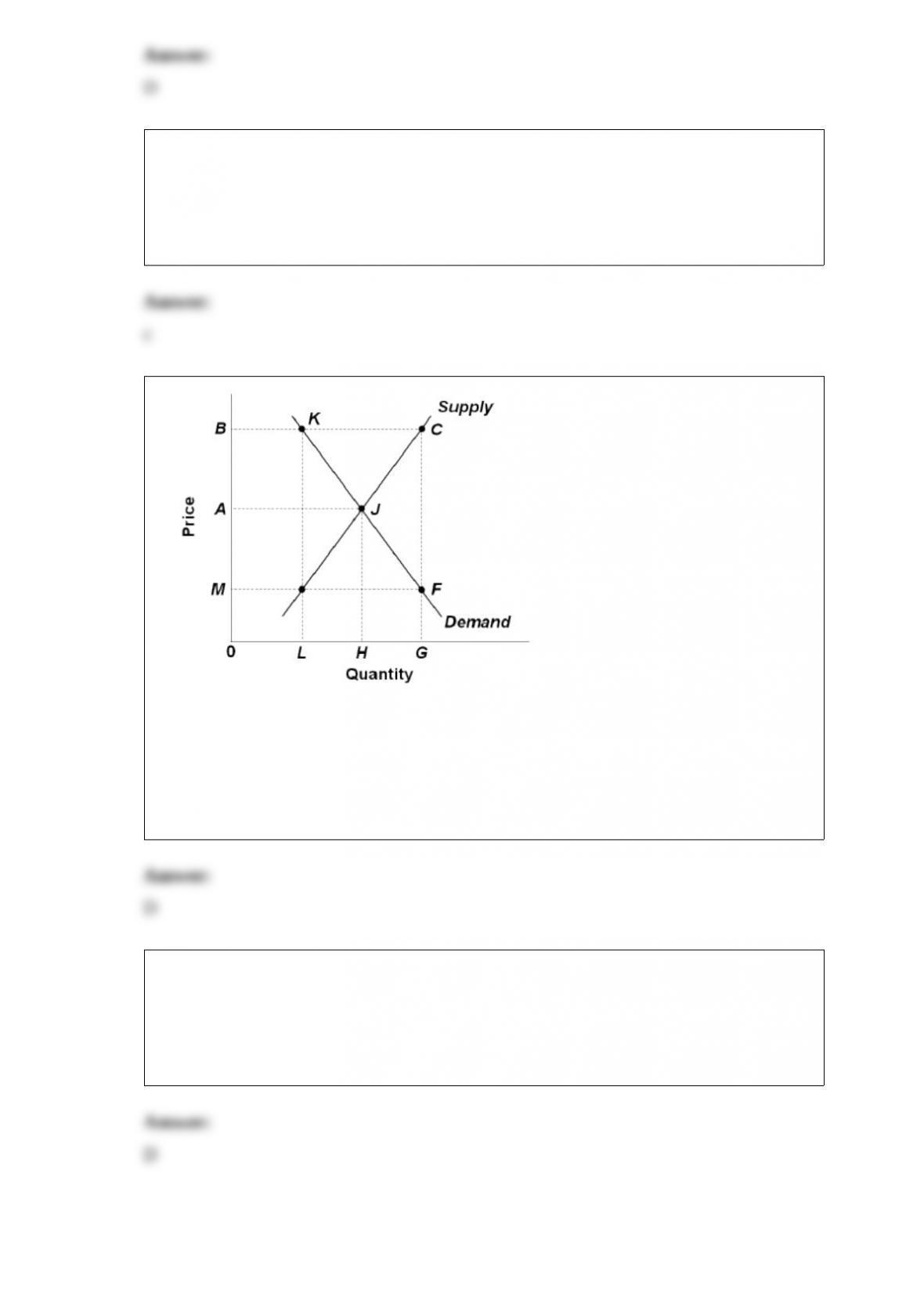
6)
Refer to the above diagram for the corn market. Assuming no externalities, a price
support of B causes:
A.economies of scale.
B.production to be less profitable to farmers.
C.an underallocation of resources to this product.
D.an overallocation of resources to this product.
7) The aggregate supply curve (short-run) slopes upward and to the right because:
A.changes in wages and other resource prices completely offset changes in the price
level.
B.the price level is flexible upward but inflexible downward.
C.supply creates its own demand.
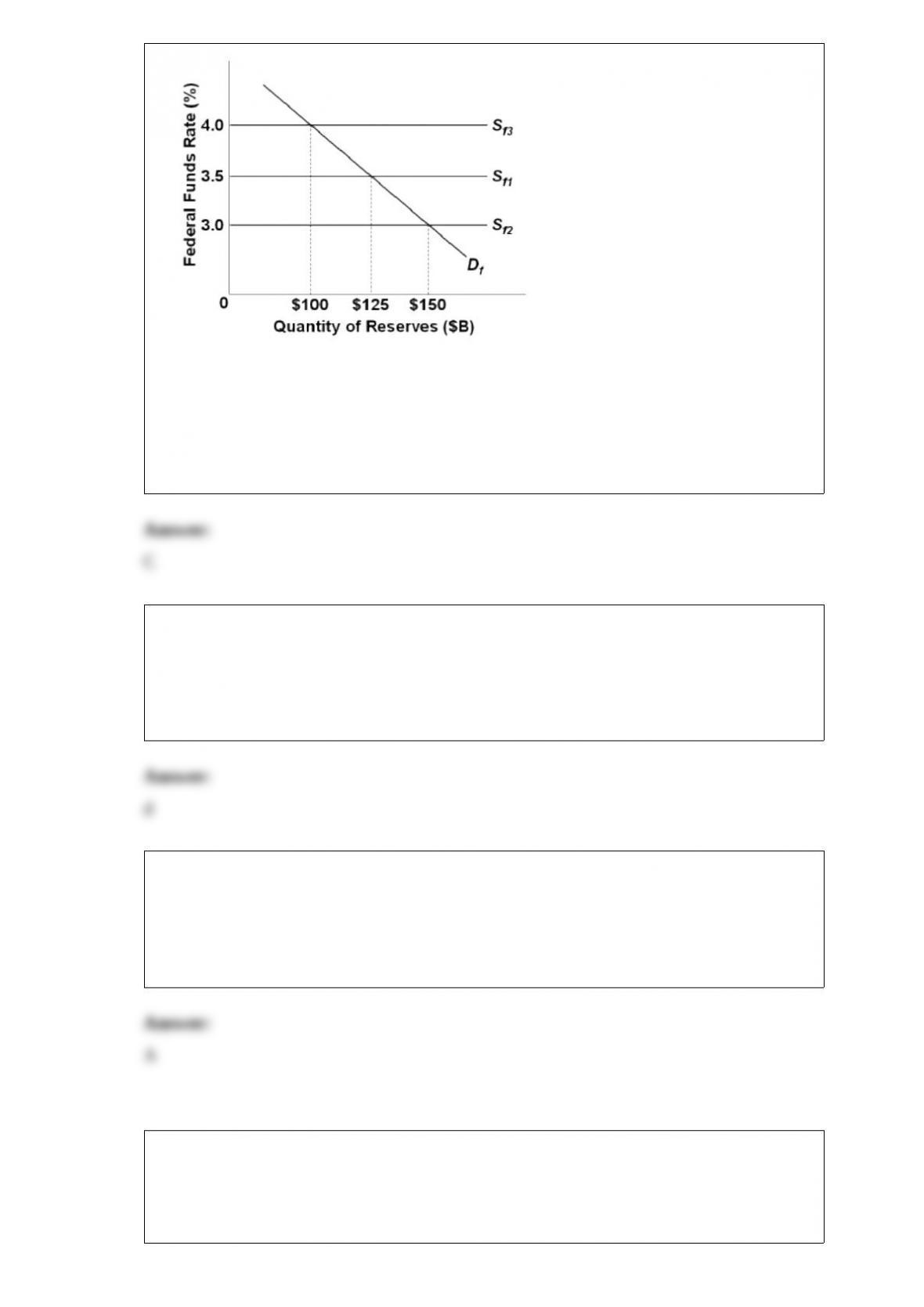
8)
Refer to the above diagram for the Federal funds market. If the quantity of reserves falls
from $150 billion to $125 billion, we can expect:
A.the Federal funds rate to rise to 4.0 percent.
B.the discount rate to rise to 3.5 percent.
C.the prime interest rate to rise.
D.banks to loan more to each other.
9) a firm’s total variable cost will depend on:
a.the prices of variable resources.
b.the production techniques that are used.
c.the level of output.
d.all of these.
10) Which one of the following is true about the U.S. Federal Reserve System?
A.There are 12 regional Federal Reserve Banks.
B.The head of the U.S. Treasury also chairs the Federal Reserve Board.
C.There are 14 members of the Federal Reserve Board.
D. The Open Market Committee is smaller in size than the Federal Reserve Board.
11) A shortcoming of the aggregate expenditures model is that it does not:
A.account for cost-push inflation.
B.explain how demand-pull inflation can arise.
C.explain how cyclical unemployment can arise.

D.detail the components of aggregate spending.
12) The persistence of large subsidies to farmers can be explained in terms of:
A.public choice theory.
B.the inelasticity of demand for farm products.
C.the paradox of voting.
D.cost-benefit analysis.
13) graphically, the market demand curve is:
a.steeper than any individual demand curve that is part of it.
b.greater than the sum of the individual demand curves.
c.the horizontal sum of individual demand curves.
d.the vertical sum of individual demand curves.
14) if the coefficient of price elasticity is less than 1 but greater than zero, demand is:
a.perfectly inelastic.
b.perfectly elastic.
c.relatively inelastic.
d.relatively elastic.
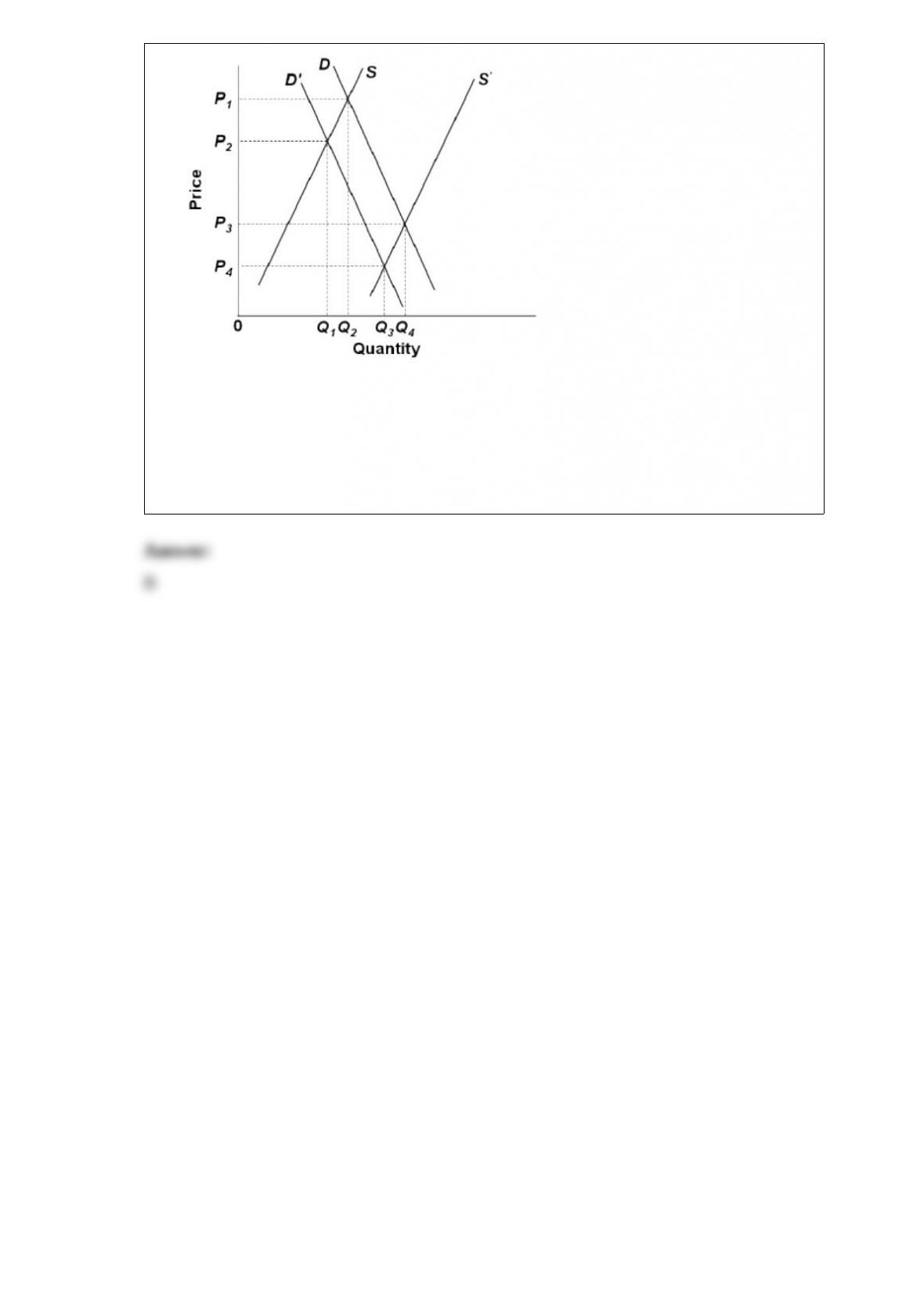
15)
Refer to the above diagram. Which of the following supply and demand shifts portray
the long-run problem that farms face?
A.S to S’ and D to D’
B.S to S’ and D’ to D
C.S’ to S and D’ to D
D.S’ to S and D to D’