
1) The following data are for a series of increasingly extensive flood control projects:
Refer to the above data. For Plan D marginal costs and marginal benefits are:
A.$72,000 and $64,000 respectively.
B.$28,000 and $12,000 respectively.
C.$24,000 and $18,000 respectively.
D.$16,000 and $28,000 respectively.
2) other things equal, which of the following might shift the demand curve for gasoline
to the left?
a.the discovery of vast new oil reserves in montana
b.the development of a low-cost electric automobile
c.an increase in the price of train and air transportation
d.a large decline in the price of automobiles
3) The portion of the public debt held outside Federal agencies and the Federal Reserve
is:
A.substantially larger than the portion held by Federal Agencies and the Federal
Reserve.
B.smaller than the portion held by Federal Agencies and the Federal Reserve.
C.equally split between U.S. and foreign lenders.
D.all held by foreign lenders.
4) if the demand for steak (a normal good) shifts to the left, the most likely reason is
that:
a.consumer incomes have fallen.
b.cattle production has declined.
c.the price of steak has risen.
d.the price of cattle feed has gone up.
5) which of the following might shift a nation’s production possibilities curve inward?
a.improved technology.
b.devastation by war.
c.improved health care.
d.a business downturn in which unemployment temporarily rises.
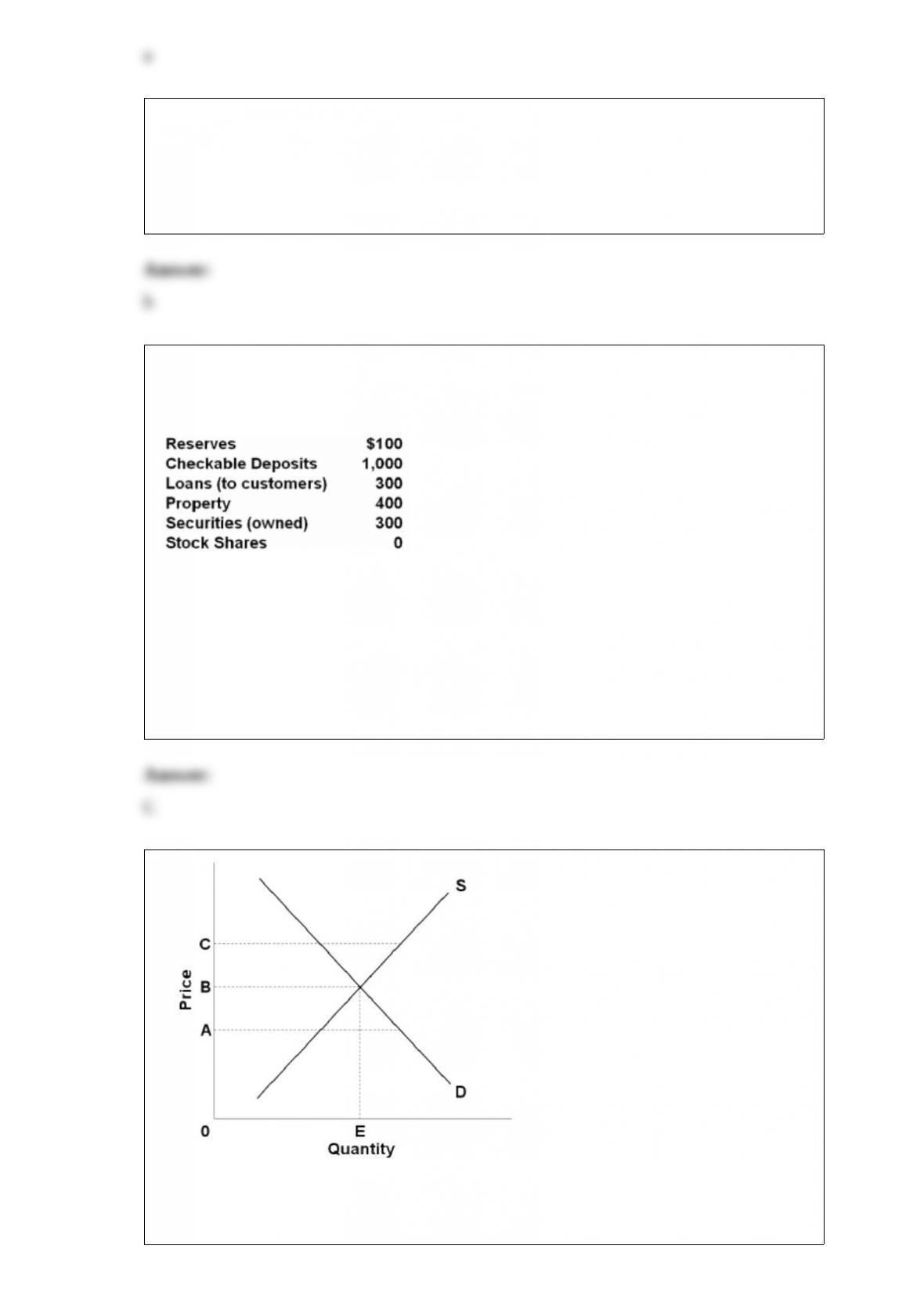
6) The following information for the Moolah Bank.
Refer to the above information and assume that Moolah Bank is “loaned up.” If it
receives a $100 deposit of currency, the banking system of which Moolah is a part
could expand loans by:
A.$100.
B.$90.
C.$900.
D.$1000.
7)
refer to the above diagram. a government-set price floor is best illustrated by:
a.price a
b.quantity e
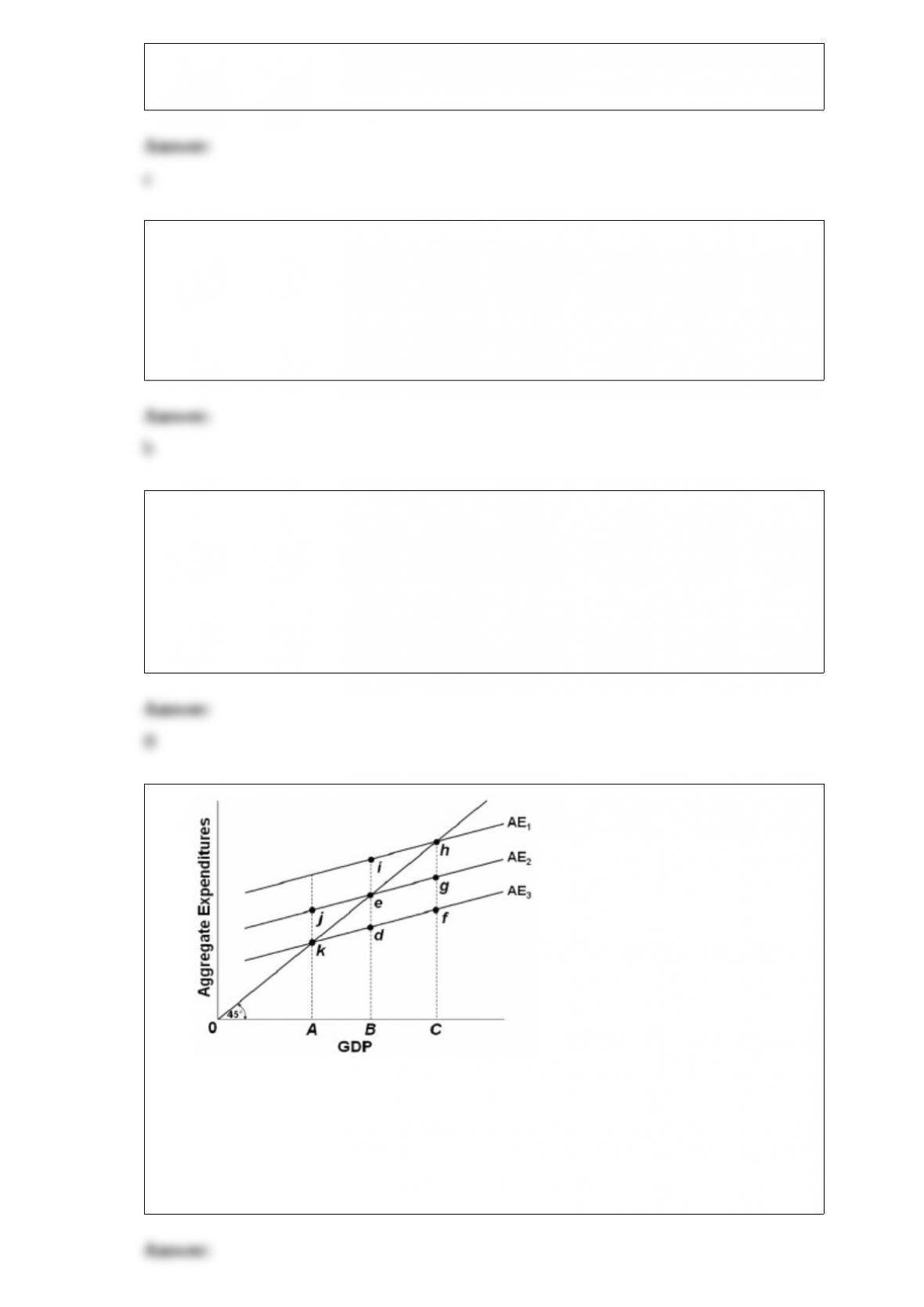
c.price c
d.price b
8) a decrease in the demand for recreational fishing boats might be caused by an
increase in the:
a.income of sports fishers.
b.price of outboard motors.
c.size and number of fish available.
d.price of sailing boats.
9) Suppose that the level of GDP increased by $100 billion in a private closed economy
where the marginal propensity to consume is 0.5. Aggregate expenditures must have
increased by:
A.$100 billion.
B.$50 billion.
C.$500 billion.
D.$5 billion.
10)
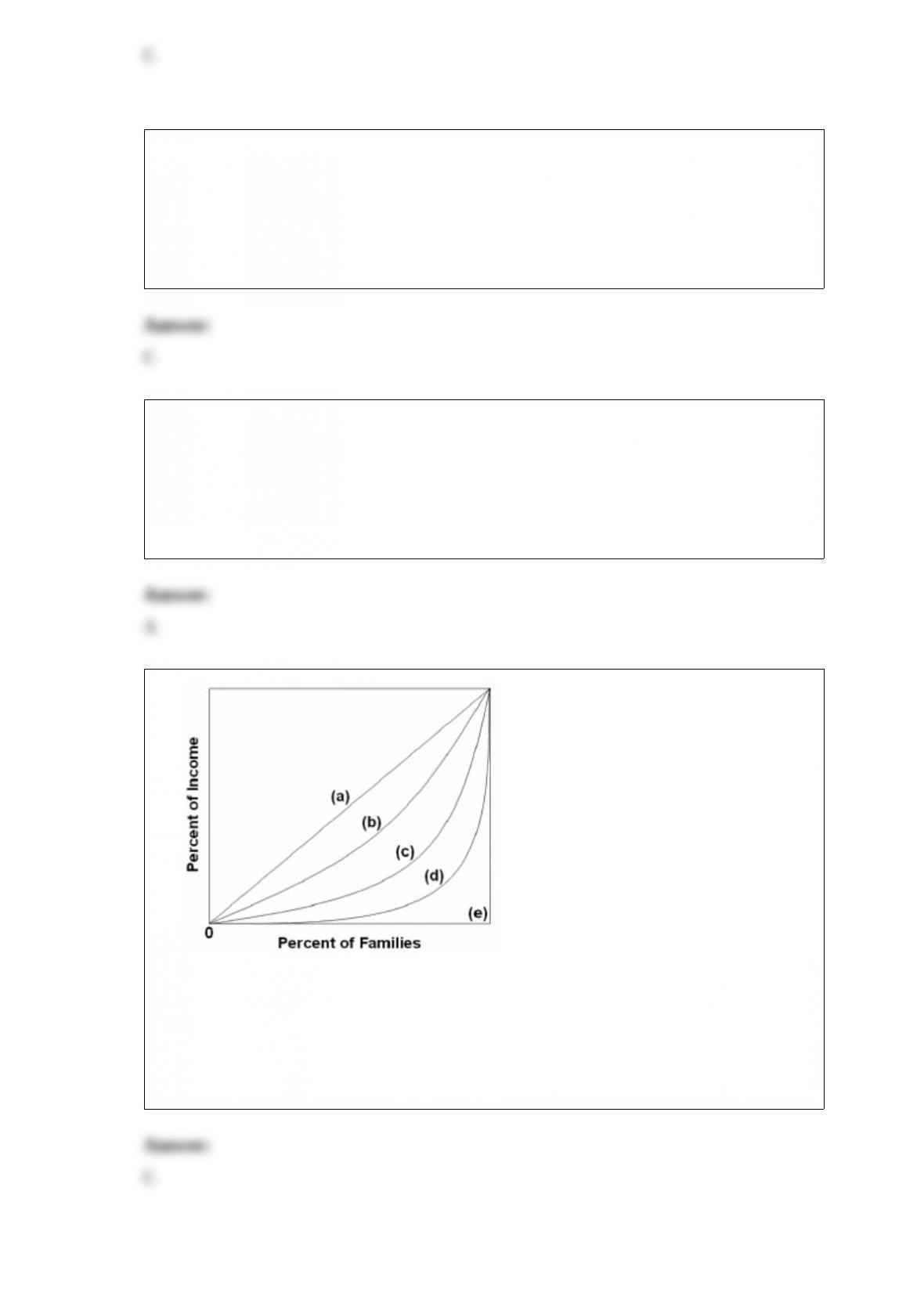
Refer to the above diagram. If the full-employment level of GDP is B and aggregate
expenditures are at AE3, the:
A.inflationary expenditure gap is BC.
B.recessionary expenditure gap is BC.
C.recessionary expenditure gap is ed.
D. inflationary expenditure gap is ed.
11) For a firm selling its product in a purely competitive market, the marginal revenue
product of labor can be found by:
A.adding marginal product to total product as one more unit of labor is employed.
B.adding marginal revenue to total product as one more unit of labor is employed.
C.multiplying marginal product by product price.
D.dividing marginal product by product price.
12) The Fed’s initial step in pursuing restrictive monetary policy using the Federal funds
rate is to:
A.announce a higher target.
B.sell bonds to banks and the public.
C.raise the discount rate.
D.raise the prime interest rate.
13)
Refer to the above diagram where curves (a) through (e) are for five different countries.
The Gini ratio is:
A.zero in country (e) and 1 in country (a).
B.greater in country (b) than in country (c).
C.zero in country (a) and 1 in country (e).
D.less than 0.5 in country (d).

14)
Refer to the above diagram. Assume both upward and downward price and wage
flexibility in the economy. In the extended AD-AS model:
A.demand-pull inflation would involve a rightward shift of curve A, followed by a
rightward shift of curve C
B.cost-push inflation would involve a leftward shift of curve C, followed by an upward
shift of curve B.
C.recession would involve a leftward shift of curve A
D.a rightward shift of curve D would be equivalent to an outward shift of the nation’s
production possibilities curve.
15) When commercial banks use excess reserves to buy government securities from the
public:
A.new money is created.
B.commercial bank reserves increase.
C.the money supply falls.
D.checkable deposits decline.
16) 1) W < MRP; W < MRC
2) W = MRP; W < MRC
3) W = MRP; W = MRC
4) W > MRP; W > MRC
Refer to the above list. The outcome in a purely competitive labor market is shown by:
A.1
B.2
C.3
D.4