1) Economists consider governments to be “wasteful:”
A.whenever they over- or underallocate resources to a project.
B.only when they overallocate resources to a project.
C.only when they underallocate resources to a project.
D.whenever they attempt to correct a market failure.
2) During periods of rapid inflation, money may cease to work as a medium of
exchange:
A.unless it has been designated legal tender.
B.unless it is backed by gold.
C.it is too scarce for everyone to have enough for transactions.
D.because people and businesses will not want to accept it in transactions.
3) consumer sovereignty refers to the:
a.fact that resource prices are higher than product prices in capitalistic economies.
b.idea that the pursuit of self-interest is in the public interest.
c.idea that the decisions of producers must ultimately conform to consumer demands..
d.fact that a federal agency exists to protect consumers from harmful and defective
products.
4) the division of labor means that:
a.labor markets are geographically segmented.
b.unskilled workers outnumber skilled workers.
c.workers specialize in various production tasks.
d.each worker performs a large number of tasks.
5) Which of the following would, other things equal, increase the demand for U.S. farm
products?
A.bumper crops abroad
B.depreciation of the U.S. dollar
C.deteriorating trade relations with China and Russia
D.increases in foreign tariffs on imported farm products
6) The real wage will rise if the nominal wage:
A.falls more rapidly than the general price level.
B.increases at the same rate as labor productivity.
C.increases more rapidly than the general price level.
D.falls at the same rate as the general price level.
7)
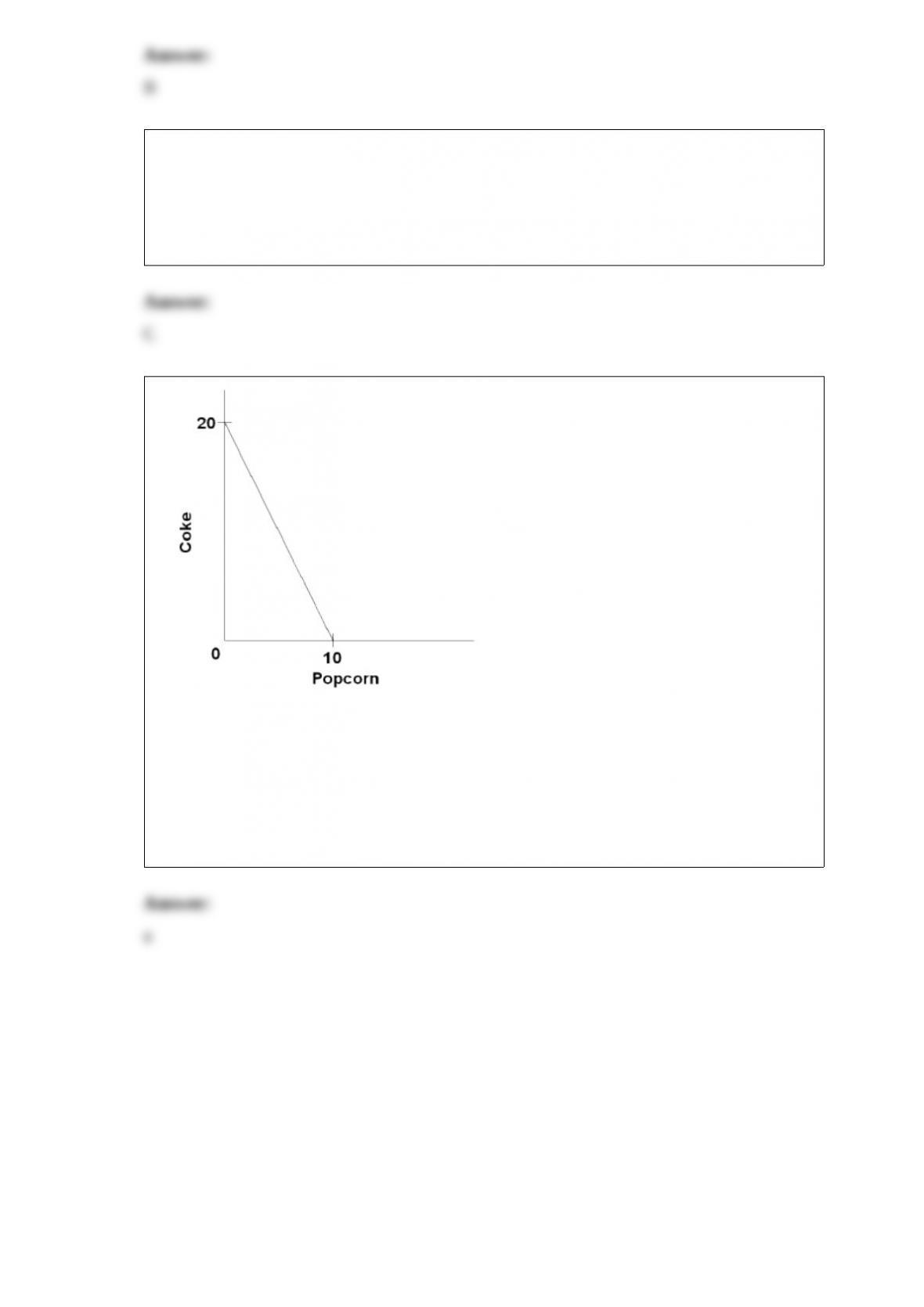
suppose you have a money income of $10, all of which you spend on coke and popcorn.
in the above diagram, the prices of coke and popcorn respectively are:
a.$.50 and $1.00.
b.$1.00 and $.50.
c.$1.00 and $2.00.
d.$.40 and $.50.
8)
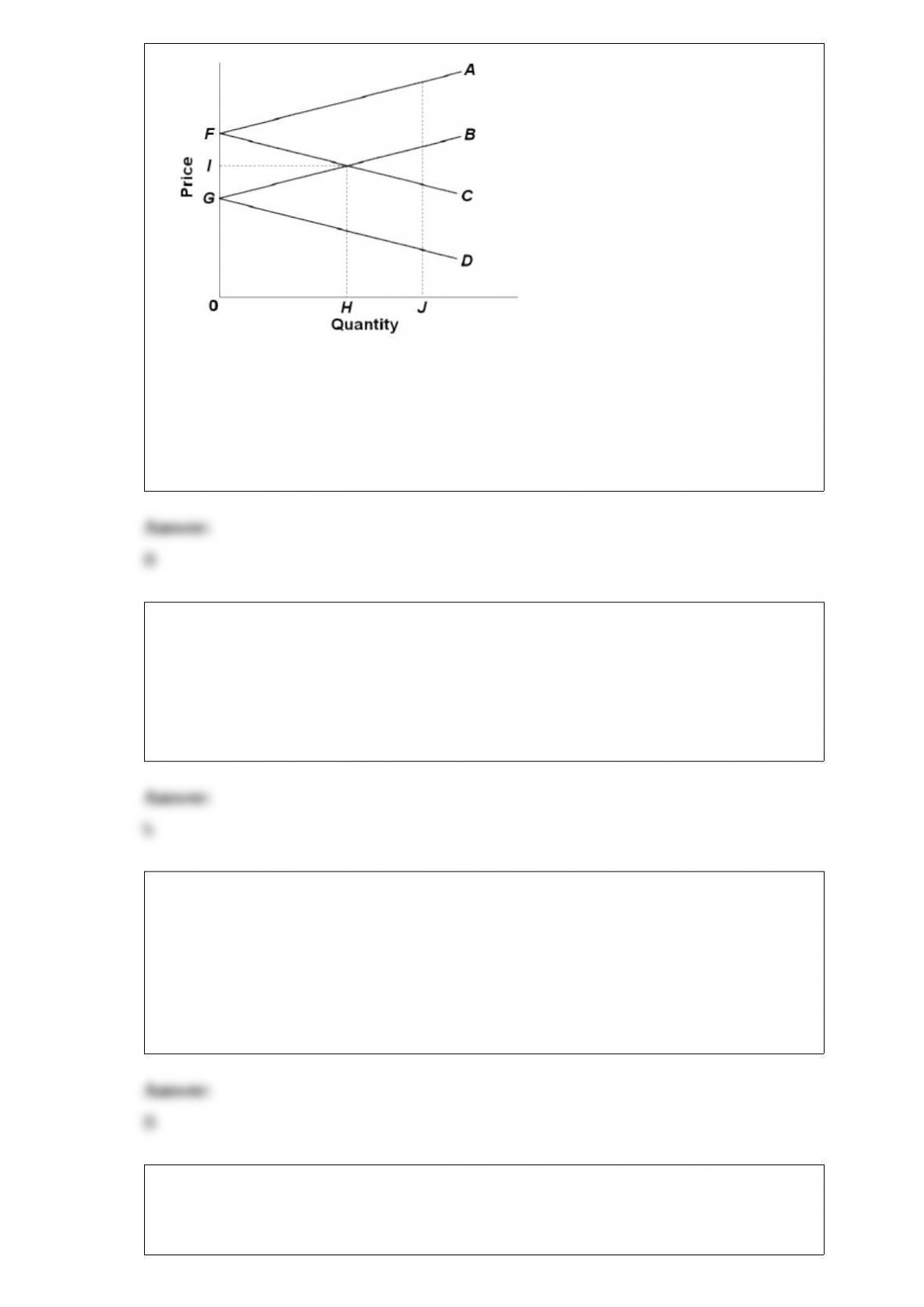
Refer to the above diagram pertaining to two nations and a specific product. The
equilibrium world price occurs at:
A.F
B.I
C.G
D.J
9) suppose the price elasticity of demand for bread is 0.20. if the price of bread falls by
10 percent, the quantity demanded will increase by:
a.2 percent and total expenditures on bread will rise.
b.2 percent and total expenditures on bread will fall.
c.20 percent and total expenditures on bread will fall.
d.20 percent and total expenditures on bread will rise.
10) Suppose the domestic price (no-international-trade price) of wheat is $3.50 a bushel
in the United States while the world price is $4.00 a bushel. Assuming no transportation
costs, the United States will:
A.have a domestic shortage of wheat.
B.export wheat.
C.import wheat.
D.neither export nor import wheat.
11) (Last Word) ATMs and human bank tellers:
A.are substitute resources.
B.are capital goods.
C.have both declined in number because of bank mergers.
D.are complementary resources.
12)
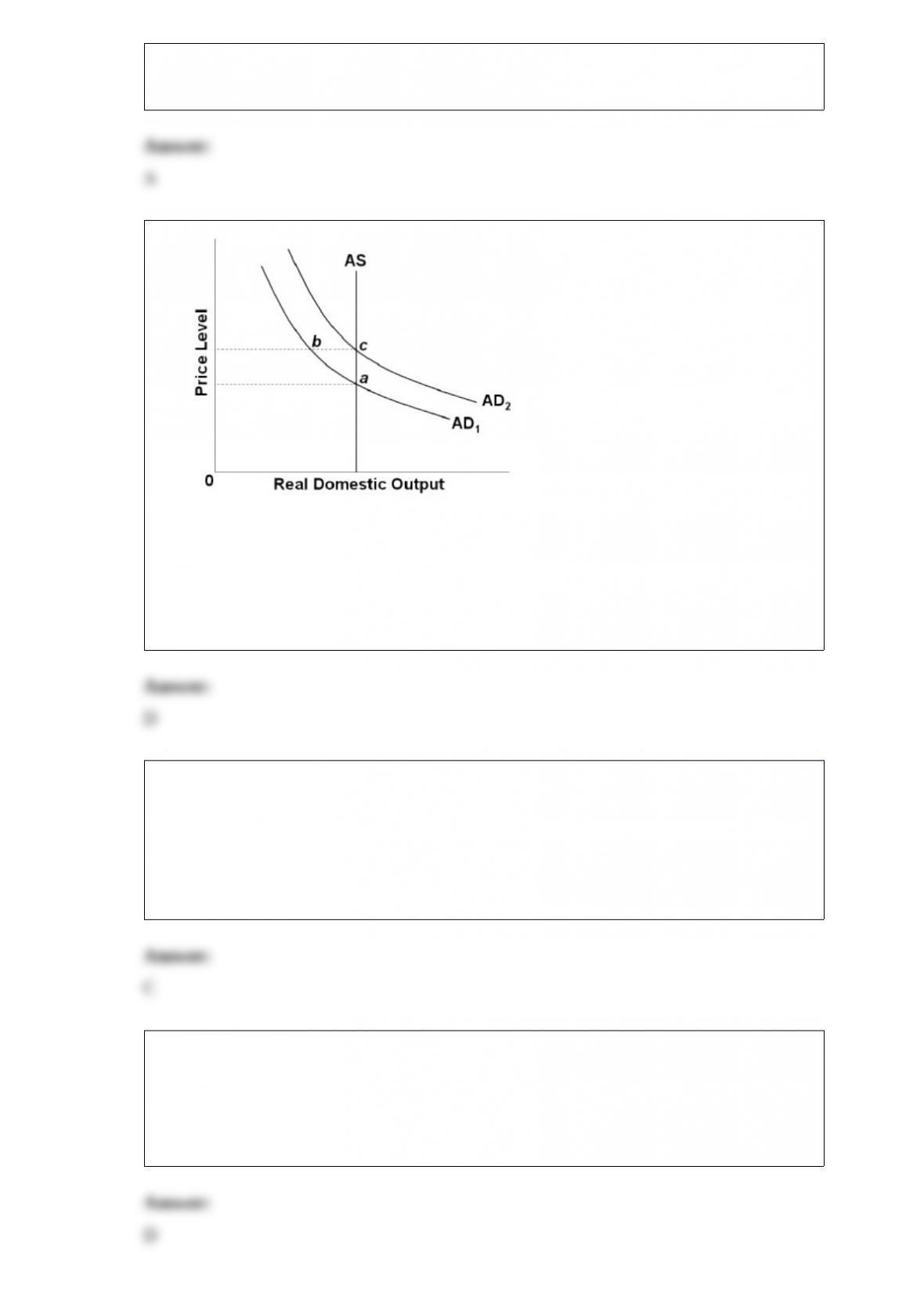
Refer to the above diagram. Rational expectations theory says that a fully anticipated
decrease in aggregate demand from AD2 to AD1 will:
A.move the economy from a to b to c.
B.shift the AS curve to the left.
C.move the economy from c to new equilibrium b.
D.move the economy directly from c to a.
13) Assume the demand for automobile tires is highly inelastic and that the supply is
highly elastic. The burden of a $2 excise tax on each tire will be:
A.borne by resource suppliers who provide the inputs for manufacturing tires.
B.shared about equally by buyers and sellers of tires.
C.borne primarily by buyers of tires.
D.borne primarily by sellers of tires.
14) In forestry, in countries where property rights are not secure, there is:
A.an incentive to harvest trees quickly.
B.little incentive to replant trees.
C.a tendency for deforestation to occur.
D.all of these.
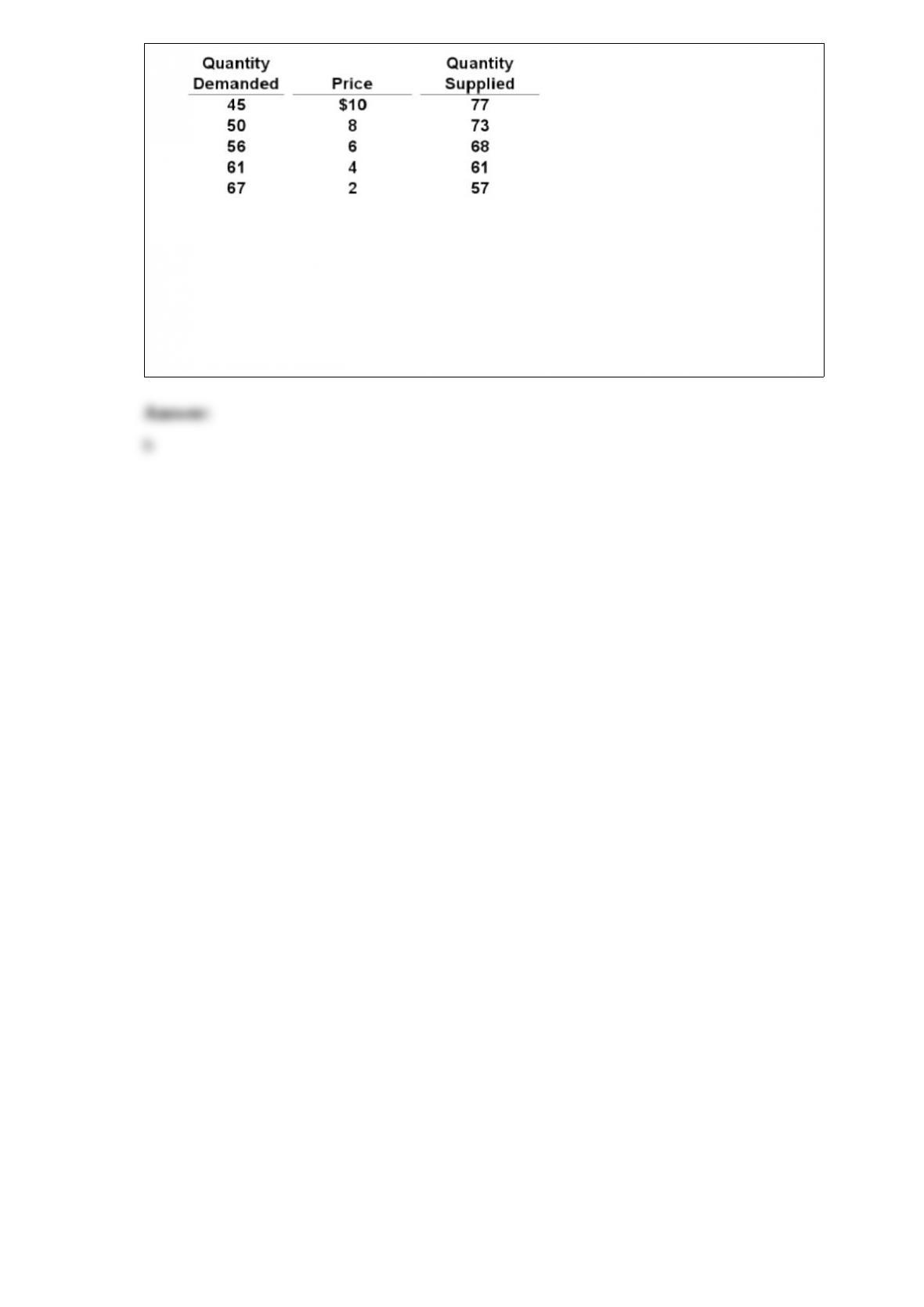
15)
refer to the above data. suppose quantity supplied declined by 23 units at each price,
changing the equilibrium price in a direction and amount for you to determine. over that
price range, demand is:
a.elastic.
b.inelastic.
c.perfectly elastic.
d.perfectly inelastic.