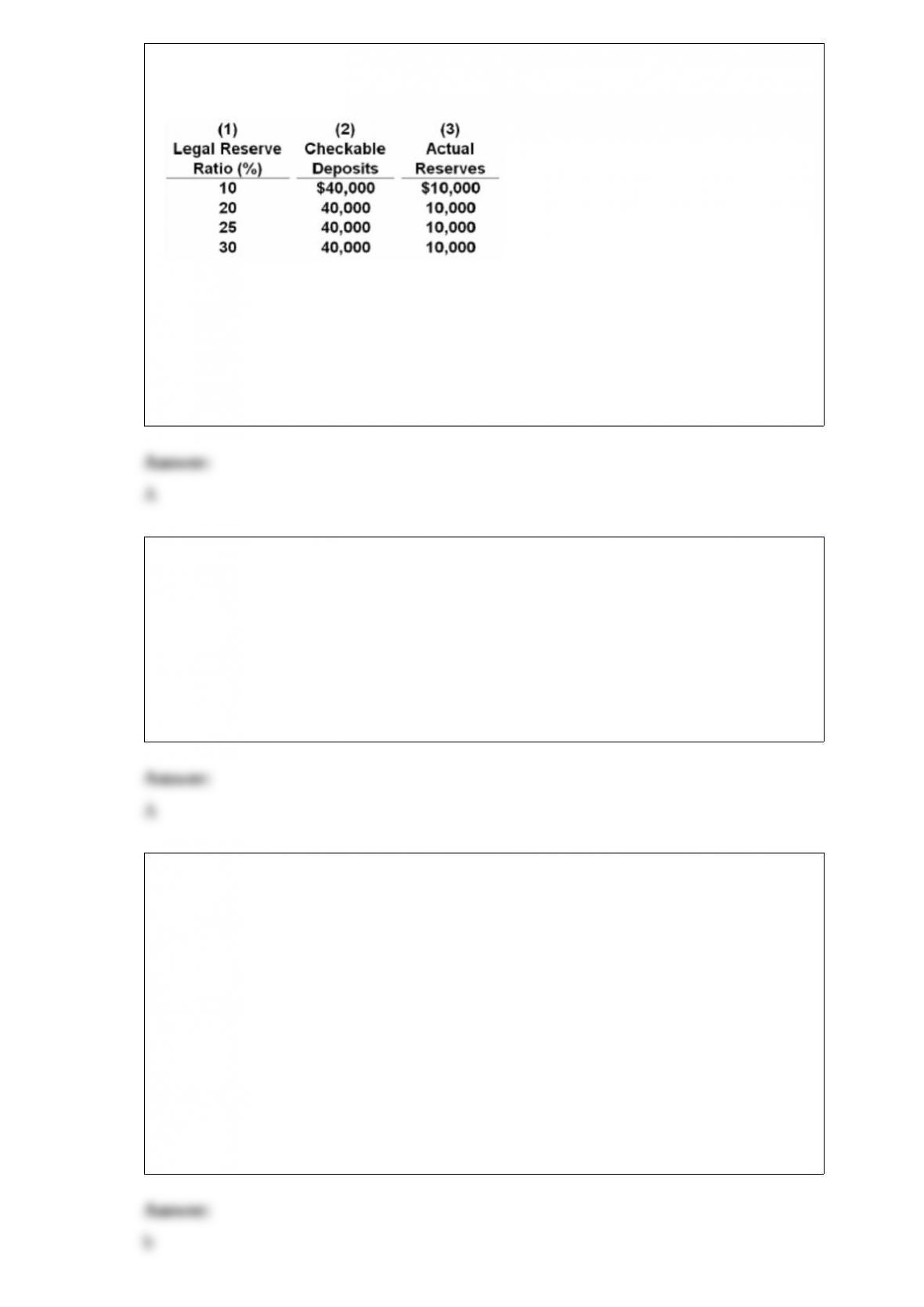
1) The following table for a commercial bank or thrift:
Refer to the above table. If the legal reserve ratio falls from 25 percent to 10 percent,
excess reserves of this single bank will:
A.rise by $6,000 and the monetary multiplier will increase from 4 to 10.
B.rise by $60,000 and the monetary multiplier will increase from 4 to 10.
C.fall by $6,000 and the monetary multiplier will decline from 30 to 10.
D.fall by $2,000 and the monetary multiplier will decline from 10 to 4.
2) Which of the following is correct?
A.Vertical mergers are more likely to be acceptable under antitrust laws than are
horizontal mergers.
B.A vertical merger entails the merging of two or more competing firms.
C.Horizontal mergers are more likely to be acceptable under antitrust laws than are
vertical mergers.
D.Conglomerate mergers occur when two or more firms at various stages in a good’s
production are combined.
3) assume that if the interest rate that businesses must pay to borrow funds were 20
percent, it would be unprofitable for businesses to invest in new machinery and
equipment so that investment would be zero. but if the interest rate were 16 percent,
businesses will find it profitable to invest $10 billion. if the interest rate were 12
percent, $20 billion would be invested. assume that total investment continues to
increase by $10 billion for each successive 4 percentage point decline in the interest
rate.
refer to the above information. which of the following correctly expresses the indicated
relationship as an equation?
a.i = 20 – 4i.
b.i = 20 – .4i.
c.i = 24 – .4i.
d.i = 20 – 10i.
4) A decrease in aggregate demand will cause a greater decline in real output the:
A.less flexible is the economy’s price level.
B.more flexible is the economy’s price level.
C.steeper is the economy’s AS curve.
D.larger is the economy’s marginal propensity to save.
5) Which of the following will increase commercial bank reserves?
A.the purchase of government bonds in the open market by the Federal Reserve Banks
B.a decrease in the reserve ratio
C.an increase in the discount rate
D.the sale of government bonds in the open market by the Federal Reserve Banks
6) as of 1998, living standards in the united states were nearly ______ times higher than
those in africa.
a.3
b.8
c.14
d.20
7)
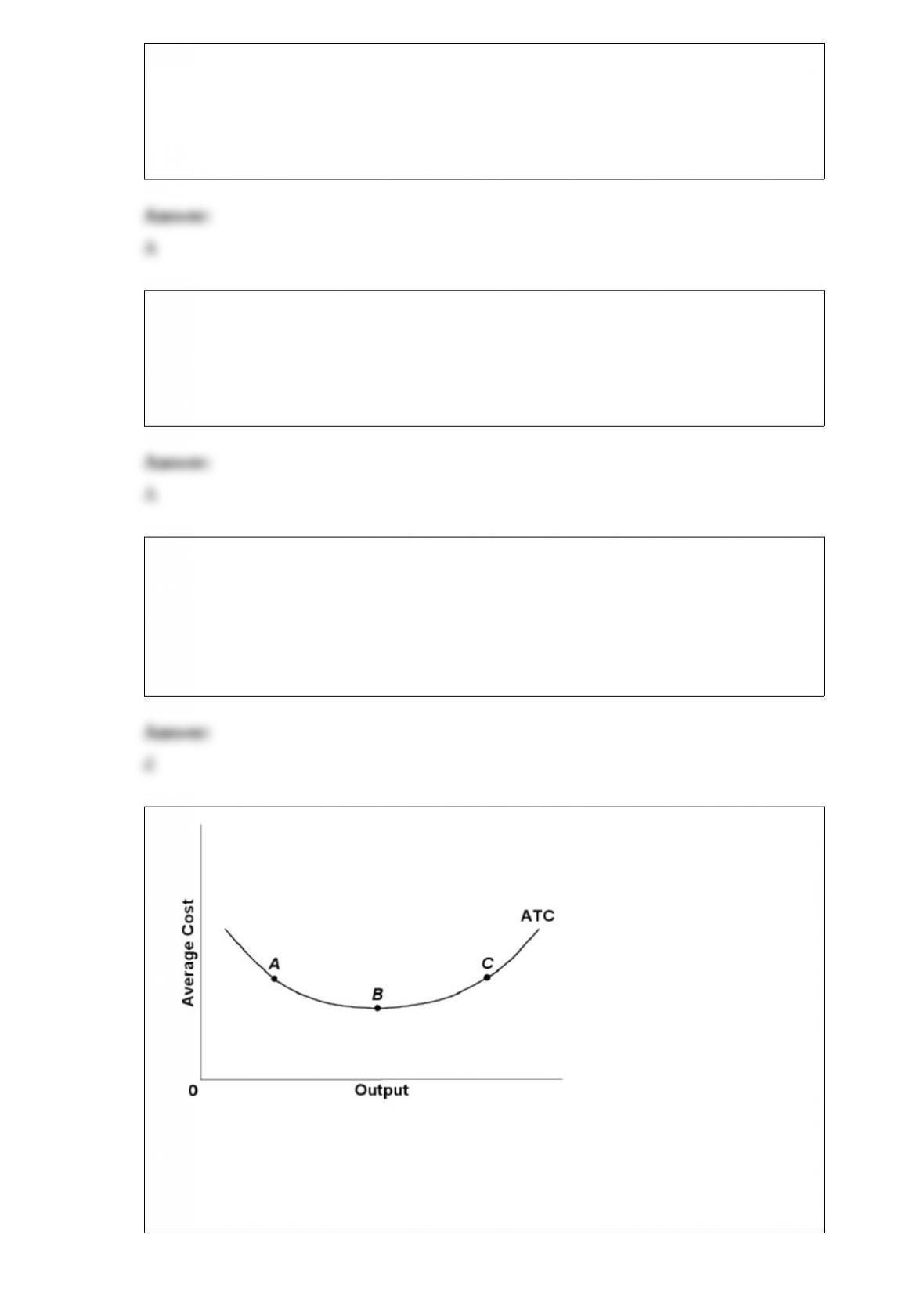
in the above long-run average total cost curve the:
a.movement from a to b reflects diseconomies of scale.
b.movement from b to c reflects diseconomies of scale.
c.realization of economies of scale would shift the entire curve downward.
d.movement from b to c reflects the law of diminishing returns.

8) Kara and Kyle are competing Sockeye Salmon fishers. Both have been allocated
ITQs that limit their catch to 2,000 tons of Sockeye Salmon each. Kara’s cost per ton is
$8; Kyle’s cost per ton is $12.
Refer to the information above. If the market price of Sockeye Salmon is $15 per ton,
what is the minimum amount Kara would have to offer Kyle to convince him to sell
Kara his ITQs?
A.$3.
B.$4.
C.$5.
D.$7.
9) Which of the following generalizations is false? Other things equal:
A.interest rates are higher if lenders are imperfectly, rather than purely, competitive.
B.the interest rate is less on small loans than on larger loans.
C.long-term loans normally command higher interest rates than short-term loans.
D.the greater the risk on a loan, the greater the interest rate.
10) if we say that a price is too high to clear the market, we mean that:
a.quantity demanded exceeds quantity supplied.
b.the equilibrium price is above the current price.
c.quantity supplied exceeds quantity demanded.
d.the price of the good is likely to rise.
11) in national income accounting, consumption expenditures include purchases of:
a.both new and used consumer goods.
b.automobiles for personal use, but not houses.
c.consumer durable and nondurable goods, but not services.
d.consumer nondurable goods and services, but not consumer durable goods.
12)
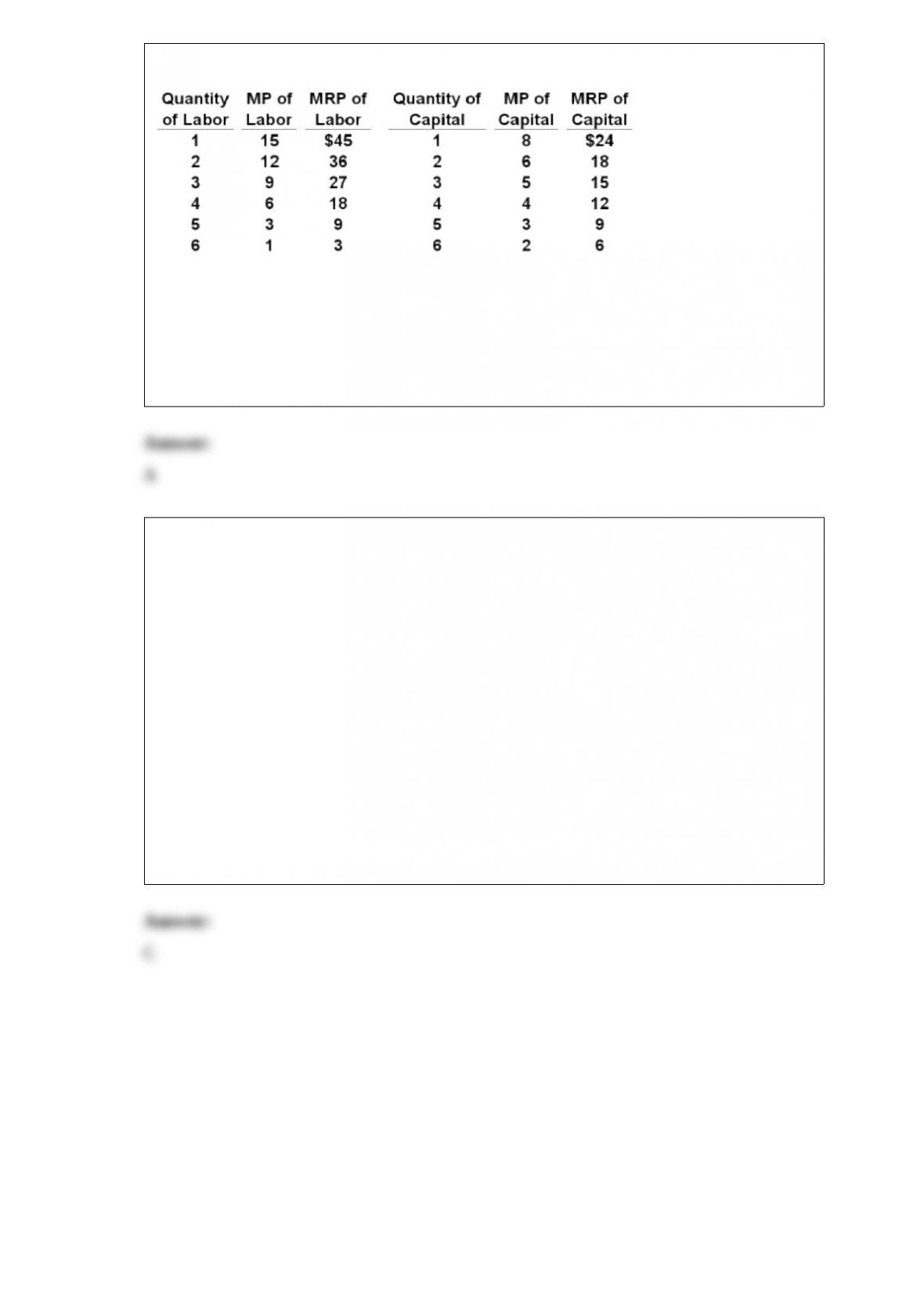
Refer to the above data. If the prices of labor and capital are $9 and $15 respectively,
and labor and capital are the only inputs, the firm’s economic profits will be:
A.$102.
B.$82.
C.$67.
D.$28.
13) Answer the next question(s) on the basis of the following list of assets:
1> Large ($100,000 and over) time deposits
2> Noncheckable savings deposits
3> Currency (coins and paper money)
4> Small (under $100,000) time deposits
5> Stock certificates
6> Checkable deposits
7>Money market deposit accounts
8>Money market mutual fund balances held by individuals
9>Money market mutual fund balances held by businesses
Refer to the above list. The M2 definition of money comprises:
A.items 1, 2, 3, and 6.
B.items 3, 4, 5, and 6.
C.items 2, 3, 4, 6, 7, and 8.
D.items 1, 2, 3, and 4.