
1) an important outcome of the uruguay round of gatt negotiations was:
a.a worldwide reduction of agricultural export subsidies.
b.establishment of the european union.
c.the elimination of all tariffs and quotas worldwide.
d.establishment of the world bank.
2) if a profitable firm’s fixed costs somehow were zero:
a.mc and atc would be equal at all levels of output.
b.afc would become negative as output increases.
c.avc and atc would coincide.
d.atc would be zero at all output levels.
3) suppose aiyanna’s pizzeria currently faces a linear demand curve and is charging a
very high price per pizza and doing very little business. aiyanna now decides to lower
pizza prices by 5 percent per week for an indefinite period of time. we can expect that
each successive week:
a.demand will become more price elastic.
b.price elasticity of demand will not change as price is lowered.
c.demand will become less price elastic.
d.the elasticity of supply will increase.
4) in 2007, the greatest number of immigrants arriving in the united states came from:
a.india and el salvador.
b.the dominican republic and cuba.
c.china and vietnam.
d.mexico and china.
5) an economy is enlarging its stock of capital goods:
a.when net investment exceeds gross investment.
b.when gross investment exceeds replacement investment.
c.whenever gross investment is positive.
d.when replacement investment exceeds gross investment.

6) The legal reserve ratio applies to checkable deposits at:
A.national banks.
B.credit unions.
C.savings and loans.
D.institutions of all of these types.
7) patents:
a.give firms the exclusive right to produce or control a product for 100 years.
b.discourage research and innovation.
c.are a source of monopoly.
d.are also called trademarks.
8) a perfectly inelastic demand schedule:
a.rises upward and to the right, but has a constant slope.
b.can be represented by a line parallel to the vertical axis.
c.cannot be shown on a two-dimensional graph.
d.can be represented by a line parallel to the horizontal axis.
9) When economists say that the demand for labor is a derived demand, they mean that
it is:
A.dependent on government expenditures for public goods and services.
B.related to the demand for the product or service labor is producing.
C.based on the desire of businesses to exploit labor by paying below equilibrium wage
rates.
D.based on the assumption that workers are trying to maximize their money incomes.
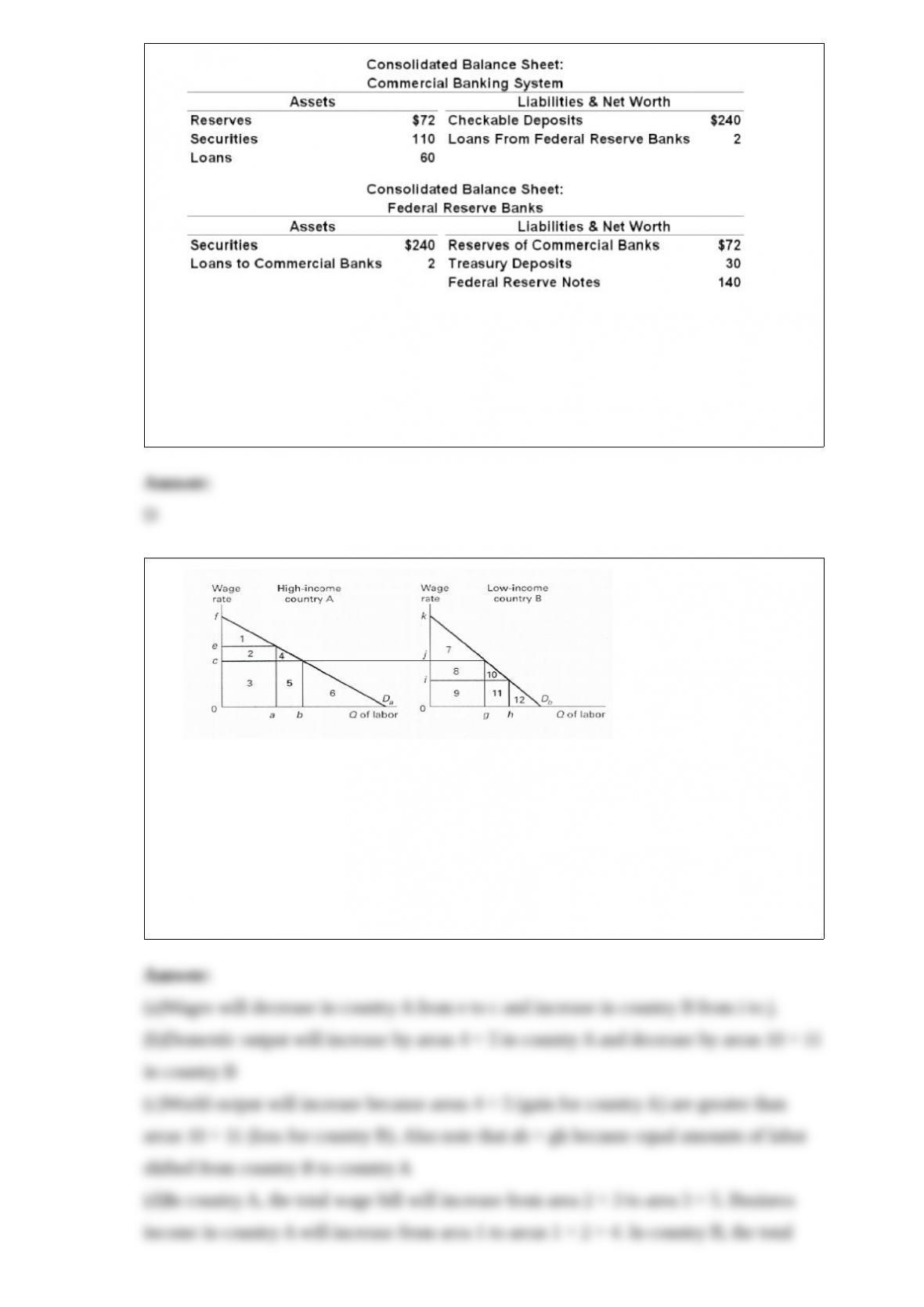
10)
Which of the following will happen when the Federal Reserve buys bonds from the
public in the open market and the amount of cash held by the public does not change?
A.the required reserve ratio will increase
B.the money supply will decrease
C.the deposits of commercial banks will decline
D.commercial bank reserves will increase
11) The next four questions
refer to the graph below. (Assume that the premigration labor force in country A is a
and that it is h in country B.) Explain your answers with reference to areas in the graph
(1, 2, etc.) or to letters (a, b, c, etc.).
(a)What will happen to wage rates in country A and country B because of the migration
of labor from country B to country A?
(b)What will happen to domestic output in country A and country B after immigration?
(c)What will happen to world output given the experience in these two nations?
(d)What will happen to income shares for workers and business in each country?

12) (Last Word) “The Case of ATMs” best illustrates the:
A.law of diminishing marginal utility.
B.the substitutability of resources.
C.idea of derived demand.
13) according to u.s. census bureau data, approximately how many illegal immigrants
are estimated to be living continuously in the united states?
a.5 million
b.12 million
c.23 million
d.30 million
14) the mr = mc rule applies:
a.in the short run, but not in the long run.
b.in the long run, but not in the short run.
c.in both the short run and the long run.
d.only to a purely competitive firm.
15) a point inside a production possibilities curve best illustrates:
a.unemployment.
b.the efficient use of resources.
c.the use of best-available technology.
d.unlimited wants.
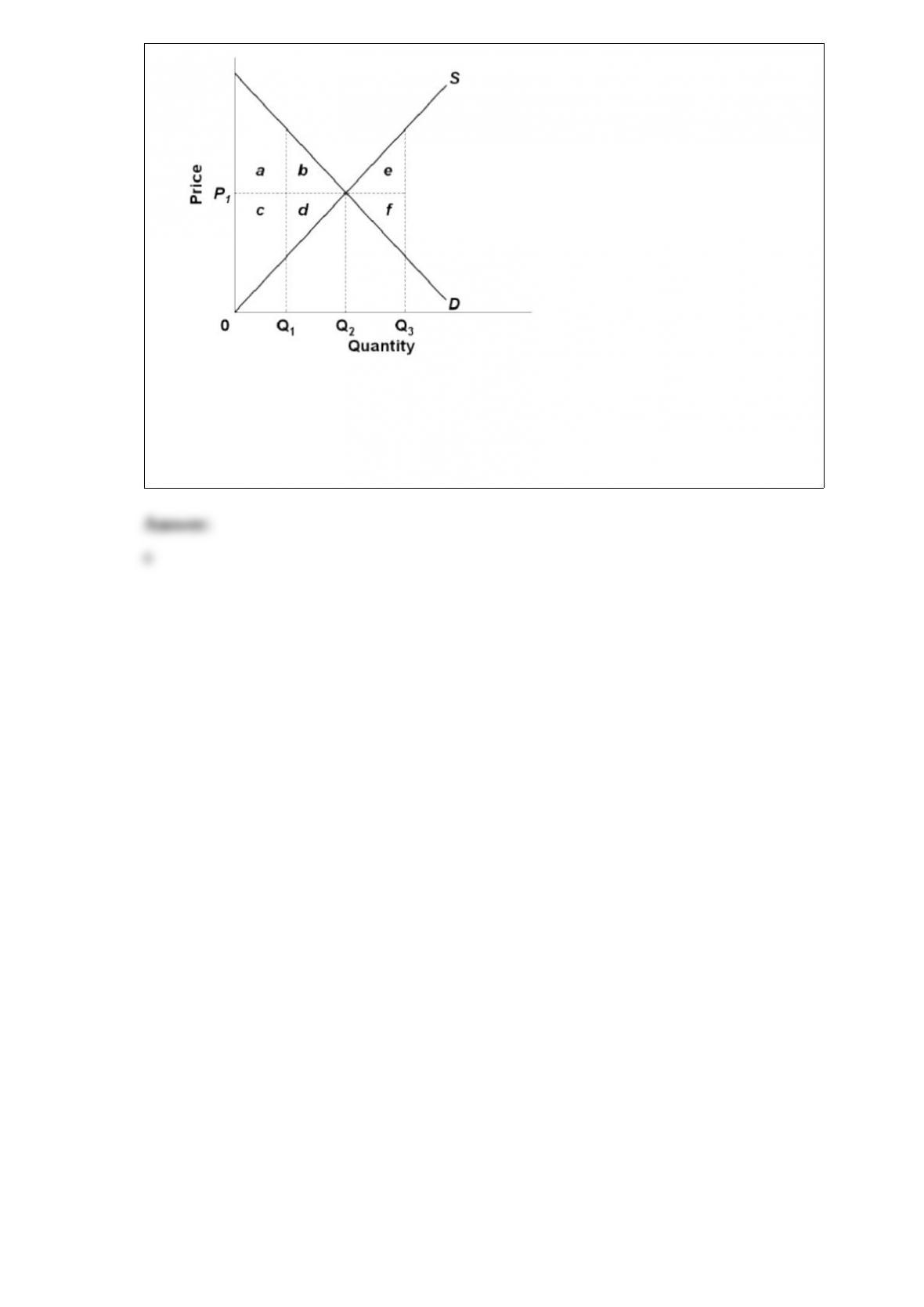
16)
refer to the above diagram. at quantity q1:
a.maximum willingness to pay exceeds minimum acceptable price.
b.the sum of consumer and producer surplus is maximized.
c.minimum acceptable price exceeds maximum willingness to pay.
d.an efficiency loss (or deadweight loss) of a + b occurs.