1) Firms whose central business is providing individual account shares of collections of
stocks, bonds, or both are known as:
A.insurance companies.
B.thrifts.
C.commercial banks.
D.mutual funds companies.
2) in drawing the production possibilities curve we assume that:
a.technology is fixed.
b.unemployment exists.
c.economic resources are unlimited.
d.wants are limited.
3) A company’s extraction cost curve slopes upward to reflect:
A.that marginal extraction costs increase as the company extracts more of the resource.
B.that user costs rise as the company extracts more of the resource.
C.that the price of the non-renewable resource increases as the amount extracted
increases.
D.all of these.
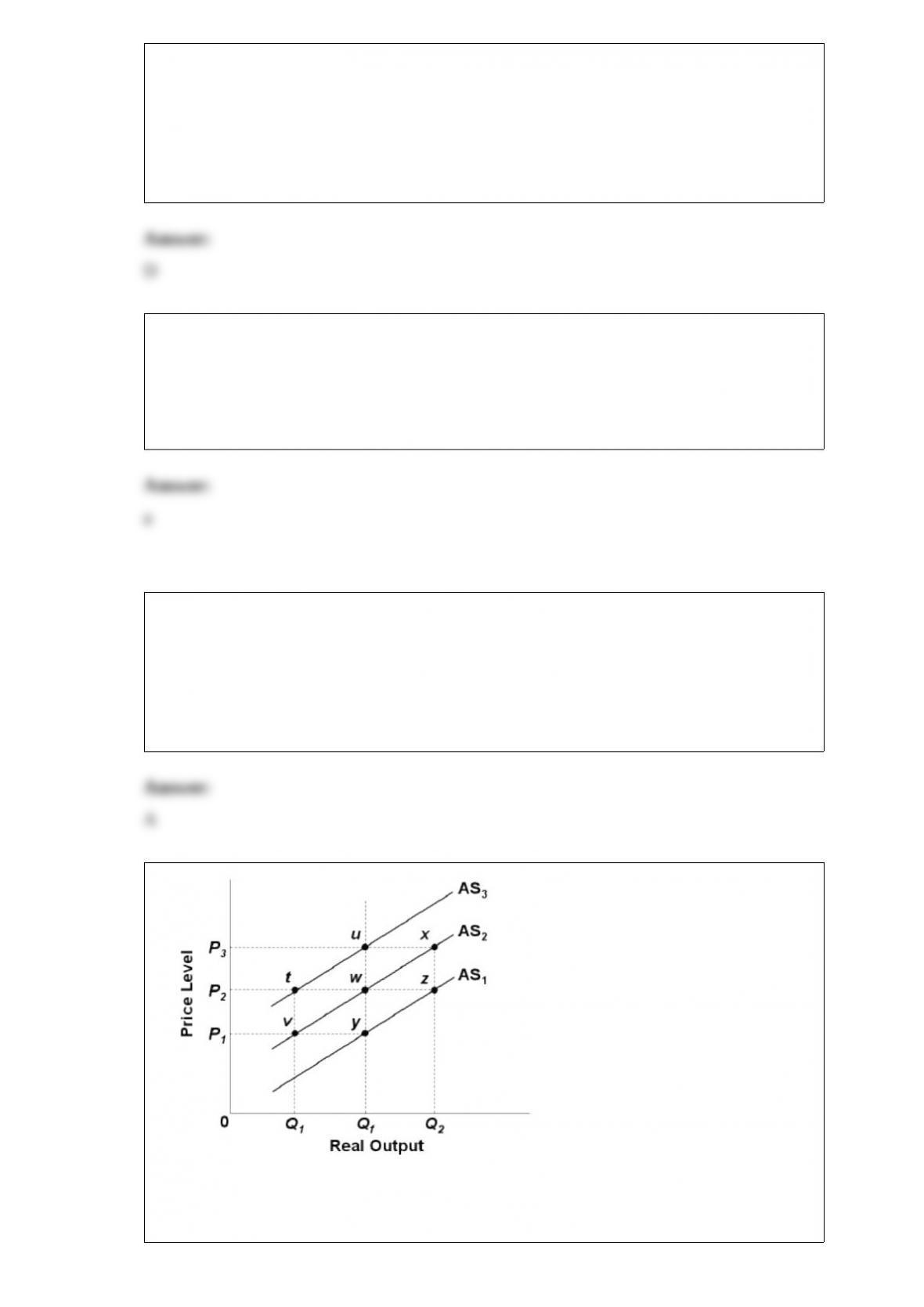
4)
Refer to the above diagram and assume the economy is operating at equilibrium point
w. In the short run, an increase in the price level from P2 to P3 would move the
economy from point w to point:
A.v
B.x
C.u
D.z
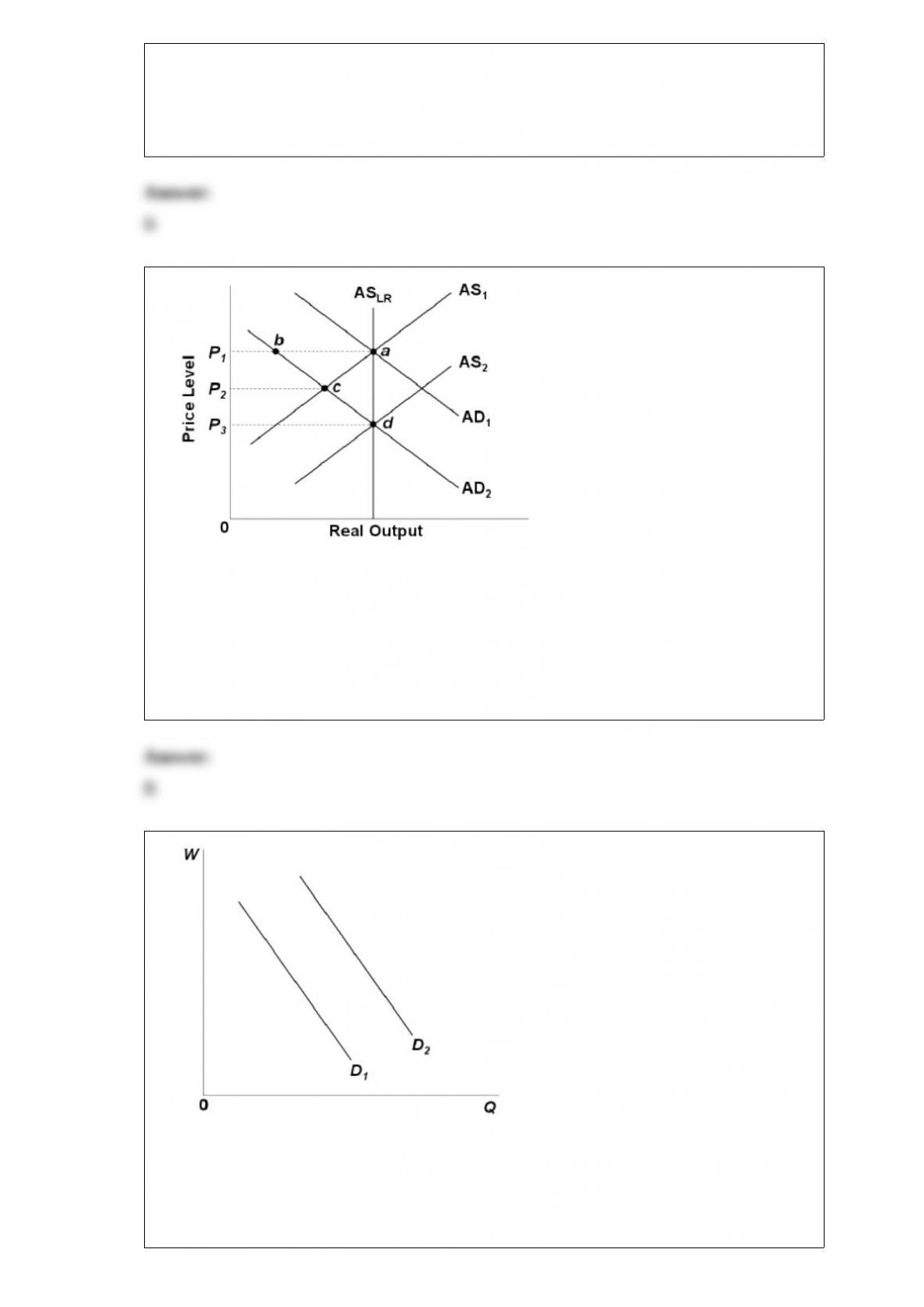
5)
Refer to the above diagram and assume the economy initially is in equilibrium at point
a. In the mainstream view, a decline in aggregate demand from AD1 to AD2 would
likely move the economy:
A.directly from a to d
B.directly from a to b
C.from a to c, then quickly from c to d
D.from a to c, then eventually from c to b
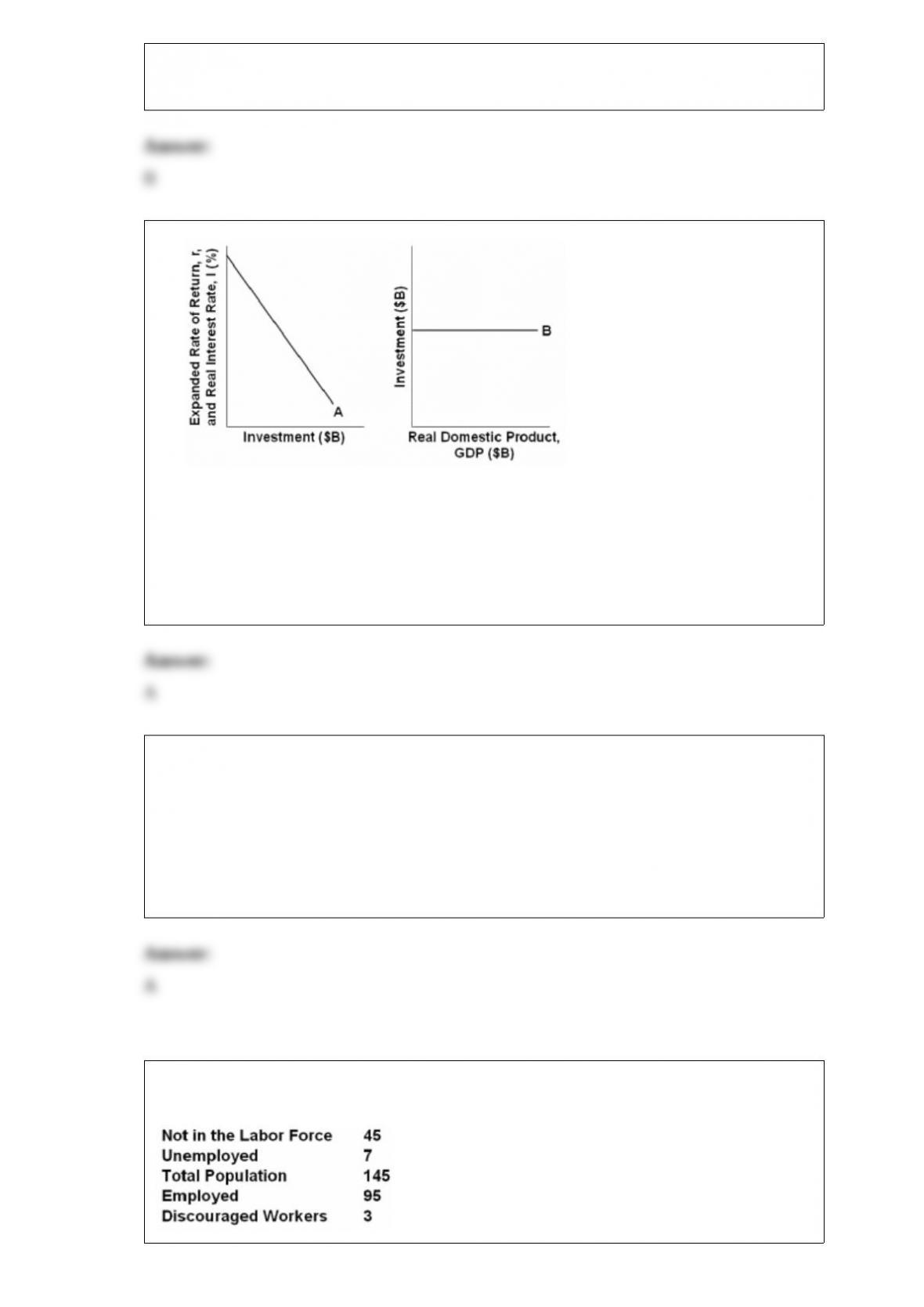
6)
A shift in union labor demand from D1 to D2 in the above diagram might be the result
of:
A.a refusal by union members to buy the product they are producing.
B.an increase in tariffs on products competing with those produced by relevant union
workers.
C.increases in the prices of complementary inputs.
D.a strike (work stoppage) by the union.
7)
Refer to the above diagram. Other things equal, an interest rate reduction coupled with
a rightward shift in curve A will:
A.shift curve B upward.
B.shift curve B downward.
C.have no effect on curve B.
D.reduce GDP.
8) Fiscal policy refers to the:
A.manipulation of government spending and taxes to stabilize domestic output,
employment, and the price level.
B.manipulation of government spending and taxes to achieve greater equality in the
distribution of income.
C.altering of the interest rate to change aggregate demand.
D. fact that equal increases in government spending and taxation will be contractionary.
9) answer the next question(s) on the basis of the following information about the
hypothetical economy of scoob. all figures are in millions.

refer to the above information. if the natural rate of unemployment in scoob is 5
percent, then:
a.structural unemployment is about 3 percent.
b.frictional unemployment is about 2 percent.
c.cyclical unemployment is about 2 percent.
d.hidden unemployment is about 5 percent.
10) The largest efficiency gains from deregulation have occurred in the:
A.natural gas and cable television industries.
B.cable television and railroad industries.
C.communications and stockbrokering industries.
D.airlines, trucking, and railroad industries.
11) a manufacturer of frozen pizzas found that total revenue decreased when price was
lowered from $5 to $4. it was also found that total revenue decreased when price was
raised from $5 to $6. thus,
a.the demand for pizza is elastic above $5 and inelastic below $5.
b.the demand for pizza is elastic both above and below $5.
c.the demand for pizza is inelastic above $5 and elastic below $5.
d.$5 is not the equilibrium price of pizza.
12) the following information:
refer to the above data. when two workers are employed:
a.total product is 20
b.total product is 18
c.average product is 10
d.total product cannot be determined from the information given.

13) Other things equal, an increase in the productivity of capital goods will:
A.increase the demand for loanable funds and decrease the equilibrium interest rate.
B.increase the demand for loanable funds and increase the equilibrium interest rate.
C.increase the supply of loanable funds and decrease the equilibrium interest rate.
D.increase the supply of loanable funds and increase the equilibrium interest rate.
14) Economists object to exchange controls because they:
A.reduce efficiency by distorting the pattern of international trade.
B.limit consumer choice.
C.lead to the development of black markets for foreign exchange.
D.do all of these.