Archives: Quiz
BUS 394 Quiz
If people value clean air over dirty air, and if the air in city A is cleaner than the air in city B (by a wide margin), then we would expect that ____________________, all else equal between the two cities. […]
BUS 820 Quiz 2
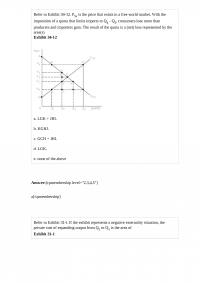
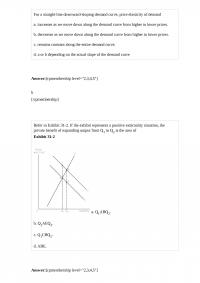
Refer to Exhibit 34-12. PW is the price that exists in a free world market. With the imposition of a quota that limits imports to Q4 – Q3, consumers lose more than producers and importers gain. The result of the […]
BUS 489 Test 2
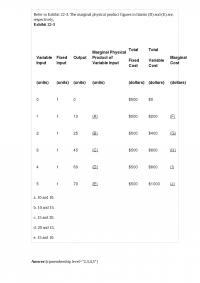
Refer to Exhibit 22-3. The marginal physical product figures in blanks (D) and (E) are, respectively, Exhibit 22-3 a. 10 and 10. b. 10 and 15. c. 15 and 20. d. 20 and 15. e. 15 and 10. Answer: Refer […]
ECON 711 Which of the following can
Which of the following can bring about an increase in the demand for labor? a. an increase in the demand for the product that labor produces b. an increase in the marginal physical product of labor c. a decrease in […]
ECON 884 Test 1
For a straight-line downward-sloping demand curve, price elasticity of demand a. increases as we move down along the demand curve from higher to lower prices. b. decreases as we move down along the demand curve from higher to lower prices. […]
ECON A 234 Final
Given that fixed costs are constant as output increases, average fixed costs are also constant. a. True b. False The English economist David Ricardo argued that a. grain prices were high because land rents were high. b. land rents were […]
Economics 700 Midterm
What is the relationship between the elasticity of demand for a product and the elasticity of demand for labor (that is used in producing the product)? a. The higher the price of the product, the higher the elasticity of demand […]
ECON A 350
Which of the following statements is false? a. Average fixed cost continually declines as output increases. b. Marginal cost is equal to the change in total cost divided by the change in quantity of output. c. The law of diminishing […]
Economics 702 Test 1
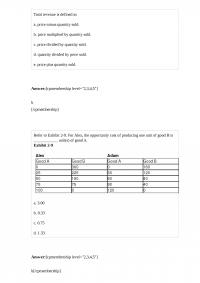
Total revenue is defined as a. price minus quantity sold. b. price multiplied by quantity sold. c. price divided by quantity sold. d. quantity divided by price sold. e. price plus quantity sold. Refer to Exhibit 2-9. For Alex, the […]
BUS 541 Quiz
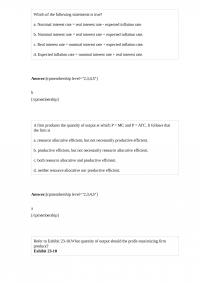
Which of the following statements is true? a. Nominal interest rate = real interest rate – expected inflation rate. b. Nominal interest rate = real interest rate + expected inflation rate. c. Real interest rate = nominal interest rate + […]
Economics 393 Homework
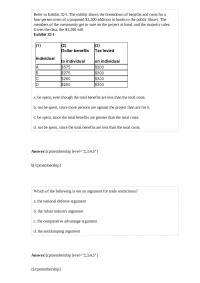
Refer to Exhibit 32-l. The exhibit shows the breakdown of benefits and costs for a four-person town of a proposed $1,200 addition in books to the public library. The members of the community get to vote on the project at […]
MicroEconomic 342 Homework
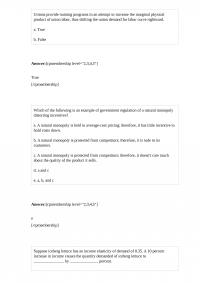
Unions provide training programs in an attempt to increase the marginal physical product of union labor, thus shifting the union demand for labor curve rightward. a. True b. False Which of the following is an example of government regulation of […]
Economics 865 During the
During the twentieth century, the U.S. farm sector experienced a. large increases in its ability to produce output. b. relatively little improvement in its ability to produce output. c. a marked decrease in its ability to produce output. d. relatively […]
ECON 449 Homework
Which of the following statements is true? a. The concept of opportunity costs cannot be illustrated within a PPF framework. b. If scarcity did not exist, neither would a PPF. c. All PPFs are downward-sloping straight lines. d. There are […]
ECON 488
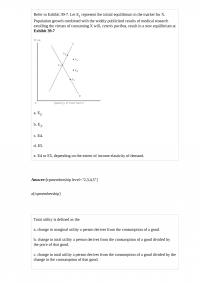
Refer to Exhibit 39-7. Let E1 represent the initial equilibrium in the market for X. Population growth combined with the widely publicized results of medical research extolling the virtues of consuming X will, ceteris paribus, result in a new equilibrium […]
BUS 581
When negative externalities are connected with the production of a good, a. market output will be greater than the socially optimal output. b. private costs and social costs are equal. c. the government should subsidize the production of the good. […]
ECB 273 Quiz 3
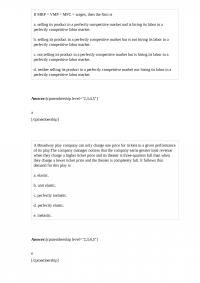
If MRP = VMP = MFC = wages, then the firm is a. selling its product in a perfectly competitive market and is hiring its labor in a perfectly competitive labor market. b. selling its product in a perfectly competitive […]
ECON A 584 Quiz 1
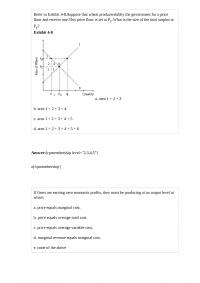
Refer to Exhibit 4-8.Suppose that wheat producerslobby the government for a price floor and receive one.This price floor is set at PF.What is the size of the total surplus at PF? Exhibit 4-8 a. area 1 + 2 + 3 […]
MicroEconomic 268
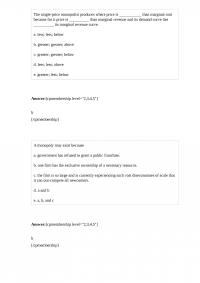
The single-price monopolist produces where price is ___________ than marginal cost because for it price is __________ than marginal revenue and its demand curve lies __________ its marginal revenue curve. a. less; less; below b. greater; greater; above c. greater; […]
ECON E 743 Midterm 1
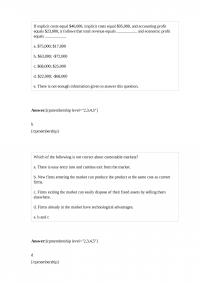
If explicit costs equal $40,000, implicit costs equal $95,000, and accounting profit equals $23,000, it follows that total revenue equals __________ and economic profit equals __________. a. $75,000; $17,000 b. $63,000; -$72,000 c. $68,000; $25,000 d. $22,000; -$68,000 e. There […]
BUS 109 Quiz
A vertical supply curve represents: a. an inverse relationship between price and quantity supplied. b. an independent relationship between price and quantity supplied. c. an independent relationship between price and supply. d. a direct relationship between price and quantity supplied. […]
BUS 803
Suppose that for Alicia the marginal benefit (MB) of producing is $75 and that the marginal cost (MC) of producing is $5.Suppose also that her marginal benefit of stealing is $85 and the marginal cost of stealing is $5.Is Alicia […]
MicroEconomic 786 Quiz 2
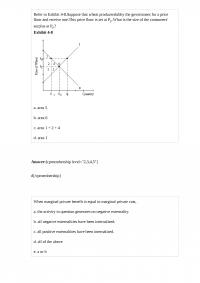
Refer to Exhibit 4-8.Suppose that wheat producerslobby the government for a price floor and receive one.This price floor is set at PF.What is the size of the consumers’ surplus at PF? Exhibit 4-8 a. area 5 b. area 6 c. […]
MicroEconomic 323 Final
One reads the following in a newspaper: “Today the president and Congress agreed to impose new restrictive quotas on Japanese cars coming into the country.” As a result, an economist would predict that the a. supply of cars in the […]
Economics 863 Midterm 2
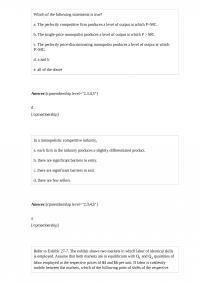
Which of the following statements is true? a. The perfectly competitive firm produces a level of output at which P=MC. b. The single-price monopolist produces a level of output at which P > MC. c. The perfectly price-discriminating monopolist produces […]
ECON 375 Quiz 1
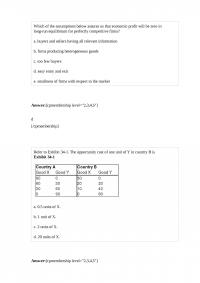
Which of the assumptions below assures us that economic profit will be zero in long-run equilibrium for perfectly competitive firms? a. buyers and sellers having all relevant information b. firms producing heterogeneous goods c. too few buyers d. easy entry […]
ECON A 305 Test
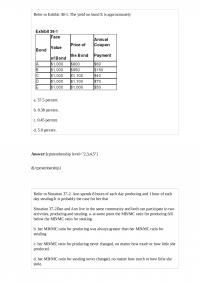
Refer to Exhibit 38-1. The yield on bond E is approximately a. 37.5 percent. b. 0.38 percent. c. 0.45 percent. d. 5.0 percent. Refer to Situation 37-2. Ann spends 8 hours of each day producing and 1 hour of each […]
ECON A 863 Final
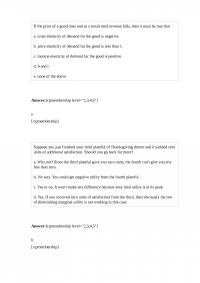
If the price of a good rises and as a result total revenue falls, then it must be true that a. cross elasticity of demand for the good is negative. b. price elasticity of demand for the good is less […]
ECON 443 Quiz 2
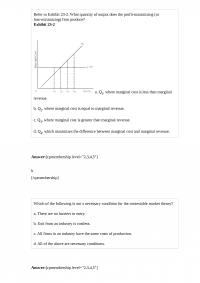
Refer to Exhibit 23-2. What quantity of output does the profit-maximizing (or loss-minimizing) firm produce? Exhibit 23-2 a. Q1, where marginal cost is less than marginal revenue. b. Q2, where marginal cost is equal to marginal revenue. c. Q3, where […]
ECB 894 Test
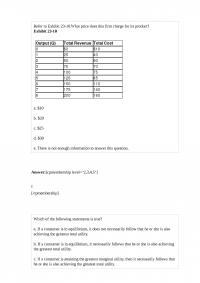
Refer to Exhibit 23-10.What price does this firm charge for its product? Exhibit 23-10 a. $10 b. $20 c. $25 d. $30 e. There is not enough information to answer this question. Which of the following statements is true? a. […]
ECON E 477 Midterm 1
The statement, “Every person who shall monopolize, or attempt to monopolize, or combine or conspire with any other person or persons to monopolize any part of the trade or commerce…shall be guilty of a misdemeanor” is a part of the […]
ECON 583 Test
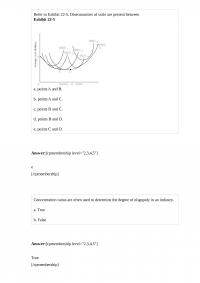
Refer to Exhibit 22-5. Diseconomies of scale are present between Exhibit 22-5 a. points A and B. b. points A and C. c. points B and C. d. points B and D. e. points C and D. Concentration ratios are […]
ECON 797 Midterm 1
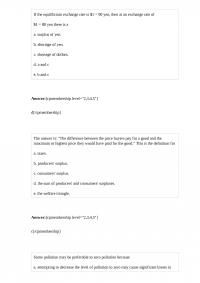
If the equilibrium exchange rate is $1 = 90 yen, then at an exchange rate of $1 = 80 yen there is a a. surplus of yen. b. shortage of yen. c. shortage of dollars. d. a and c e. […]
Economics 510 Quiz 2
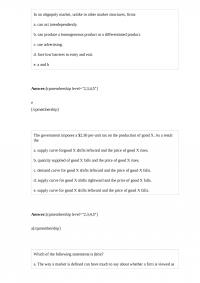
In an oligopoly market, unlike in other market structures, firms a. can act interdependently. b. can produce a homogeneous product or a differentiated product. c. use advertising. d. face low barriers to entry and exit. e. a and b The […]
BUS 259 Midterm 2
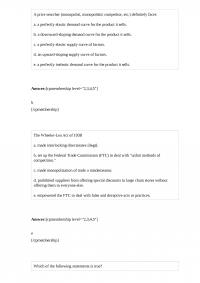
A price searcher (monopolist, monopolistic competitor, etc.) definitely faces a. a perfectly elastic demand curve for the product it sells. b. a downward-sloping demand curve for the product it sells. c. a perfectly elastic supply curve of factors. d. an […]
ECON 807
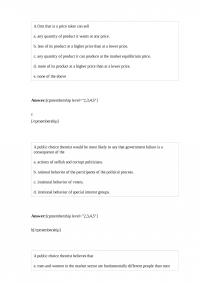
A firm that is a price taker can sell a. any quantity of product it wants at any price. b. less of its product at a higher price than at a lower price. c. any quantity of product it can […]
ECON 457 Final
Simple majority voting sometimes leads to projects being undertaken whose costs are greater than the benefits. How is this possible? a. It is not possible, unless the voting results are rigged. b. Because voters have no way to express the […]
BUS 350 Test 2
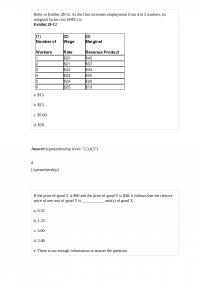
Refer to Exhibit 28-12. As the firm increases employment from 4 to 5 workers, its marginal factor cost (MFC) is Exhibit 28-12 a. $13. b. $15. c. $5.60. d. $28. If the price of good X is $90 and the […]
ECB 200 Quiz
Oil producers expect that oil prices next year will be higher than oil prices this year. As a result, oil producers are most likely to a. place more oil on the market this year, thus shifting the present supply curve […]
ECON A 296 Test 1
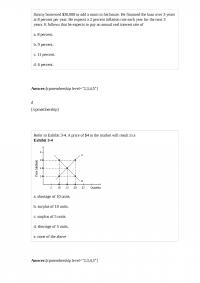
Jimmy borrowed $30,000 to add a room to his house. He financed the loan over 3 years at 8 percent per year. He expects a 2 percent inflation rate each year for the next 3 years. It follows that he […]
MicroEconomic 687 Quiz 1
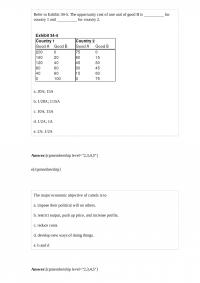
Refer to Exhibit 34-5. The opportunity cost of one unit of good B is __________ for country 1 and __________ for country 2. a. 20A; 15A b. 1/20A; 1/15A c. 10A; 15A d. 1/2A; 1A e. 2A; 1/2A The major […]
BUS 415 Midterm 1
If the quantity demanded of good X is greater than the quantity supplied of good X, then the market for good X is in disequilibrium. a. True b. False If the percentage change in quantity demanded of a good is […]
Economics 616 Midterm 1
Which of the following statements is false? a. A subsidy can be used to internalize a negative externality; a tax can be used to internalize a positive externality. b. Ronald Coase stressed the reciprocal nature of externalities. c. One way […]
ECON E 456 Test 2
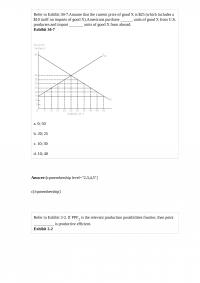
Refer to Exhibit 34-7.Assume that the current price of good X is $25 (which includes a $10 tariff on imports of good X).Americans purchase ______ units of good X from U.S. producers and import _______ units of good X from […]
ECON E 514 Test 2
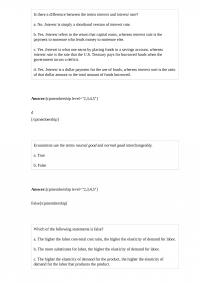
Is there a difference between the terms interest and interest rate? a. No. Interest is simply a shorthand version of interest rate. b. Yes. Interest refers to the return that capital earns, whereas interest rate is the payment to someone […]
ECON A 899 Midterm 1
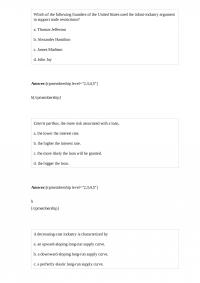
Which of the following founders of the United States used the infant-industry argument to support trade restrictions? a. Thomas Jefferson b. Alexander Hamilton c. James Madison d. John Jay Ceteris paribus, the more risk associated with a loan, a. the […]
ECON 227
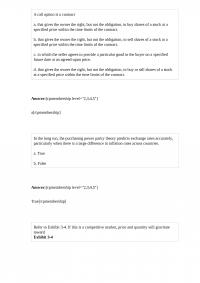
A call option is a contract a. that gives the owner the right, but not the obligation, to buy shares of a stock at a specified price within the time limits of the contract. b. that gives the owner the […]
ECON 768 Final
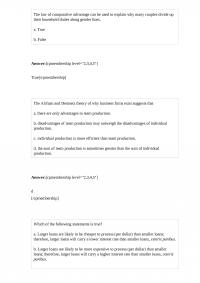
The law of comparative advantage can be used to explain why many couples divide up their household duties along gender lines. a. True b. False The Alchian and Demsetz theory of why business firms exist suggests that a. there are […]
MicroEconomic 386
A perfectly competitive firm is a price taker. a. True b. False According to public choice theory, low voter turnouts are the result of voters a. being apathetic. b. being uninformed. c. being lazy. d. disliking the candidates. e. calculating […]
ECB 732 Quiz 1
Suppose you are eating buffalo wings at a local happy hour. The total utils from doing so after the fourth, fifth, sixth, and seventh wings are 80, 116, 136, 146, respectively. The marginal utility of the seventh wing is __________ […]