
Simple majority voting sometimes leads to projects being undertaken whose costs are
greater than the benefits. How is this possible?
a. It is not possible, unless the voting results are rigged.
b. Because voters have no way to express the intensity of their preferences.
c. Because many voters choose to be rationally ignorant.
d. Because free riding is pervasive.
One reads in the newspaper: “Today the president and Congress enacted a law which
adds new requirements that child care providers must meet before they can offer their
services for sale.” As a result, an economist would predict that
a. the supply of child care services will increase, thus lowering the price of child care
services.
b. the supply of child care services will be unaffected by the stiffer requirements and
therefore the price of child care services will not change.
c. the demand for child care services will fall because people who buy child care
services do not want stiffer requirements placed on child care providers.
d. the supply of child care services will decrease, thus raising the price of child care
services.
e. none of the above
Suppose a monopolist practices perfect price discrimination. Its marginal revenue curve

a. will lie below its demand curve.
b. will lie above its demand curve.
c. will coincide with its demand curve.
d. has no definite relationship with its demand curve.
An increase in productivity in the agricultural sector when the demand curve is inelastic
results in __________ prices for consumers and __________ revenues for farmers
a. higher; lower
b. higher; higher
c. lower; lower
d. lower; higher
e. no change in; no change in
A decrease in the wage rate
a. shifts the supply curve of labor rightward.
b. increases the quantity supplied of labor.

c. shifts the supply curve of labor leftward.
d. decreases the quantity supplied of labor.
X-inefficiency refers to
a. the tendency for an economy to allocate too many resources to the monopolist.
b. the increase in costs and organizational slack in a monopoly resulting from the lack
of competitive pressure.
c. the resources used to regulate the behavior of a monopolist.
d. a and b
e. a and c
During an election, a candidate who is not doing as well in the polls as his or her
opponent will
a. modify his or her position so that it is more like that of his or her opponent.
b. modify his or her position so that it is less like that of his or her opponent.
c. become more specific in discussing the issues.
d. label his or her opponent as a middle-of-the-roader.

If the percentage change in quantity demanded is greater than the percentage change in
price for good X,then the demand for good X is
a. inelastic.
b. unit elastic.
c. elastic.
d. perfectly inelastic.
As a determinant of a person’s income, luck is more important in the __________ run,
as continuous reoccurrences of one kind of luck are __________.
a. short; likely
b. short; unlikely
c. long; likely
d. long; unlikely

If the PPF for two goods is a downward-sloping straight line, the resources used to
produce those goods are equally well suited to the production of both goods.
a. True
b. False
The longer you hold stocks in the stock market, the more likely you will earn a positive
return, ceteris paribus.
a. True
b. False
Smith drives his car numerous places.Sometimes he drives his car around his residential
neighborhood and sometimes he drives it on the highway.Occasionally, Smith gets
peeved with the way other people drive and makes a rude gesture to them.Based on one
of the theories discussed in the textbook, he is
a. more likely to make a rude gesture to another driver on the highway than in his
residential neighborhood.
b. less likely to make a rude gesture to another driver on the highway than in his
residential neighborhood.
c. equally likely to make a rude gesture to another driver on the highway as in the
residential neighborhood.

d. There is not enough information provided to answer this question.
When the official dollar price of a foreign currency is lowered, the dollar is being
a. appreciated.
b. overvalued.
c. undervalued.
d. devalued.
e. revalued.
Refer to Exhibit 4-5. Suppose the government imposes a price ceiling at P = $0 for
transplanted kidneys. The result will be a
Exhibit 4-5
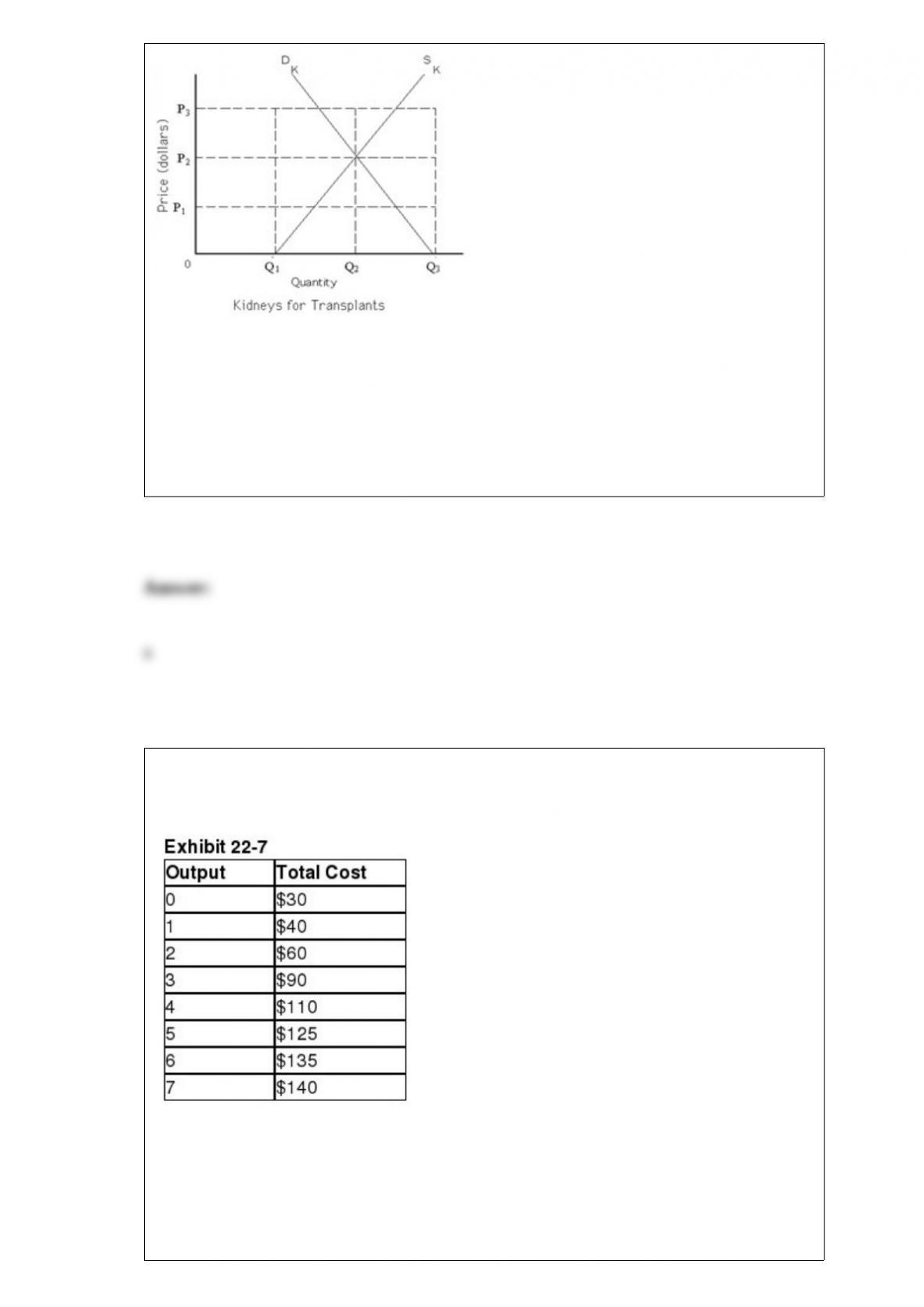
a. shortage of kidneys equal to (Q3 – Q1).
b. surplus of kidneys equal to (Q3 – Q1).
c. shortage of kidneys equal to (Q2 – Q1).
d. surplus of kidneys equal to (Q2 – Q1).
Refer to Exhibit 22-7. The marginal cost of producing the seventh unit of output is
a. $85.00.
b. $12.14.
c. $21.00.

d. $5.00.