
Oil producers expect that oil prices next year will be higher than oil prices this year. As
a result, oil producers are most likely to
a. place more oil on the market this year, thus shifting the present supply curve of oil
rightward.
b. hold some oil off the market this year, thus shifting the present supply curve of oil
leftward.
c. place more oil on the market this year, thus increasing the quantity supplied of oil at
lower but not higher prices.
d. hold some oil off the market this year, thus decreasing the quantity supplied of oil at
lower but not higher prices.
Consider two straight-line PPFs. They have the same vertical intercept, but curve I is
flatter than curve II. The opportunity cost of producing the good on the horizontal axis
a. is greater along curve I.
b. is greater along curve II.
c. is the same along both curves.
d. cannot be compared for the two curves without more information.
Which of the following statements is false?
a. If the income elasticity of demand for a good is less than 1, the demand for the good
is income inelastic.

b. If the income elasticity of demand for a good is greater than 1, the demand for the
good is income elastic.
c. If the income elasticity of demand for a good is equal to 1, the demand for the good is
income unit elastic.
d. If the income elasticity of demand for a good is less than zero, the good is a normal
good.
e. A good can be both a normal good and income inelastic.
The PPF between goods X and Y will be a downward-sloping
a. straight line if increasing opportunity costs exist.
b. straight line if decreasing opportunity costs exist.
c. curve that is bowed inward if increasing opportunity costs exist.
d. straight line if constant opportunity costs exist.
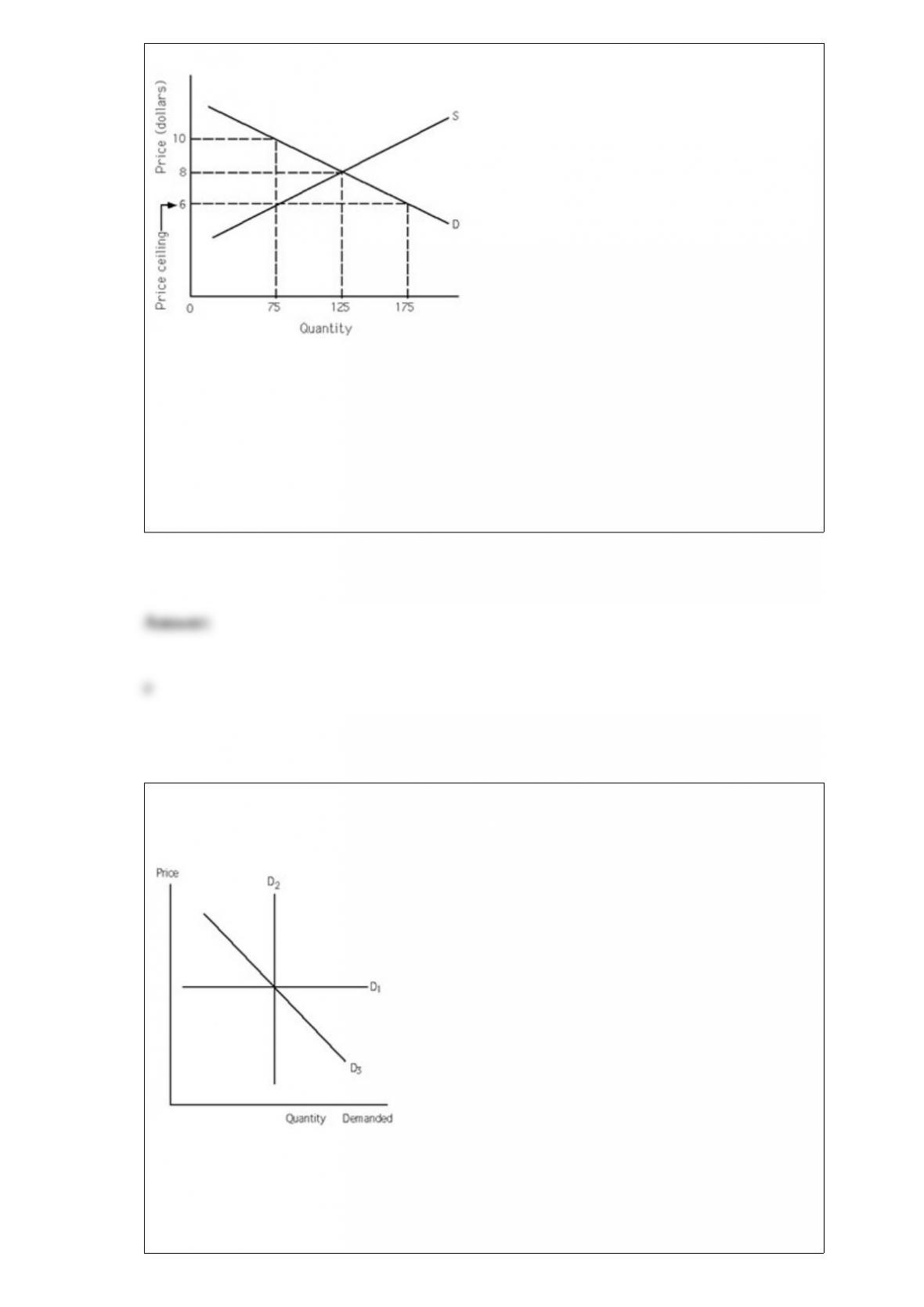
Refer to Exhibit 4-1. How many fewer units are exchanged because of the price ceiling
than would have been exchanged at the equilibrium price?
Exhibit 4-1
a. 50
b. 60
c. 65
d. 100
Refer to Exhibit 20-l. The demand for the good represented by demand curve D2 is
Exhibit 20-1
a. inelastic.
b. elastic.

c. unit elastic.
d. perfectly elastic.
e. perfectly inelastic.
Suppose that all the necessary conditions exist for the realization of equal wage rates in
every labor market, but that currently the wage rate in market X is higher than the wage
rate in market Y. We expect that eventually the wage rate
a. in market X will increase more.
b. in market Y will decrease.
c. in market X will decrease and the wage rate in market Y will increase.
d. will not change in either market, because something out of the ordinary must have
caused the wage rates in the two markets not to be equal.
e. a and b
Which of the following statements is false?
a. Government can remove individuals from a prisoner’s dilemma setting and make both
participants better off.
b. Government can define and enforce the property rights that individuals actually want

defined and enforced.
c. Individuals in a prisoner’s dilemma setting may want to get out of the prisoner’s
dilemma setting.
d. none of the above
The 100th game of chess gives Jones more utility than the 32nd game of chess. It
follows that
a. neither the law or principle of diminishing marginal utility holds.
b. the law of diminishing marginal utility may hold since the 32nd game of chess might
have been a different “good” than the 100th game of chess (after all, it could have been
played with a different person).
c. there must be a law of increasing marginal utility.
d. total utility after the 32nd game had to be higher than total utility after the 100th
game.
e. none of the above
Suppose 60 percent of all households earn 60 percent of all income. Based on this
information it follows that
a. 20 percent of all households earn 20 percent of all income.

b. 40 percent of all households earn 40 percent of all income.
c. the Lorenz curve and the line of perfect income equality are one and the same.
d. a, b, and c
e. none of the above
It has been argued that because the monopolistic competitive firm faces a
downward-sloping demand curve, in long run equilibrium it
a. underutilizes its plant size.
b. has excess capacity.
c. produces an output smaller than the one that would minimize its costs of production.
d. a and b
e. all of the above
Refer to Exhibit 3-2. Suppose equilibrium is at point A. Something then changes and
equilibrium becomes point C. Which of the following is consistent with the change in
equilibrium from point A to C (assuming that good X is a normal good)?
Exhibit 3-2

Good X a. There was an increase in income and production technology advanced.
b. There was a decrease in income and production technology advanced.
c. There was an increase in the price of a substitute and an increase in wages.
d. There was a decrease in the price of a complement and an increase in wages.
Perfectly competitive industries are
a. difficult to enter because there are already so many producers in the industry.
b. not particularly appealing or attractive to enter because there tend to be so many
buyers that it is difficult to deal with them.
c. relatively easy to enter but not so easy to exit from.
d. a and b
e. none of the above
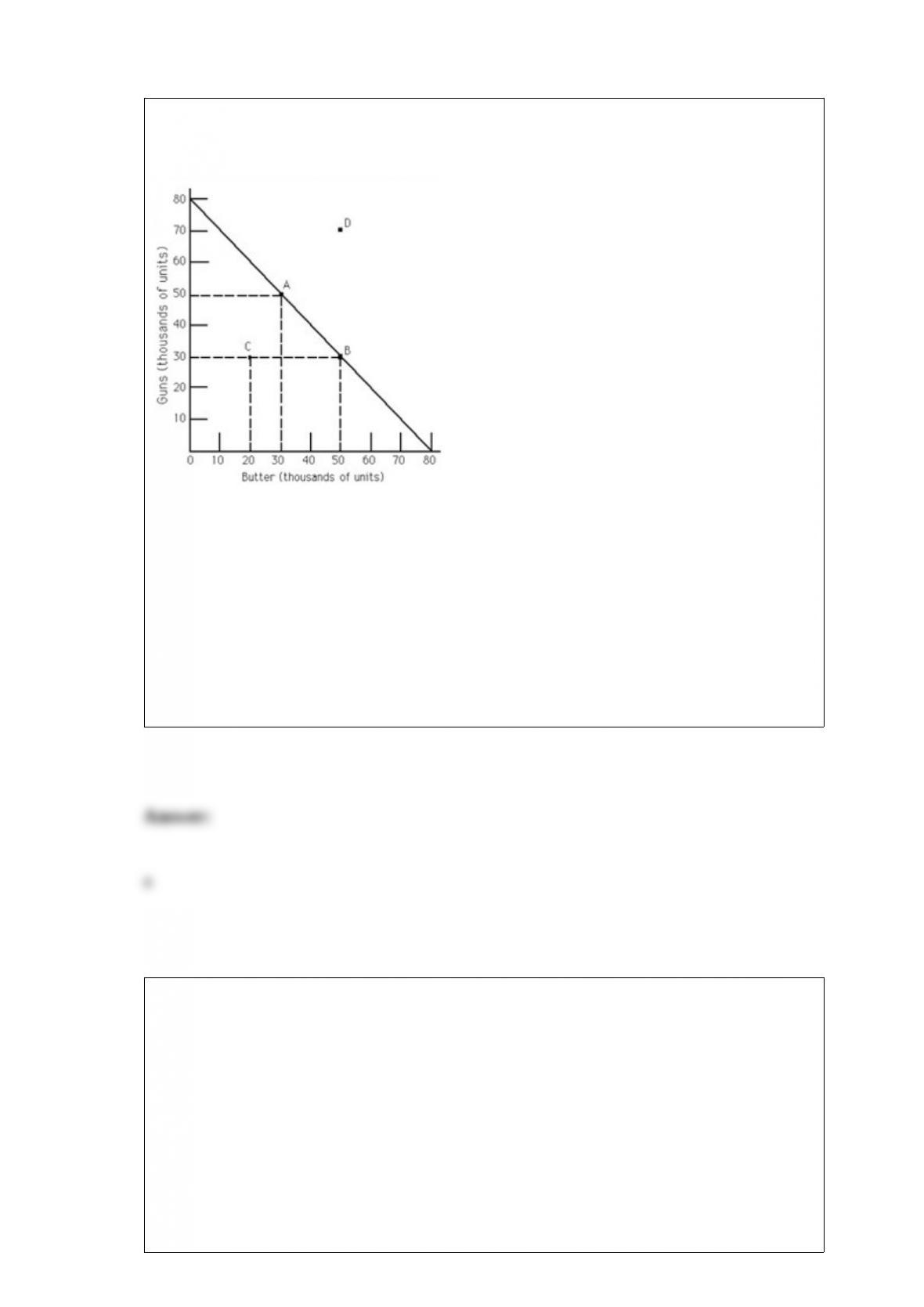
Refer to Exhibit 2-1. If the economy is at point C, it follows that
Exhibit 2-1
a. more guns and more butter could be produced with available resources than are
currently being produced.
b. only more guns could be produced with available resources than are currently being
produced.
c. only more butter can be produced with available resources than are currently being
produced.
d. C is an unattainable point.
One measure of the severity of poverty is the ratio of income to poverty which is
calculated by
a. dividing a family’s poverty income threshold by that family’s income.
b. dividing a family’s transfer payments received by that family’s income.
c. dividing a family’s income by the family’s poverty income threshold.
d. dividing a family’s income by that family’s transfer payments received.

e. none of the above
In the case of a negative externality, the socially optimal output naturally exists if
a. the external costs associated with the negative externality are extremely small.
b. the external costs divided by price is equal to price divided by marginal private cost.
c. there are no free riders.
d. the public good aspects of the negative externality outweigh the costs incurred by the
negative externality.
e. none of the above
Refer to Situation 27-2. The output produced per $1 of cost in the U.S. is
Situation 27-2
a. 120 units of good Y.

b. 0.83 units of good Y.
c. 22 units of good Y.
d. 2 units of good Y.
The physical and mental talents people bring to production processes comprise the
resource called
a. entrepreneurship.
b. natural resources.
c. capital.
d. labor.
When the equilibrium dollar price of a foreign currency decreases due to changes in
demand for or supply of the foreign currency, the domestic currency
a. has appreciated.
b. has depreciated.
c. is overvalued.
d. is undervalued.

e. is revalued.
Which of the following would not result from a price ceiling (set below the equilibrium
price)?
a. a shortage
b. fewer exchanges
c. an increase in supply
d. nonprice rationing devices
We take one dollar from a pauper and give it to a millionaire. Assuming a diminishing
marginal utility of money,
a. total utility in the economy must rise.
b. total utility in the economy must fall.
c. total utility in the economy must remain the same.
d. we cannot say whether or not total utility changes.

Risk
a. is the result of economic rent seeking.
b. is the same as uncertainty.
c. exists when the probability of a given event can be estimated.
d. exists when a potential occurrence is so unpredictable that a probability cannot be
estimated.
e. none of the above