
Suppose that for Alicia the marginal benefit (MB) of producing is $75 and that the
marginal cost (MC) of producing is $5.Suppose also that her marginal benefit of
stealing is $85 and the marginal cost of stealing is $5.Is Alicia currently maximizing
utility in terms of producing and stealing?If not, should she produce more and steal less,
or produce less and steal more to move toward utility maximization?
a. Yes, Alicia is maximizing utility.
b. No, Alicia is not maximizing utility.Since the MB/MC ratio for producing is less than
the MB/MC ratio for stealing, Alicia should produce more and steal less.
c. No,Alicia is not maximizing utility.Since the MB/MC ratio for producing is greater
than the MB/MC ratio for stealing, Alicia should produce more and steal less.
d. No,Alicia is not maximizing utility.Since the MB/MC ratio for producing is less than
the MB/MC ratio for stealing, Alicia should steal more and produce less.
A private equity firm is a group of investors that buys up the publicly traded stock of a
large corporation and then takes the corporation private.
a. True
b. False
If the marginal cost curve for a firm first declines and then rises, it follows that the MPP
of the variable input
a. is constant.
b. first declines and then rises.
c. first rises and then declines.
d. continually declines.
e. none of the above
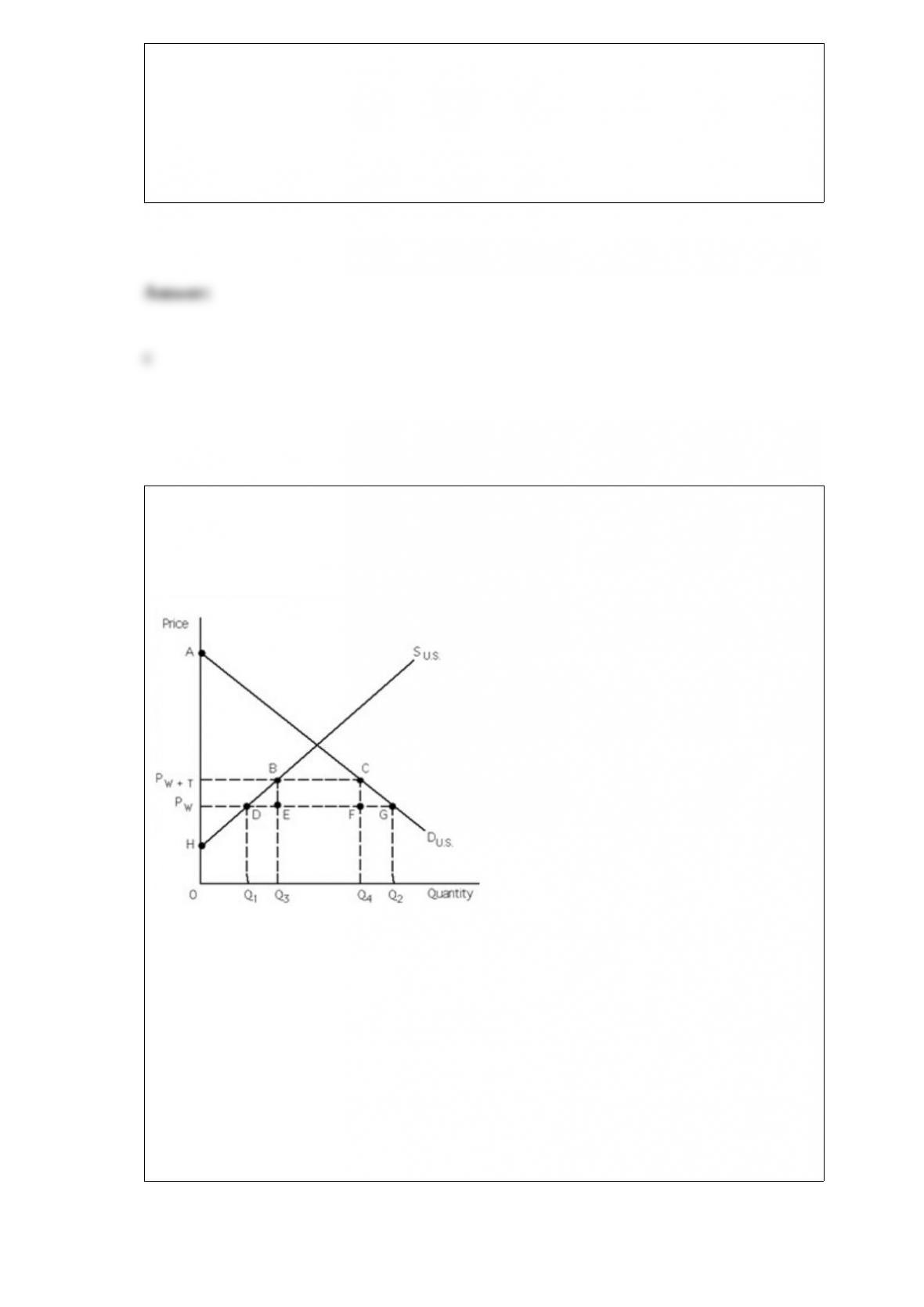
Refer to Exhibit 34-11. A tariff raises the price in the market from PW to PW + T. As a
result, U.S. domestic sales rise from __________.
Exhibit 34-11
a. Q1 to Q4
b. Q3 to Q2
c. Q1 to Q3
d. Q4 to Q2
e. Q3 to Q4

The essence of a prisoner’s dilemma setting is that if both person A and person B do
what is best for each of them,
a. they end up in a position that is “the best” for each of them.
b. they end up in a position that is “the worst” for each of them.
c. one ends up in a position that is “the best” for him and the other ends in a position
that is “the worst” for him.
d. they end up in a position from which each would prefer to move away.
e. none of the above
Refer to Exhibit 38-4.If the closing price of Black Motor’s stock on the previous day
was $76.95, what value goes in blank (C)?
Exhibit 38-4

a. +1.95
b. -1.95
c. +0.95
d. -0.95
e. There is not enough information given to answer this question.
If the price elasticity of demand for a good is zero, then demand is
a. perfectly elastic.
b. perfectly inelastic.
c. unit elastic.
d. inelastic.
e. none of the above
Refer to Exhibit 28-8. If the profit-maximizing monopsonist were to pay its workers
what the marginal worker’s services are worth to it, the wage rate would be
Exhibit 28-8

a. W1.
b. W2.
c. W3.
d. W4.
e. W5.
When you purchase a share of stock, you are
a. borrowing funds from the corporation.
b. lending funds to the corporation.
c. selling an ownership right in the corporation.
d. acquiring an ownership right in the corporation.
e. b and d

Which of the following is a definition of poverty in absolute terms?
a. A family is in poverty if it receives less than $10,000 a year in money income.
b. A family is in poverty if it receives an income that places it in the lowest 5 percent of
family income recipients.
c. A family is in poverty if the majority of families receive more income than it
receives.
d. a, b, and c
Prior to attending college, Marvin is offered a lucrative four-year contract as an actor in
a daytime soap opera. Assuming that acting and attending college are Marvin’s
preferred alternatives and that he must choose between the two, his opportunity cost of
attending college after receiving the offer ________________, making him
____________ likely to attend college than before he received the offer.
a. increases; less
b. decreases; more
c. stays the same; equally likely
d. increases; more
e. decreases; less

How does contestable markets theory challenge orthodox market structure theory?
a. Contestable markets theory argues that firms do not maximize sales; orthodox market
structure theory argues that they do.
b. Orthodox market structure theory places much greater weight than contestable
markets theory on the number of firms in an industry as a major factor in determining a
firm’s behavior.
c. Contestable markets theory emphasizes product differentiation; orthodox market
structure theory does not.
d. Contestable markets theory emphasizes nonprice competition; orthodox market
structure theory does not.
In your textbook there is an exhibit that shows (for selected industries) the median
weekly earnings of workers represented by labor unions and the median weekly
earnings of workers not represented by labor unions. The point to be made by this
comparison is that in some cases,
a. nonunion workers earn more than union workers (which is different from what most
people expect).
b. nonunion workers and union workers earn the same.
c. union workers earn more than nonunion workers.
d. the number of union workers is greater than the number of nonunion workers.
e. a and c

Which of the following statements is false?
a. In the case of a negative externality, the market equilibrium is inefficient.
b. In the case of a negative externality, when a tax is set equal to the marginal external
costs (MEC) efficiency can be achieved.
c. In the case of a negative externality, when a tax is set that is greater than the marginal
external costs (MEC) inefficiency will result.
d. In the case of a positive externality, when a tax is set equal to the marginal external
benefits (MEB) efficiency can be achieved.
High demand for a product does not necessarily mean a high quantity demanded for
that product if the price is high enough.
a. True
b. False
Refer to Exhibit 27-5. Assume the firm is a factor price taker and that the price of a unit
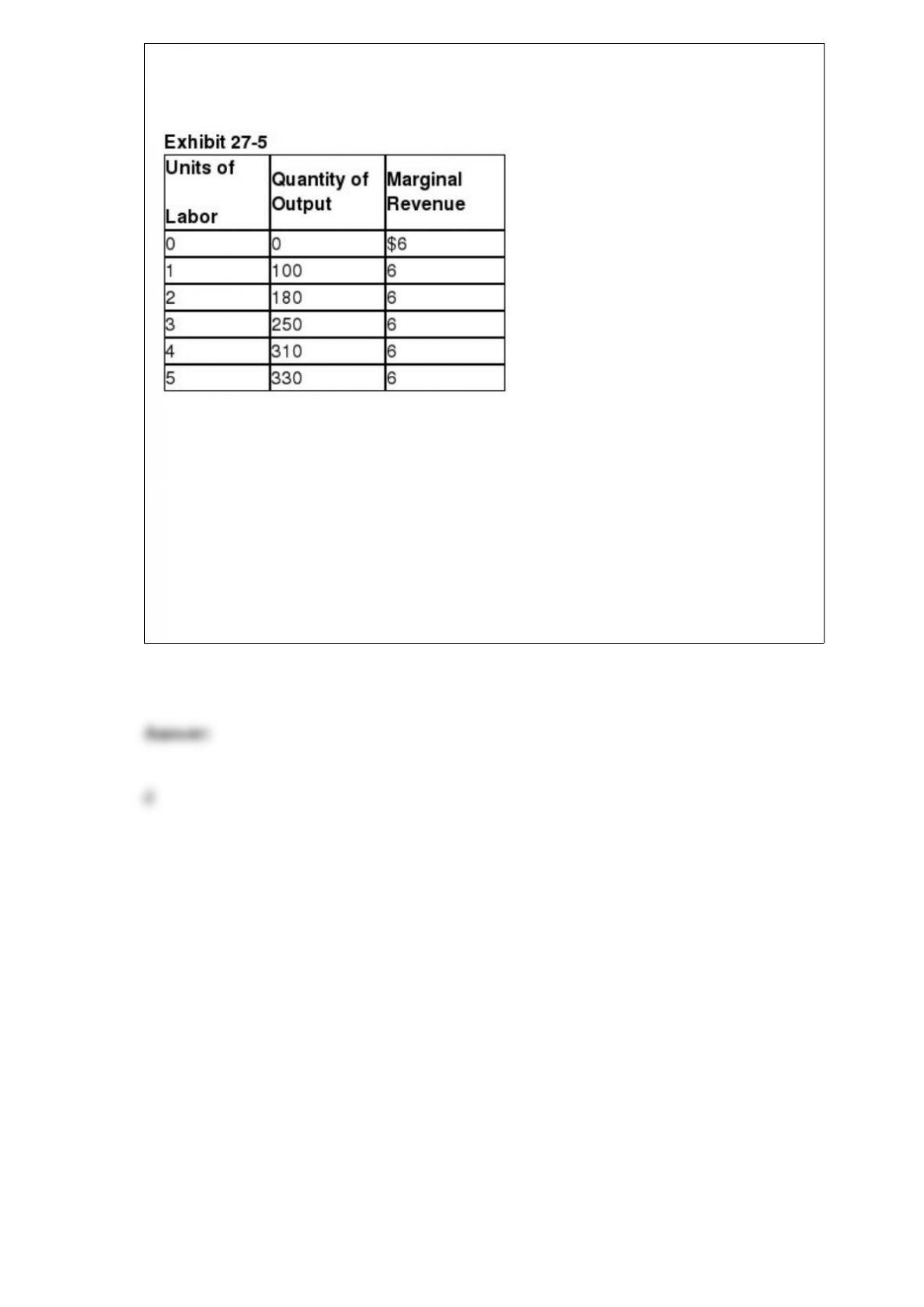
of labor is constant at $360. The firm should hire __________ of labor.
a. one unit
b. two units
c. three units
d. four units
e. five units