
Unions provide training programs in an attempt to increase the marginal physical
product of union labor, thus shifting the union demand for labor curve rightward.
a. True
b. False
Which of the following is an example of government regulation of a natural monopoly
distorting incentives?
a. A natural monopoly is held to average-cost pricing; therefore, it has little incentive to
hold costs down.
b. A natural monopoly is protected from competitors; therefore, it is rude to its
customers.
c. A natural monopoly is protected from competitors; therefore, it doesn’t care much
about the quality of the product it sells.
d. a and c
e. a, b, and c
Suppose iceberg lettuce has an income elasticity of demand of 0.35. A 10 percent
increase in income causes the quantity demanded of iceberg lettuce to
_______________ by ______________ percent.

a. rise; 3.5
b. rise; 28.57
c. fall; 28.57
d. fall; 3.5
Which of the following statements is false?
a. Average-cost pricing usually refers to setting a price for a natural monopoly firm that
is equal to its ATC, thus guaranteeing the firm a normal profit.
b. An economist thinks that there are both benefits and costs to most (if not all) types of
regulation.
c. The public choice theory of regulation holds that regulators are seeking to do, and
will do through regulation, what is in the best interest of the society at large.
d. One of the unintended effects of profit regulation (in the form of guaranteeing the
natural monopoly firm that it will always earn normal profit-nothing more and nothing
less) is that the natural monopoly has no incentive to keep its costs down.
Which of the following is inconsistent with long-run industry equilibrium?
a. upward-sloping marginal cost curves for all of the firms in the industry
b. zero economic profits
c. P = minimum ATC
d. SRATC = LRATC
e. none of the above
Refer to Exhibit 3-9. Consumers view X and Y as substitutes. If the price of Y
increases, an economist would expect a movement in the market for X from
Exhibit 3-9
a. F to E.
b. A to B.
c. E to F.
d. B to A.

It usually takes less time to buy a six-pack of 7-Up, a loaf of bread, and a half-gallon of
ice cream at a small convenience store (such as a 7-Eleven) than at a large, full-service
grocery store. Which of the following persons is most likely to buy these items at a
convenience store?
a. a person with a high opportunity cost of time
b. a person with alow opportunity cost of time
c. a person who is out of work
d. a person who works at a full-service grocery store
Which of the following statements is false?
a. On occasion, governments have helped to create and maintain cartels.
b. Once a cartel agreement has been made, cartel members have an incentive to cheat
on the agreement.
c. A single cartel member may be better off with a cartel agreement that all members
abide by (including itself) than with no cartel agreement at all.
d. Cartels are easy to form and to maintain.
A profit maximizing firm that is a price taker in both product and factor markets will
hire a factor up to the point at which

a. the last unit of the factor hired adds as much to costs as it does to revenues.
b. the value of marginal product equals the wage rate.
c. the marginal revenue product equals the wage rate.
d. all of the above
e. a and b
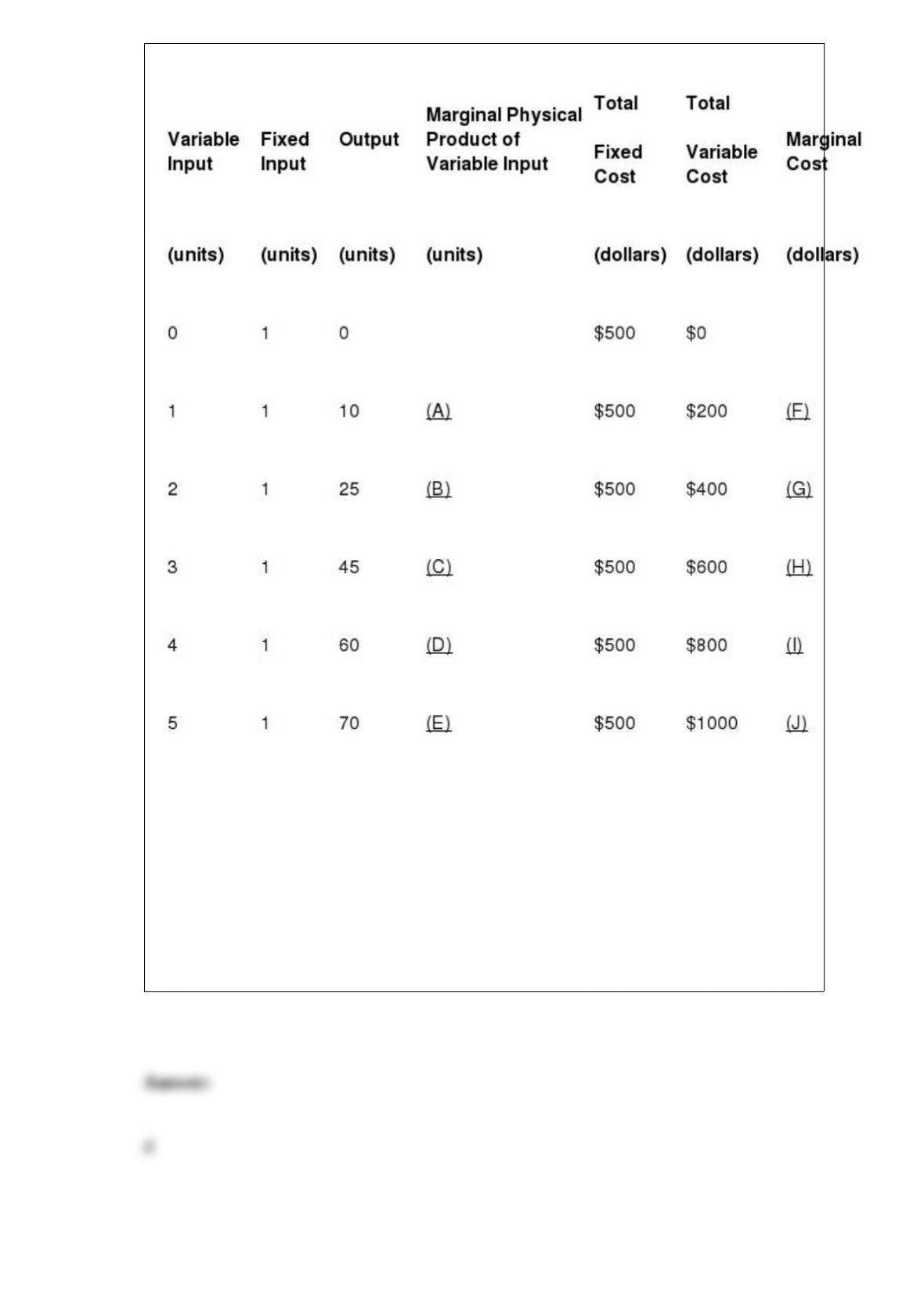
Refer to Exhibit 22-3. The marginal cost figures in blanks (I) and (J), respectively, are
Exhibit 22-3
a. $5.33 and $10.00.
b. $1.33 and $2.00.
c. $1.33 and $1.43.
d. $13.33 and $20.
e. none of the above

A quota is
a. a tax imposed on imported goods.
b. a legal limit on the amount of a good that can be produced by foreign owners of a
firm located in a host country.
c. a legal limit on the amount of a good that can be imported.
d. an agreement between two countries in which the exporting country voluntarily
agrees to limit its exports to the importing country.
If a person’s income and the prices of both goods all rise by the same percentage, then
her budget constraint
a. moves inward toward the origin, and its slope remains the same.
b. moves outward away from the origin, and its slope changes.
c. moves outward away from the origin, and its slope remains the same.
d. does not change in any way.
Which of the following is false?
a. For bond buyers, the higher the yield the better it is for them.
b. For bond buyers, the higher the price of the bond the better it is for them.

c. For bond buyers, the lower the yield the worse it is for them.
d. The term yield on a bond is the same as the term interest rate on a bond.
Which of the following statements is false?
a. As a result of a quota, consumers’ surplus falls.
b. As a result of a tariff, producers’ surplus rises.
c. As a result of a tariff, consumers’ surplus falls.
d. As a result of a quota, producers’ surplus rises.
e. none of the above
Under the traditional view of unions, unionization leads to __________ prices because
unions __________.
a. higher; have a negative impact on the productivity of the workers
b. lower; have a positive impact on the productivity of the workers
c. stable; demand long and stable wage contracts from their employers
d. none of the above
If the marginal utility of a good is negative, then
a. consumers should buy less of it.
b. consumers will consume it only if it is free.
c. consumers should buy more of it to make its marginal utility positive.
d. the law of diminishing marginal utility is being violated.
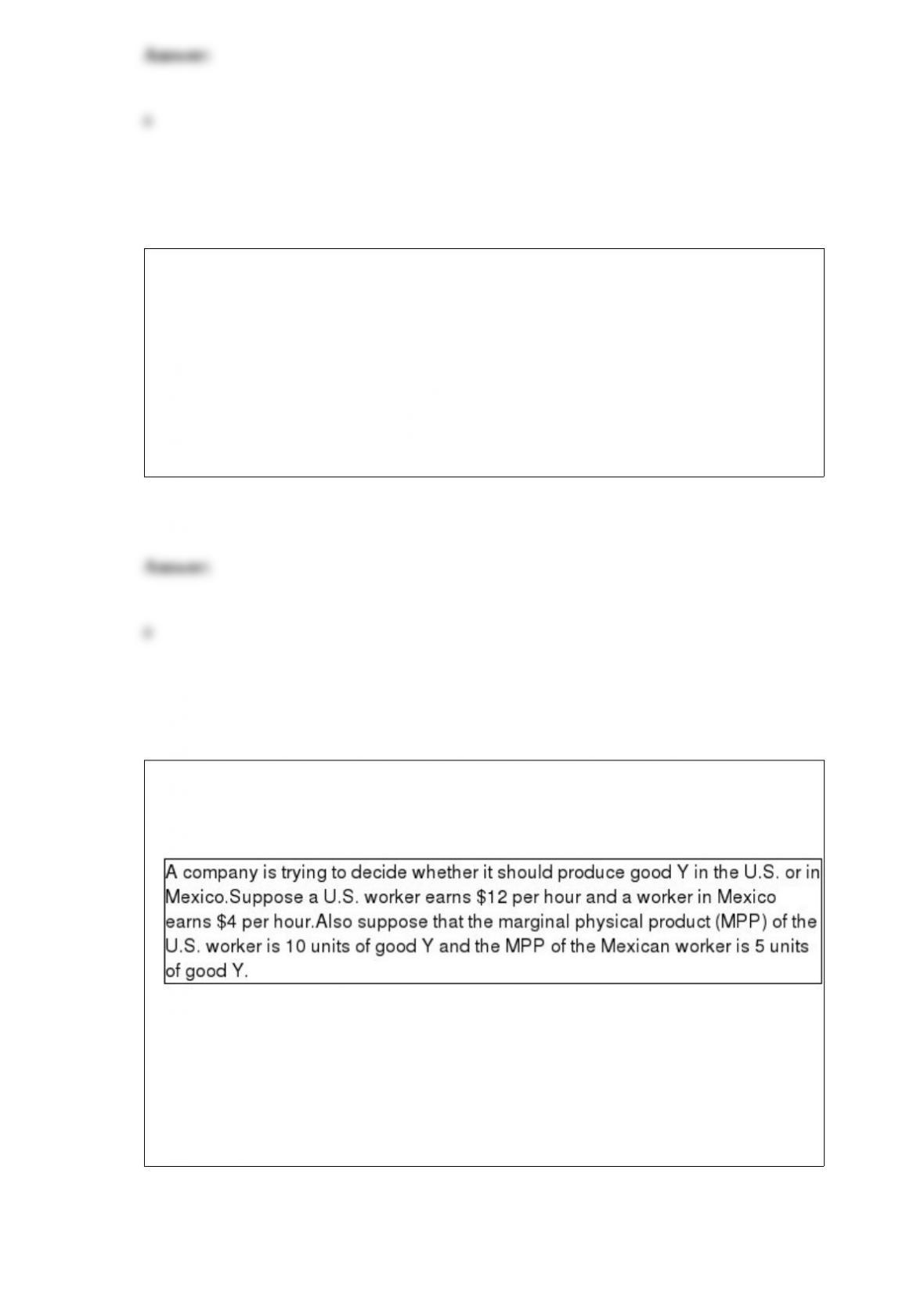
Refer to Situation 27-2. The output produced per $1 of cost in the Mexico. is
Situation 27-2
a. 1.25 units of good Y.
b. 0.80 units of good Y.
c. 9.0 units of good Y.
d. 1.0 units of good Y.

Suppose there is a decrease in U.S. income and Mexican income does not change. We
would expect to see
a. both the dollar and the peso depreciate.
b. both the dollar and the peso appreciate.
c. the dollar depreciate and the peso appreciate.
d. the dollar appreciate and the peso depreciate.
Market failure is a situation in which
a. the market does not provide the ideal or optimal amount of a particular good.
b. there are too many buyers but not enough sellers.
c. prices are too high for “average” people to buy necessities.
d. there is a question over the quality of a product for sale.

A decrease in unemployment causes the PPF to shift outward (to the right).
a. True
b. False
Countries that engage in specialization and trade can consume at a level beyond their
production possibilities frontier.
a. True
b. False
A tax may be used as a corrective device in the case of a negative externality because it
will __________ marginal private costs and __________ supply.
a. increase; decrease
b. increase; increase
c. decrease; decrease
d. decrease; increase

When the monopoly firm sells two units of its product, it earns total revenue of $260
and it incurs a total cost of $210. If its marginal revenue for the second unit was $110,
what was the marginal revenue of the first unit?
a. $100
b. $150
c. $133
d. $220
e. There is not enough information to answer the question.
For a perfectly competitive firm, when the price of the product it sells rises, its MRP of
labor curve __________, while its VMP of labor curve __________.
a. stays where it is; shifts to the right
b. shifts to the right; shifts to the right
c. shifts to the right; stays where it is
d. shifts to the left; shifts to the left

A rise in variable input prices will affect
a. fixed costs.
b. variable costs.
c. marginal costs.
d. a, b, and c
e. b and c