
Which of the following statements is true?
a. Nominal interest rate = real interest rate – expected inflation rate.
b. Nominal interest rate = real interest rate + expected inflation rate.
c. Real interest rate = nominal interest rate + expected inflation rate.
d. Expected inflation rate = nominal interest rate + real interest rate.
A firm produces the quantity of output at which P = MC and P = ATC. It follows that
the firm is
a. resource allocative efficient, but not necessarily productive efficient.
b. productive efficient, but not necessarily resource allocative efficient.
c. both resource allocative and productive efficient.
d. neither resource allocative nor productive efficient.
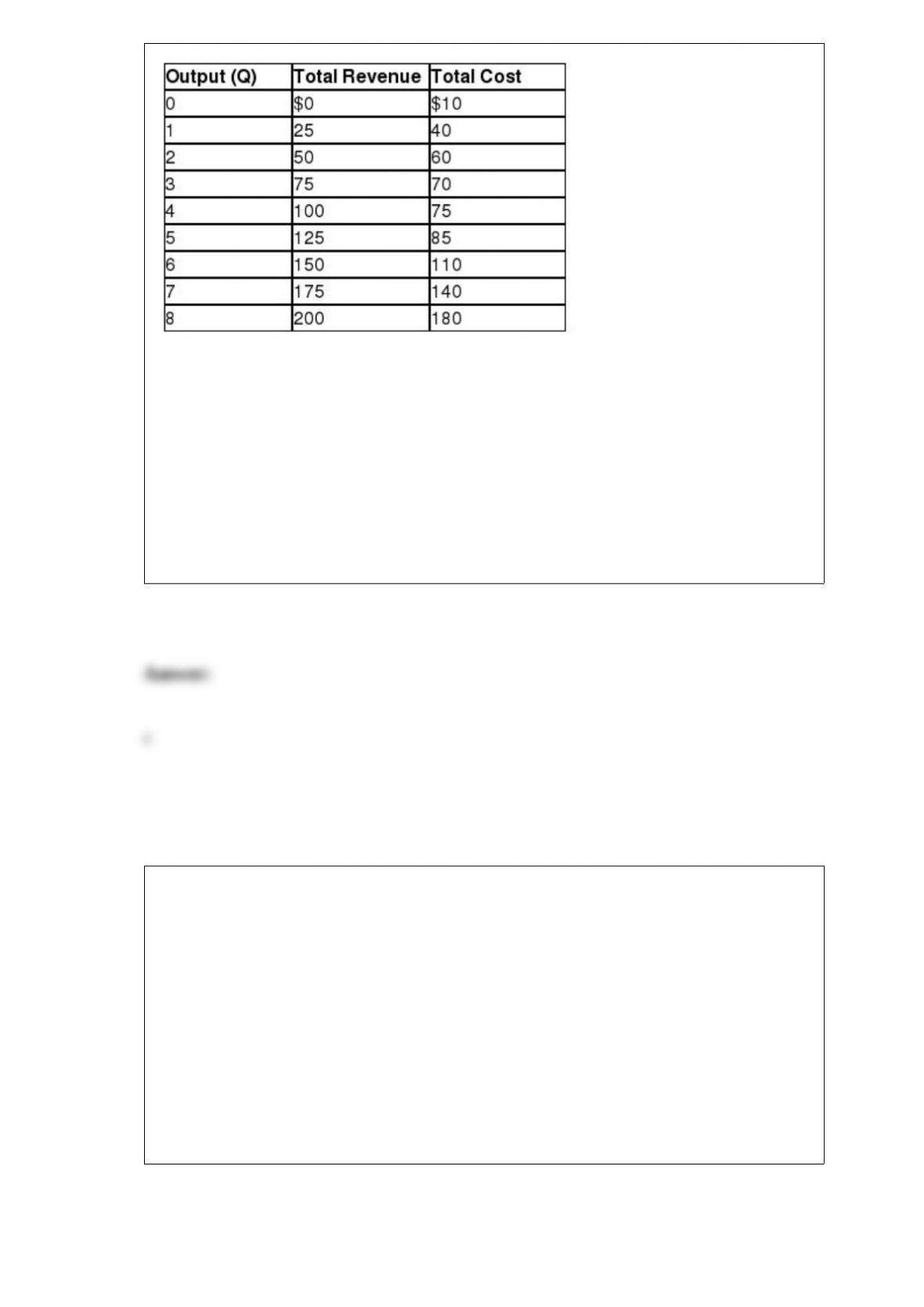
Refer to Exhibit 23-10.What quantity of output should the profit-maximizing firm
produce?
Exhibit 23-10
a. 0
b. 4
c. 6
d. 7
e. 8
“Exclusive dealing” refers to
a. charging one customer a higher price than another customer for the same good.
b. the condition that is necessary before a conglomerate merger is likely to be
successful.
c. a provision of the Sherman Act.
d. selling to a retailer on the condition that the retailer not carry any rival products.
e. none of the above
The closer the Gini coefficient is to zero, the
a. greater the degree of income inequality.
b. less the degree of income inequality.
c. greater the degree of discrimination.
d. less the degree of discrimination.
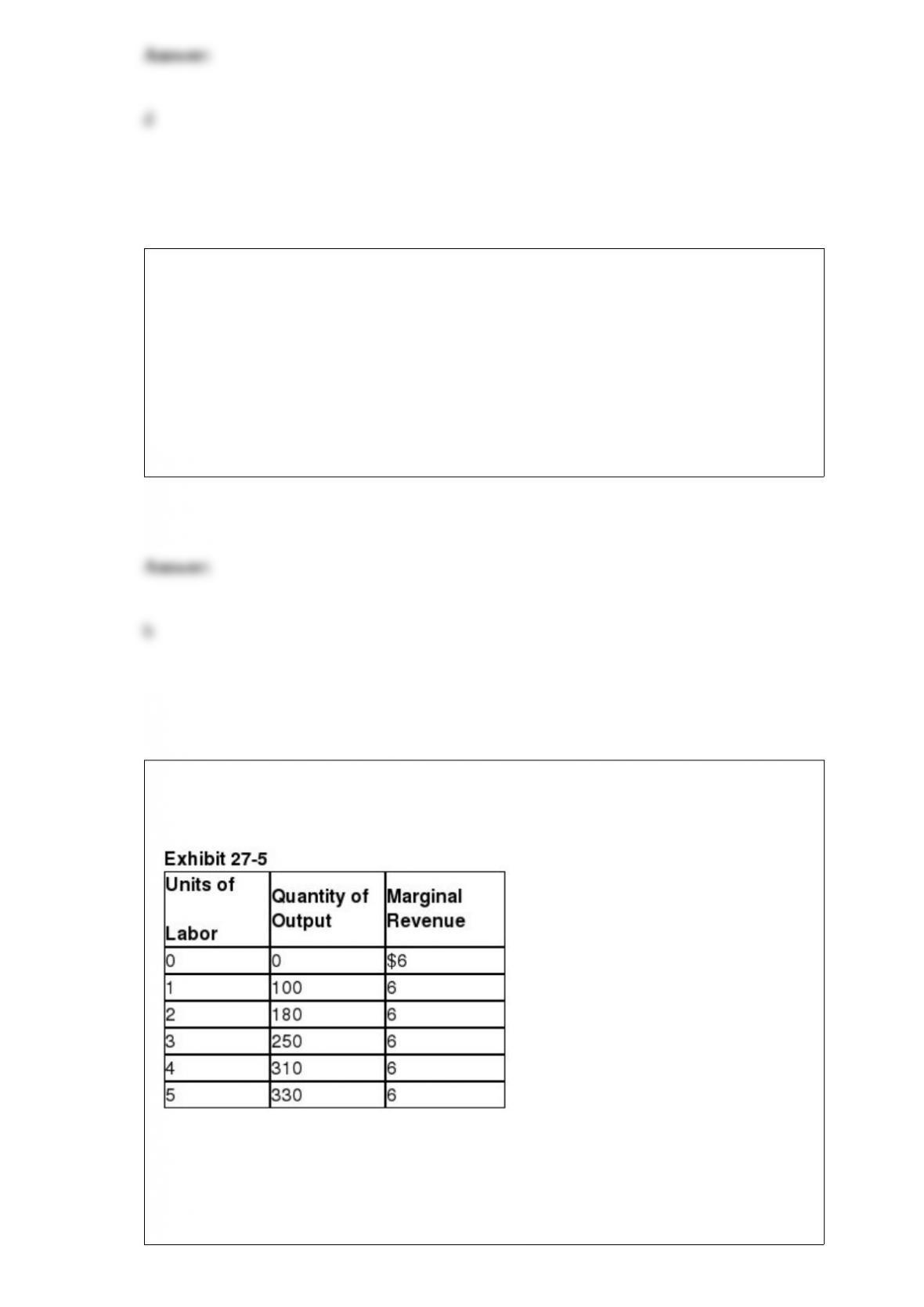
Refer to Exhibit 27-5. The data illustrate that the firm in question is a
a. price searcher (monopolist, oligopolist, etc.).
b. price taker (perfectly competitive firm).

c. factor price searcher.
d. factor price taker.
Ceteris paribus, the nominal rate of interest will increase when the
a. real rate of interest falls.
b. expected rate of inflation increases.
c. expected rate of inflation falls.
d. a and b
e. a and c
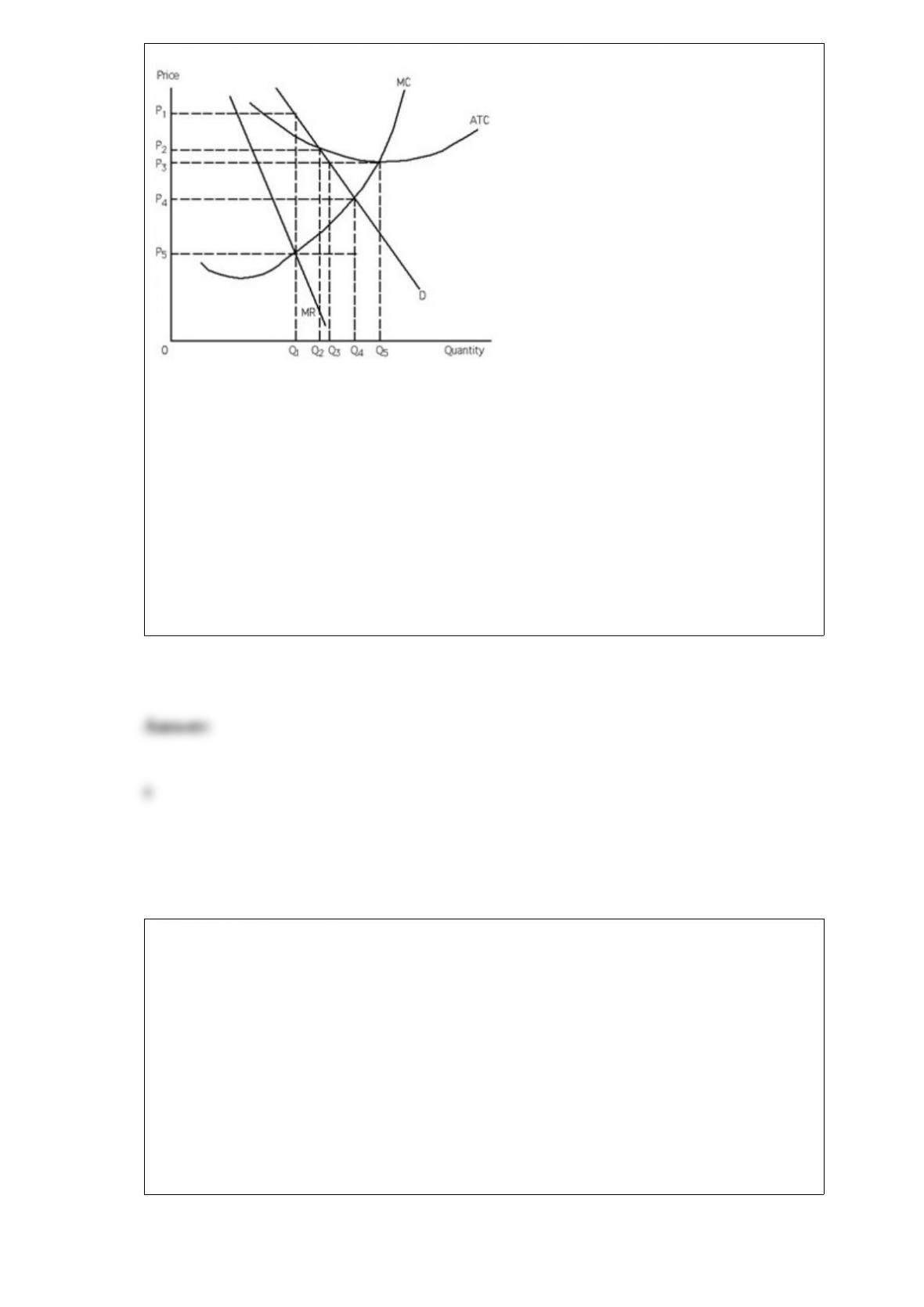
Refer to Exhibit 26-4. What is the total revenue of the profit-maximizing natural
monopoly?
Exhibit 26-40
a. P1 x Q1.
b. P2 x Q2.
c. P5 x Q1.
d. P2 x Q2.
e. P3 x Q3.
A factor that does not contribute to income inequality is
a. innate abilities and attributes.
b. the amount of work a person chooses to do.
c. education and training.
d. luck.
e. none of the above; that is, all factors contribute to income inequality.

If the price of good A decreases by 10 percent and the quantity demanded of good B
increases by 10 percent, this is evidence that goods A and B are
a. substitute for one another.
b. complement goods to one another.
c. both inferior goods.
d. both normal goods.
e. not related.
A firm’s factor demand curve is also its _______________________ curve.
a. average physical product
b. marginal physical product
c. average revenue product
d. marginal revenue product
A side effect of an action that adversely affects the well-being of others is called a
a. complement.
b. supplement.
c. negative externality.
d. marginal cost.
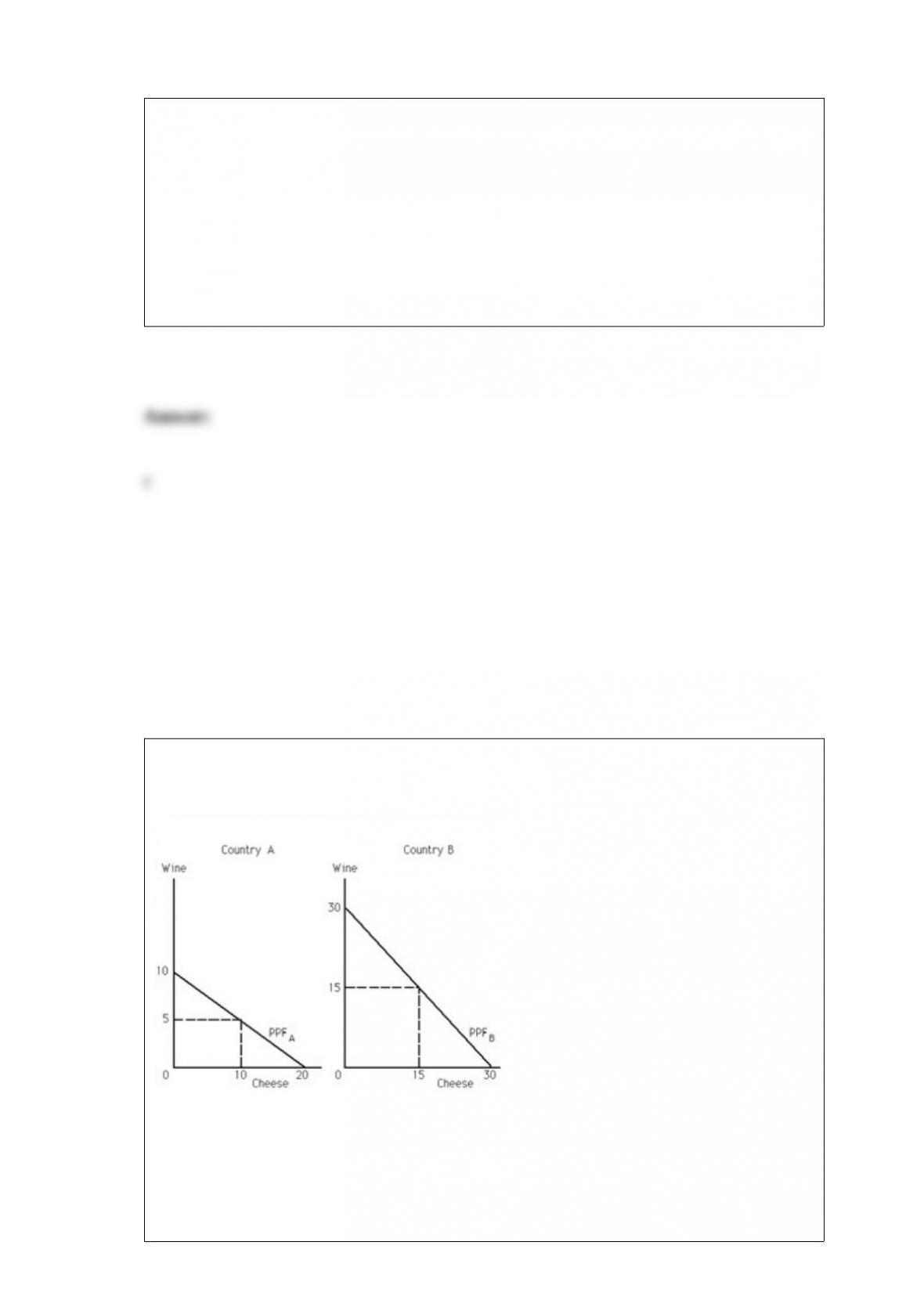
Refer to Exhibit 34-6. Which of the following is true?
Exhibit 34-6
a. Country A has a comparative advantage in both cheese and wine.
b. Country B has a comparative advantage in both cheese and wine.
c. Country A has a comparative advantage in cheese, and country B has a comparative

advantage in wine.
d. Country B has a comparative advantage in cheese, and country A has a comparative
advantage in wine.
e. none of the above
Which of the following statements is true?
a. Costs are always explicit, never implicit.
b. Costs are always implicit, never explicit.
c. George runs a stationery shop; he paid Frank $5,000 for the carpet he installed in the
shop. The $5,000 for carpet is an implicit cost.
d. An implicit cost is a cost that represents the value of resources used in production for
which no actual monetary payment is made.
e. none of the above
Refer to Exhibit 1-3.Based on the data provided in this table,if these data were plotted
in a two-variable diagram the result would be a ______________ sloping
Exhibit 1-3

a. downward; (nonlinear) curve.
b. downward; (straight) line.
c. upward; (nonlinear) curve.
d. upward; (straight) line.
e. none of the above
Someone says, “Even though the equilibrium wage rate is $8 an hour in the unskilled
labor market, if we impose a minimum wage of $10 an hour, no one currently working
will lose his or her job.” This person must believe that the
a. demand curve for unskilled labor is vertical.
b. demand curve for unskilled labor is downward-sloping.
c. supply curve for unskilled labor is downward-sloping.
d. supply curve for unskilled labor is horizontal.
e. none of the above.

When the price of a good rises, total revenue will fall if the good is elastic in demand.
a. True
b. False
Refer to Exhibit 28-5. In case (1), with a rise in the wage rate from W1 to W2, the wage
bill will fall if
Exhibit 28-5
a. (Q1 – Q2) x W1 > (W2 – W1) x Q2.
b. (Q3 – Q2) x W3 > (W2 – W3) x Q2.
c. W2 x Q2 > Q3 x W1.
d. (W1 – W3) x Q2 > (W2 – W1) x Q2.
In the case of a negative externality, the government can use a ________________ to
turn an inefficient outcome into an efficient one.In the case of a positive externality, the
government can use a ________________ to turn an inefficient outcome into an
efficient one.
a. tax; subsidy

b. subsidy; tax
c. tax; tax
d. subsidy; subsidy