
Given that fixed costs are constant as output increases, average fixed costs are also
constant.
a. True
b. False
The English economist David Ricardo argued that
a. grain prices were high because land rents were high.
b. land rents were high because grain prices were high.
c. grain prices were high because land rents were low.
d. land rents were high because grain prices were low.
e. none of the above
Jose has one evening in which to prepare for two exams and can employ one oftwo
possible strategies:

The opportunity cost of receiving a 90 on the statistics exam is ___________ points on
the economics exam.
a. 79
b. 17
c. 11
d. 90
Fixed costs
a. are equal to explicit costs plus implicit costs.
b. do not vary as output varies.
c. are the same as total costs for any level of output greater than zero.
d. are another name for sunk costs.
To increase the demand for union labor, a labor union might attempt to

a. increase the demand for the products produced by union labor.
b. decrease substitute factor prices.
c. decrease the marginal physical product productivity of union labor.
d. a and b
e. all of the above
If a labor union successfully practices collective bargaining against a monopsonist, then
a. product price will decrease.
b. both wages and employment may rise.
c. both wages and employment may fall.
d. workers will probably receive a wage further away from their marginal revenue
products.
e. b and d
Assume that the farmers know that their revenues would increase if each would take a
certain amount of acreage out of production. An agreement to do so

a. would not be made because the farmers have no incentive to enter into it.
b. would not be made because it would contradict the assumption that farmers are profit
maximizers.
c. probably would not be adhered to, if made, because it would be disadvantageous for
the farmers as a group.
d. probably would not last, if made, because each farmer would have an incentive to
break it.
When the price of Toyota Corollas rises, ceteris paribus, the demand for Corollas falls.
a. True
b. False
In the case of nonexcludable goods, economists contend that the market ___________
produce these goods because of the ________________________.
a. will; free rider problem
b. will not; law of diminishing marginal utility
c. will not; law of diminishing marginal returns
d. will not; free rider problem.

The existence of which of the following leads to an overestimate of the number of
persons in poverty?
a. unreported income
b. in-kind benefits received by the poor
c. uncounted homeless persons
d. a and b
e. a, b, and c
Noble Prizewinner Ronald Coase argued that firms exist in order to reduce transaction
costs.
a. True
b. False

Right-to-work laws
a. say that everyone has the right to work and that it is the responsibility of the
government to make available employment opportunities.
b. ensure that employers cannot prevent persons from gaining employment simply
because they are members of a union.
c. allow everyone to gain employment at a firm without being a union member but also
require that once hired the employee must join the union.
d. make it illegal to require union membership for purposes of employment.
A market demand curve for labor shows the quantities of labor demanded by
a. a particular firm in a specific labor market.
b. all the firms in a specific labor market.
c. a particular firm in various labor markets.
d. all the firms in various labor markets.
Economists sometimes refer to the resource category land as natural resources.
a. True

b. False
If the cross elasticity of demand for good A with respect to good B is +2.7, then good A
is
a. an inferior good.
b. a normal good.
c. a substitute for good B.
d. a complement to good B.
Michael can produce the following combinations of X and Y: 10X and 10Y, 5X and
15Y, and 0X and 20Y. Vernon can produce the following combinations of X and Y:
100X and 20Y, 50X and 30Y, or 0X and 40Y. It follows that
a. Michael has the comparative advantage in producing X and Vernon has the
comparative advantage in producing Y.
b. Michael has the comparative advantage in producing Y and Vernon has the
comparative advantage in producing X.
c. Neither Michael nor Vernon has a comparative advantage in producing X.
d. Neither Michael nor Vernon has a comparative advantage in producing Y.
e. There is not enough information to answer the question.

Firm X is producing the quantity of output at which marginal revenue equals marginal
cost. It is earning
a. a positive economic profit.
b. an economic loss.
c. a normal profit.
d. There is not enough information to answer the question.
In 2009, the lowest 20 percent of households in the United States earned approximately
what percent of the total income of all households?
a. 1%
b. 3%
c. 8%
d. 16%
e. 20%

When a monopolist can perfectly price discriminate, it follows that
a. price equals marginal revenue.
b. price equals marginal cost at the quantity of output it chooses to produce.
c. the monopolist is resource-allocative efficient.
d. b and c
e. a, b, and c
Refer to Exhibit 22-13.What dollar amounts go in blanks (G) and (H), respectively?
Exhibit 22-13 Quantity of Output (Q) Total Fixed Cost (TFC) Average Fixed Cost
(AFC) Total Variable Cost
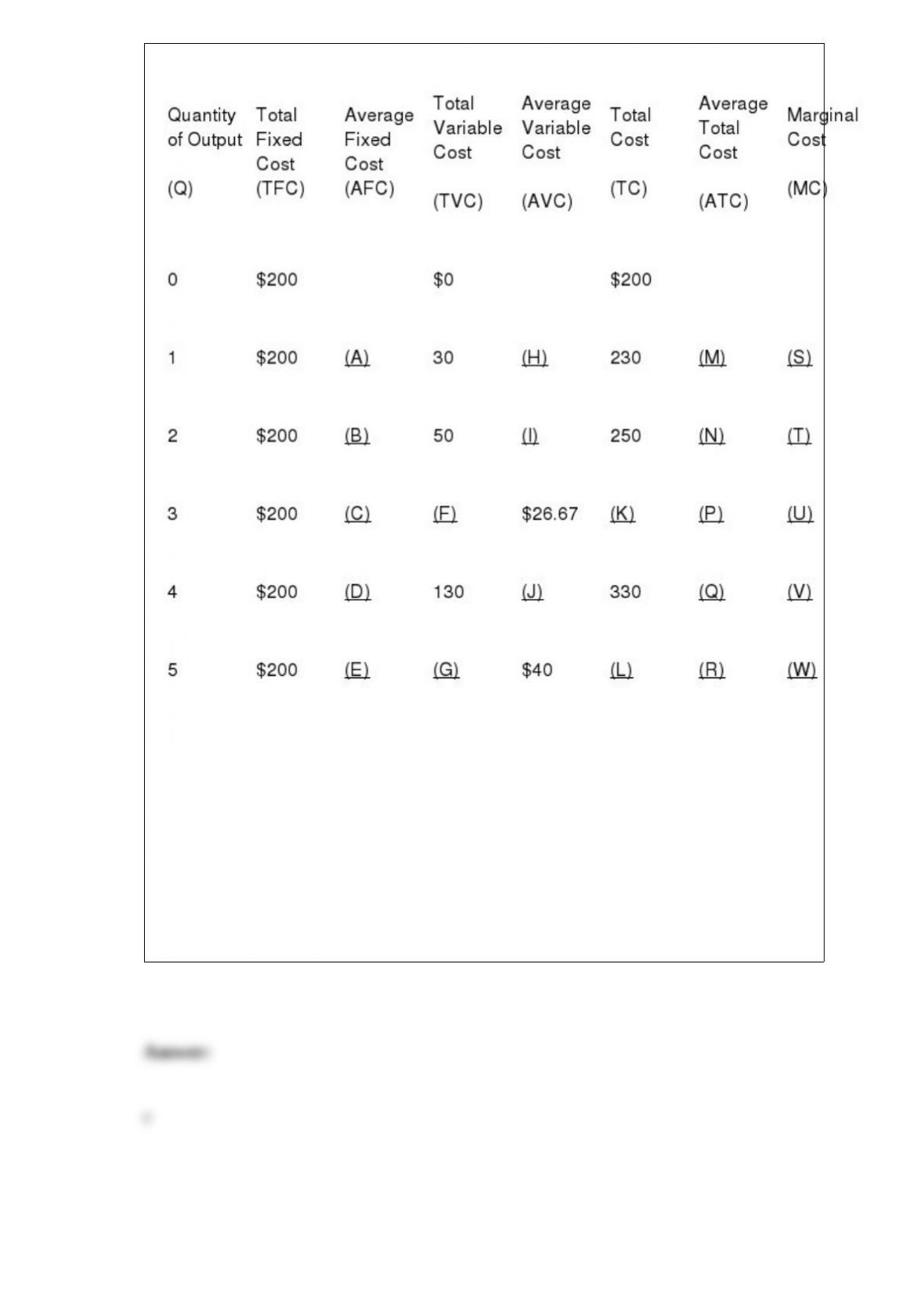
a. $100; $30
b. $400; $50
c. $200; $30
d. $40; $20
e. There is not enough information to answer this question.

Suppose the production of a good results in positive externalities. If output occurs at the
intersection of the supply curve and the marginal social benefits curve, then
a. the socially optimal level of output will be produced.
b. society will incur a net social cost.
c. society will want less produced, and producers will be willing to satisfy that desire.
d. there is market failure.
The type of merger that is most likely to change the degree of concentration, or
competition, in an industry is the __________ merger.
a. four-firm
b. vertical
c. four-firm
d. horizontal
e. none of the above
One country has a comparative advantage over another country in the production of a
good if it

a. has a curved production possibilities curve and the other country has a linear
production possibilities curve.
b. has a linear production possibilities curve and the other country has a curved
production possibilities curve.
c. is a lower opportunity cost producer of the good.
d. has lower fixed costs than the other country.
If $1 = 96 Japanese yen on Wednesday and on Thursday $1 = 100 Japanese yen, then
the dollar depreciated against the yen between Wednesday and Thursday.
a. True
b. False