
Which of the following can bring about an increase in the demand for labor?
a. an increase in the demand for the product that labor produces
b. an increase in the marginal physical product of labor
c. a decrease in the price of labor (wage rate)
d. a and b
e. a, b, and c
Which of the following is true?
a. Buyers always prefer lower prices to higher prices.
b. Buyers never prefer lower prices to higher prices.
c. Buyers rarely prefer lower prices to higher prices.
d. Buyers prefer lower prices to higher prices, ceteris paribus.
The slope of a (nonlinear) curve varies from one point to another.
a. True
b. False

In Industry A, the largest four firms together have a 30 percent share of the market and
there are a total of eight firms in the market. In Industry B, the largest four firms
together have a 30 percent share of the market and there are 100 other firms in the
market. If we want to distinguish between the concentration in these two industries, the
best measure to use is the
a. four-firm concentration ratio.
b. horizontal-merger index.
c. vertical-merger index.
d. Herfindahl index.
e. none of the above
As interest rates decrease, present values __________, and firms will buy __________
capital goods.
a. increase; fewer
b. decrease; fewer
c. increase; more
d. decrease; more
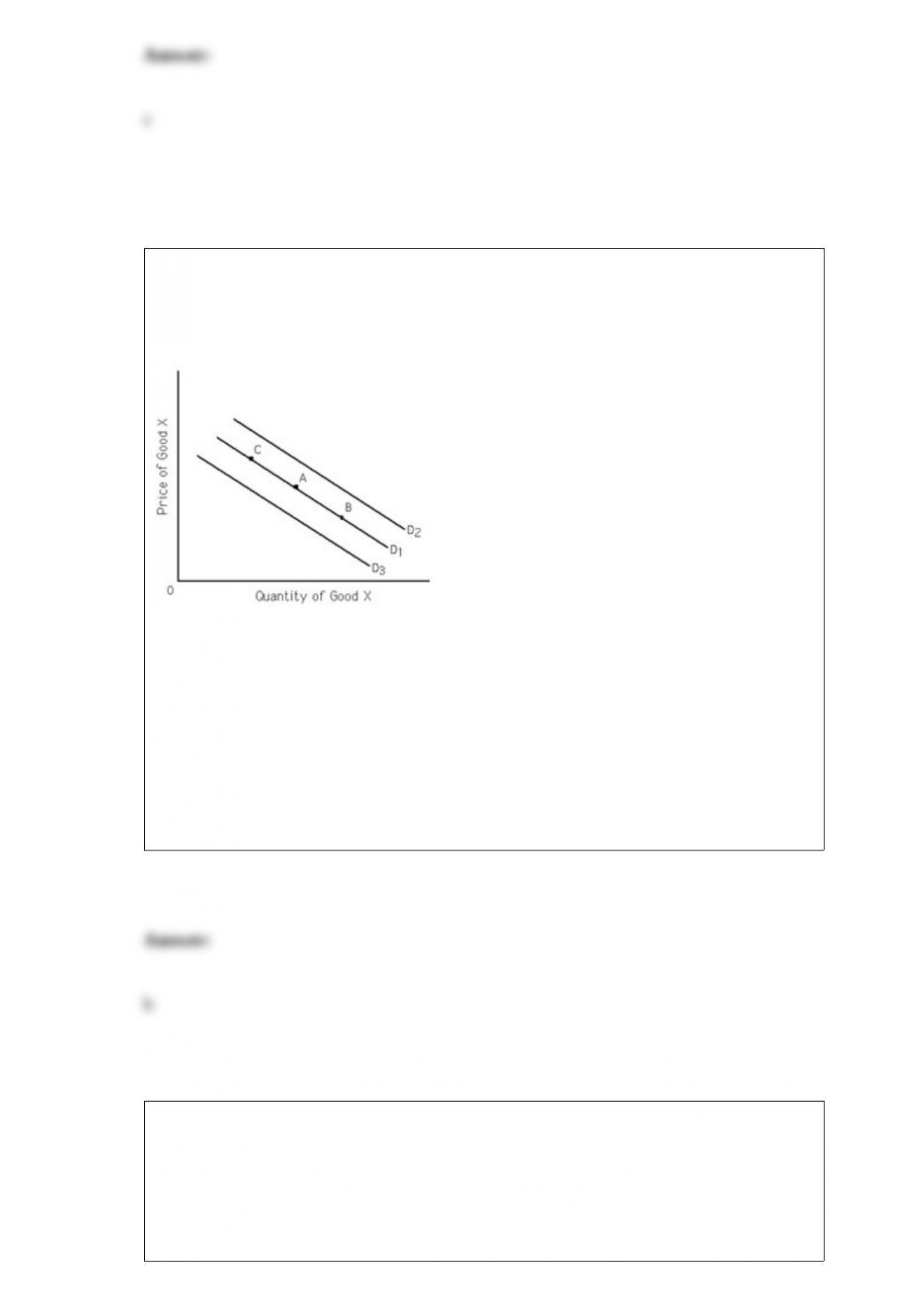
Refer to Exhibit 3-6. If an increase in income causes the demand for good X to shift
from D1 to D3, then good X is
Exhibit 3-6
a. a normal good.
b. an inferior good.
c. a substitute good.
d. a complementary good.
e. a neutral good.
Which of the following is an example of a positive economic statement?
a. The U.S. public should devote more resources to education.
b. The poor should pay lower taxes and the rich should pay higher taxes.

c. Soap operas should be taken off television.
d. If you drop a ball from the top of a building, it will fall to the ground.
When the perfectly competitive firm produces the quantity of output at which marginal
revenue equals marginal cost, it naturally
a. produces the quantity of output at which marginal cost equals price, since for the
perfectly competitive firm price equals marginal revenue.
b. produces the quantity of output at which short-run average total cost equals price,
since for the perfectly competitive firm short-run average total cost equals marginal
revenue.
c. earns a profit, since equating marginal revenue and marginal cost guarantees profit.
d. takes a loss.
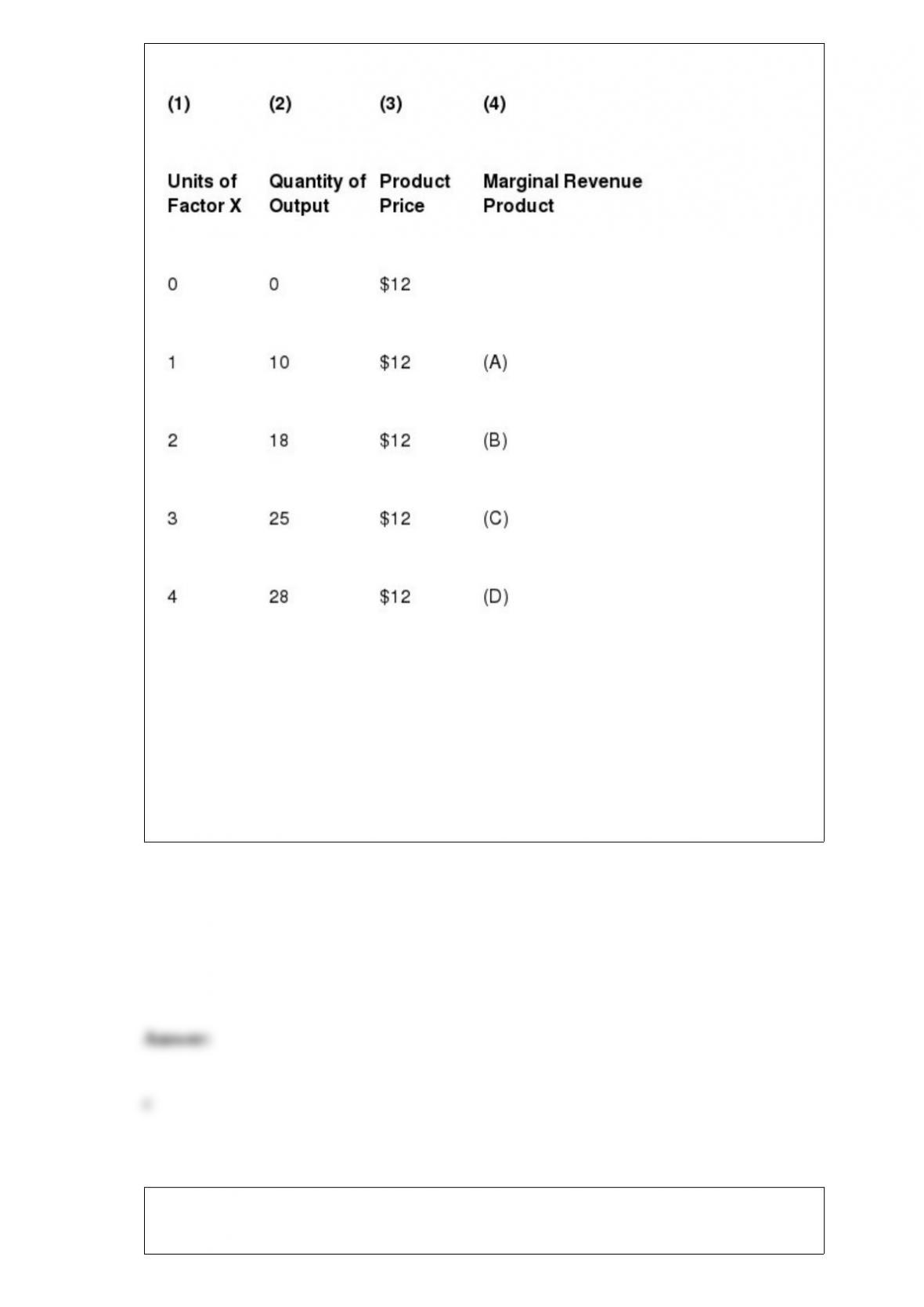
Refer to Exhibit 27-1. The data show that marginal revenue is __________ price, thus
we are dealing with a(n) __________ competitive firm.
Exhibit 27-1
a. greater than; perfectly
b. equal to; imperfectly
c. equal to; perfectly
d. less than; perfectly
The key behavioral assumption of the cartel theory is that oligopolists in the industry
act as if

a. all firms in the industry are the same size.
b. all firms in the industry are price takers.
c. there is a dominant firm in the industry and many fringe firms.
d. there is only one firm in the industry.
e. none of the above
“Collective bargaining” refers to
a. negotiations between labor unions and management about wage rates and other
issues.
b. negotiations among labor unions over jurisdictional control.
c. negotiations between labor, management, and government over the drafting of labor
laws.
d. b and c
e. none of the above
The opportunity cost of attending college is
a. the money one spends on college tuition, books, and so forth.
b. the highest valued alternative one forfeits to attend college.
c. the least valued alternative one forfeits to attend college.
d. equal to the salary one will earn when one graduates from college.
The Federal Trade Commission Act of 1914
a. made conspiracy in the restraint of trade illegal.
b. made price discrimination, exclusive dealing, tying contracts, and the acquisition of
competing companies’ stock illegal when they ‘substantially lessen competition or tend
to create a monopoly.”
c. declared “unfair methods of competition in commerce” illegal.
d. attempted to decrease the failure rate of small businesses by protecting them from the
competition of large and growing chain stores.
e. banned anticompetitive mergers that occurred as a result of one company acquiring
the physical assets of another company.
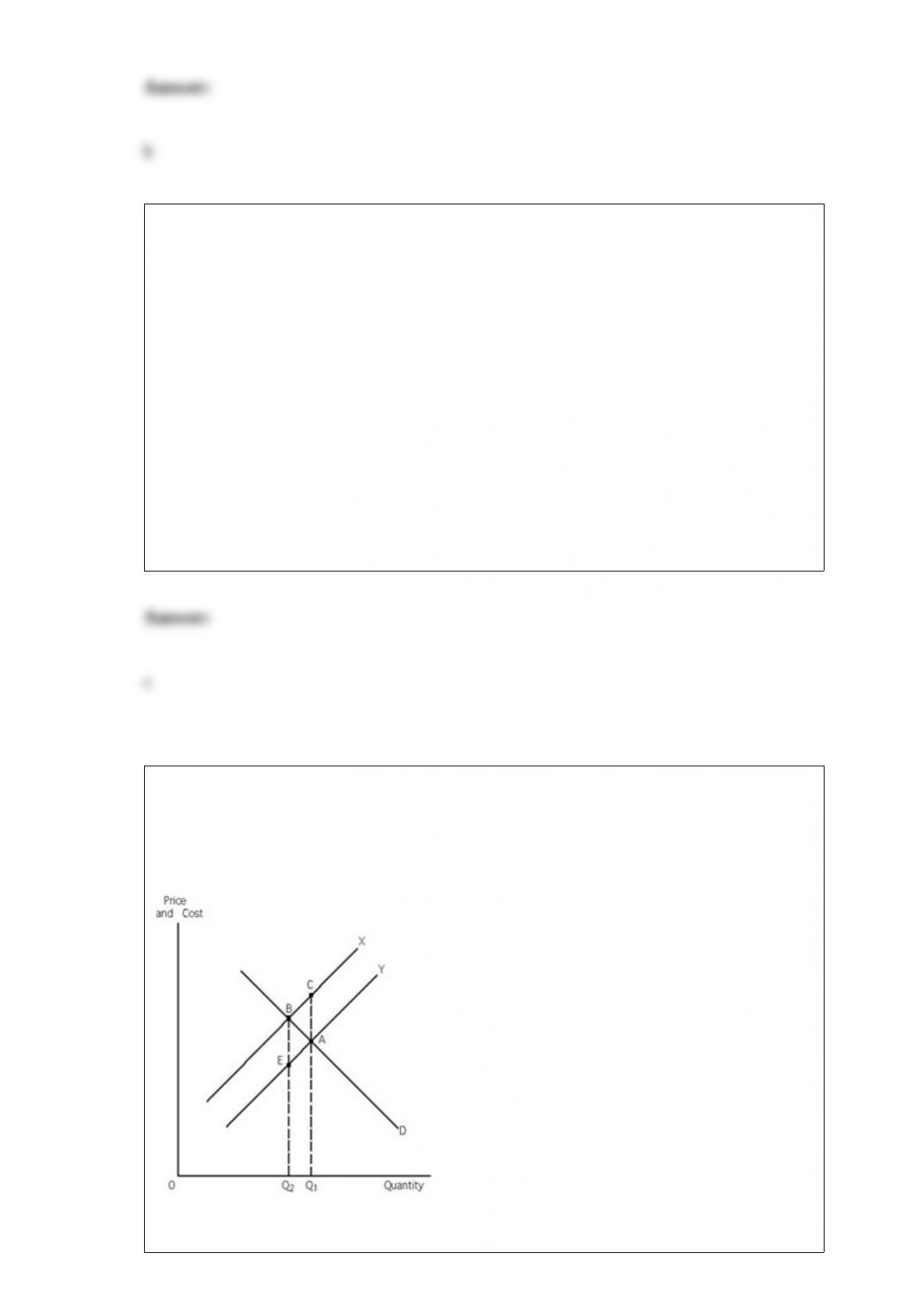
Refer to Exhibit 31-1. If the exhibit represents a negative externality situation, then
what is Q1?
Exhibit 31-1
a. It is the quantity of output at which marginal social costs (

b. It is the quantity of output at which MPC >
c. It is the market output; it is the quantity of output that exists if the external costs
associated with the negative externality are not taken into account.
d. It is the socially optimal output; it is the quantity of output that exists if the external
costs associated with the negative externality are taken into account.
e. none of the above
In the case of externalities, government can use taxes and subsidies to turn an
inefficient outcome into an efficient outcome.
a. True
b. False
Refer to Exhibit 26-3. The Justice Department would consider this industry to be
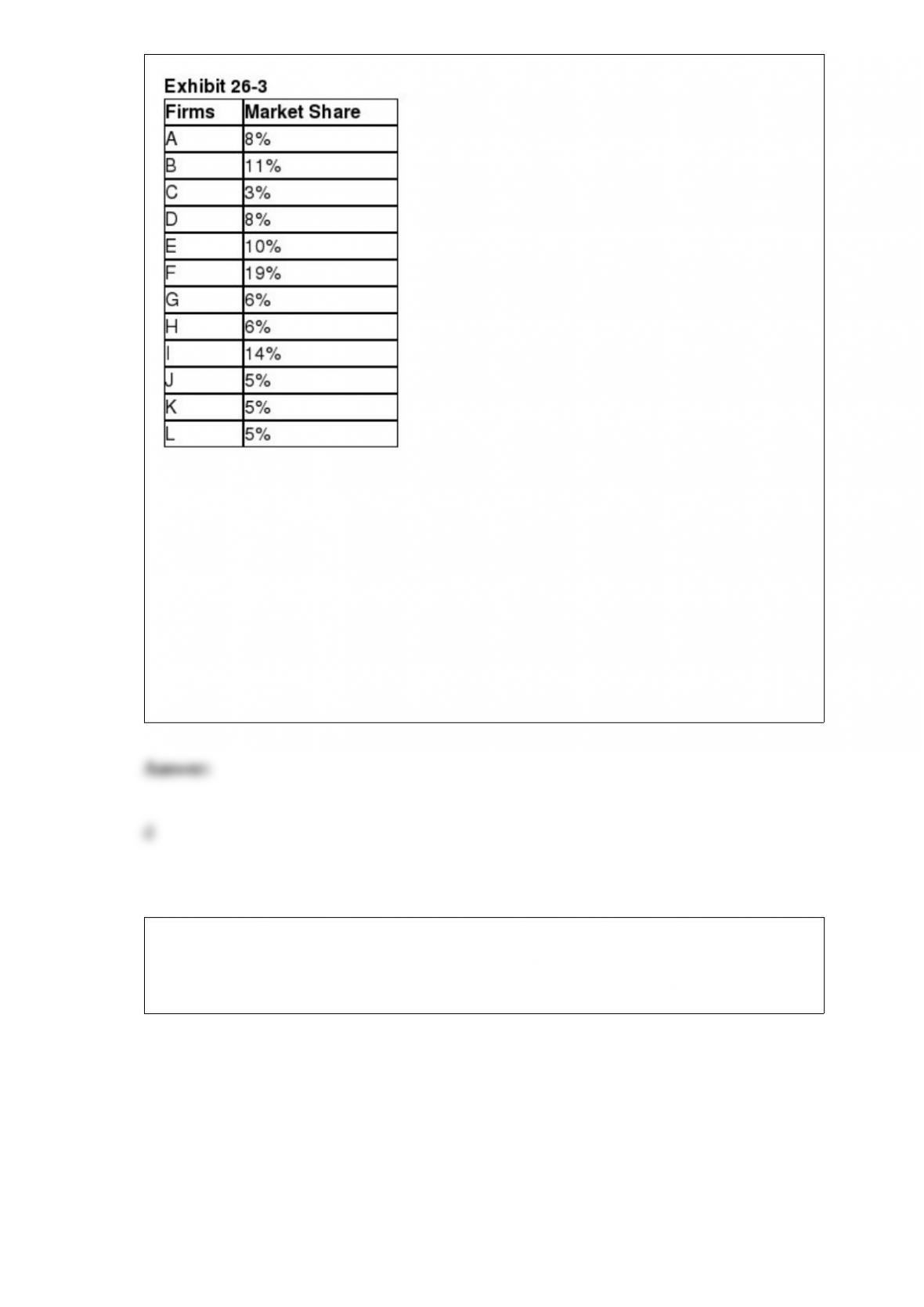
a. concentrated, because the top four firms together control more than 50 percent of the
market share.
b. concentrated, because there are fewer than 15 firms in the industry.
c. unconcentrated, because there are more than 10 firms in the industry.
d. moderately concentrated, because the Herfindahl index is between 1,000 and 1,800.
e. unconcentrated, because the Herfindahl index is less than 1,000.
Refer to Exhibit 3-2. Which of the following would result in a movement from point B
on D2 to point A on D1?
Exhibit 3-2

Good X a. There was an increase in income (assuming that good X is an inferior good)
and technology remained constant.
b. There was an increase in income (assuming that good X is a normal good) and
technology remained constant
c. There was an increase in income (assuming that good X is an inferior good) and
technology improved.
d. There was an increase in income (assuming that good X is a normal good) and
technology declined.
If the demand for a good falls by less than the supply of the good rises, then the good’s
equilibrium price will __________ and its equilibrium quantity will __________.
a. rise; fall
b. rise; rise
c. fall; fall
d. fall; rise
A line is parallel to the vertical axis. The slope of the line is
a. zero.
b. infinite.
c. indicative of an inverse relationship between two variables.
d. indicative of a direct relationship between two variables.
e. b and d