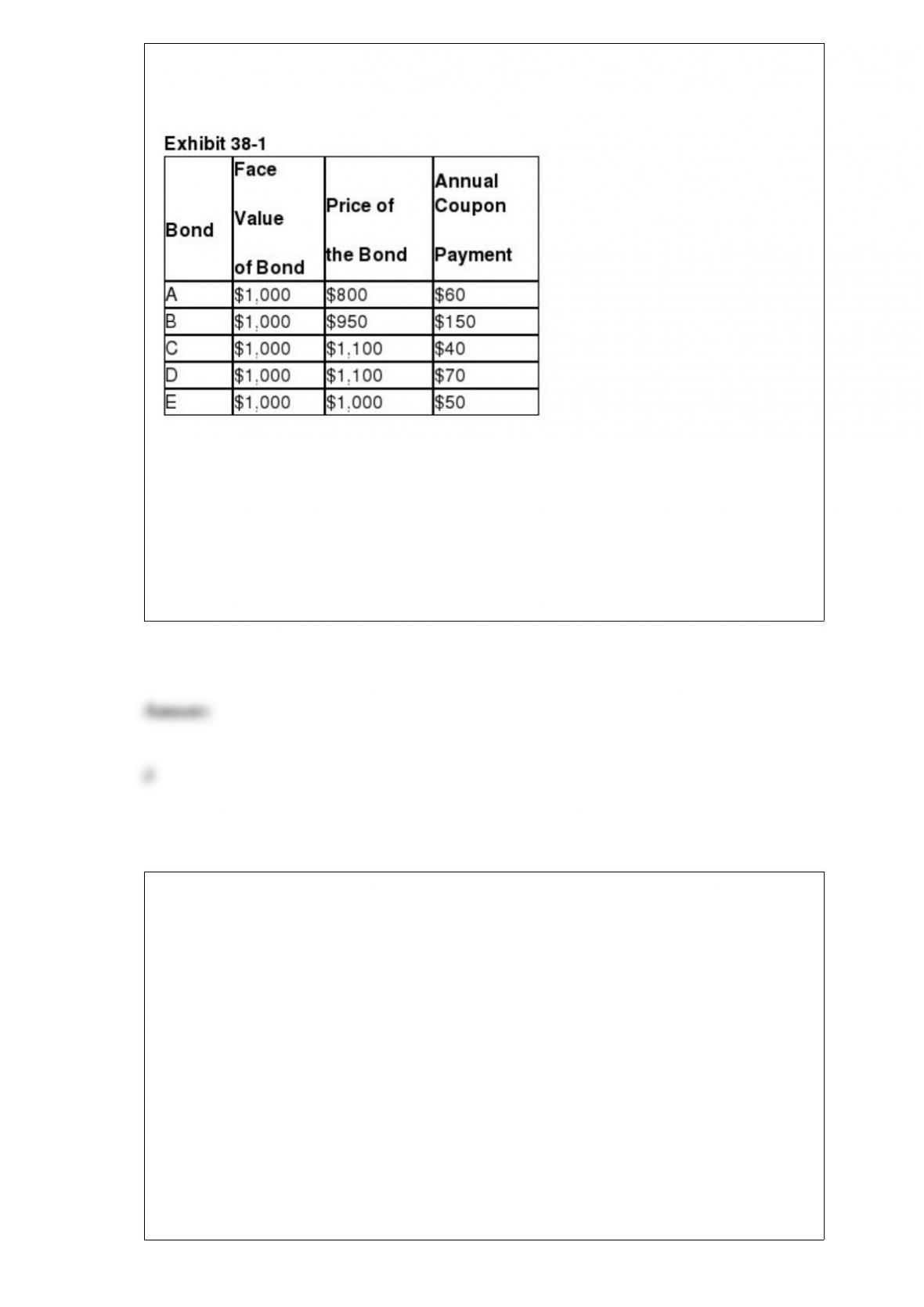
Refer to Exhibit 38-1. The yield on bond E is approximately
a. 37.5 percent.
b. 0.38 percent.
c. 0.45 percent.
d. 5.0 percent.
Refer to Situation 37-2. Ann spends 8 hours of each day producing and 1 hour of each
day stealing.It is probably the case for her that
Situation 37-2Dan and Ann live in the same community and both can participate in two
activities, producing and stealing. a. at some point the MB/MC ratio for producing fell
below the MB/MC ratio for stealing.
b. her MB/MC ratio for producing was always greater than her MB/MC ratio for
stealing.
c. her MB/MC ratio for producing never changed, no matter how much or how little she
produced.
d. her MB/MC ratio for stealing never changed, no matter how much or how little she
stole.

e. There is not enough information to answer the question.
An example of an implicit cost is the foregone income that a business owner-manager
could have earned working for someone else.
a. True
b. False
Which of the following statements is false?
a. The monopolistic competitor is a price searcher.
b. The monopolistic competitor produces a product that differs slightly from the
products of the other firms in the industry.
c. The monopolistic competitor faces a horizontal demand curve.
d. The monopolistic competitor produces an output at which price is greater than
marginal cost.

The minimum wage is an example of a
a. price door.
b. price wall.
c. price floor.
d. price ceiling.
If output rises from 150 units per hour to 170 units per hour as another worker is hired
and the additional worker receives $25 in wages per hour, it follows that marginal cost
is
a. $1.25
b. $500
c. $1.33
d. $0.75
e. $0.80
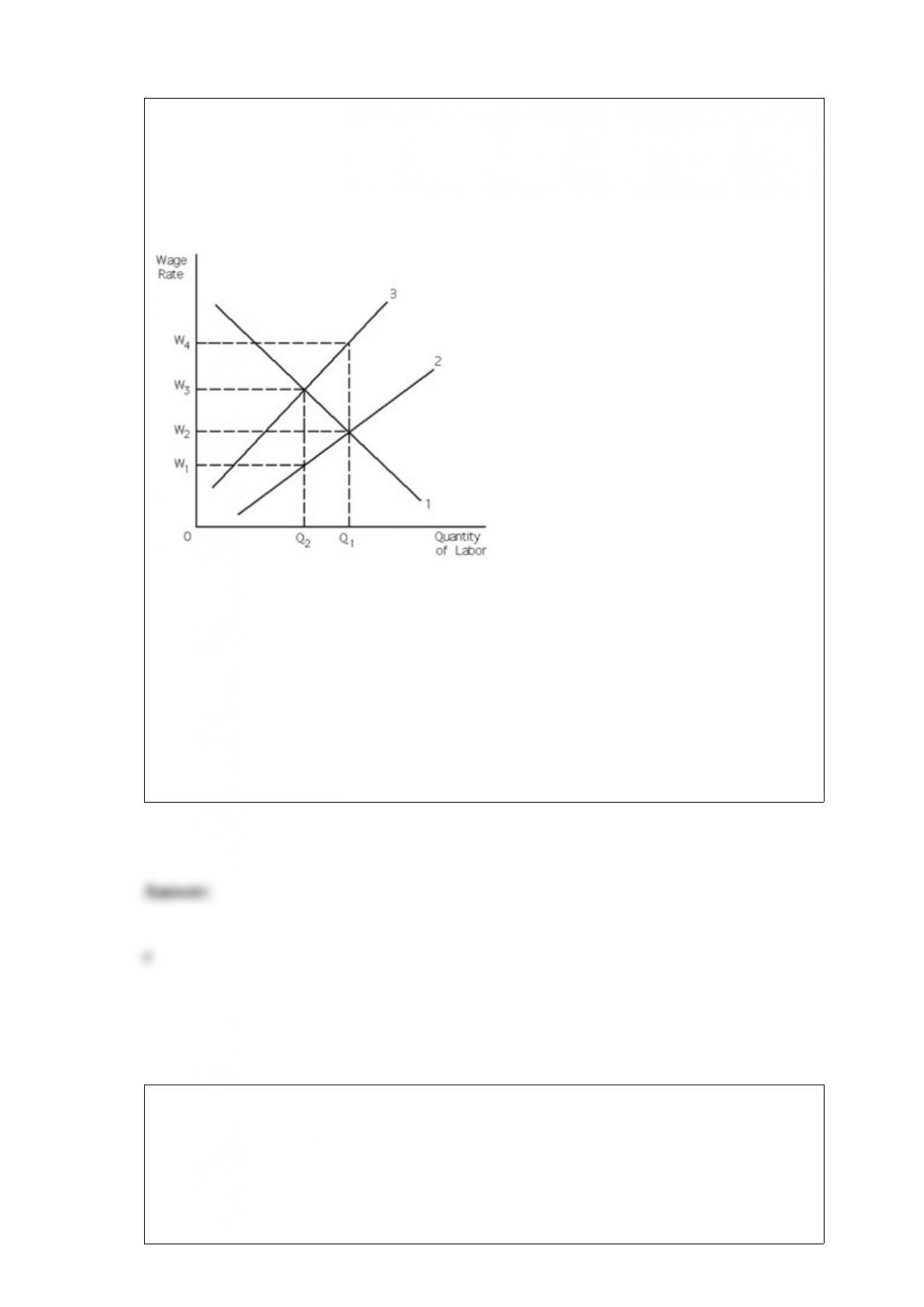
Refer to Exhibit 28-10. If the firm in the exhibit is a monopsony, then the curve
represented by the number 2 is its __________ curve, and the curve represented by the
number 3 is its __________ curve.
Exhibit 28-10
a. marginal factor cost; factor supply
b. factor supply; marginal revenue product
c. marginal revenue product; average total cost
d. marginal cost; marginal factor cost
e. factor supply; marginal factor cost
Congressperson A: “If you approve that new water treatment plant in my district, I’ll
vote to keep the Air Force base open in your district.”Congressperson B:”It’s a deal.”
This is an example of
a. logrolling.

b. lobbying.
c. median voting.
d. logtumbling.
The economy moves from point A, where it produces 100 units of X and 200 units of Y,
to point B, where it produces 200 units of X and 150 units of Y. It follows that
a. point A is a productive inefficient point.
b. point A may be a productive inefficient point.
c. point A may be a productive efficient point.
d. point B is a productive efficient point.
e. b and c
Suppose you are consuming a particular good and you could somehow give back the
last unit you consumed. What would happen to total and marginal utility (assuming that
the marginal utility of the unit given back is positive)?
a. Both total and marginal utility would decrease.
b. Both total and marginal utility would increase.
c. Total utility would increase but marginal utility would decrease.
d. Total utility would decrease but marginal utility would increase.

e. There would be no change in marginal utility but total utility would decrease.
Suppose that minimum efficient scale as a percentage of U.S. consumption is 5 percent
in industry X and it is 10 percent in industry Y. It follows that we would expect to find
a. fewer firms in industry Y than X.
b. fewer firms in industry X than Y.
c. bigger firms in industry Y than X.
d. bigger firms in industry X than Y.
e. none of the above
Labor unions have caused
a. the fraction of national income that goes to labor (union and nonunion, combined) to
increase.
b. the fraction of national income that goes to labor (union and nonunion, combined) to
decrease.
c. almost no change in the fraction of national income that goes to labor (union and
nonunion, combined).
d. the fraction of national income that goes to profits to rise.
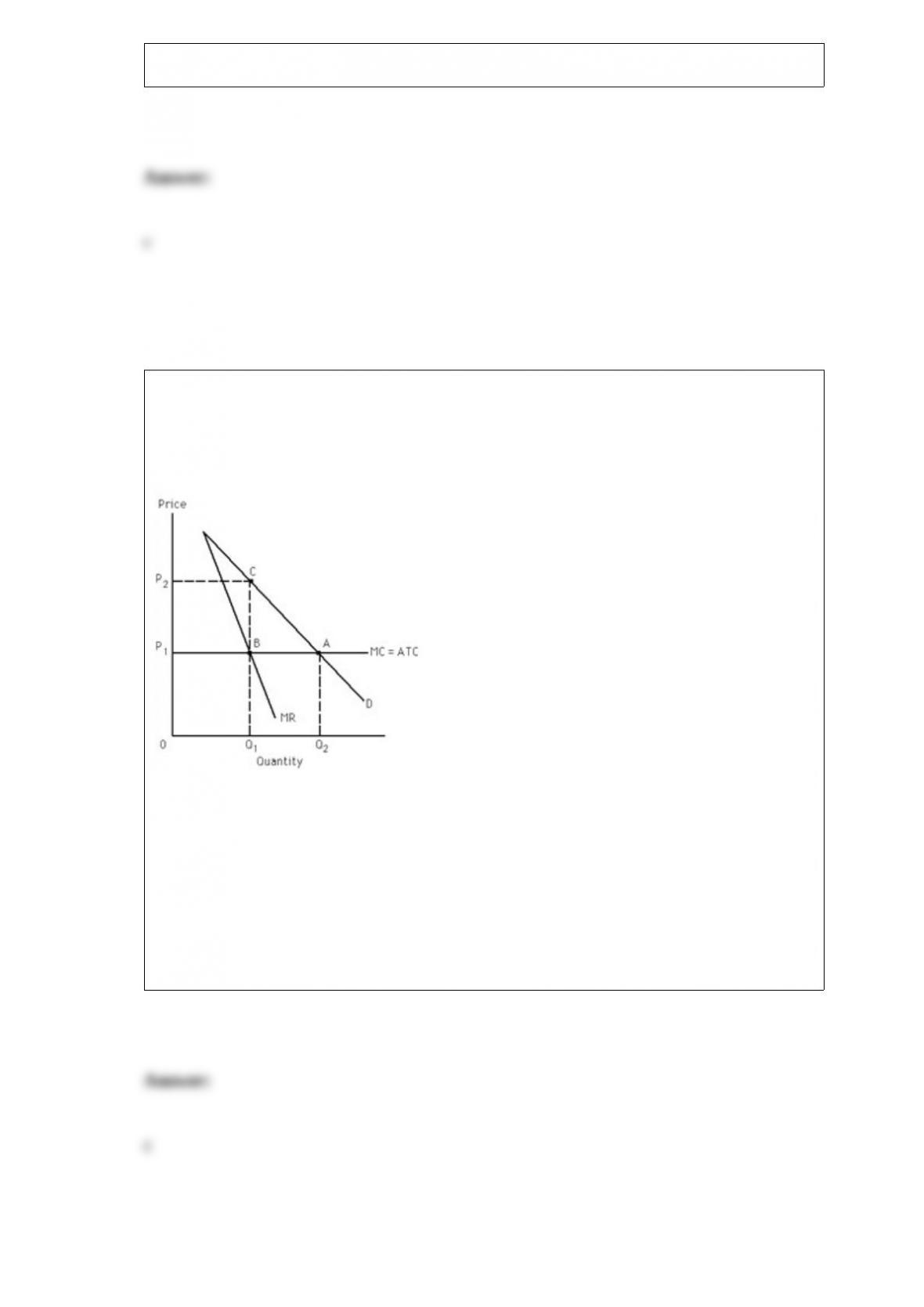
Refer to Exhibit 24-1. According to economist Gordon Tullock, what area is subject to
rent seeking activity?
Exhibit 24-1
a. area Q1BAQ2
b. area BCA
c. area P1P2CB
d. area 0P1BQ1
e. none of the above

Often, candidates running for political office will speak in general terms instead of
specific terms because voters agree more on __________ than __________.
a. benefits; costs
b. costs; benefits
c. means; ends
d. ends; means
e. none of the above
In a simple majority vote, the losses to the losers are greater than the gains to the
winners. It follows that the
a. outcome of the vote is efficient.
b. outcome of the vote is inefficient.
c. outcome of the vote will be nullified (most likely by the Courts).
d. vote has generated net benefits.
e. none of the above
A subset of the general population that holds an intense preference with respect to a
particular government activity is called a
a. public-service group.

b. special interest group.
c. union.
d. federation.
The infant industry argument for trade protectionism holds that
a. new industries sometimes need a protective environment in which to grow so that
they can compete with older, more established foreign competitors.
b. foreign competitors are often viewed as “infants” by large U.S. firms.
c. tariffs are often preferred to quotas.
d. quotas raise prices more than tariffs raise prices.
e. a and c
The economy is currently on its production possibilities frontier (PPF). A politician says
that it is possible to get more of everything-more infrastructure, more schools, more
national defense, more spending on social programs, and so on. The politician is
a. correct if he is assuming a rightward-shifting PPF.
b. incorrect if he is assuming a rightward-shifting PPF.
c. incorrect if he is assuming a PPF that does not change.
d. correct if he is assuming a PPF that does not change.
e. a and c
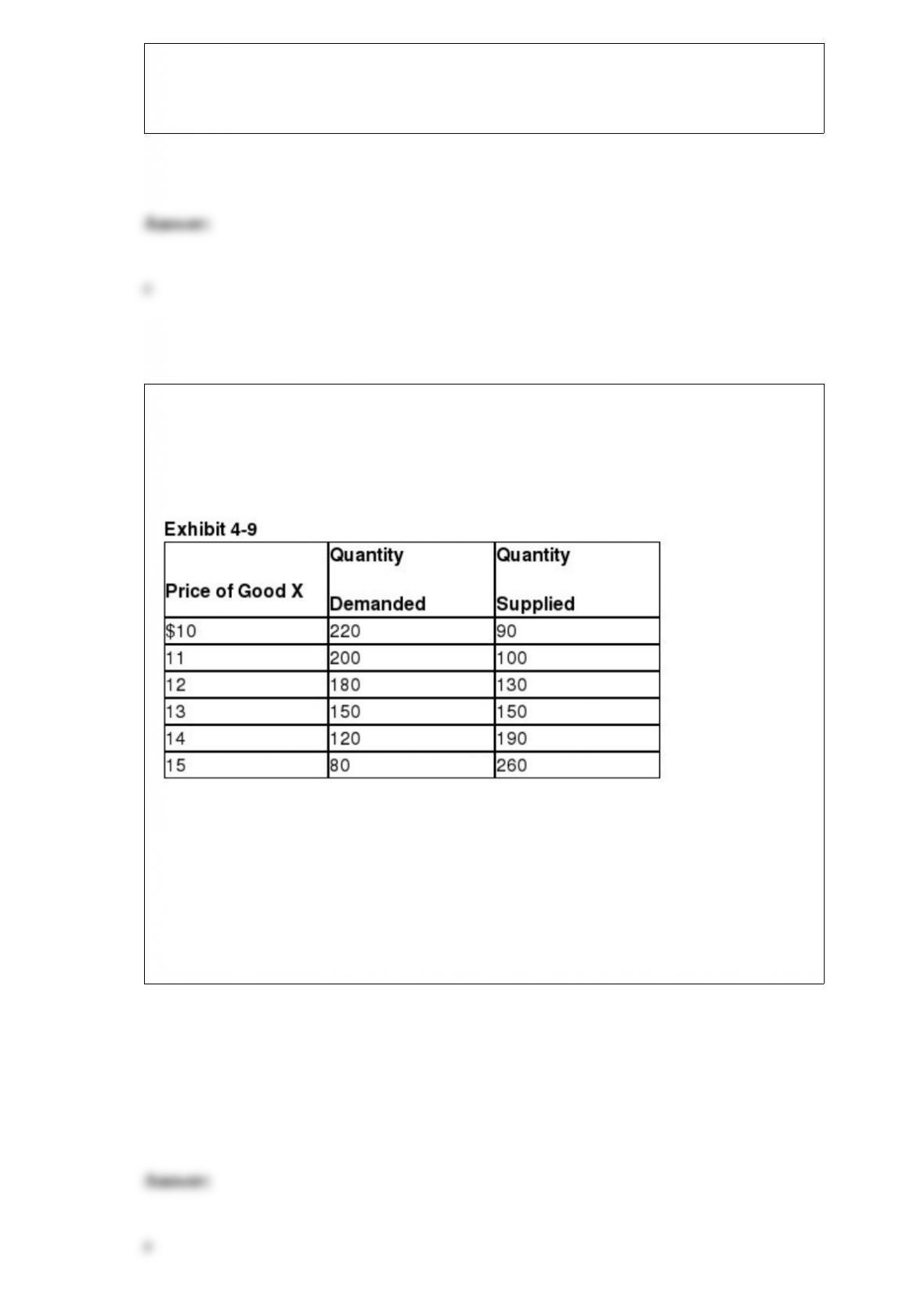
Refer to Exhibit 4-9.Suppose that the government imposes a price ceiling at a price of
$11.How many fewer units would be exchanged at the price ceiling than would be
exchanged at the equilibrium price?
a. 50
b. 30
c. 40
d. 70

Which of the following pairs of goods would be most likely to be complements?
a. olive oil and vegetable oil
b. peanuts and peanut butter
c. DVD’s and DVD players
d. hiking boots and tennis shoes
e. all of the above
A positive externality exists and government wants to impose a subsidy in order to
bring about an efficient outcome. To accomplish its objective, government must set the
subsidy equal to marginal
a. private cost.
b. social benefit.
c. external cost.
d. social cost.
e. external benefit.
If X is the actual amount of income or receipts and i is the interest rate (in decimals)
that could be earned on alternative uses of money that face the same risk, the present
value of X in t years from now is computed by
a. (it)(1 + X).
b. (Xt)(1 + i).
c. i/(1 + X)t.

d. X/(1 + i)t.
e. X/(1 – i)t .
A person who does not ignore a sunk cost increases the probability that
a. the past will influence the future.
b. the future will influence the past.
c. the future will be like the past.
d. there will be no future.
e. the future will be like the present.
A rightward shift in the demand curve for tennis balls could be caused by
a. a fall in the price of tennis balls.
b. a fall in the price of tennis rackets.
c. a rise in the price of tennis lessons.
d. a fall in income, assuming tennis balls are a normal good.