
In an oligopoly market, unlike in other market structures, firms
a. can act interdependently.
b. can produce a homogeneous product or a differentiated product.
c. use advertising.
d. face low barriers to entry and exit.
e. a and b
The government imposes a $2.50 per-unit tax on the production of good X. As a result
the
a. supply curve forgood X shifts leftward and the price of good X rises.
b. quantity supplied of good X falls and the price of good X rises.
c. demand curve for good X shifts leftward and the price of good X falls.
d. supply curve for good X shifts rightward and the price of good X falls.
e. supply curve for good X shifts leftward and the price of good X falls.
Which of the following statements is false?
a. The way a market is defined can have much to say about whether a firm is viewed as

a monopoly or not.
b. In 1945, a court ruled that Alcoa was a monopoly.
c. In the Dupont case in 1956, the market relevant to Dupont was ruled to be the
cellophane market rather than the flexible wrapping materials market.
d. The government eventually dropped its 1969 suit against IBM.
Which scenario below most accurately describes the process by which a technological
change can affect employment patterns across industries?
a. A technological advance makes it possible to produce more of good X with less labor.
As a result, labor is released from producing good X. Some of this labor ends up
producing goods Y and Z.
b. A technological advance makes it possible to produce less of good X with less labor.
As a result, labor is released from producing good X. Some of this labor ends up
producing good Y.
c. A technological advance makes it possible to produce more of good X with more
labor. As a result, more labor is needed to produce good X. There is less labor available
to produce goods Y and Z.
d. A technological advance makes it possible to produce more of good X with less labor.
As a result, labor becomes more important to the production of good X. More labor
ends up producing good X.
e. none of the above

Which of the following statements is false?
a. A theory should be judged based upon whether or not it tells us the things we want to
hear.
b. Scientists are interested in finding out when their theories are wrong or right.
c. Scientists are interested in building theories that can be refuted.
d. If evidence is consistent with a theory’s predictions, we state that the evidence fails to
reject the theory.
The marginal rate of substitution is illustrated by the
a. slope of the indifference curve.
b. slope of the budget line.
c. ratio of the marginal utility of the good on the vertical axis to the marginal utility of
the good on the horizontal axis.
d. distance between the indifference curves.
e. distance between the budget line and the indifference curve.
Which of the following assumptions is not likely to be met in the real world?
a. Demand for labor is identical in every labor market.

b. Nonpecuniary factors in each job are the same.
c. All labor is homogeneous.
d. All labor has zero costs of mobility.
e. all of the above
Which of the following conditions is not necessary for wage rates to be identical in
every labor market in both the short run and the long run?
a. Demand for labor is identical in each market.
b. Nonpecuniary factors in each job are the same.
c. All labor is homogeneous.
d. All labor has zero costs of mobility.
e. All of the above are necessary conditions.
The key behavioral assumption of the cartel theory is that oligopolists in an industry
a. try to maximize sales instead of profits.
b. act as if they are perfect competitors.

c. act in a manner consistent with there being only one firm in the industry.
d. try to create a demand for their products by way of advertising.
e. none of the above
When a good is nonexcludable, then individuals
a. will purchase the good for less than it cost to produce.
b. can obtain the benefits of the good without paying for it.
c. have an incentive to become free riders.
d. will purchase more than the optimum amount.
e. b and c
If the workers of a firm successfully negotiate an increase in wages, which of the
following is most likely to happen?
a. The demand curve for the product the firm produces shifts rightward.
b. The demand curve for the product the firm produces shifts leftward.
c. The supply curve of the product the firm produces shifts rightward.

d. The supply curve of the product the firm produces shifts leftward.
The Justice Department considers a Herfindahl index
____________________________ to be representative of a concentrated industry.
a. less than 1,000
b. between 1,000 and 1,800
c. greater than 1,800
d. greater than 10,000
In the Texas A & M study of the “buying” behavior of two white rats, as the “relative
price” of one beverage was raised,
a. both white rats began to consume more of the higher-priced beverage.
b. both white rats began to consume less of the higher-priced beverage.
c. one white rat began to consume more of the higher-priced beverage and the other
began to consume less.
d. both white rats continued consuming the same amount of the beverage as before its
price was raised.
e. There was no study done at Texas A & M with white rats.

Evidence seems to indicate that the demand for many agricultural products
a. has increased much more than supply over the years.
b. is relatively elastic.
c. is relatively inelastic.
d. is relatively income elastic.
e. b and d
As the marginal physical product of labor rises in the U.S., the marginal cost of goods
produced in the U.S. rises which makes it harder for U.S. producers to compete in the
global marketplace.
a. True
b. False
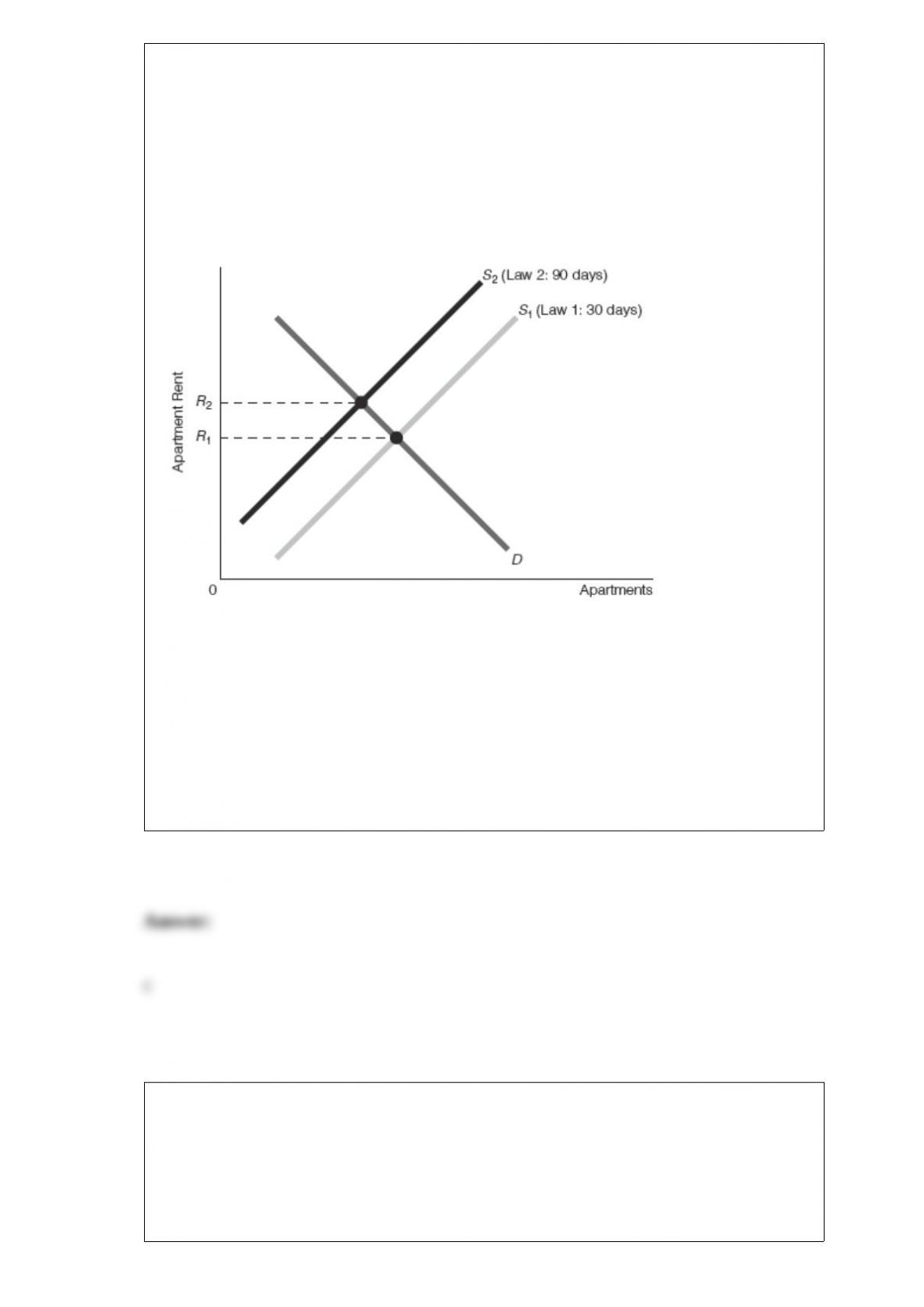
Refer to Exhibit 5-6. Under law 1 a renter has 30 days to vacate an apartment after
being served with an eviction notice.Under law 2, the renter has 90 days to vacate after
being served with an eviction notice.This graph shows that the supply of apartments
is____________ under law 1 than under law 2, and thus apartment rent is
_______________ under law 1 than under law 2.
Exhibit 5-6
a. less; lower
b. less; higher
c. greater; lower
d. greater; higher
If real interest rates in Japan fall relative to real interest rates in the United States, the
yen will likely __________ in terms of the dollar and the dollar will likely __________
in terms of the yen.
a. appreciate; depreciate
b. depreciate; appreciate
c. remain unaffected; remain unaffected
d. remain unaffected; appreciate
e. remain unaffected; depreciate
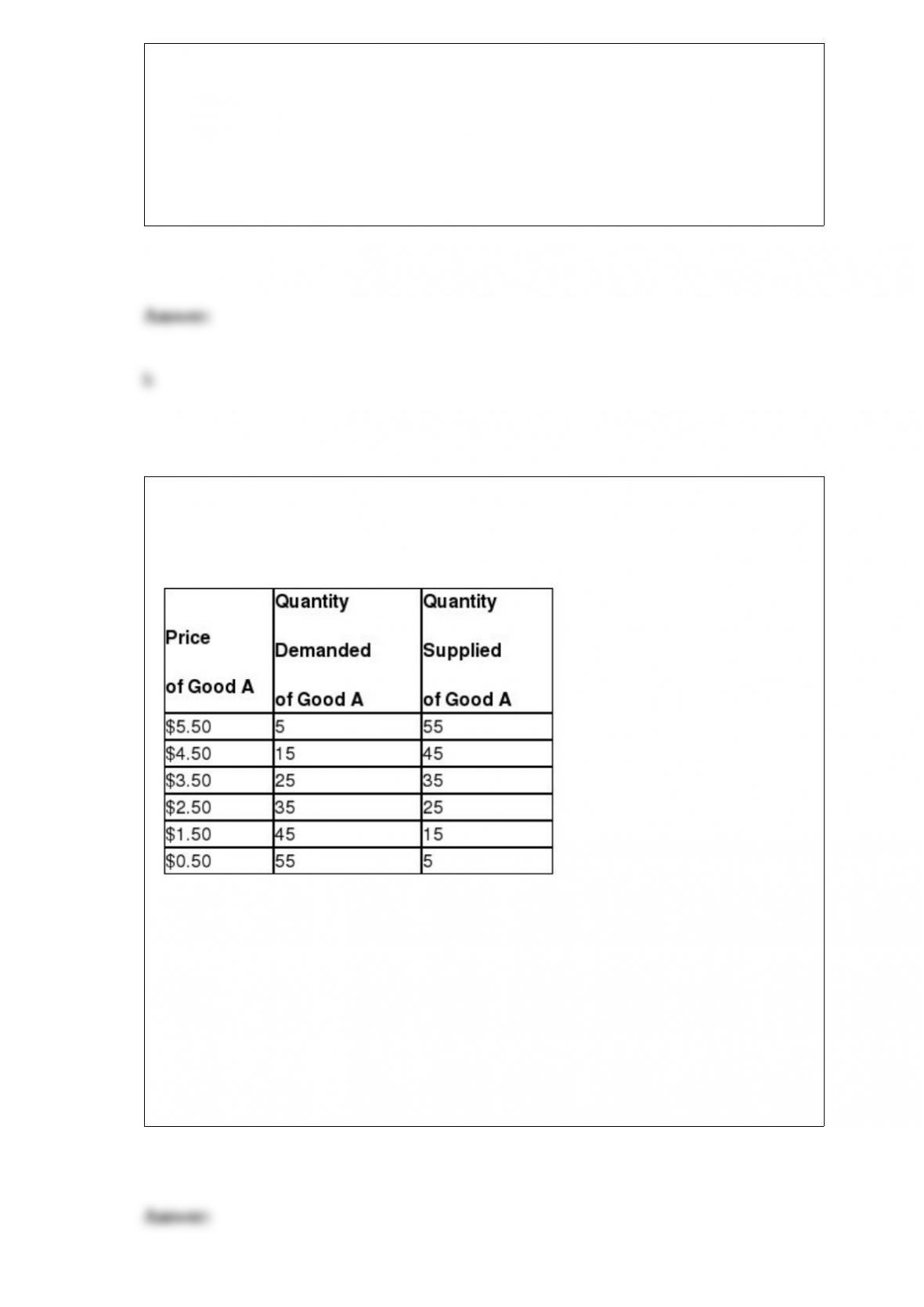
Refer to Exhibit 20-3. If price decreases from $5.50 to $4.50, total revenue along the
demand curve
Exhibit 20-3
a. increases to $67.50.
b. increases to $87.50.
c. remains at $87.50.
d. decreases to $67.50.
e. decreases to $27.50.