
If the quantity demanded of good X is greater than the quantity supplied of good X,
then the market for good X is in disequilibrium.
a. True
b. False
If the percentage change in quantity demanded of a good is equal to the percentage
change in buyer’s income, then the good is said to be
a. income elastic.
b. income inelastic.
c. income unit elastic.
d. price unit elastic.
e. price inelastic.
When a negative externality exists, the market is said to underproduce the good
connected with the negative externality.
a. True
b. False

For a perfectly competitive firm, MR = MC at 250 units of output. At 250 units, ATC is
greater than AVC. It necessarily follows that
a. the firm should shut down its operation.
b. the marginal cost curve must have an upward-sloping portion and a
downward-sloping portion.
c. the firm should continue to produce.
d. b and c
e. none of the above
The Robinson-Patman Act of 1936
a. made interlocking directorates illegal.
b. set up the Federal Trade Commission (FTC) to deal with “unfair methods of
competition.”
c. made monopolization of trade a misdemeanor.
d. prohibited suppliers from offering special discounts to large chain stores without
offering them to everyone else.

e. empowered the FTC to deal with false and deceptive acts or practices.
The least-cost rule states that a firm minimizes costs by buying factors in the
combination at which the MRP-to-price ratio for each is the same.
a. True
b. False
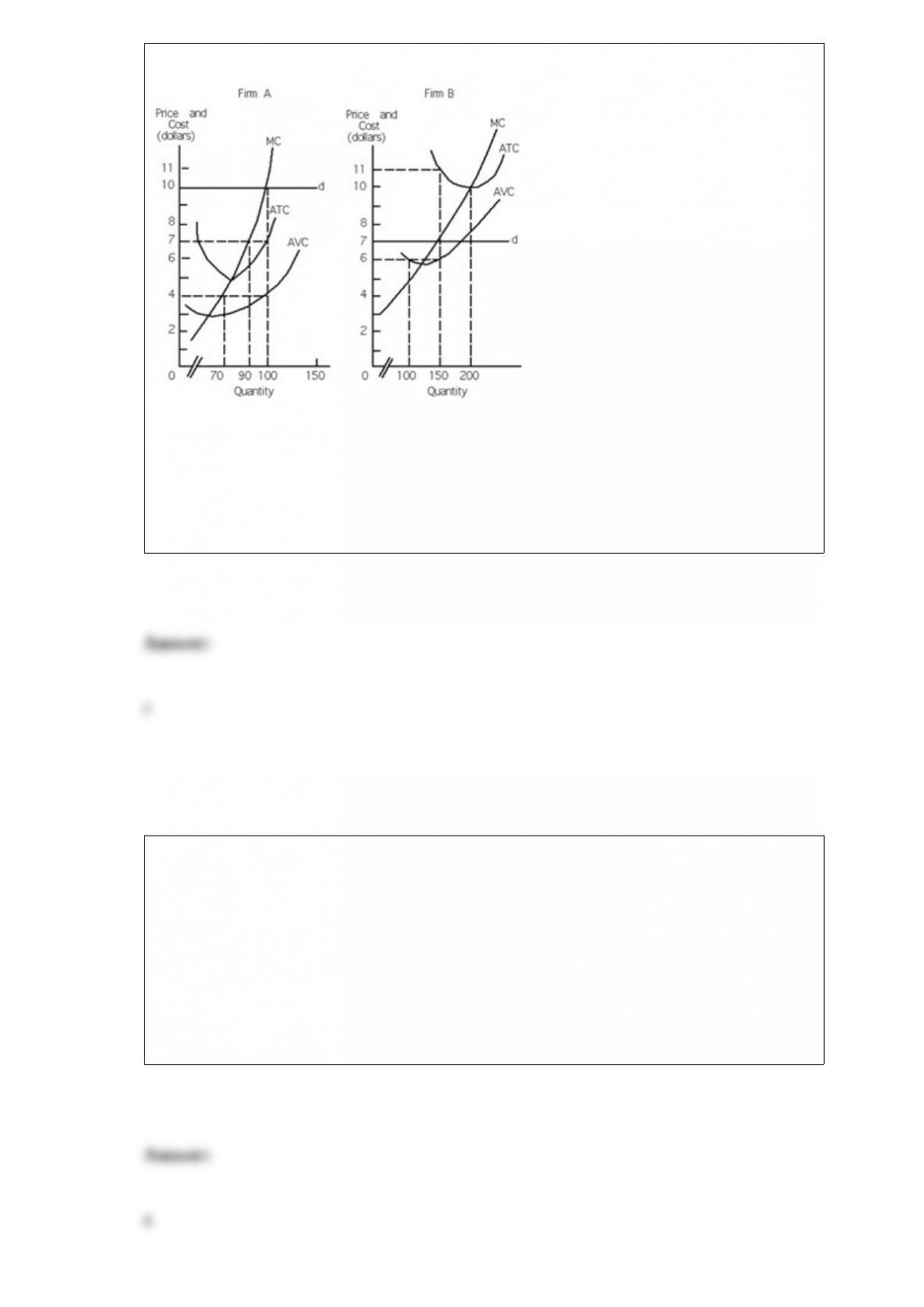
Refer to Exhibit 23-8. What is the total revenue of Firm A at the profit-maximizing (or
loss-minimizing) level of output?
Exhibit 23-8
a. $300
b. $700
c. $1,000
d. $400
A decrease in the quantity of resources
a. shifts the PPF leftward.
b. shifts the PPF rightward.
c. moves the economy up a given PPF.
d. moves the economy down a given PPF.

With respect to the stock market, the acronym IPO stands for
a. investment proposal option.
b. immediate public offering.
c. internal public offering
d. initial public offering.
At a price above the equilibrium price, there is
a. a shortage.
b. a surplus.
c. excess demand.
d. super-equilibrium.
e. none of the above
Given that MUX/PX < MUY/PY, consumers who spend all their income on these two
goods
a. can never maximize total utility.

b. have maximized total utility.
c. can increase total utility by buying more of X and less of Y.
d. can increase total utility by buying more of Y and less of X.
e. a and b
The price of X was $10 in year 1 and $14 in year 2. Which of the following could be
the correct reason for the rise in price?
a. The demand for X was higher in year 2 than in year 1, ceteris paribus.
b. The supply of X was lower in year 2 than in year 1, ceteris paribus.
c. The demand was higher, and the supply was lower, in year 2 than in year 1.
d. a and b
e. a, b, and c
A theory predicts that all swans are white.A thousand people go out into the field and
identify the color of the swans they see.Their results reveal that, of the 10,000 swans
they saw, all were white.It follows that
a. the swan theory is a falsifiable theory.
b. the swan theory is correct.

c. the evidence fails to reject the swan theory.
d. a and b
e. a and c
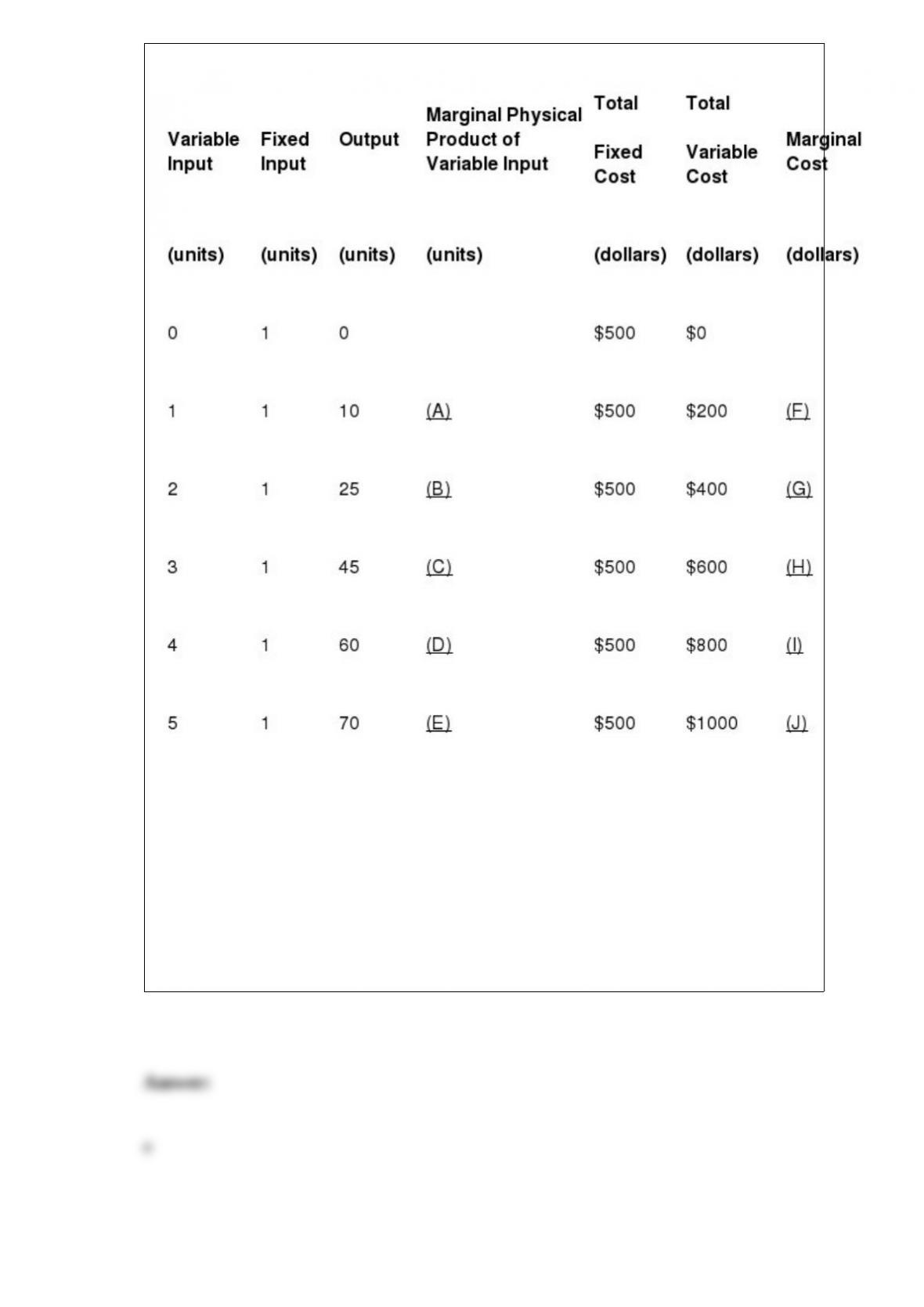
Refer to Exhibit 22-3. The average variable cost of producing 45 units of output is
Exhibit 22-3
a. $1.33.
b. $1.60.
c. $2.00.
d. $2.44.
e. $13.33.

If the long-run industry supply curve is downward-sloping, it follows that there are
__________ costs in the industry.
a. increasing
b. constant
c. decreasing
d. a or b
e. There is not enough information to answer the question.