
Which of the following statements is true?
a. The concept of opportunity costs cannot be illustrated within a PPF framework.
b. If scarcity did not exist, neither would a PPF.
c. All PPFs are downward-sloping straight lines.
d. There are more attainable points than unattainable points in every PPF diagram.
It is argued that the market will
a. not produce a nonexcludable public good.
b. produce the socially optimal output of a nonexcludable public good.
c. produce too much of a nonexcludable public good.
d. produce a nonexcludable public good if marginal social benefits are equal to
marginal private benefits.
e. b and d
According to the text, the _______________ is currently the primary reserve currency.
a. Chinese renmimbi
b. euro
c. U.S. dollar
d. Japanese yen
e. British pound
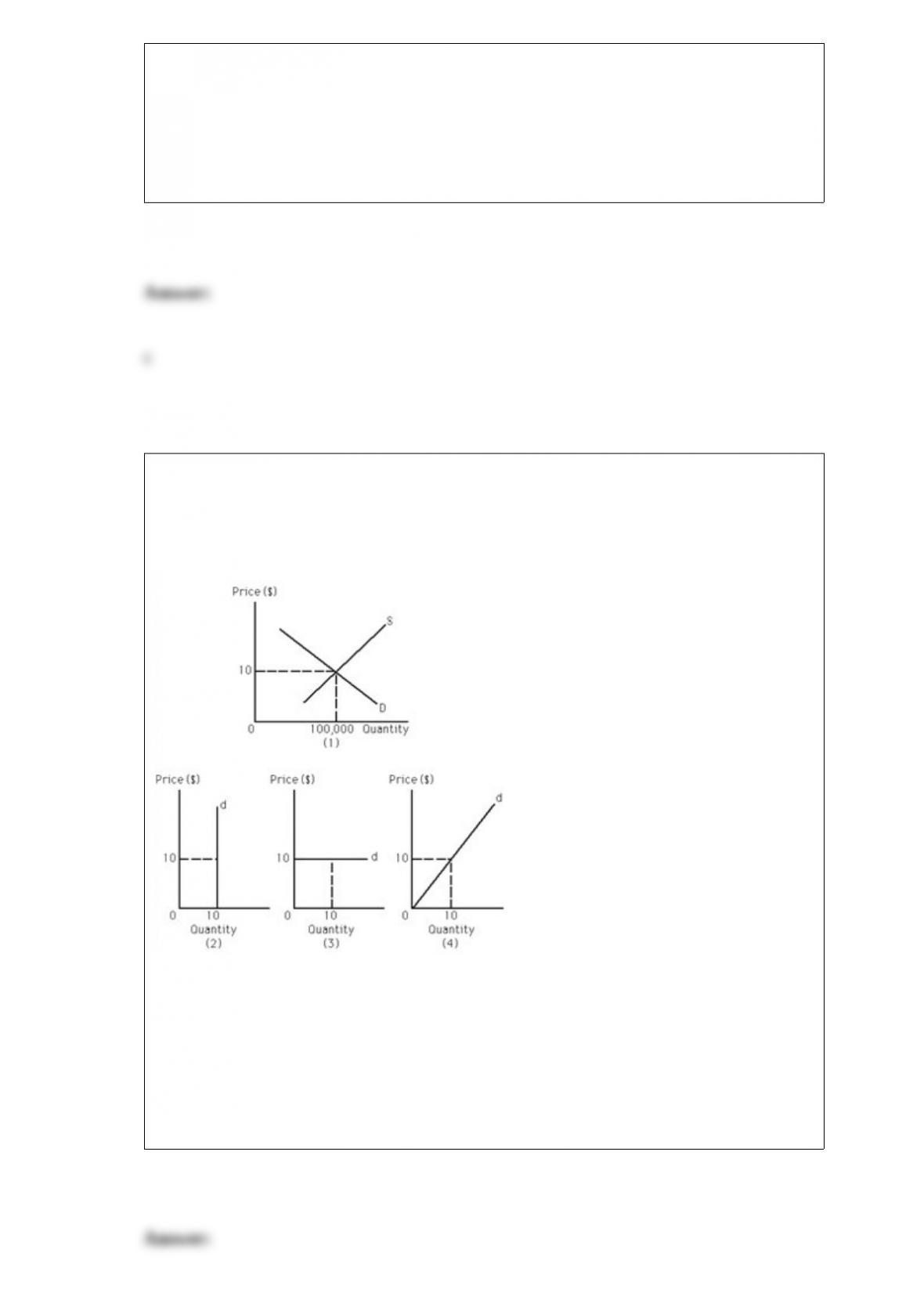
Refer to Exhibit 23-6. A perfectly competitive firm operating in the market depicted in
graph (1) faces the demand curve depicted in
Exhibit 23-6
a. graph (1)-the same as the market demand curve.
b. graph (2).
c. graph (3).
d. graph (4).
Which economist said, “This focus on distribution makes the significance of
distributional issues (transfer issues) in political life relatively greater and the
significance of widespread common interest in political life relatively smaller.”?
a. John Maynard Keynes
b. Milton Friedman
c. David Friedman
d. Mancur Olson
e. David Ricardo
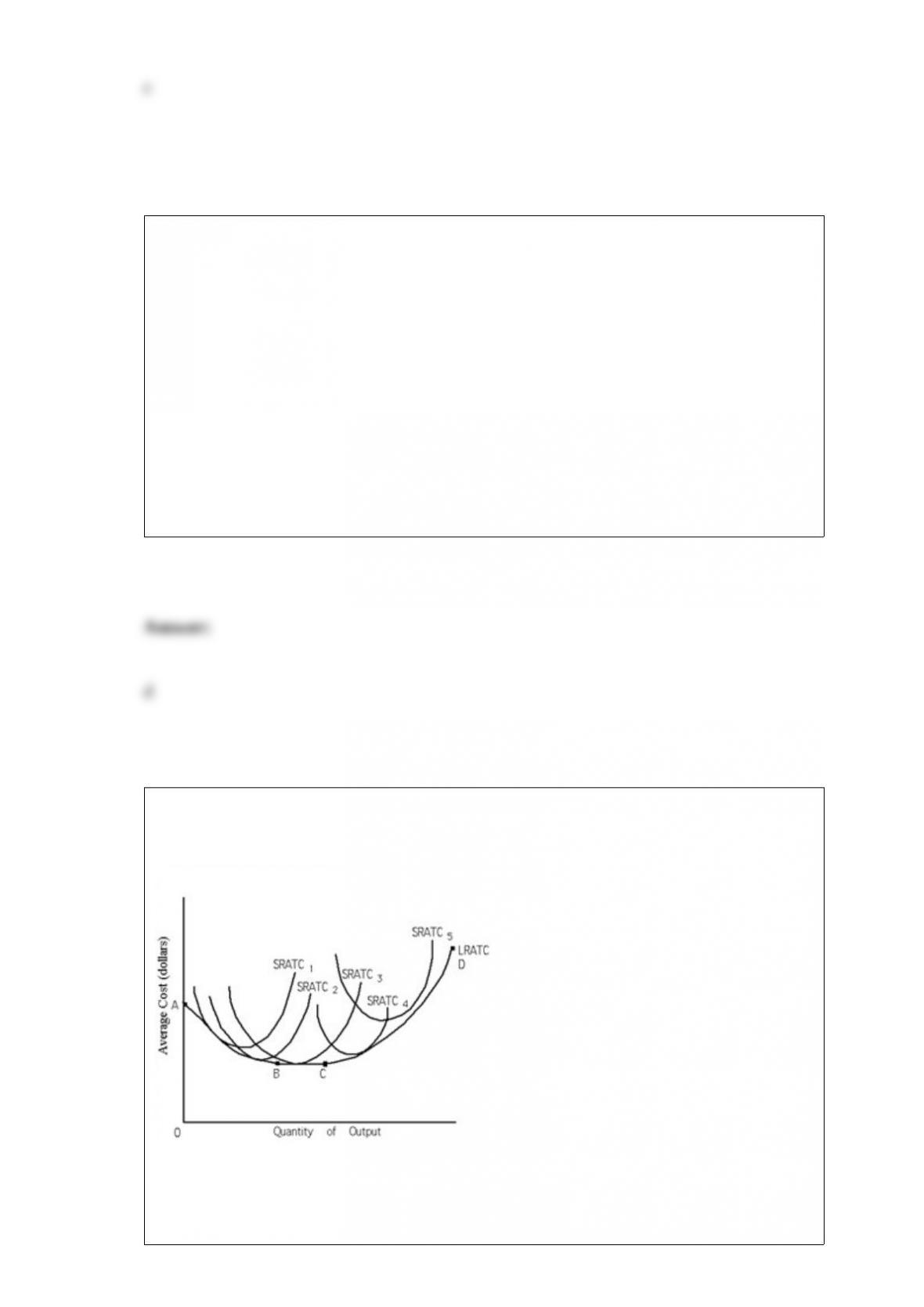
Refer to Exhibit 22-5. The minimum efficient scale is at
Exhibit 22-5
a. point A.
b. point B.

c. point C.
d. point D.
e. points B and C.
A tariff is a tax on
a. savings.
b. capital goods.
c. imports.
d. land.
The demand for loanable funds curve is
a. upward sloping.
b. downward sloping.
c. perfectly elastic.
d. perfectly inelastic.

The Coase theorem states that
a. positive externalities are directly related to the weather-the better the weather, the
more positive externalities.
b. in the case of trivial or zero transaction costs, negative externalities are more likely to
appear.
c. when transaction costs are high, positive externalities will be minimized.
d. in the case of trivial or zero transaction costs, the property rights assignment does not
matter to the resource-allocative outcome.
The Gini coefficient is a number between
a. 0 and 1.
b. 1 and 10.
c. 0 and 100.
d. -1 and 1.
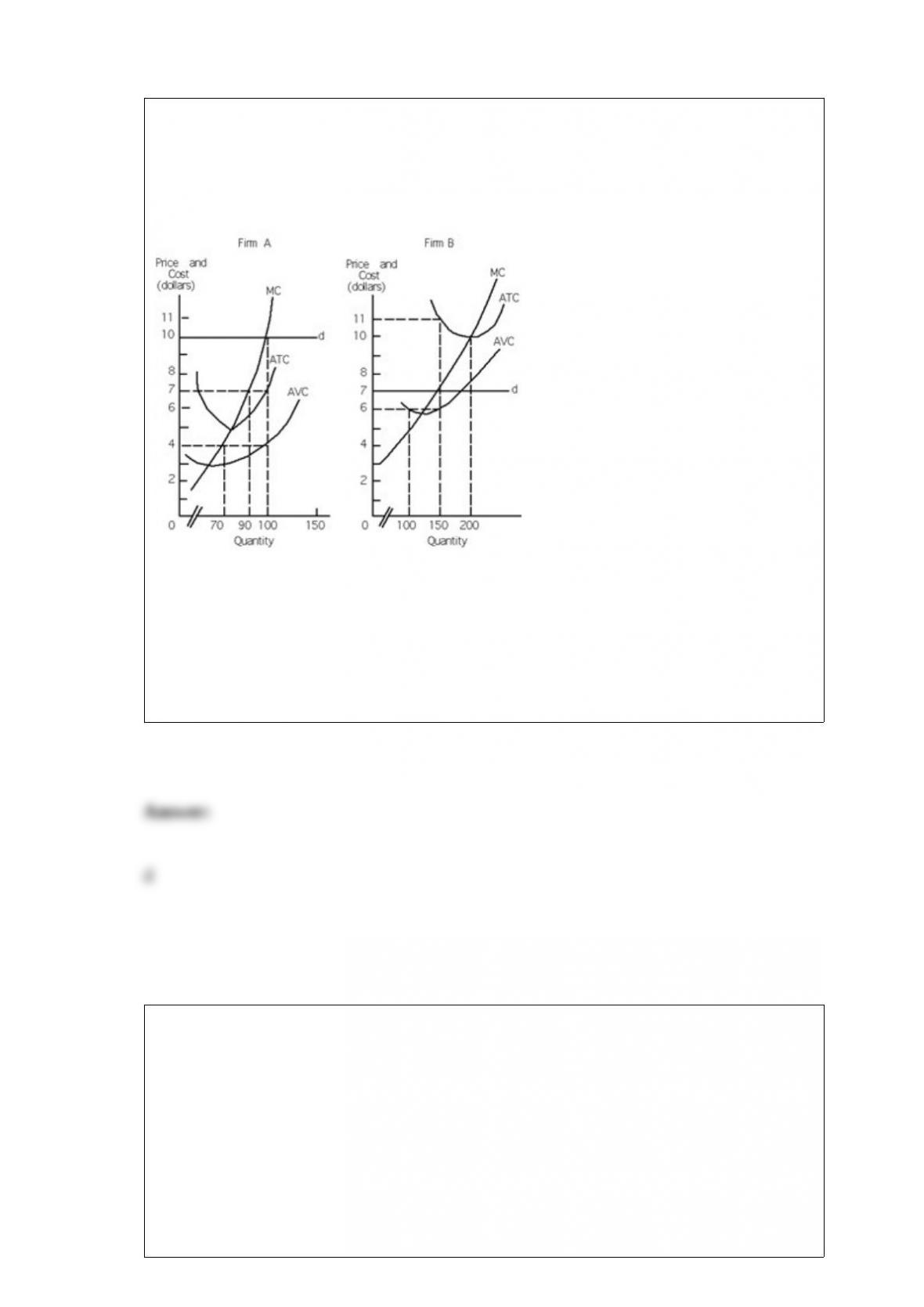
Refer to Exhibit 23-8. What is the total variable cost of firm B at the profit-maximizing
(or loss-minimizing) level of production?
Exhibit 23-8
a. $6
b. $750
c. $1,650
d. $900
For a perfectly competitive firm,
a. the marginal revenue curve and the demand curve are the same.
b. the marginal revenue curve and the marginal cost curve are the same.
c. the supply curve and the marginal revenue curve are the same.
d. the demand curve and the marginal cost curve are the same.

e. none of the above
For a factor price taker, the marginal factor cost curve
a. and the factor supply curve both slope upward, but are not identical.
b. and the factor supply curve are identical and horizontal.
c. is horizontal, but the factor supply curve slopes upward.
d. slopes upward, but the factor supply curve is horizontal.
e. and the factor supply curve are identical and slope upward.
The purchasing power parity theory states that
a. exchange rates between any two currencies will adjust to reflect changes in the
relative price level of the two countries.
b. exchange rates between any two currencies will adjust to reflect change in the
relative income growth rates of the two countries.
c. the larger the economic growth rate in a country, the less likely its currency will
depreciate in value.
d. exchange rates cannot be compared over time.

e. currencies appreciate as often as they depreciate.
A community of 100 persons wants to redistribute (transfer) some income from
themselves to members of group A.So far, they don’t seem to be able to do what they
say they want to do.This is most likely because each member of the community of 100
persons sees his contribution as __________________ relative to the total (of
contributions) and therefore chooses to be a __________________.
a. large; rent-seeker
b. small; rent-seeker
c. small; free rider
d. large; free rider
e. none of the above
Which of the following does not affect wages?
a. number of persons who can do a particular job
b. degree of effort employees exert while on the job
c. workers’ abilities and skills
d. product demand
e. none of the above; i.e., all of the factors affect wages

“As the price of apples goes up, the demand for apples goes down.” The author of this
statement
a. implies that price and demand are unrelated.
b. uses the word “demand” when he should use the word ‘supply.”
c. uses the word “demand” when he should use the words “quantity demanded.”
d. implies that demand and price have a direct relationship.
If the U.S. dollar depreciates in the foreign exchange market, U.S. exports will be
__________ and U.S. imports will be __________.
a. relatively less expensive; relatively less expensive
b. relatively less expensive; relatively more expensive
c. relatively more expensive; relatively more expensive
d. relatively more expensive; relatively less expensive
e. unaffected; relatively less expensive

Treasury bonds are so safe (risk-free) that they often pay relatively low returns.
a. True
b. False
If, for a perfectly competitive firm, price is greater than average variable cost, then it
follows that
a. total revenue is greater than total cost.
b. total revenue is greater than total variable cost.
c. the firm will lose more or earn less by shutting down in the short run than by
continuing to produce.
d. b and c
e. There is not enough information to answer the question.
Which of the following statements is false?
a. The monopolistic competitor is a price searcher.

b. The monopolistic competitor produces an output at which price is greater than
marginal cost.
c. The demand curve facing a monopolistic competitor is less elastic than the demand
curve facing a monopolist.
d. There are many substitutes in a monopolistic competitive industry.
If, under a fixed exchange rate system, the dollar price of a Mexican peso is above its
equilibrium level, then the
a. dollar is overvalued.
b. peso is overvalued.
c. dollar has appreciated.
d. peso has depreciated.
Suppose the marginal revenue product of individuals who work in the union sector is
greater than that of individuals who work in the nonunion sector. Normally, we would
expect labor to move from the nonunionized sector to the unionized sector-from where
it is worth less to where it is worth more. But if this cannot happen, owing to the
supply-restraining efforts of the union, then
a. wages in the nonunion sector will rise.
b. wages in the union sector will fall.

c. there will be a misallocation of labor—not all labor will be employed where it is most
valuable.
d. workers in the union sector will move to the nonunion sector.
A price ceiling is a government-mandated
a. minimum price below which legal trades cannot be made.
b. maximum price above which legal trades cannot be made.
c. minimum price above which legal trades cannot be made.
d. maximum price below which legal trades cannot be made.