The statement, “Every person who shall monopolize, or attempt to monopolize, or
combine or conspire with any other person or persons to monopolize any part of the
trade or commerce…shall be guilty of a misdemeanor” is a part of the
a. Clayton Act.
b. Robinson-Patman Act.
c. Sherman Act.
d. Wheeler-Lea Act.
e. none of the above
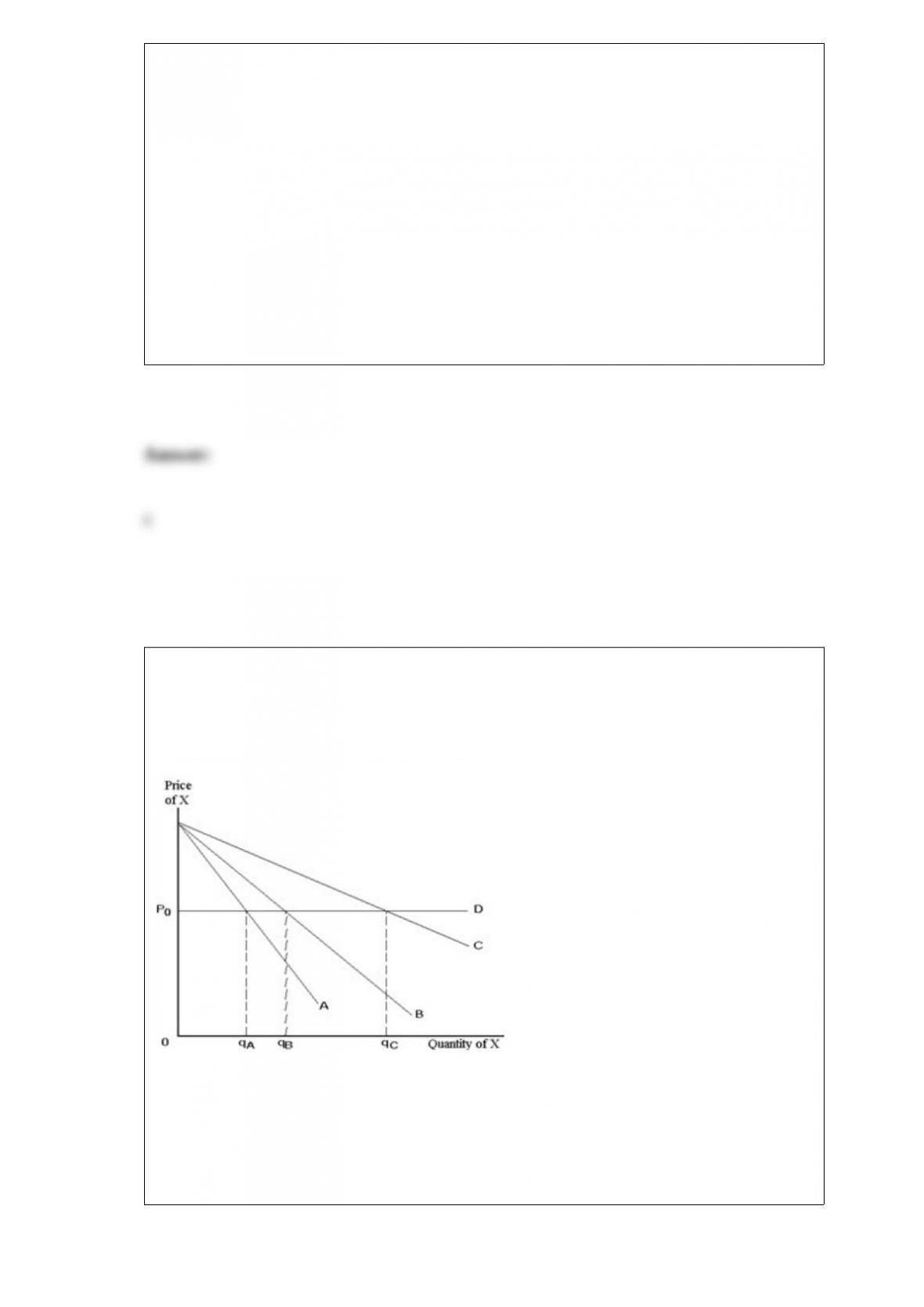
Refer to Exhibit 24-6. If C is the demand curve facing a perfectly price-discriminating
monopolist selling qC units of X, its marginal revenue curve is
Exhibit 24-6
a. A.
b. B.
c. C.
d. D.

The effects of tariffs and quotas are: a(n) __________ in consumers’ surplus, and a(n)
__________ in producers’ surplus.
a. increase; increase
b. increase; decrease
c. decrease; increase
d. decrease; decrease
If you have a high rate of time preference, then you are
a. willing to wait a longer time to consume a good than someone with a low rate of time
preference.
b. not willing to wait a long time to consume a good.
c. willing to save your earnings so that you can buy more goods in the future.
d. not acting rationally, because it means that you are willing to delay consumption of
goods and services until a later date (but you might not be around to do so).
e. a and c

Assume that a decreasing-cost industry experiences an increase in demand. In the short
run, this will
a. lead to a price increase.
b. lead to a price decrease.
c. have no influence on price.
d. a or b, depending on the marginal cost curve
One example of an optimal currency area is the states within the United States.
a. True
b. False
In moving along a demand curve for good X, which of the following is NOT held
constant?
a. the prices of substitute goods for good X
b. the prices of complementary goods for good X

c. incomes of consumers of good X
d. the price of good X
If the consumption of a good by one person reduces its consumption by others, then the
good is
a. nonrivalrous in consumption.
b. rivalrous in consumption.
c. nonexcludable.
d. excludable.
e. b and d
The quantity demanded of good A changes from 100 to 111 when the price of good A
changes from $9 to $8. The cross elasticity of demand is
a. 1.20.
b. -1.13.
c. 2.20.
d. -0.89.

e. There is not enough information to answer the question.
The higher the labor cost to total cost ratio, the lower the elasticity of demand for labor.
a. True
b. False
According to the marginal productivity theory, a perfectly competitive firm that is a
factor price taker pays its factors their
a. MRP.
b. VMP.
c. MPP.
d. a and b
e. all of the above

In recent years, industries with high four- and eight-firm concentration ratios include
cars, cereal breakfast foods, and farm machinery.
a. True
b. False
At the beginning of the 20th century one farmer in the U.S. produced enough to feed
____________ people, and at the end of the century, one farmer produced enough to
feed ____________ people.
a. 20; 40
b. 7; 15
c. 12; 42
d. 8; 35
The rivalry versus nonrivalry issue is
a. relevant to the issue of market failure.
b. not relevant to the issue of market failure.

c. relevant to the free-rider problem.
d. a and c
e. b and c
If the cross elasticity of demand for good A with respect to good B is -0.87, then good A
is
a. an inferior good.
b. a normal good.
c. a substitute for good B.
d. a complement to good B.
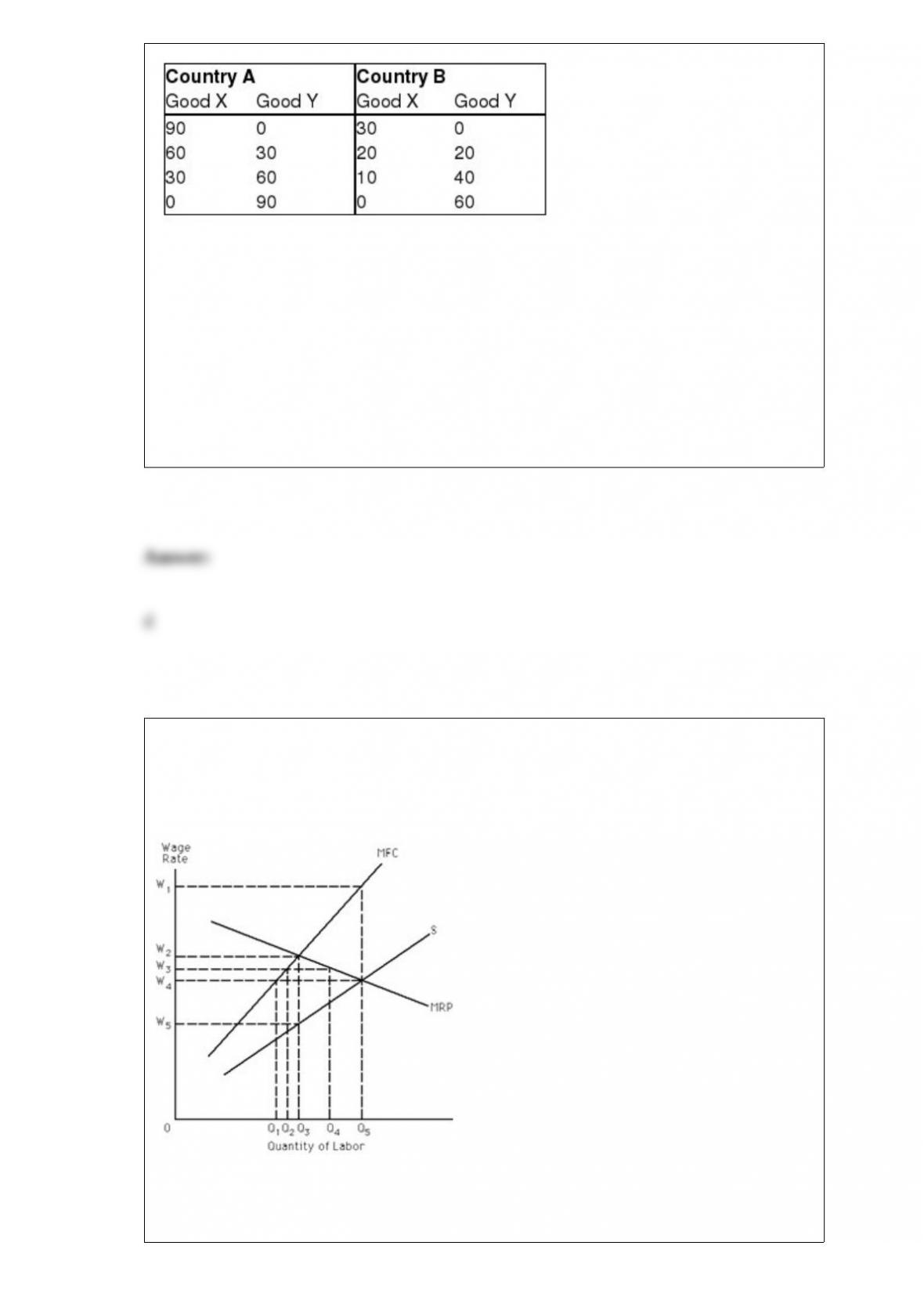
Refer to Exhibit 34-1. Considering the data, which of the following terms of trade
would both countries agree to?
Exhibit 34-1
a. 1 unit of X for 2 units of Y
b. 1 unit of X for 3 units of Y
c. 1 unit of X for 1 unit of Y
d. 1 unit of X for 1.50 units of Y
e. all of the above
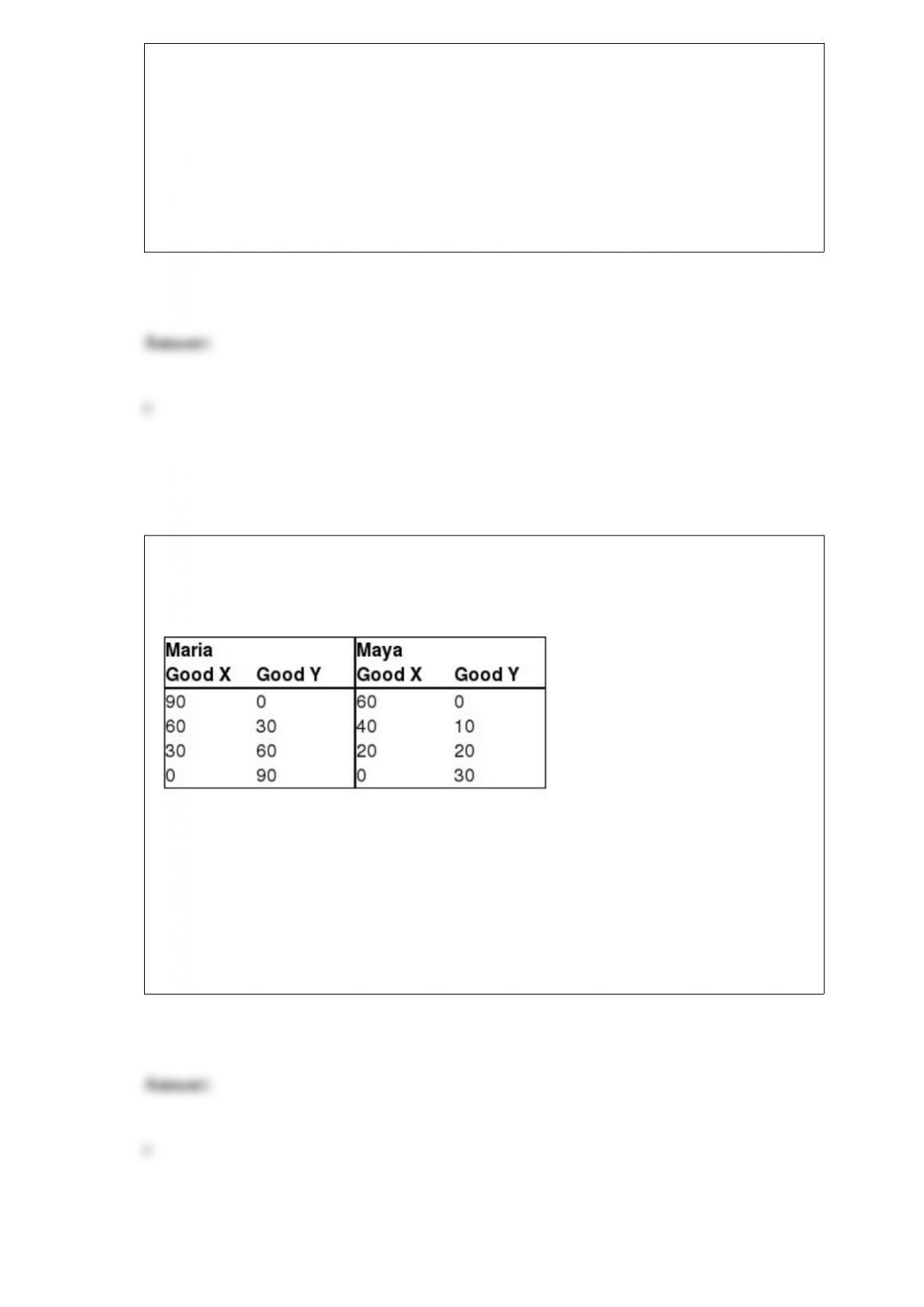
Refer to Exhibit 28-8. In the absence of collective bargaining, what quantity of labor
would the profit-maximizing monoposonist hire?
Exhibit 28-8
a. Q1
b. Q2
c. Q3
d. Q4
e. Q5
Refer to Exhibit 2-8.If Maria and Maya each specialize in the good in which she has a
comparative advantage and then engage in trade, ____________________ can consume
a combination of goods that lies beyond her PPF. Exhibit 2-8
a. Maria, but not Maya,
b. Maya, but not Maria,
c. both Maria and Maya
d. neither Maria nor Maya

A perfectly competitive market is initially in long-run competitive equilibrium. Then,
market demand increases. By the time all adjustments have been made, price will be
__________ its original level if the industry is a(n) __________ cost industry.
a. below; constant
b. above; increasing
c. at; decreasing
d. at; increasing
e. above; decreasing