
A vertical supply curve represents:
a. an inverse relationship between price and quantity supplied.
b. an independent relationship between price and quantity supplied.
c. an independent relationship between price and supply.
d. a direct relationship between price and quantity supplied.
e. a direct relationship between price and supply.
You and your roommate are eating pizza and have already consumed all but the last
slice. Your roommate claims that he is hungrier than you and therefore should get the
last slice of pizza. Your roommate has made
a. a diamond-water paradox.
b. an interpersonal utility comparison.
c. an elasticity comparison.
d. a marginal error.
The absence of value judgments is the essence of

a. normative economics.
b. positive economics.
c. microeconomics.
d. macroeconomics.
Research conducted by Nicholas Epley and his colleagues at Harvard showed that
people will spend a _________________ percentage of money given to them if it
is________________ rather than
a. smaller; cash; a rebate check.
b. greater; termed a rebate; a bonus.
c. greater; termed a bonus; a rebate.
d. smaller; a rebate check; cash.
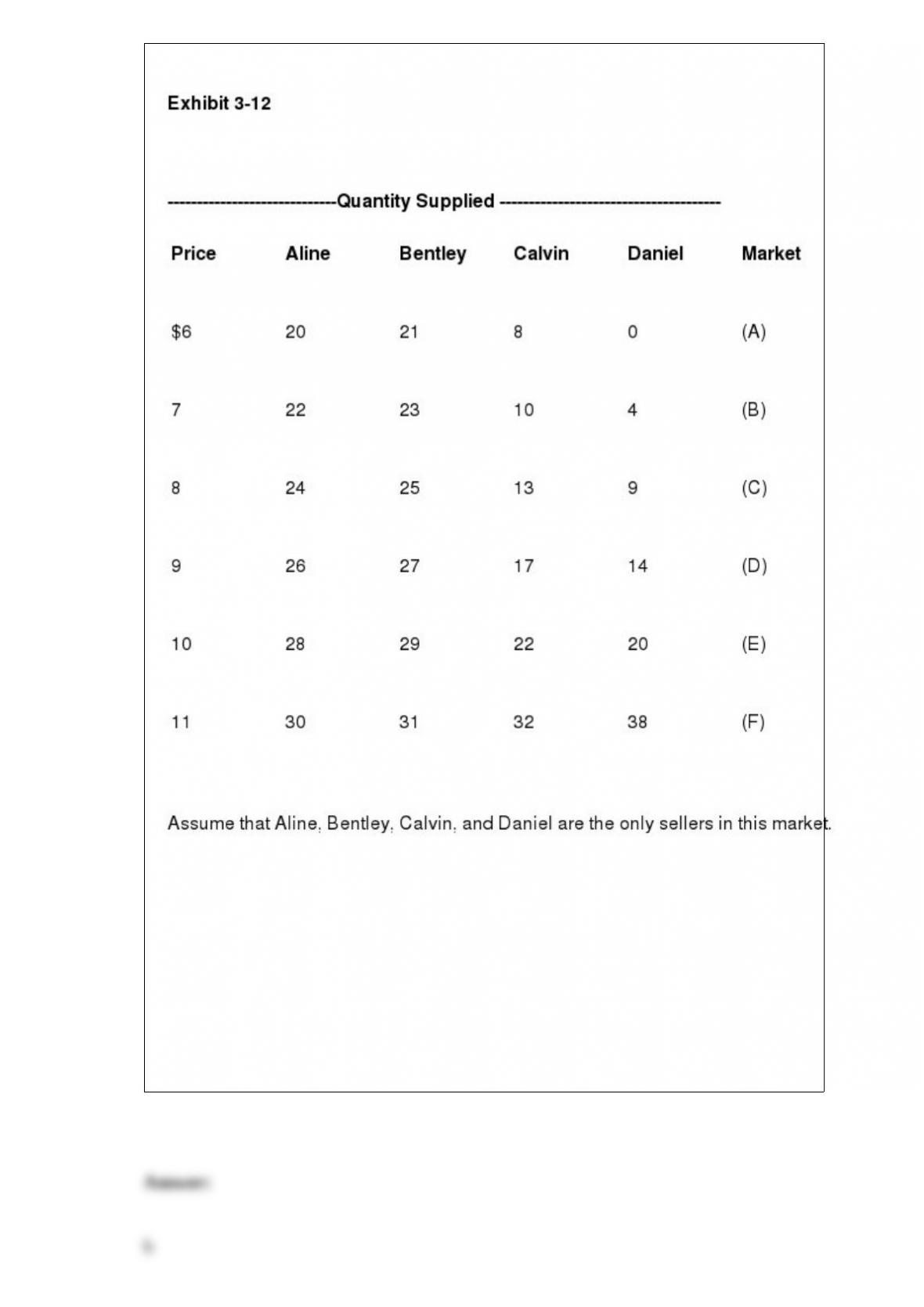
Refer to Exhibit 3-12.Fill in blanks (A) and (B) respectively with the market quantity
supplied at each given price.
a. 12.25; 14.75
b. 49; 59
c. 37; 45
d. 39; 49
e. none of the above
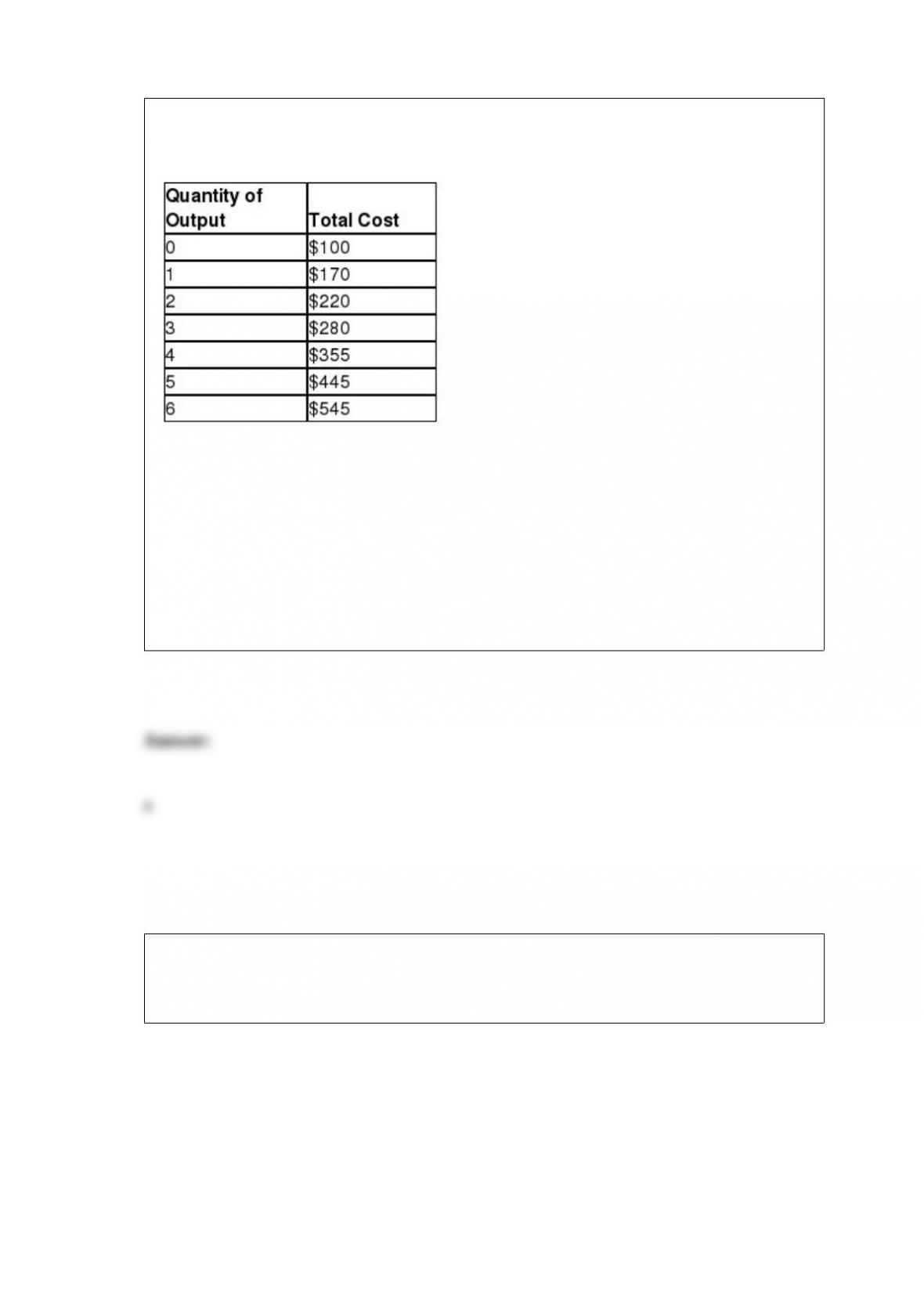
Refer to Exhibit 22-11. Average fixed cost at two units of output is
Exhibit 22-11
a. $50.
b. $60.
c. $100.
d. $110.
e. There is not enough information provided to answer this question.
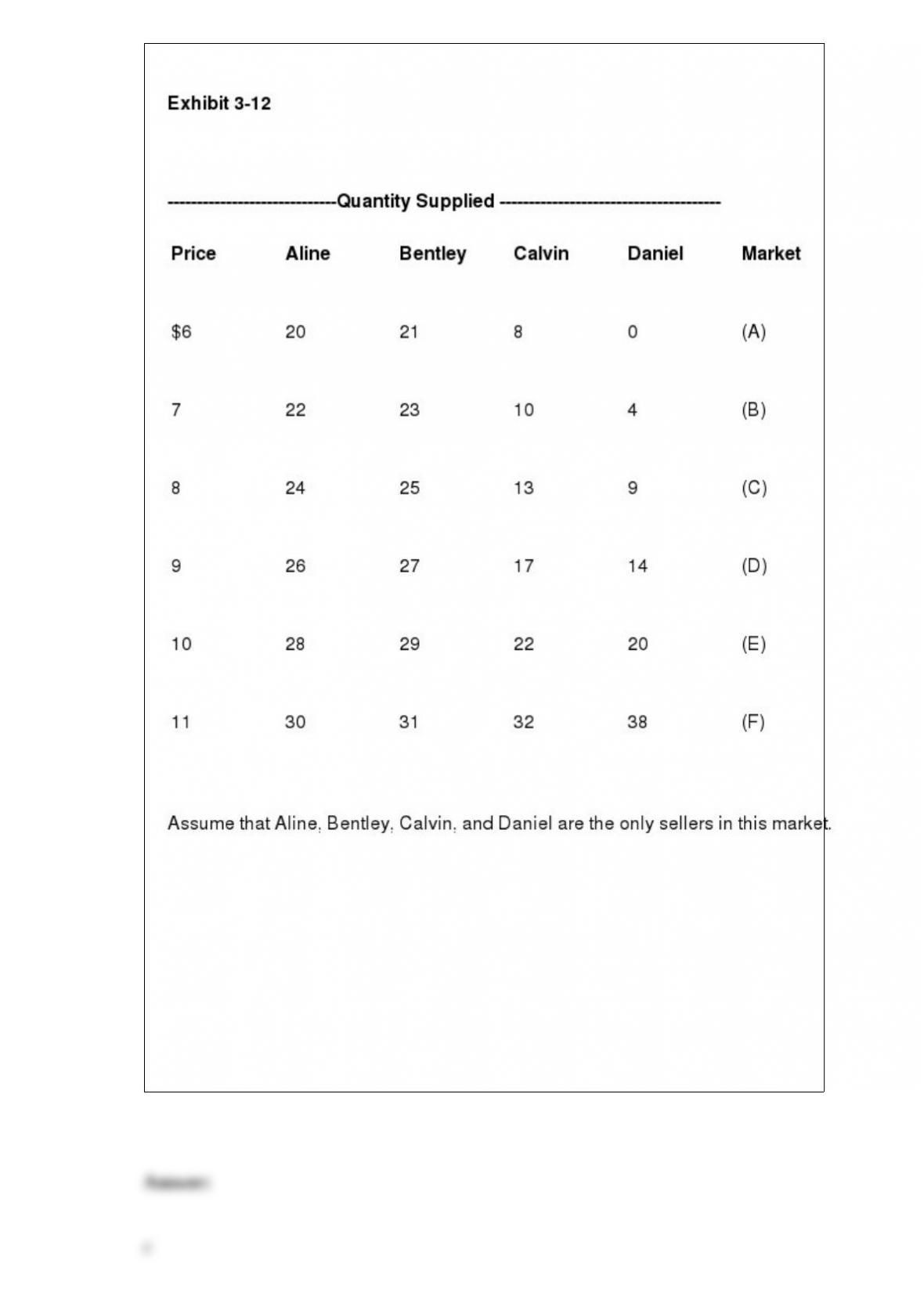
Refer to Exhibit 3-12.Fill in blanks (E) and (F) respectively with the market quantity
supplied at given each price.
a. 24.75; 32.75
b. 47; 52
c. 99; 131
d. 48; 65
e. none of the above

Price elasticity of supply and price elasticity of demand are likely to be __________ in
the __________ than in the __________.
a. higher; short run; long run
b. lower; long run; short run
c. higher; long run; short run
d. lower; past; future
e. higher; past; future
Tariffs raise the price of imported goods, but quotas rarely do.
a. True
b. False
Suppose that the exchange rate between the U.S. dollar and the Mexican peso starts out
at $0.12 per peso, and then changes to $0.09 per peso.The result will be that Americans
will buy __________ pesos because Mexican goods become relatively __________
expensive.
a. fewer; more

b. fewer; less
c. more; more
d. more; less
The price elasticity of demand is the percentage change in
a. price divided by the percentage change in quantity demanded.
b. price divided by the percentage change in demand.
c. quantity demanded divided by the percentage change in price.
d. demand divided by the percentage change in price.
e. c and d
Adrian reads about two theories, A and B.Theory A seems wrong to Adrian and theory
B seems correct to Adrian.It follows that
a. theory B is correct, and theory A is not.
b. both theories may be correct.
c. both theories may be incorrect.
d. theory A is trying to explain something completely different than theory B.

e. b and c
Which of the following statements does not invoke interpersonal utility comparisons?
a. The total utility a millionaire derives from $100 is less than the total utility a poor
person derives from $100.
b. The marginal utility a millionaire derives from the one-millionth dollar is less than
the marginal utility a poor person derives from the one-hundredth dollar.
c. For both the millionaire and the pauper, the marginal utility they derive from the
one-thousandth dollar is less than the marginal utility they derive from the
five-hundredth dollar.
d. None of the above, because all rely on interpersonal utility comparisons.
Which of the following is not a way that natural monopolies are regulated?
a. Government regulators determine the price of the product.
b. Government regulators determine an acceptable profit.
c. Government regulators determine an acceptable output.
d. Government regulators determine which patents the monopoly can retain.

Labor is a resource that is necessary to produce many goods. “If the price of labor
falls,” says the economist, “the prices of goods will soon follow.” How does this work?
a. If the price of labor falls, the supply of goods rises, and the prices of those goods fall.
b. If the price of labor falls, the quantity supplied of goods rises, and the prices of those
goods fall.
c. If the price of labor falls, the demand for goods falls, and the prices of those goods
fall.
d. If the price of labor falls, the demand for goods rises, and the prices of those goods
fall.
e. If the price of labor falls, the supply of goods falls, and the prices of those goods fall.
Public choice theory predicts candidates will
a. speak in specific instead of general terms.
b. modify their positions to become more like their opponent, if polls show they are not
doing as well as their opponent.
c. call themselves right-wingers or left-wingers, not middle-of-the-roaders.
d. label their opponents as too middle-of-the-road.
e. all of the above

____________________ constitute(s) perhaps the most significant barrier to entry into
an oligopolistic market.
a. Patent rights
b. Exclusive ownership of essential resources
c. Legal barriers
d. Economies of scale
e. Copyrights
Successful collective bargaining (on the part of a labor union) will
a. increase the demand for labor.
b. decrease the demand for labor.
c. change the marginal physical product of labor.
d. a and c
e. none of the above

Stating that income elasticity of demand for potatoes equals 0.15 is equivalent to stating
that if income
a. decreases by 10 percent, potato purchases decrease by 1.5 percent.
b. increases by 10 percent, potato purchases increase by 15 percent.
c. decreases by 1.5 percent, potato purchases decrease by 10 percent.
d. increases by 15 percent, potato purchases decrease by 10 percent.
e. none of the above
Suppose you live in New York City and the government has imposed price ceilings on
apartment rental rates. You want to rent an apartment from Smith, who says that unless
you buy the furniture in the apartment for $4,000, he cannot rent the apartment to you.
The condition of buying the furniture could be considered
a. a price ceiling.
b. a price floor.
c. a tie-in sale.
d. to be something no renter would agree to.
e. c and d

The present value of $100,000 two years in the future at a 3 percent interest rate is
approximately
a. $94,260.
b. $97,087.
c. $9,434.
d. $106,090.
The need for a rationing device results from scarcity.
a. True
b. False
If the seller of good X raises the price of good X, it follows that the total revenue of
good X will __________, if demand is __________.
a. rise; inelastic
b. rise; elastic
c. fall; unit elastic

d. fall; elastic
e. a and d