
Which of the following statements is true?
a. The perfectly competitive firm produces a level of output at which P=MC.
b. The single-price monopolist produces a level of output at which P > MC.
c. The perfectly price-discriminating monopolist produces a level of output at which
P>MC.
d. a and b
e. all of the above
In a monopolistic competitive industry,
a. each firm in the industry produces a slightly differentiated product.
b. there are significant barriers to entry.
c. there are significant barriers to exit.
d. there are few sellers.
Refer to Exhibit 27-7. The exhibit shows two markets in which labor of identical skills
is employed. Assume that both markets are in equilibrium with Q1 and Q2 quantities of
labor employed at the respective prices of $4 and $6 per unit. If labor is costlessly
mobile between the markets, which of the following pairs of shifts of the respective
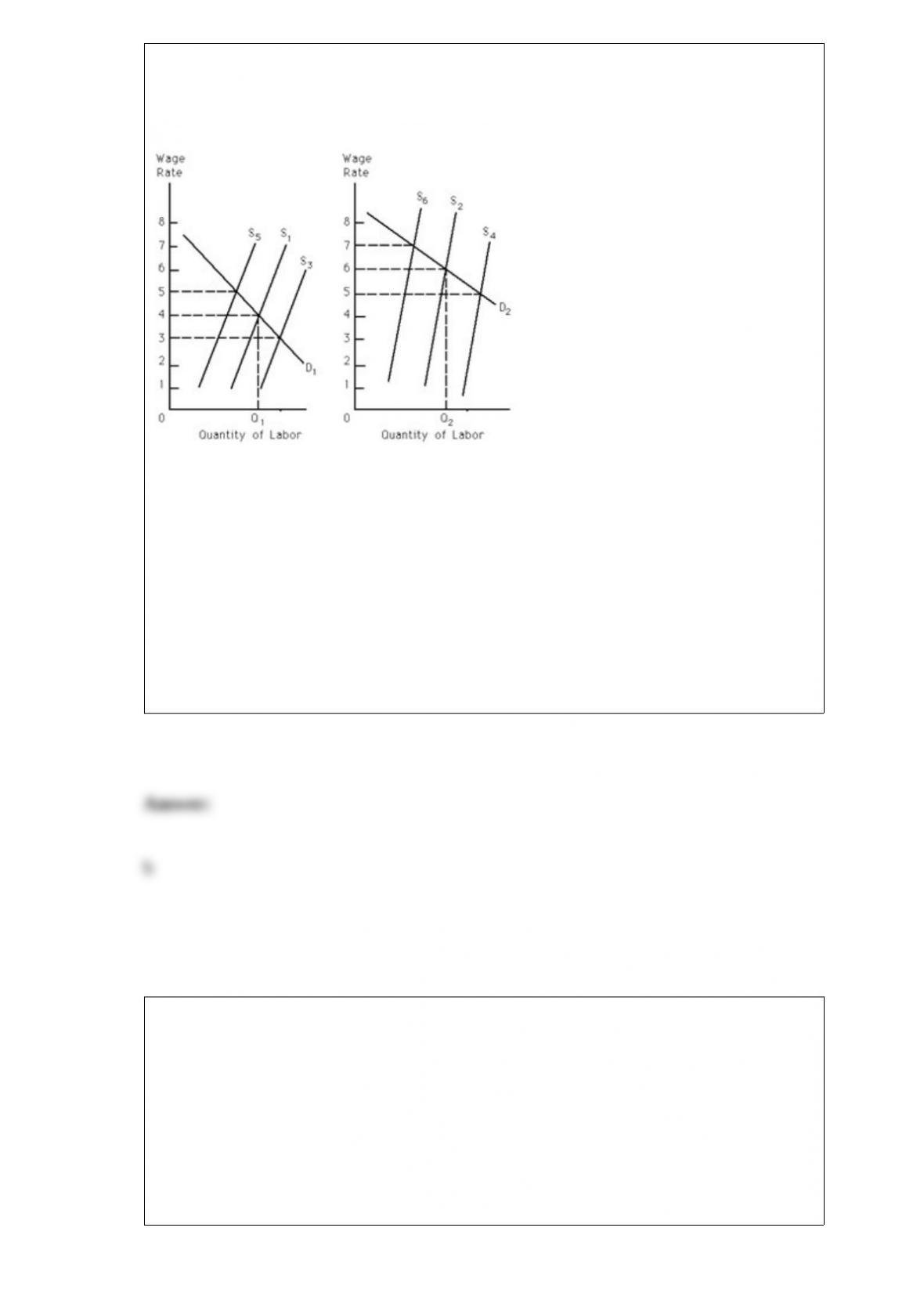
labor supply curves is to be expected?
Exhibit 27-7
Market AMarket B
a. S1 to S5 and S2 to S6
b. S1 to S5 and S2 to S4
c. S1 to S3 and S2 to S6
d. S1 to S3 and S2 to S4
In a simple majority vote on a public project,
a. the project will never be undertaken if the costs exceed the benefits.
b. the project may be undertaken even though the total costs exceed the total benefits.
c. the intensity of individual preferences is taken into account.
d. the project will always be undertaken if the total benefits exceed the total costs.

In reading the stock market quotes in the newspaper, the column with the heading “P/E”
gives the
a. number of shares of the stock traded that day.
b. dividend per share divided by the closing price per share.
c. stock symbol for the company.
d. latest closing price per share divided by the latest available earnings per share.
Suppose the production of a good results in negative externalities. If all costs are taken
into account, then
a. output will occur at the socially optimal level.
b. the price of the product will be higher than if all costs are not taken into account.
c. more output will be produced than if all costs are not taken into account.
d. a and b
e. a, b, and c

Natural monopolies exist because of
a. economies of scale.
b. diseconomies of scale.
c. decreasing returns to scale.
d. public franchises.
e. deregulation.
What looks like discrimination in the labor markets is always just a problem of the high
cost of information.
a. True
b. False
Marginal revenue product (MRP) is
a. equal to marginal revenue multiplied by marginal physical product.

b. the additional revenue generated by employing an additional factor unit.
c. the additional output generated by employing an additional factor unit.
d. a and b
e. a and c
With a quota, the __________ is greater than the __________.
a. loss in producers’ surplus; gain in consumers’ surplus
b. loss in consumers’ surplus; loss in producers’ surplus plus higher total revenues on
the imported goods
c. loss in producers’ surplus plus higher total revenues on the imported goods;
consumers’ surplus
d. tax; revenue
e. quota-determined price; quota-determined output
Agricultural price supports refer to
a. minimum prices set by the government on certain farm products.
b. maximum prices set by the government on certain farm products.

c. supply-restricting policies imposed by the government on certain farm products.
d. b and c
e. none of the above
Which of the following comes closest to being a monopsony?
a. a car manufacturer in Detroit
b. a McDonald’s in a big city
c. a coal company who employees all of the workers in a given town
d. a farmer who hires labor
Which of the following conditions does not characterize long-run competitive
equilibrium?
a. Economic profit is zero.
b. Price is greater than marginal cost.
c. No firm has an incentive to change its plant size.
d. No firm has an incentive to produce more or less output.
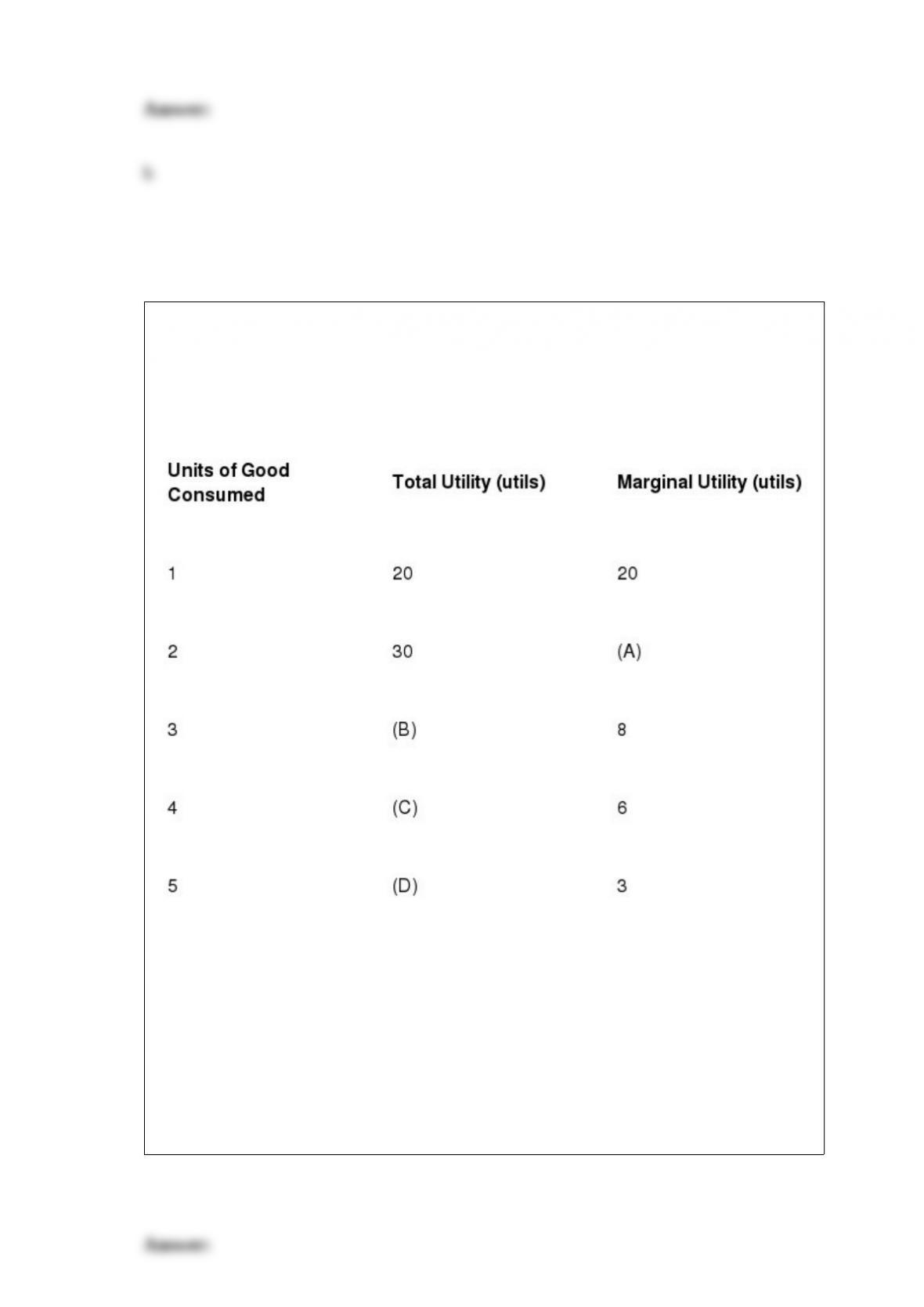
Refer to Exhibit 21-5.What value goes in blank (B)?
Exhibit 21-5
a. 27
b. 38
c. 40
d. 35
e. There is not enough information to answer this question.

The capture theory of regulation holds that regulators use their influence and power to
support the well being of the regulatory agency itself.
a. True
b. False
Suppose farmers agree to reduce their supply of foodstuffs. The most likely reason they
would want to do this is they believe that less supply
a. means higher prices and higher total revenue.
b. means consumers will buy more of what they have to sell.
c. translates into higher-quality foodstuffs and that the higher the quality of the
foodstuffs they sell, the higher the prices for what they sell.
d. will get Congress to favor them with agriculture subsidies.
e. will get Congress to decrease their taxes.
Accounting profit equals economic profit if __________ equals __________.
a. explicit costs; implicit costs
b. total revenue; marginal cost
c. implicit costs; zero
d. explicit costs; zero
e. unit cost; marginal cost
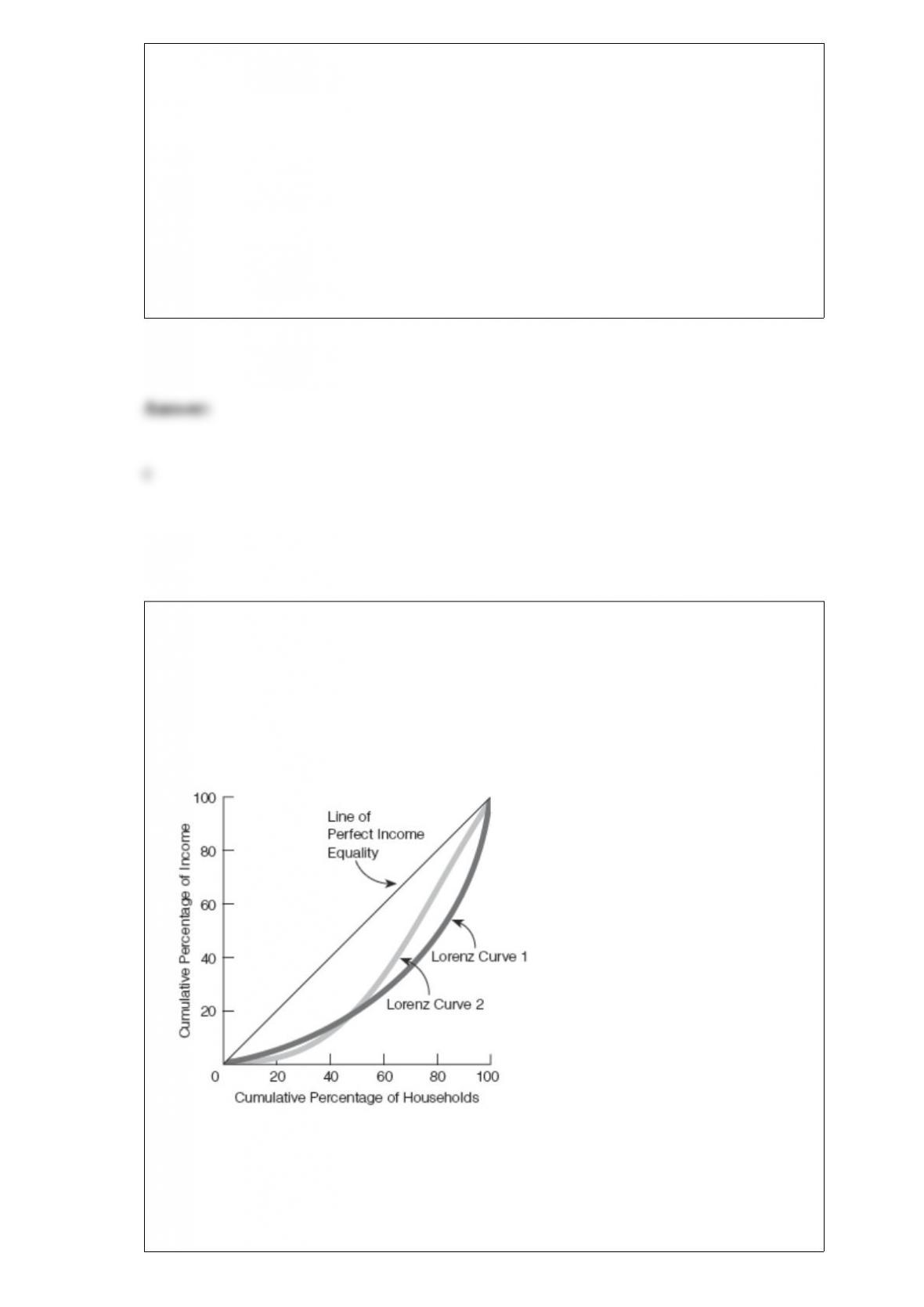
Refer to Exhibit 29-2.This graph depicts the Lorenz curve for two countries, country 1
(Lorenz curve 1) and country 2 (Lorenz curve 2).The Gini coefficient associated with
Lorenz curve 1 appears to be ____________ than the Gini coefficient associated with
Lorenz curve 2.This information indicates that the income distribution is
______________ equal in country 2 than in country 1.
Exhibit 29-2
a. lower; less
b. higher; less

c. lower; more
d. higher; more
As the marginal physical product of a variable input increases, the marginal cost
decreases.
a. True
b. False
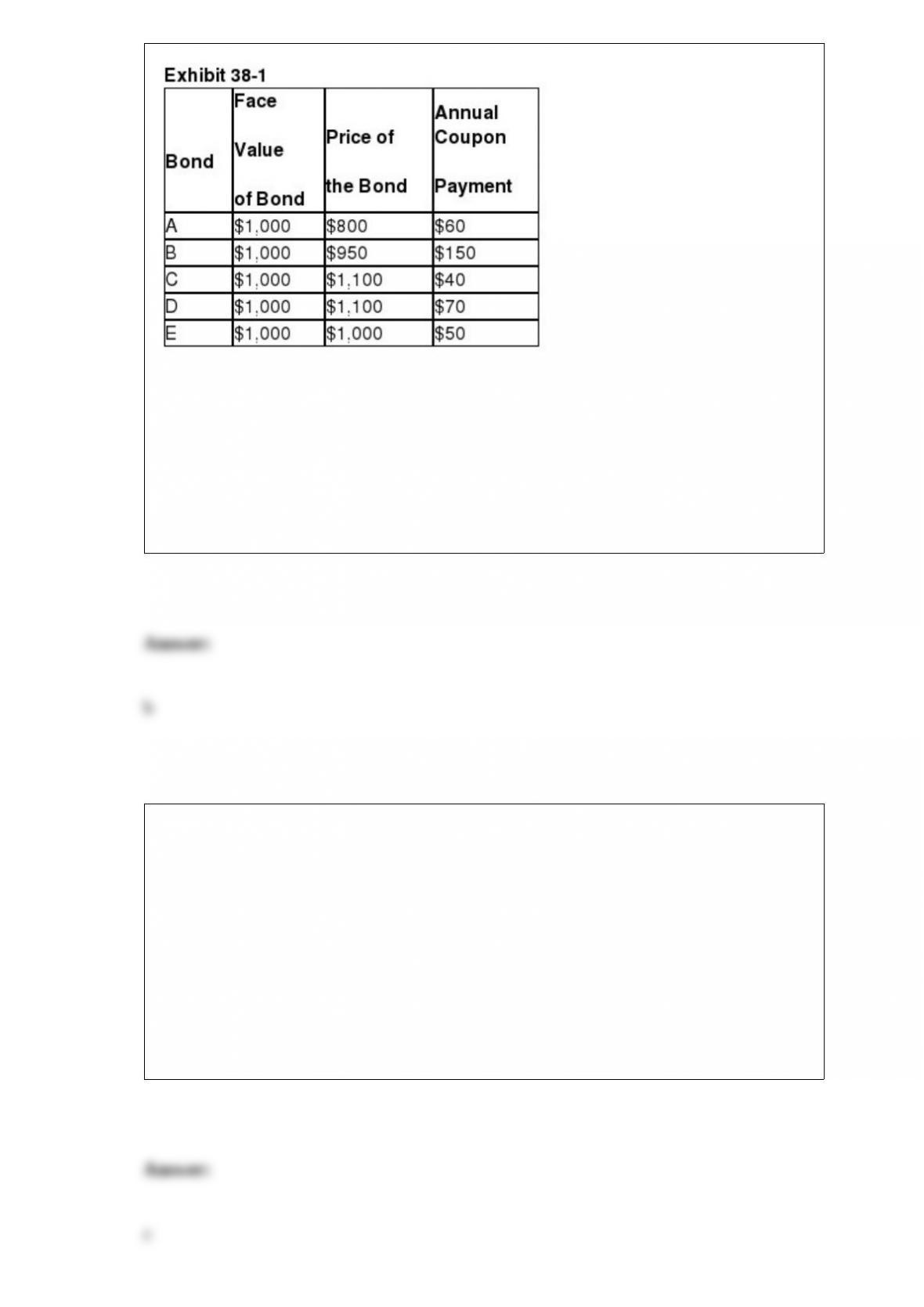
Refer to Exhibit 38-1. The yield on bond B is approximately
a. 9.5 percent.
b. 15.8 percent.
c. 0.15 percent.
d. 17 percent.
In the long run, a firm earns zero economic profit, given the condition that
a. P = MR.
b. P = AVC.
c. P = ATC.
d. (P – MC) = 0.
e. none of the above

The economy can produce 15X and 15Y, 10X and 20Y, 5X and 25Y, or OX and 30Y. It
follows that the production possibility frontier (PPF) is
a. a downward-sloping straight line.
b. an upward-sloping straight line.
c. a downward-sloping convex curve.
d. a downward-sloping concave curve.
Refer to Exhibit 23-1. The demand curve facing the firm represented by the information
in this table is
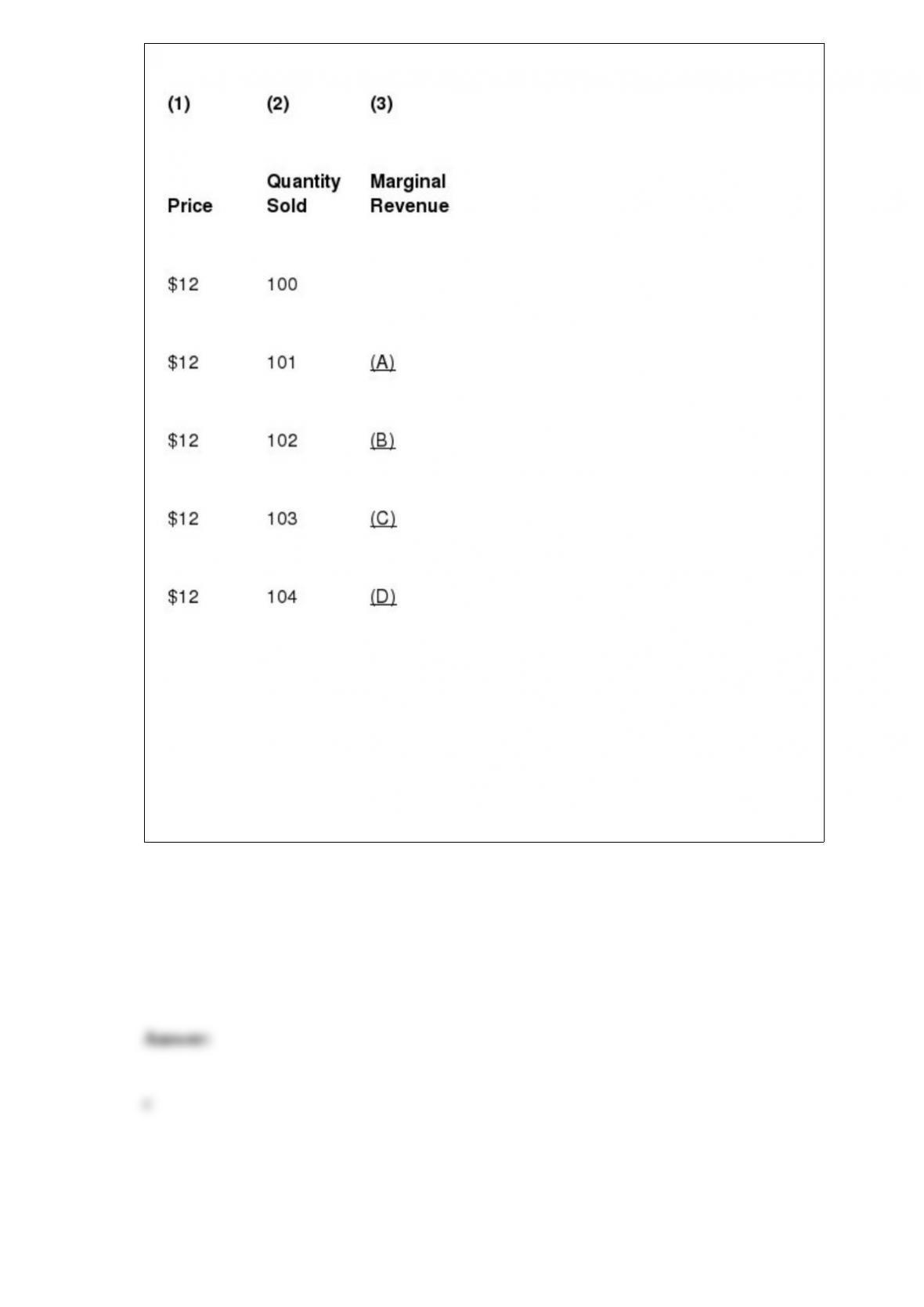
a. downward-sloping.
b. upward-sloping.
c. horizontal.
d. vertical.