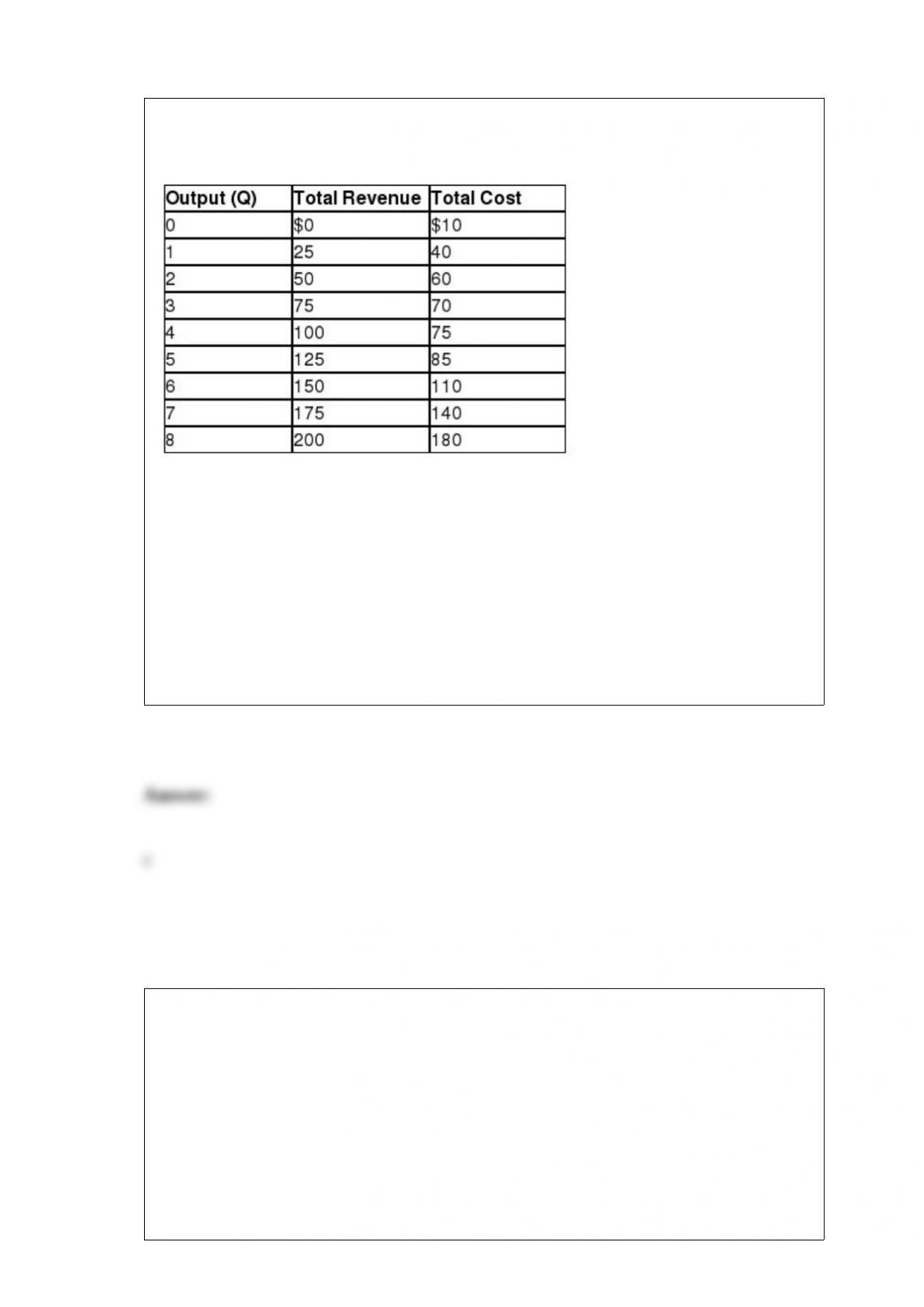
Refer to Exhibit 23-10.What price does this firm charge for its product?
Exhibit 23-10
a. $10
b. $20
c. $25
d. $30
e. There is not enough information to answer this question.
Which of the following statements is true?
a. If a consumer is in equilibrium, it does not necessarily follow that he or she is also
achieving the greatest total utility.
b. If a consumer is in equilibrium, it necessarily follows that he or she is also achieving
the greatest total utility.
c. If a consumer is attaining the greatest marginal utility, then it necessarily follows that
he or she is also achieving the greatest total utility.
d. If a consumer is attaining the greatest total utility, then it necessarily follows that he
or she is also achieving the greatest marginal utility.
A person buys X in one market and combines it with Y purchased in another market.
The combination of X and Y gives Z, which the person sells in a third market for a
higher price than the sum of the prices of X and Y. Which theory of profit is most
consistent with this example?
a. Profit is the return to being alert to an arbitrage (broadly defined) opportunity.
b. Uncertainty is the source of profit.
c. Profit is the return to the entrepreneur as innovator.
d. none of the above
Monopolistic competitive firms and perfectly competitive firms are similar in that both
a. set price equal to marginal cost.
b. face a horizontal demand curve.
c. face no barriers to entry or exit.
d. produce a homogeneous product.
e. all of the above
Economist B thinks that it is important to identify the condition(s) under which the case
for government is strongest.With respect to the provision of nonexcludable public
goods, she says
a. people must pay taxes to pay for the nonexcludable public good.
b. firms must pay taxes to pay for the nonexcludable public good.
c. people must actually want the nonexcludable public good that the government
provides.
d. people must express their desire for the nonexcludable public good by voting for it.
e. none of the above
The economist who said, “I am distressed by the sight of poverty. I am benefited by its
alleviation; but I am benefited equally whether I or someone else pays for its
alleviation; the benefits of other people’s charity therefore partly accrues to me” was
a. John Kenneth Galbraith.
b. John Rawls.
c. Milton Friedman.
d. Adam Smith.
e. David Ricardo.
A government agricultural policy that restricts output by limiting the number of farm
acres that can be used to produce a particular crop is the
a. marketing quota system.
b. acreage allotment program.
c. price support program.
d. target price system.
e. paying farmers not to produce system.
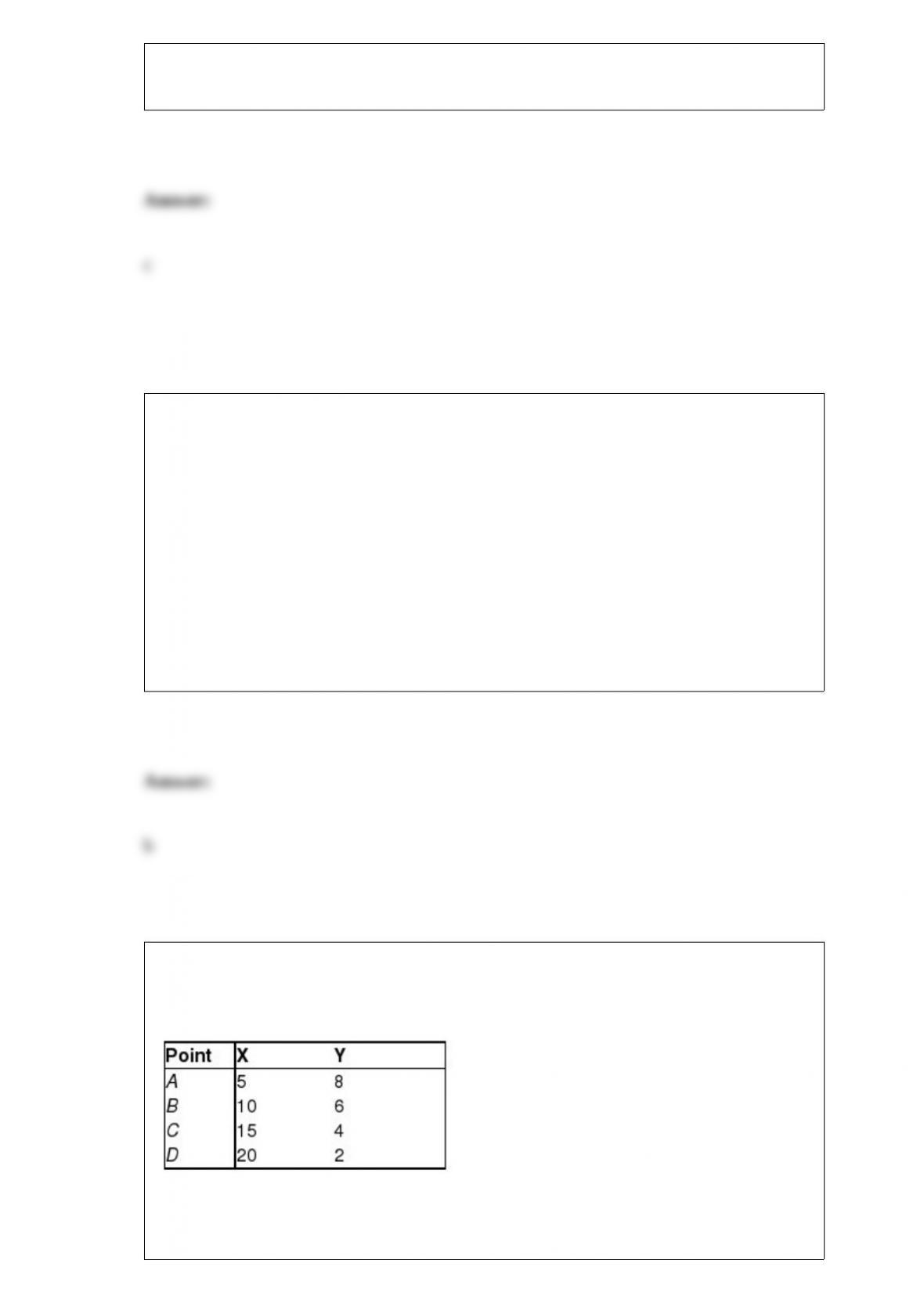
Refer to Exhibit 1-3.According to the data provided in this table, what is the slope of
the line between points C and D (if these data were graphed with X on the horizontal
axis and Y on the vertical axis)? Exhibit 1-3
a. -0.40

b. -2.50
c. 0.40
d. 2.50
e. none of the above
Refer to Exhibit 4-3. Which of the following is true?
a. If price P1 is set as a price ceiling it will have an effect on the market for good X.
b. If price P1 is set as a price floor it will have an effect on the market for good X.
c. Price P1 is the equilibrium price for good X.
d. If price P1 is set as a price floor, then it is the highest price that can legally be
charged in the market for good X.
The MU/P ratio for good X is greater than the MU/P ratio for good Y. To achieve
consumer equilibrium, the consumer reallocates dollars from the purchase of good Y to
the purchase of good X. If the law of diminishing marginal utility holds, the marginal
utility of good X __________ and the marginal utility of good Y __________.
a. falls, rises
b. rises, falls
c. rises, stays constant
d. falls, stays constant
e. stays constant, rises
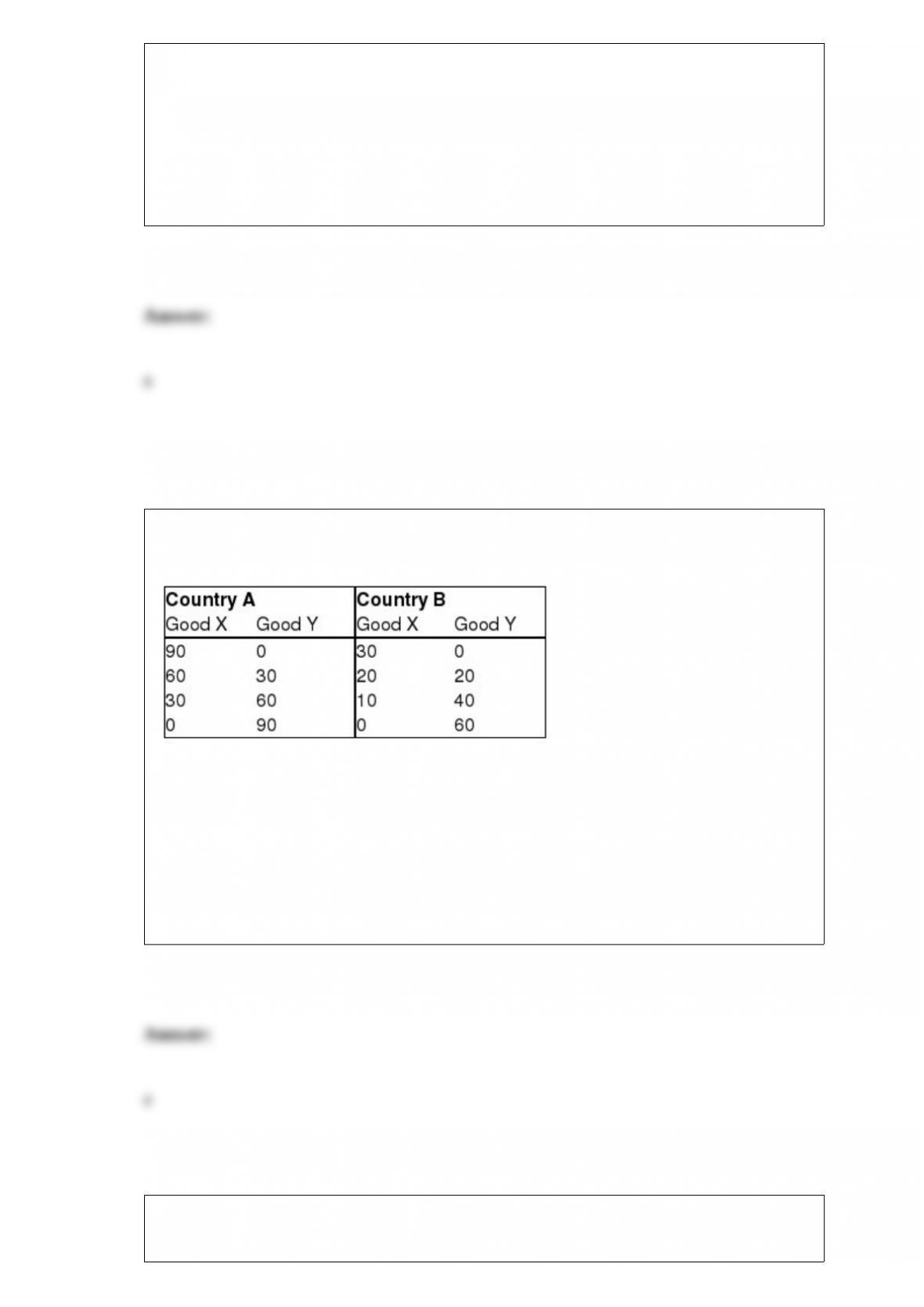
Refer to Exhibit 34-1. The opportunity cost of one unit of X in country A is
Exhibit 34-1
a. 1 unit of Y.
b. 2 units of Y.
c. 10 units of Y.
d. 0.50 units of Y.
A surplus will occur in a market when the price of the product is above the equilibrium
price.
a. True
b. False
Which of the following statements is false?
a. Externalities can sometimes be internalized through individual voluntary agreements.
b. It would be a relatively easy matter to establish property rights in the air.
c. Persuasion can be used in some cases to internalize externalities.
d. Taxes and subsidies are sometimes used as corrective devices for market failures.
A firm that is a price taker in a factor market faces a(n) __________ supply curve of
factors.
a. upward-sloping
b. horizontal
c. downward-sloping
d. vertical

Which of the following statements is true?
a. The lower the elasticity of demand for cars, the higher the elasticity of demand for
the workers that produce cars.
b. The higher the elasticity of demand for cars, the lower the elasticity of demand for
the workers that produce cars.
c. The lower the elasticity of demand for cars, the lower the elasticity of demand for the
workers that produce cars.
d. The fewer the substitute factors for union labor, the higher the elasticity of demand
for union labor.
e. c and d
Suppose the marginal utility (MU) of a paperback books is 40 utils and each costs $5
while the MU of a hamburger is 20 utils and each costs $4. If you consume one movie
and buy one hamburger per week, are you attaining consumer equilibrium?
a. Yes, so there is no need to change.
b. No. You need to buy more books and fewer hamburgers.
c. No. You need to buy more hamburgers and fewer books.
d. There is not enough information to answer the question.
The assumption that precludes economic profits in monopolistic competition in the long
run is that
a. there are many buyers and sellers.
b. the firms produce a homogeneous product.
c. there is easy entry and exit in this market structure.
d. buyers and sellers have all relevant information.