
Suppose you are eating buffalo wings at a local happy hour. The total utils from doing
so after the fourth, fifth, sixth, and seventh wings are 80, 116, 136, 146, respectively.
The marginal utility of the seventh wing is __________ utils.
a. 14
b. 146
c. 10
d. 20.9
If total utility is a positive number, marginal utility must also be a positive number.
a. True
b. False
Suppose that the total utility from consuming one unit of good X is 54 utils, the total
utility of two units of good X is 74 utils, and the total utility of three units of good X is
84 utils.The marginal utility of the third unit is
a. 10 utils.
b. 70.67 utils.
c. 12.25 utils.

d. 20 utils.
The monopolistic competitive firm faces a __________ demand curve and therefore is a
price __________.
a. downward-sloping; searcher
b. horizontal; taker
c. downward-sloping; taker
d. horizontal; searcher
Refer to Exhibit 23-1. The marginal revenue curve represented by the information in
this table is
Exhibit 23-1 (1) (2) (3)
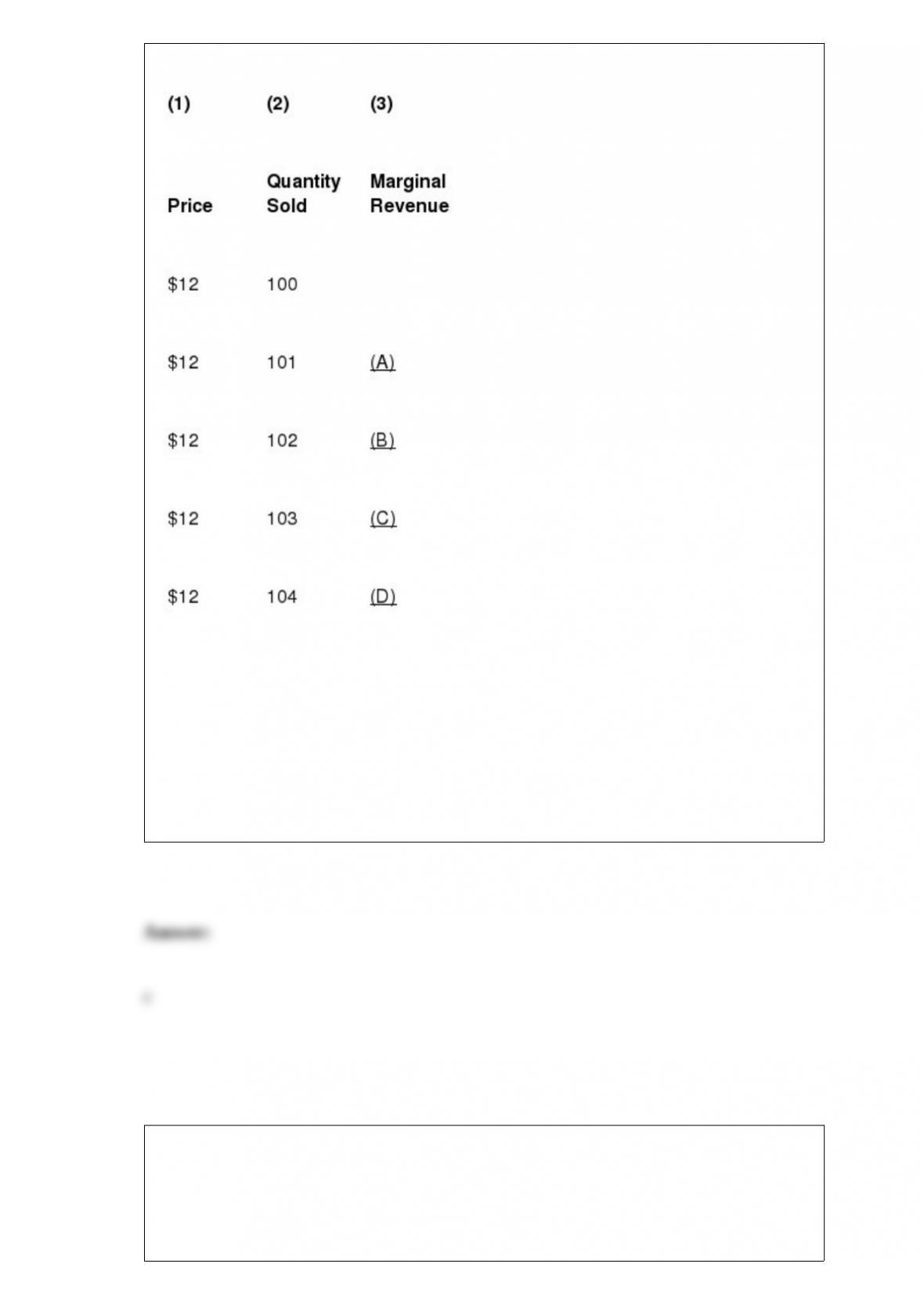
a. downward-sloping.
b. upward-sloping.
c. horizontal.
d. vertical.
Consumer equilibrium exists when the
a. slope of the indifference curve is greater than the slope of the budget constraint.
b. consumer is on his highest indifference curve.

c. marginal rate of substitution equals the slope of the budget constraint.
d. slope of the indifference curve equals the slope of the budget constraint.
e. c and d
Which of the following will reduce the cutback in union labor for a given wage
increase?
a. an increase in the number of substitutes for union labor
b. an increase in the elasticity of demand for the product that labor produces
c. a decrease in the elasticity of demand for the product that labor produces
d. an increase in the total revenue for the product that labor produces
e. a decrease in the total revenue for the product that labor produces
If price is on the vertical axis and quantity demanded is on the horizontal axis, why is a
demand curve downward sloping (left to right)?
a. Because a demand curve is the graphical representation of the law of demand, which
specifies an inverse relationship between price and supply, ceteris paribus.
b. Because a demand curve is the graphical representation of the law of demand, which

specifies a direct relationship between price and quantity supplied, ceteris paribus.
c. Because a demand curve is the graphical representation of the law of demand, which
specifies an inverse relationship between price and demand, ceteris paribus.
d. Because a demand curve is the graphical representation of the law of demand, which
specifies a direct relationship between price and demand, ceteris paribus.
e. Because a demand curve is the graphical representation of the law of demand, which
specifies an inverse relationship between price and quantity demanded, ceteris paribus.
Which of the following is descriptive of rent-seeking?
a. A domestic company hires a lobbyist to go to Washington, D.C. and try to influence
legislators to impose tariffs on Brazilian (imported) goods that compete with the good it
produces.
b. Company X hires an accountant to work for it.
c. Jill pays her apartment rent a few days late each month and usually ends up having to
pay a late fee.
d. This year Bob earned a large profit from the small business he owns and operates.
e. b and d
Refer to Situation 32-l. At the time the total yearly salary (including all the benefits) of
the average auto worker was no more than $50,000 per year, and the cost per job saved
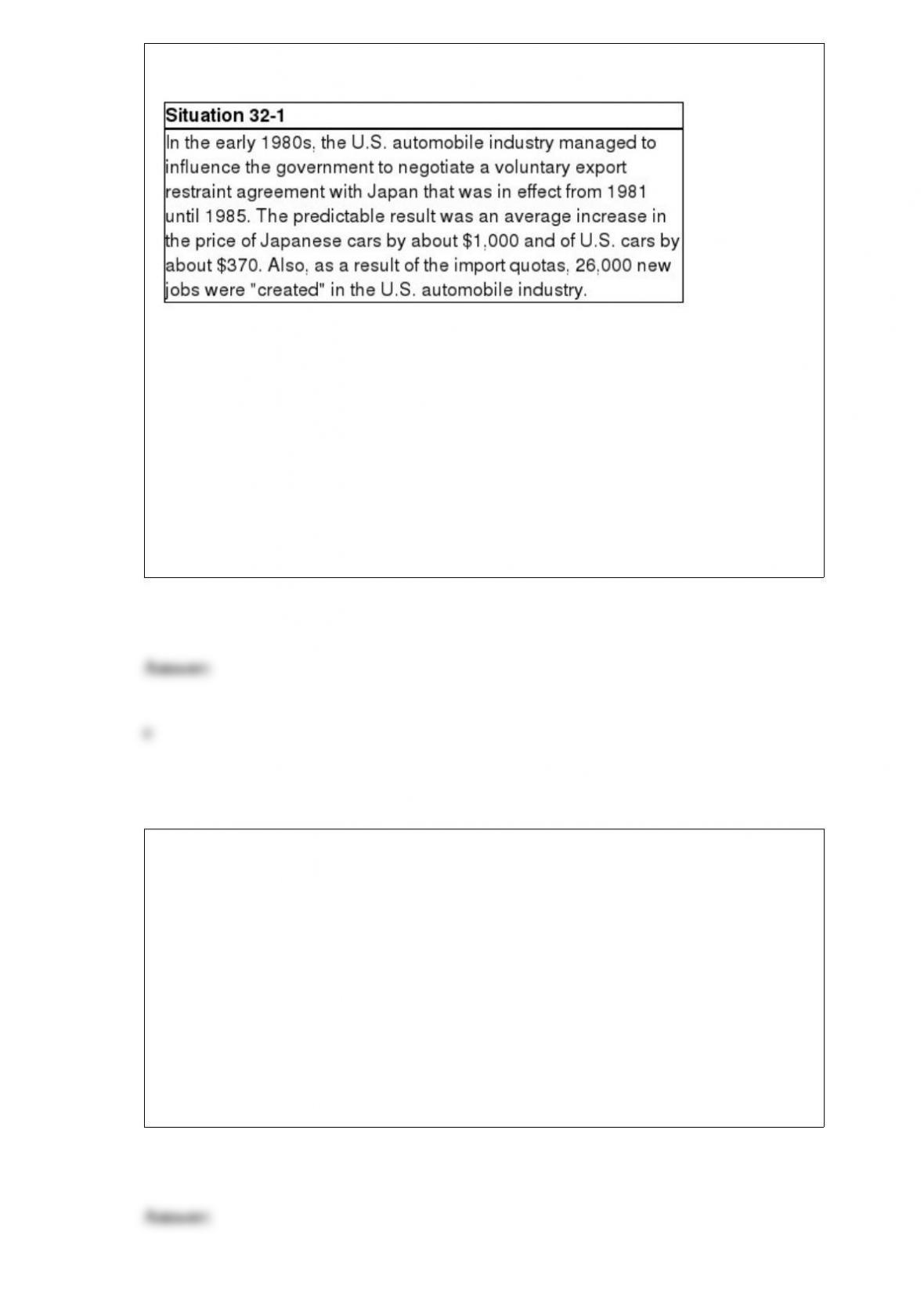
was estimated at $160,000 per worker per year. We can conclude that
a. import quotas are a cost-efficient way of saving jobs.
b. the U.S. auto industry, through its lobbying efforts, managed to promote the general
public interest.
c. the net social benefits of import quotas were positive.
d. all of the above
e. none of the above
In the case of a positive externality, in order to achieve efficiency the government must
set the _________________ equal to the marginal ____________________.
a. tax; external costs
b. tax; external benefits
c. subsidy; external costs
d. subsidy; external benefits
e. subsidy; private costs
In the real-world, which of these industries is most clearly an oligopoly?
a. wheat
b. electricity generation
c. cereal breakfast foods
d. restaurants
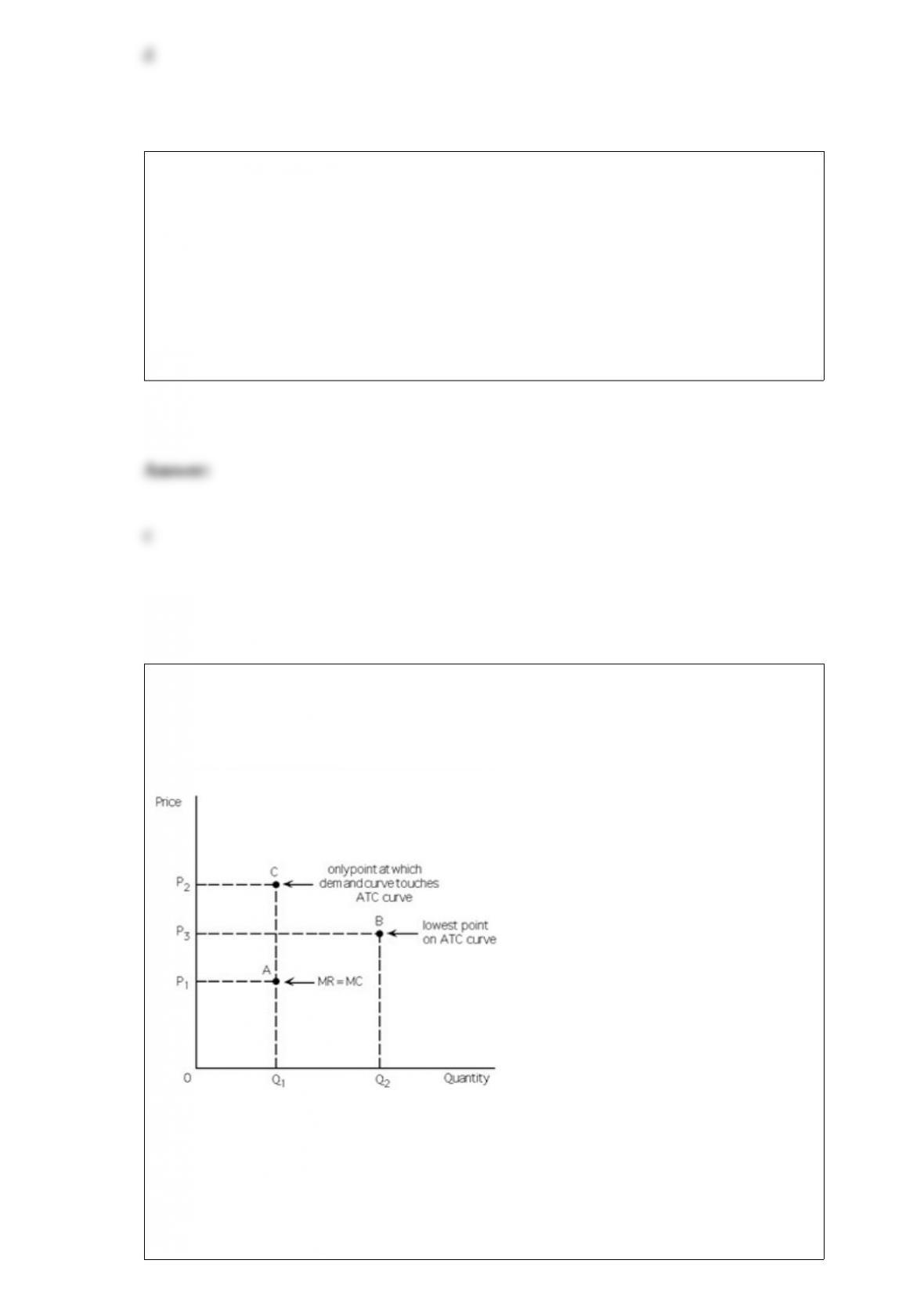
Refer to Exhibit 25-6. Excess capacity refers to the distance between
Exhibit 25-6
a. P2 and P1.
b. Q1 and point C.
c. Q2 and Q1.

d. P3 and P1.
e. P2 and point C.
The elasticity of demand for labor is 2.16. It follows that if the
a. wage rate changes by 10 percent, the demand for labor changes by 2.16 percent.
b. demand for labor changes by 2.16 percent, the wage rate changes by 1.0 percent.
c. wage rate changes by 10 percent, the quantity demanded of labor changes by 21.6
percent.
d. wage rate changes by 2.16 percent, the quantity demanded of labor changes by 2.16
percent.
e. none of the above
The cost of building a new interstate highway system is reported to be high at $25
billion. Does it necessarily follow that the interstate highway is not worth building?
a. Yes, because it is better to spend $25 billion on ending poverty than on building
another interstate highway system.
b. No, because building a new interstate highway system promotes economic growth,

which helps everyone.
c. No, because the benefits of building a new interstate highway system may be greater
than $25 billion.
d. Yes, because the benefits of building a new interstate highway system may be greater
than $25 billion.
When Hurricane Katrina hit the Gulf Coast of the United States in 2005 it destroyed
5,000,000 acres of timber.Given that lumber is timber that has been sawed or split into
planks and boards, explain in terms of supply and/or demand how the hurricane
impacted each of the following markets (be sure to note the expected resulting impact
on equilibrium price and quantity):
a. Domestic lumber
b. Imported lumber
c. New home construction