
During the twentieth century, the U.S. farm sector experienced
a. large increases in its ability to produce output.
b. relatively little improvement in its ability to produce output.
c. a marked decrease in its ability to produce output.
d. relatively stable demand for its output.
e. increasing relative prices for its output.
The monopoly firm may earn positive economic profits in the long run because
a. it produces a homogeneous product.
b. it is the only firm that wishes to produce the product.
c. of high barriers to entry.
d. a and c
e. all of the above
The price at which a perfectly competitive firm sells its product is determined by
a. the individual seller based on his costs of production and his profit margin.

b. all sellers and buyers of the product.
c. the buyers of the product, because there are so many sellers that they cannot agree on
a price.
d. the government, because there are so many buyers and sellers of the product that
together they cannot agree on the price.
The Robinson-Patman Act of 1936 prohibited
a. large retailers from selling at prices below those prices charged by small retailers.
b. large retailers from engaging in false and deceptive acts and practices.
c. suppliers from offering price discounts to large retailers unless they also offered
discounts to all other retailers.
d. customers from seeking out the lowest-priced good from different retailers.
e. all of the above
Rent seeking occurs when the seller charges
a. different prices for the product it sells, and the price differences do not reflect cost
differences.
b. the highest price each consumer would be willing to pay for the product rather than

go without it.
c. a uniform price per unit for one specific quantity, a lower price for an additional
quantity, and so on.
d. a and c
e. none of the above
If the demand curve for agricultural products is inelastic, then it would be in the best
interest of farmers as a group to
a. increase output and thereby receive greater revenues.
b. cause the price of their product to decrease.
c. find some way to decrease the quantities of output that are placed on the market for
sale.
d. petition the government to find a way to decrease the demand for their product.
e. a and b
Labor unions tend to favor strictly enforced immigration laws with the intention of
lowering the elasticity of demand for union labor.
a. True

b. False
As the price of good X rises, the demand for good Y falls. Therefore, goods X and Y are
a. substitutes.
b. normal goods.
c. complements.
d. inferior goods.
e. none of the above
The marginal utility curve for units 6 through 8 of good Z lies below the horizontal
axis.What does this imply must be true about the total utility curve for units 6 through 8
of good Z?
a. That portion of good Z’s total utility curve must be upward sloping.
b. That portion of good Z’s total utility curve must be downward sloping.
c. That portion of good Z’s total utility curve must be horizontal.
d. That portion of good Z’s total utility curve must also lie below the horizontal axis.
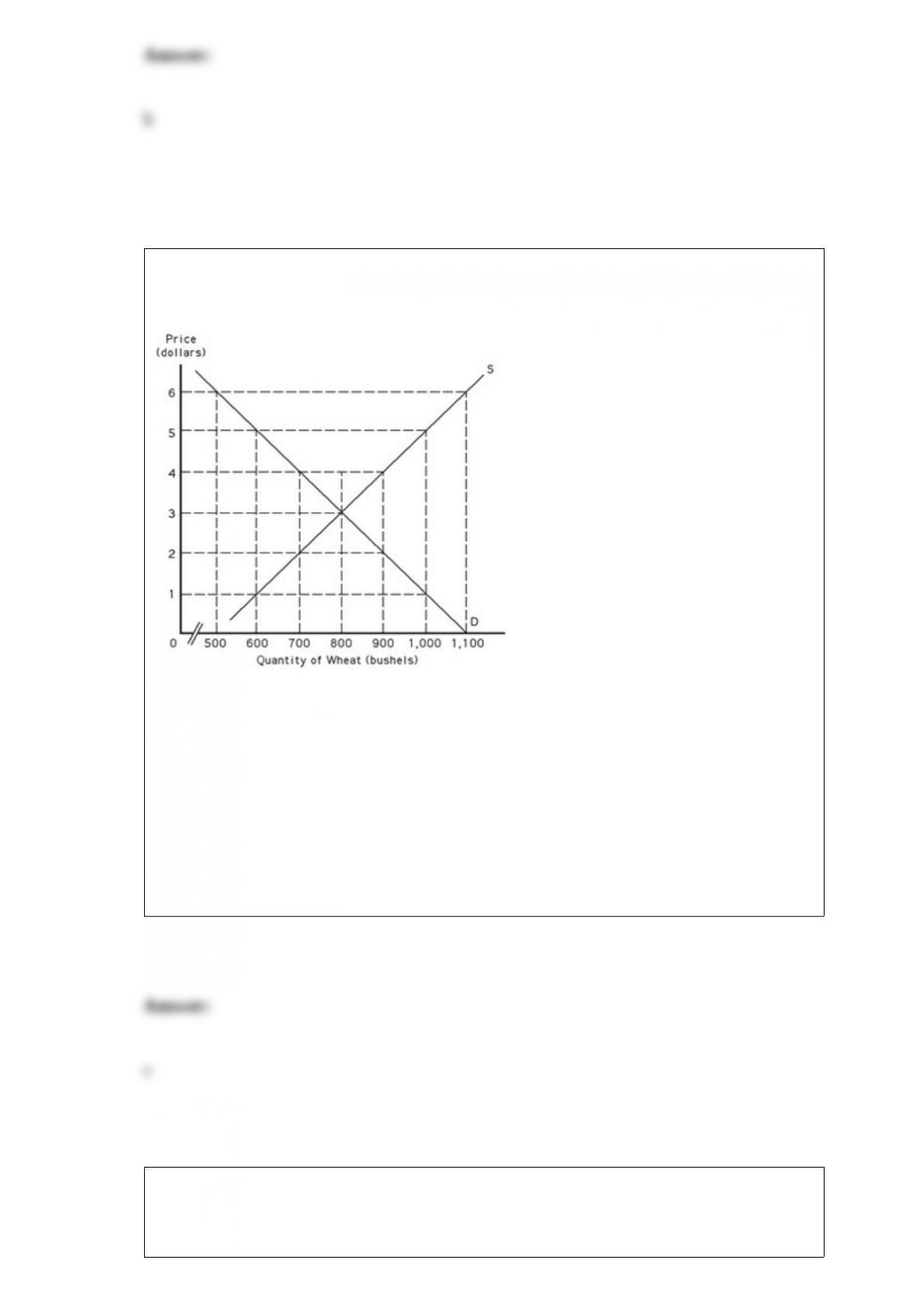
Refer to Exhibit 39-4. The price support of $6 per bushel would cost the government
Exhibit 39-4
a. $600.
b. $3,000.
c. $3,600.
d. $4,800.
e. $6,600.
The term after the bell means after the closing of the stock market.
a. True

b. False
Michelle can work at job A earning $50,000 a year, job B earning $83,000 a year, or job
C earning $85,000 a year. If Michelle chooses job C, then her economic rent from
working at that job rather than job A is
a. $35,000.
b. $2,000.
c. $0.
d. $33,000.
Cy recently went into the business of producing and selling cardboard boxes. For this
business, which of the following is most likely to be a fixed cost?
a. fire insurance
b. labor costs
c. paper costs
d. adhesive costs
e. b, c, and d are equally likely to be fixed costs
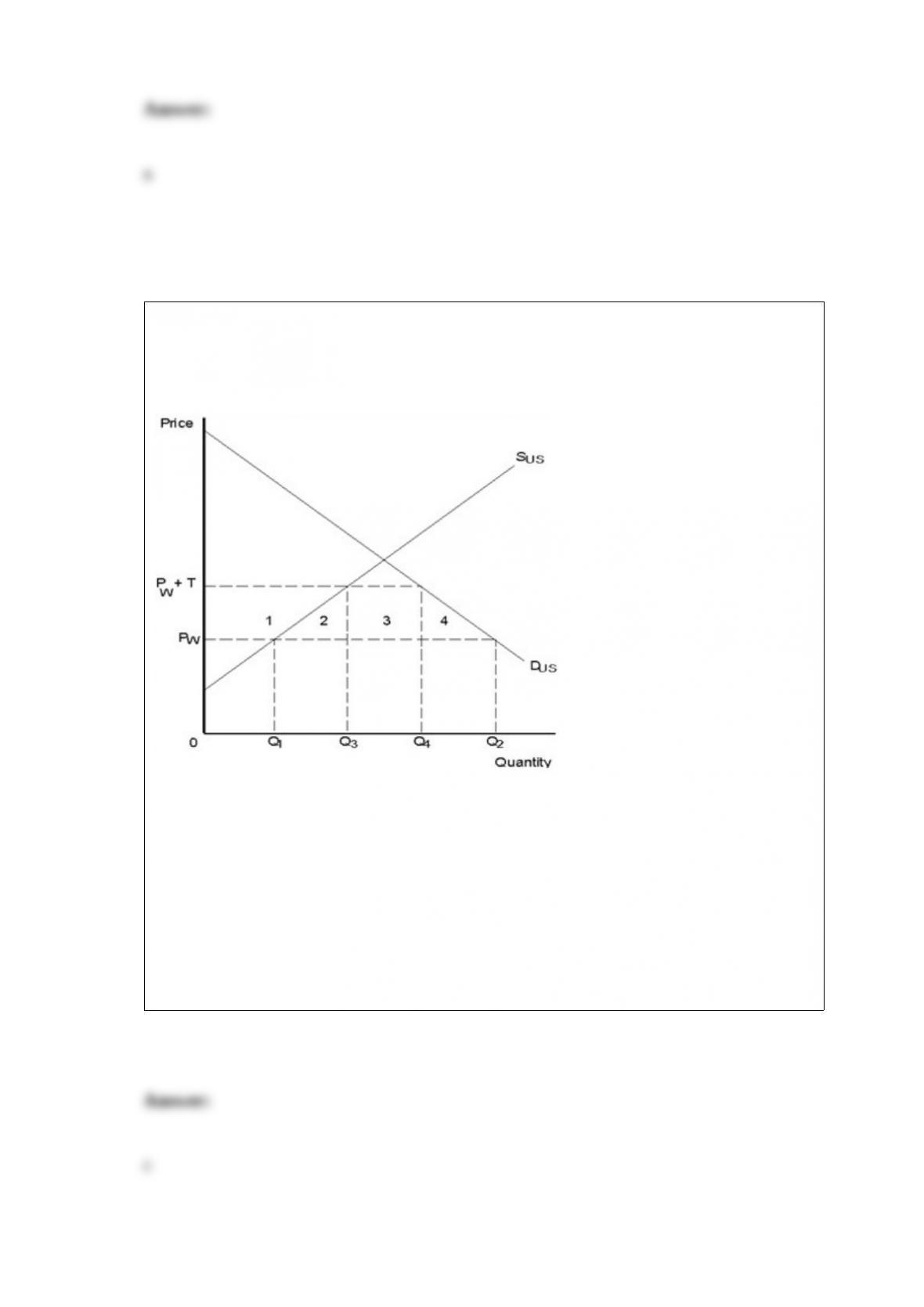
Refer to Exhibit 34-3. The world price is PW. If a tariff is imposed, the price rises to PW
+ T. Because of the tariff, government collects tariff revenues equal to the area of
Exhibit 34-3
a. 1.
b. 1 + 2.
c. 3.
d. 1 + 2 + 4.
e. 1 + 3.
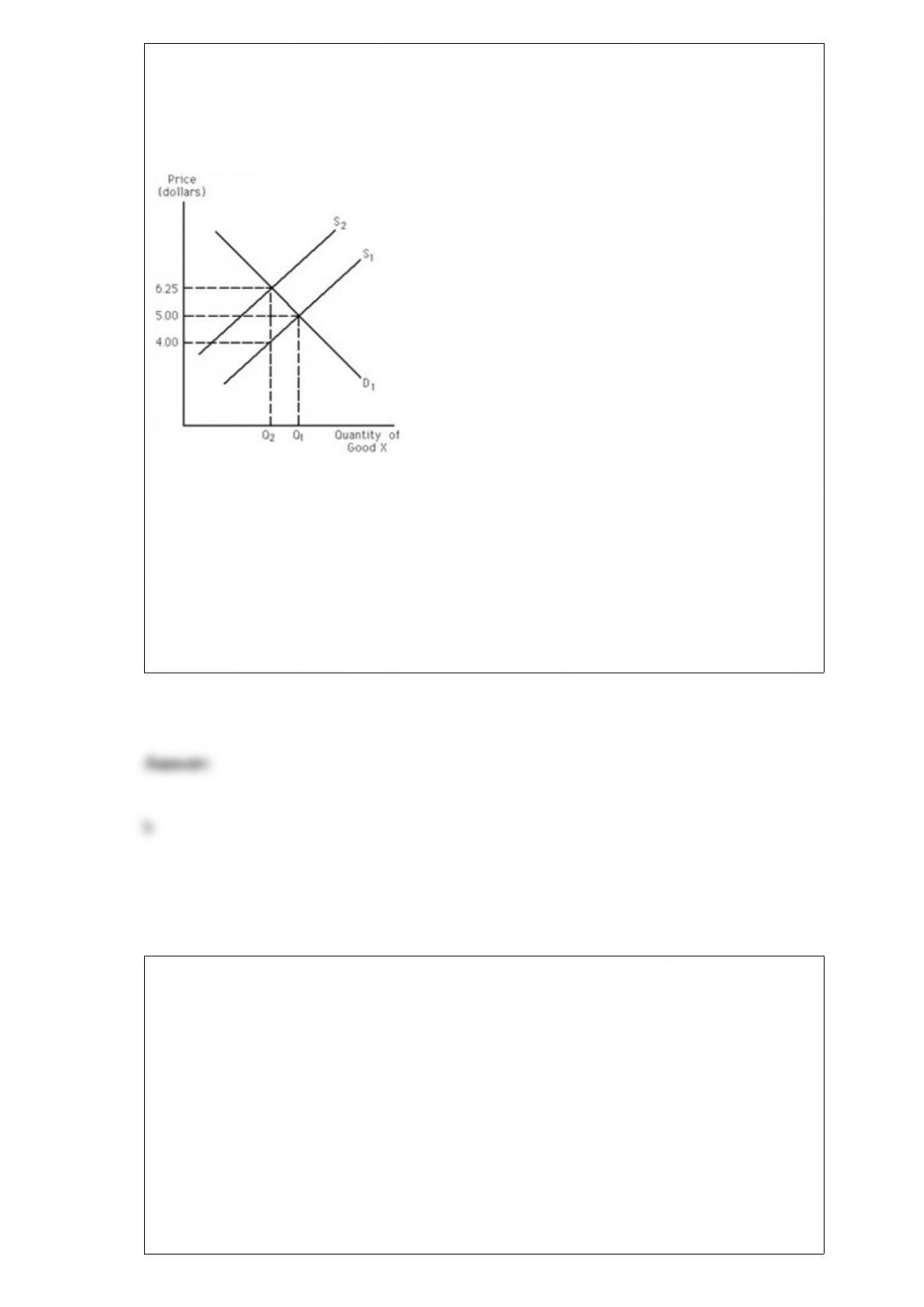
Refer to Exhibit 20-2. The market for good X is initially in equilibrium at $5. The
government then places a per-unit tax on good X, as shown by the shift of S1 to S2.
What is the per-unit tax equal to?
Exhibit 20-2
a. $1.00
b. $2.25
c. $0.25
d. $4.00
e. $1.25
An externality is internalized if
a. the person(s) or group that generated the externality incorporate into their own
private cost-benefit calculations the external benefits (in the case of a positive
externality) or the external costs (in the case of a negative externality) that third parties
bear.
b. people are made aware of it and realize that social benefits are less than private
benefits (in the case of a positive externality) and that social costs are less than private
costs (in the case of a negative externality).
c. the person(s) or group that generated the externality do not incorporate into their own
private cost-benefit calculations the external benefits (in the case of a positive
externality) or the external costs (in the case of a negative externality) that third parties
bear.
d. b and c
e. none of the above
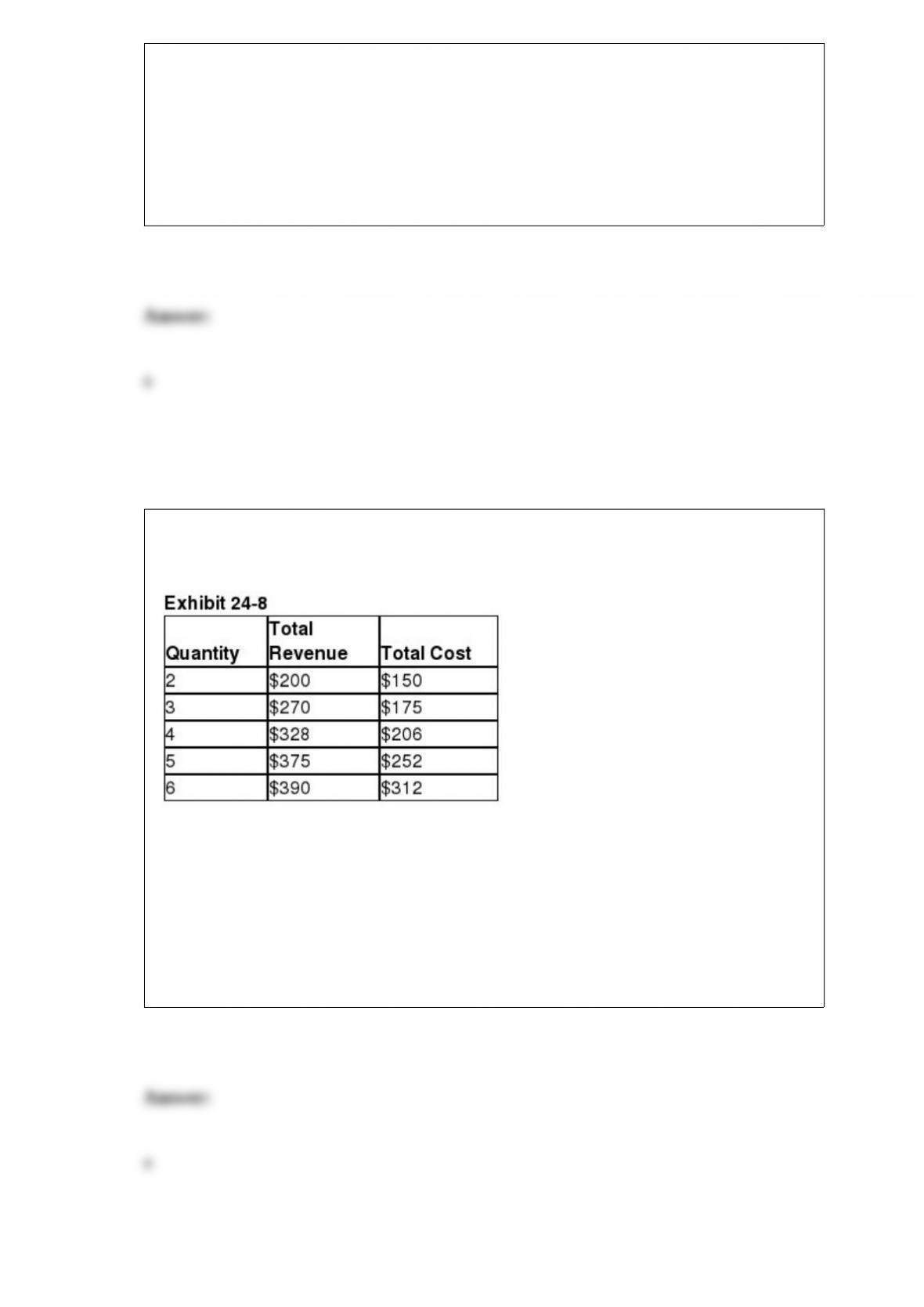
Refer to Exhibit 24-8. The maximum profits earned by a single-price monopolist will be
a. $127.
b. $50.
c. $95.
d. $32.
As the price of good X rises from $1.50 to $1.75 the result is a decrease in the quantity
demanded of good X from 650 units to 590 units. The price elasticity of demand for
good X is _____________ and total revenue __________ as the price of good X rises
from $1.50 to $1.75.
a. 0.63; falls
b. 1.59; rises
c. 1.59; falls
d. 0.63; rises
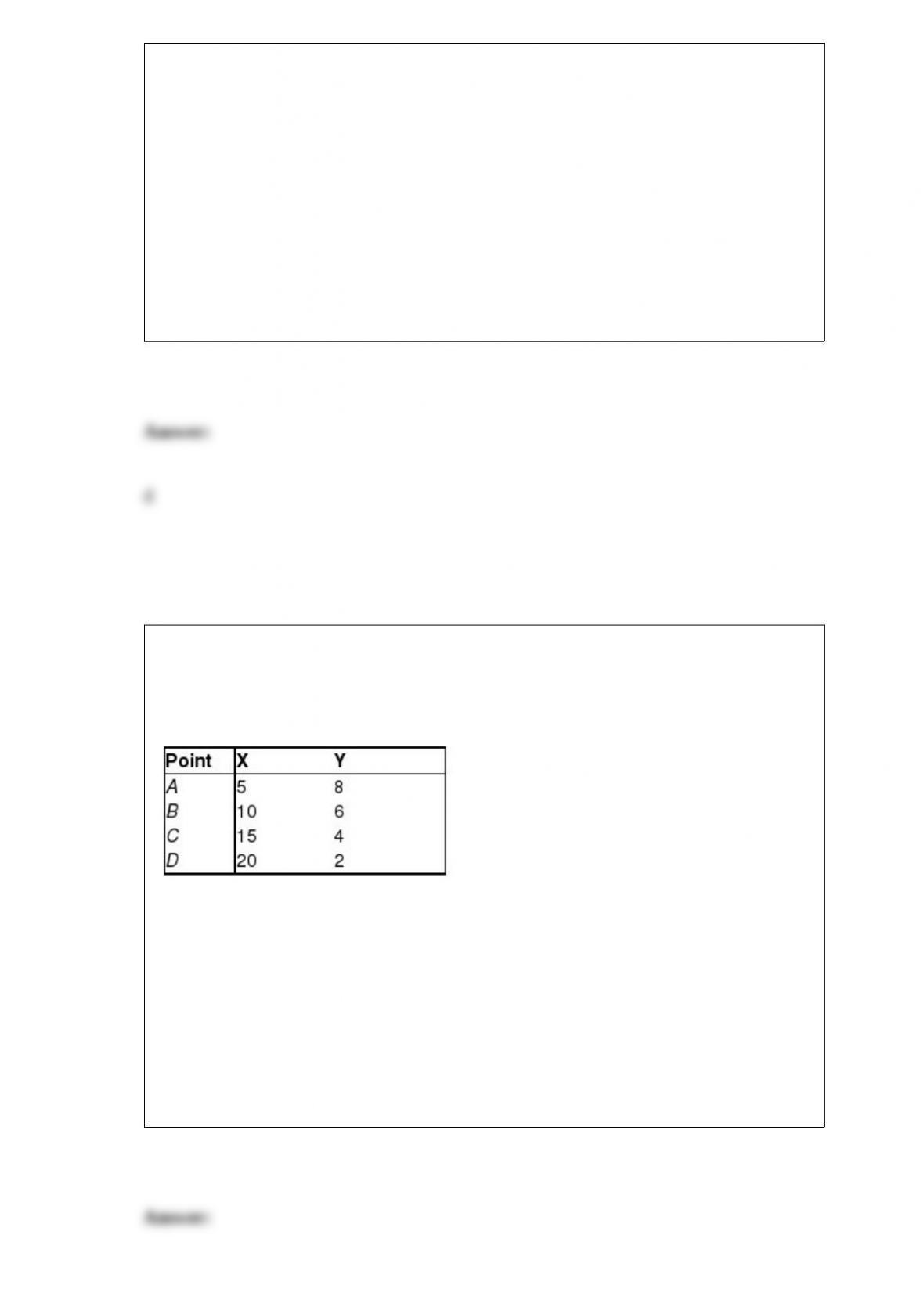
Refer to Exhibit 1-3.According to the data provided in this table, what is the slope of
the line between points A and B, if these data were graphed with X on the horizontal
axis and Y on the vertical axis?
Exhibit 1-3
a. -0.40
b. -2.50
c. 0.40
d. 2.50
e. none of the above

Consider two options: (A) you receive a guaranteed payment of $100; (B) a coin is
tossed and if heads comes up, you win nothing; if tails comes up, you win $200. The
expected payoff for option B is:
a. $200
b. $100
c. $300
d. $75
e. There is not enough information to answer the question.