
A perfectly competitive firm is a price taker.
a. True
b. False
According to public choice theory, low voter turnouts are the result of voters
a. being apathetic.
b. being uninformed.
c. being lazy.
d. disliking the candidates.
e. calculating their costs and benefits of voting.
Refer to Exhibit 23-2. If the firm produces the quantity of output at which marginal
revenue (MR) equals marginal cost (MC), is it guaranteed maximum profit or
minimized loss?
Exhibit 23-2
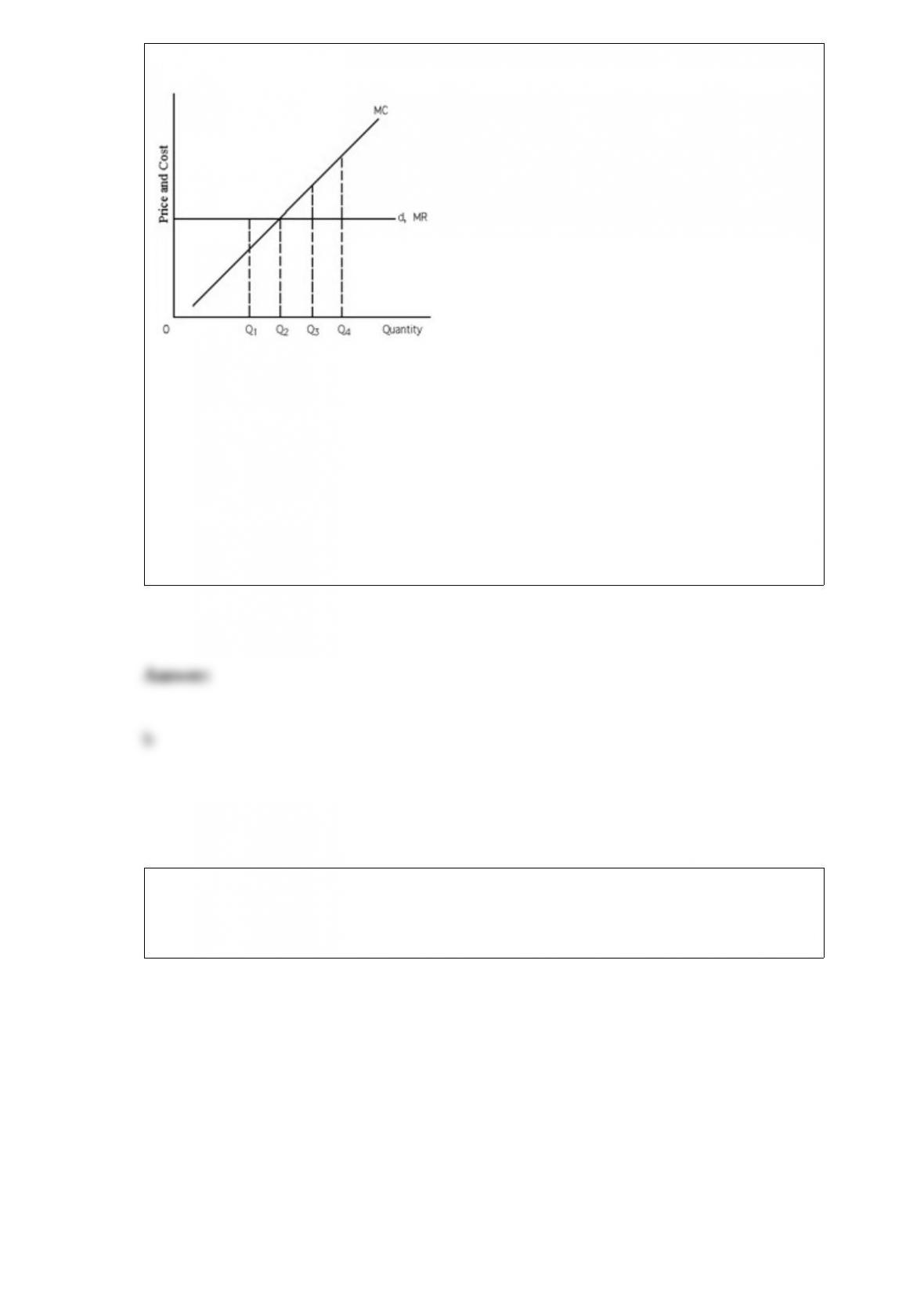
a. Yes, when MR = MC, it follows that MR – MC
= 0, and thus the firm maximizes profit and minimizes losses.
b. No, at the quantity of output at which MR = MC, it could be the case that average
variable cost is greater than price and the firm would do better to shut down.
c. Yes, when the firm produces the quantity at which MR = MC, it has maximized both
revenue and profit.
d. Yes, because if the MC curve is rising, the average total cost curve always lies below
it and thus profit is earned.
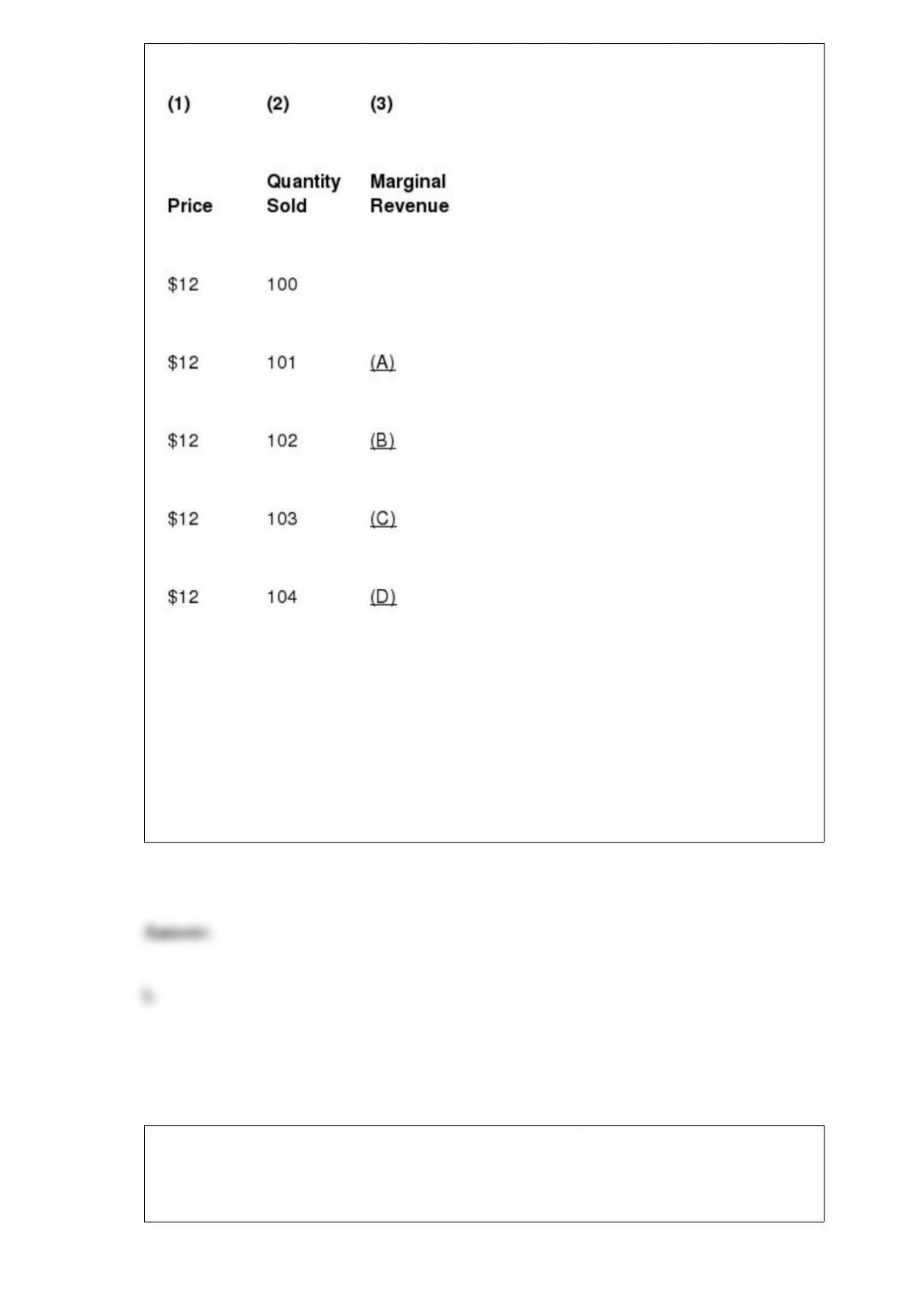
Refer to Exhibit 23-1. The dollar amounts that go in blanks (A) and (B) are,
respectively,
Exhibit 23-1
a. $1 and $12.
b. $12 and $12.
c. $8.42 and $8.50.
d. $12 and $6.
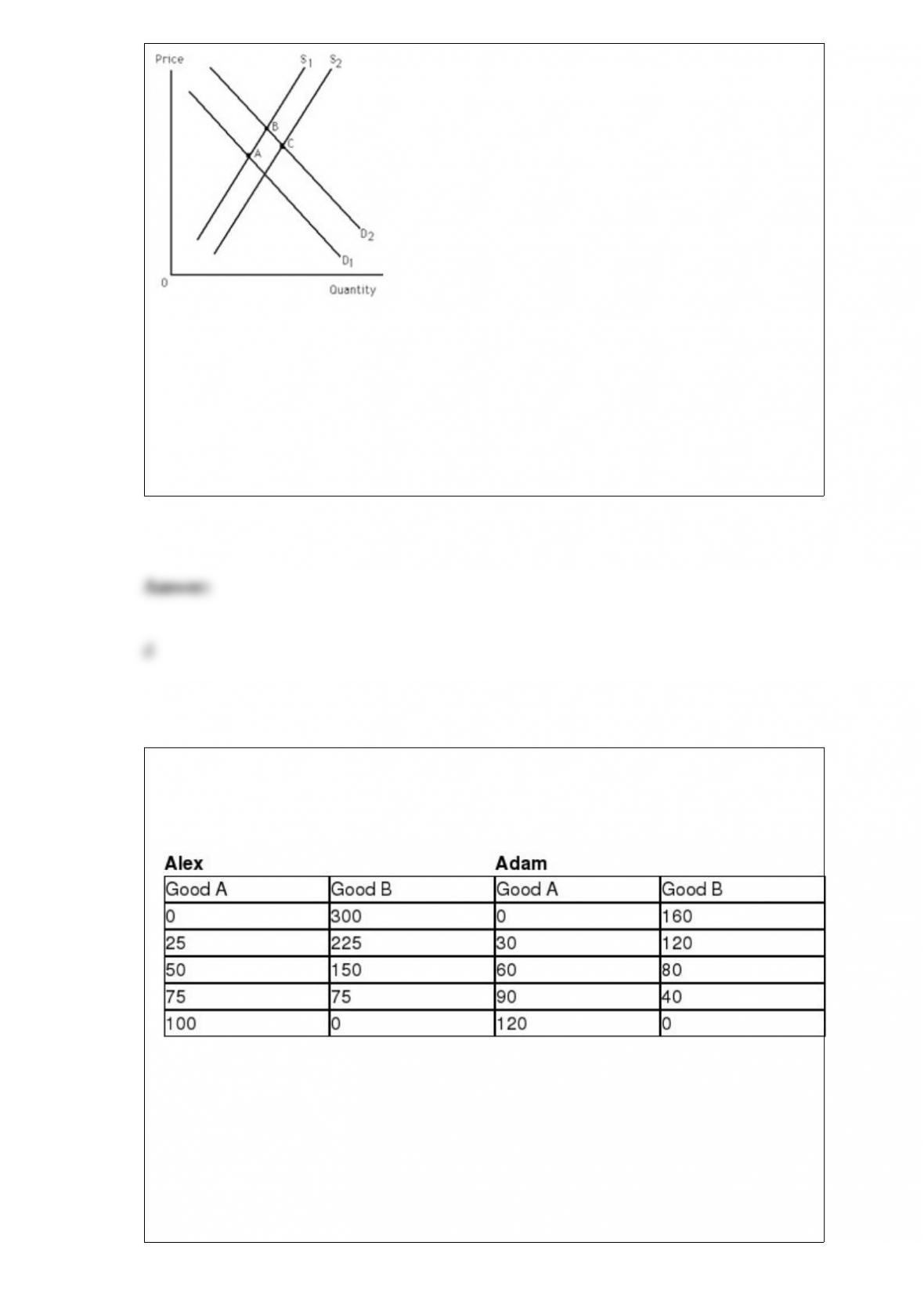
Refer to Exhibit 3-2. Which of the following would result in a movement from point A
on D1 to point B on D2?
Exhibit 3-2
Good X a. There was a decrease in the price of a substitute for good X.
b. There was an increase in the price of a complement to good X.
c. There was a decline in technology in the production of good X.
d. There was an increase in the price of a substitute for good X.
Refer to Exhibit 2-9. For Adam, the opportunity cost of producing one unit of good B is
____________ unit(s) of good A.
Exhibit 2-9
a. 3.00
b. 0.33
c. 0.75
d. 1.33

If the demand for a product that labor produces is highly elastic, a small percentage
increase in price will __________ quantity demanded of the product by a relatively
__________ percentage, which, in turn, will __________ the demand for the labor that
produces the product.
a. increase; small; slightly reduce
b. decrease; small; greatly increase
c. decrease; large; greatly increase
d. decrease; large; greatly reduce
e. increase; large; greatly reduce
Price ceilings and price floors
a. shift demand and supply curves and therefore have no effect upon the rationing
function of prices.
b. interfere with the rationing function of prices.
c. make the rationing function of free markets more efficient.
d. cause surpluses and shortages, respectively.

Why must profits be zero in long-run competitive equilibrium?
a. If profits are not zero, firms will enter or exit the industry.
b. If profits are not zero, firms will produce higher-quality goods.
c. If profits are not zero, marginal revenue will rise.
d. If profits are not zero, marginal cost will rise.
Positive externalities can be internalized using persuasion, but persuasion is not
effective with negative externalities.
a. True
b. False

Second-degree price discrimination is discrimination among
a. units.
b. quantities.
c. buyers.
d. prices.
One theory discussed in the textbook is that there is a direct relationship between the
opportunity cost of having children and the number of children a woman will have.
a. True
b. False
Politicians will usually
a. prefer to discuss means rather than ends.
b. prefer to discuss the issues in specific terms rather than in general terms.
c. not like to be perceived as either an extreme “right-winger” or an extreme
“left-winger.”
d. refer to their opponents as “middle-of-the-roaders.”
The law of diminishing marginal utility helps to explain why supply curves are
generally upward sloping.
a. True
b. False
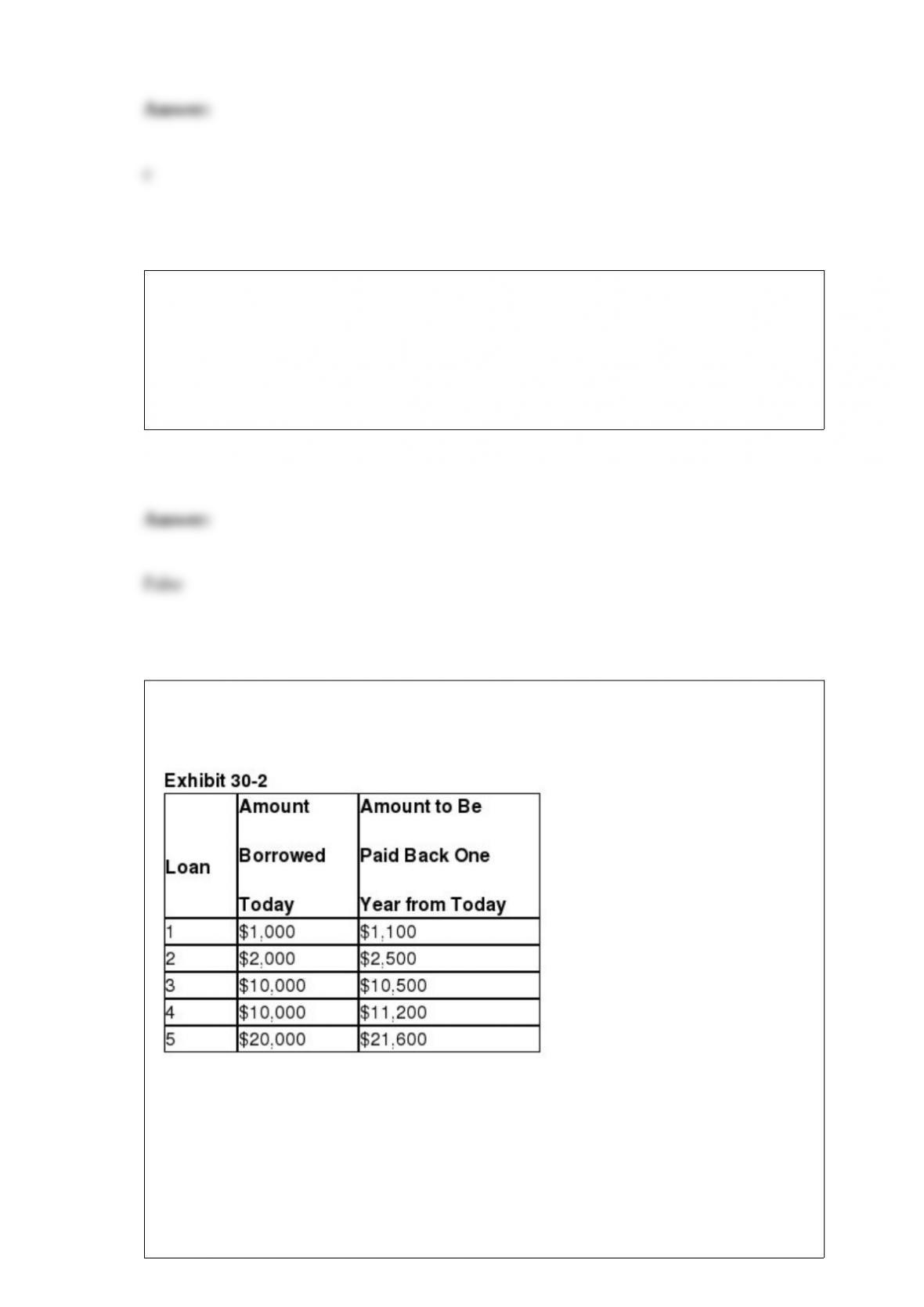
Refer to Exhibit 30-2. The interest and interest rate for loan 2 are, respectively,
a. $500 and 25.0 percent.
b. $2,500 and 25.0 percent.
c. $500 and 12.5 percent.
d. $2,500 and 12.5 percent.

e. none of the above
Interest rates differ because of differences in
a. risk.
b. the term of the loan.
c. the cost of making the loan.
d. a and b
e. all of the above
When a store offers an incentive for buying more, such as charging $50 for one sweater
or $90 for two sweaters, it is an example of price discrimination.
a. True
b. False

Which of the following statements is false?
a. If a firm is a factor price taker, marginal factor cost is constant and equal to factor
price. This means a factor price taker pays a wage equal to its marginal factor cost.
b. Firms hire the factor quantity at which marginal revenue product equals marginal
factor cost.
c. If a firm is a product price taker, marginal revenue product is greater than value
marginal product.
d. If a firm is product price taker and a factor price taker, it pays labor a wage equal to
its value marginal product.
An agricultural price support
a. will create a surplus in the relevant market, assuming the price support is above
equilibrium price.
b. will create a shortage in the relevant market, assuming the price support is above
equilibrium price.
c. is an example of a price floor.
d. will lead to greater total revenue for farmers if demand (for the product) farmers sell
is inelastic between the equilibrium price and the price support (and assuming the price
support is above equilibrium price).
e. a, c, and d

Which of the following statements is sequentially correct?
a. Changes in marginal physical product change marginal cost, which changes average
variable and average total cost.
b. Changes in marginal cost change marginal physical product, which changes average
variable and average total cost.
c. Changes in average variable cost change marginal cost, which changes average total
cost, which changes marginal physical product.
d. Changes in average variable and average total cost change marginal cost, which
changes marginal physical product.
Refer to Exhibit 24-1. If the product is produced under single-price monopoly, what do
total costs equal at the profit maximizing level of output?
a. area 0P1BQ1
b. area BCA
c. area P1P2CB
d. area P2CAP1
e. none of the above

When a good is nonexcludable, then individuals
a. will purchase the good for more than what it cost to produce the good.
b. can obtain the benefits of the good without paying for it.
c. have an incentive to become free riders.
d. will purchase more than the optimum amount.
e. b and c
A network good is a good whose value decreases as the expected number of units sold
increases.
a. True
b. False
Refer to Exhibit 3-6. If D1 is the relevant demand curve, a decrease in the price of good
X may cause
Exhibit 3-6
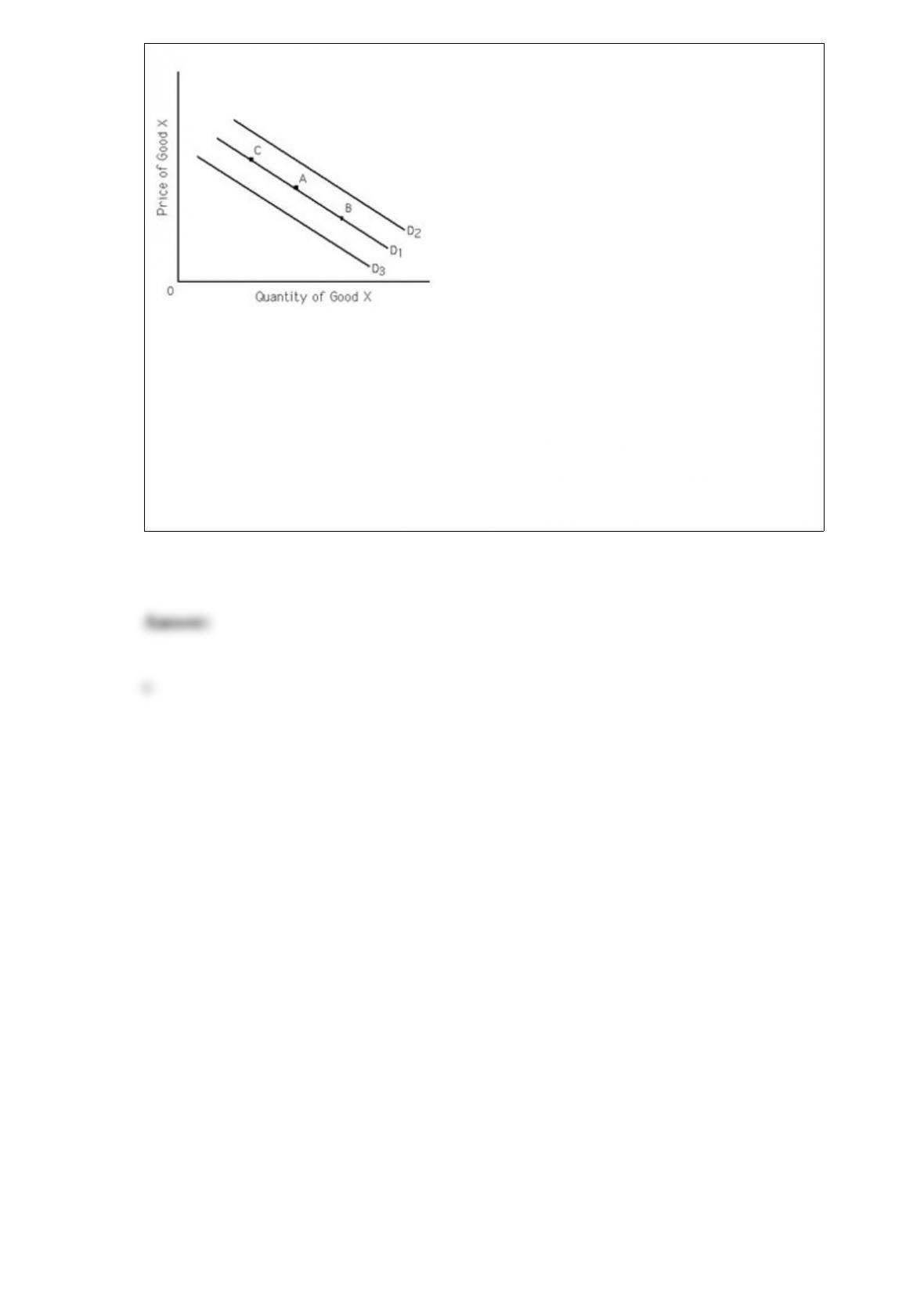
a. demand to shift from D1 to D2.
b. demand to shift from D1 to D3.
c. a movement along D1 from point A to point B.
d. a movement along D1 from point A to point C.