
Which of the following statements is false?
a. A subsidy can be used to internalize a negative externality; a tax can be used to
internalize a positive externality.
b. Ronald Coase stressed the reciprocal nature of externalities.
c. One way to deal with negative externalities is for government to apply regulations
directly to the activity that generates the externalities.
d. Simply because taxes and subsidies are sometimes used to adjust for negative and
positive externalities, respectively, it does not necessarily follow that the socially
optimal level of output will be reached.
Which of the following illustrates the law of demand?
a. Jorge buys fewer pencils at $2 per pencil than at $1 per pencil, ceteris paribus.
b. Chen buys more ice cream at $4 per half-gallon than at $3 per half gallon, ceteris
paribus.
c. Karissa buys fewer sweaters at $50 each than at $35 each, ceteris paribus.
d. a, b, and c
e. a and c
Refer to Exhibit 23-9. Assume that demand increases from D1 to D2; in the new long
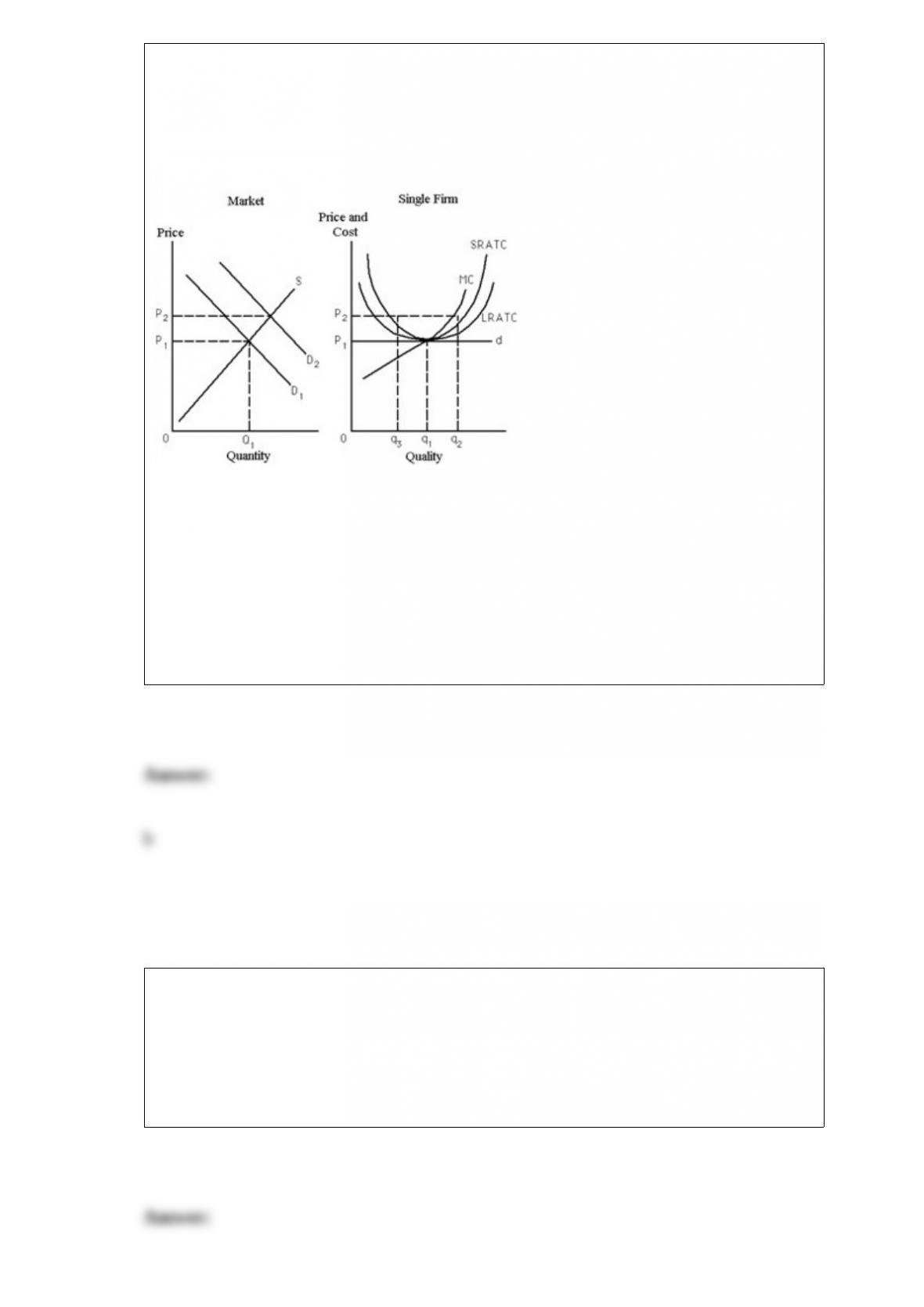
run equilibrium, price settles at a level between P1 and P2 This means that the industry
in question is a(n) __________-cost industry.
Exhibit 23-9
a. decreasing
b. increasing
c. constant
d. marginal
e. low
For a given labor market, an increase in the MPP of labor will shift the demand curve
for labor rightward.
a. True
b. False

Suppose Andrea is taking just two courses and is at a point inside her PPF of grades for
those two courses.If Andrea changes her work habits then it is impossible for
a. either one of her grades to rise.
b. both of her grades to rise.
c. both of her grades to fall.
d. either one of her grades to rise while the other grade remains constant.
e. none of the above is impossible in this situation
When a firm decides whether or not to relocate its production to another country, they
must consider both the pay of the workers and the marginal productivity of the workers.
a. True
b. False
The __________ problem in the market for used cars is capable of collapsing the
market for __________.

a. adverse selection; good used cars
b. adverse selection; lemons
c. moral hazard; good used cars
d. moral hazard; lemons
The ______________ the gap between the tuition a college student pays and the
equilibrium tuition for that college, the _____________ likely the student’s instructors
will be on time and attentive during their office hours.
a. larger; less
b. smaller; more
c. larger; more
d. smaller; less
e. a and b
In contrast to a tariff, a quota does not
a. reduce consumers’ surplus.
b. increase producers’ surplus.

c. generate revenues for government.
d. raise price.
e. c and d
The law of supply states that price and quantity supplied are
a. inversely related, ceteris paribus.
b. directly related, ceteris paribus.
c. not related.
d. fixed.
Special interest group X receives a 1/150th slice of the economic pie.Its net benefits
from an economic growth policy are $7,000, which are the same as its net benefits from
a transfer policy.What is the change in the size of the economic pie (Real GDP) that is
required to bring about this result?
a. $1,050,000
b. $46.67
c. $150,000
d. $2,500,000

e. none of the above
In the textbook, economics is defined as the science of
a. money and business.
b. choices.
c. scarcity.
d. price.
e. individuals’ actions.
For a perfectly competitive firm, the demand curve it faces is horizontal at the price
determined in the market.
a. True
b. False

Economies of scale refer to
a. the minimum point on the short-run average total cost curve.
b. the flat portion of the long-run average total cost curve.
c. a decrease in the long-run average total cost of production as output increases.
d. a and b
e. none of the above
A bond purchaser bought a bond from which she receives $800 a year from the issuer. If
the face value of the bond is __________ then the coupon rate is __________.
a. $10,000; 10 percent
b. $8,000; 8 percent
c. $10,000; 8 percent
d. $8,000; 12 percent
e. none of the above
The antitrust legislation that declares illegal “unfair methods of competition in

commerce” is
a. the Sherman Act.
b. the Clayton Act.
c. the Federal Trade Commission Act.
d. the Robinson-Patman Act.
If the purchase and sale of a currently illegal drug (for example, marijuana) were
decriminalized, economists would expect
a. an increase in demand and supply of this drug.
b. an increase in demand and a decrease in supply of this drug.
c. a decrease in demand and an increase in supply of this drug.
d. a decrease in demand and supply of this drug.
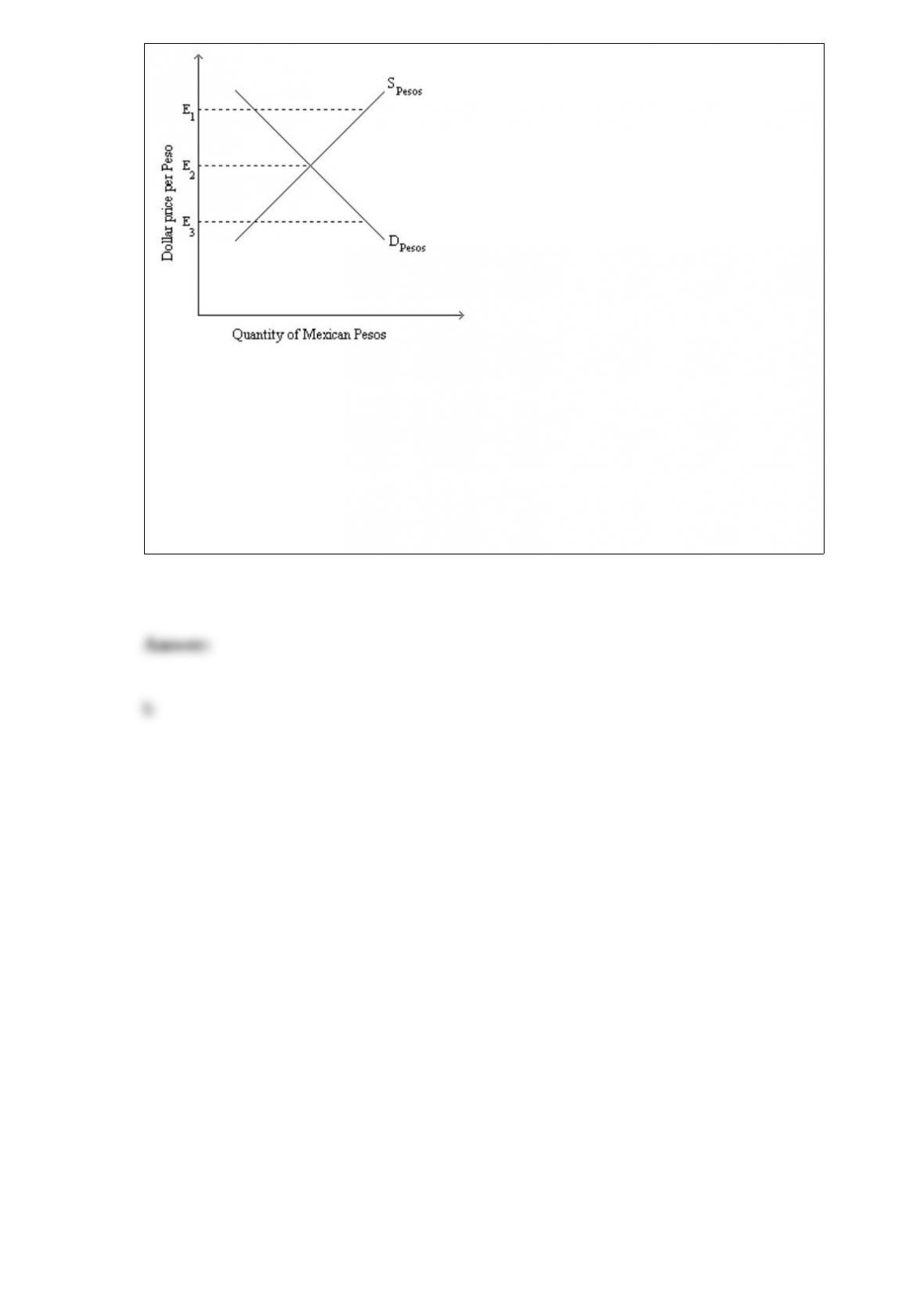
Refer to Exhibit 35-4. Under a fixed exchange rate system, at the exchange rate of E3,
the peso is __________ and there is a __________.
Exhibit 35-4
a. overvalued; surplus of dollars
b. undervalued; shortage of pesos
c. overvalued; shortage of dollars
d. undervalued; surplus of pesos