
When negative externalities are connected with the production of a good,
a. market output will be greater than the socially optimal output.
b. private costs and social costs are equal.
c. the government should subsidize the production of the good.
d. there will be a shortage of the good.
The ________________________ Acts, passed by the British Parliament in the 1760s,
imposed taxes on a variety of products imported into the American colonies.
a. Smoot-Hawley Tariff
b. Tea
c. Townsend
d. British East India
Which of the following is true?
a. The price elasticity of demand for Royal Crown Cola is higher than the price
elasticity of demand for soft drinks in general.
b. The price elasticity of demand for Royal Crown Cola is lower than the price elasticity

of demand for soft drinks in general.
c. The price elasticity of demand for Royal Crown Cola is equal to the price elasticity of
demand for soft drinks in general.
d. It is invalid to make interproduct elasticity comparisons.
As evidenced by one of the exhibits in the textbook, union wages are ___________
higher than non-union wages in the same industry.
a. always
b. sometimes
c. rarely
d. never
The market demand curve for labor is
a. the horizontal summation of the firms’ demand curves for labor, derived exactly the
same way the product market demand curve is derived from the consumers’ demand
curves.
b. the vertical summation of the firms’ demand curves for labor.
c. any one firm’s demand curve labor multiplied horizontally by the number of firms in
the labor market.
d. none of the above
If the minimum wage law sets a price floor that is below the equilibrium wage in the
unskilled labor market, the minimum wage will create a shortage of unskilled labor.
a. True
b. False
For ABC, Inc., 250,000 units of output per year represent minimum efficient scale. If
ABC, Inc. decides to produce 200,000 units this year, it will be operating in the region
of
a. decreasing returns to scale.
b. economies of scale.
c. diseconomies of scale.

d. constant returns to scale.
e. none of the above
Price elasticity of demand is a measure of the responsiveness of quantity demanded to
changes in
a. interest rates.
b. price.
c. supply.
d. demand.
Refer to Exhibit 39-8. Assume that E1 represents the initial equilibrium in the market
for grain X. As a result of a breakthrough in genetic engineering that develops an
insect-resistant variety of grain X,
Exhibit 39-8
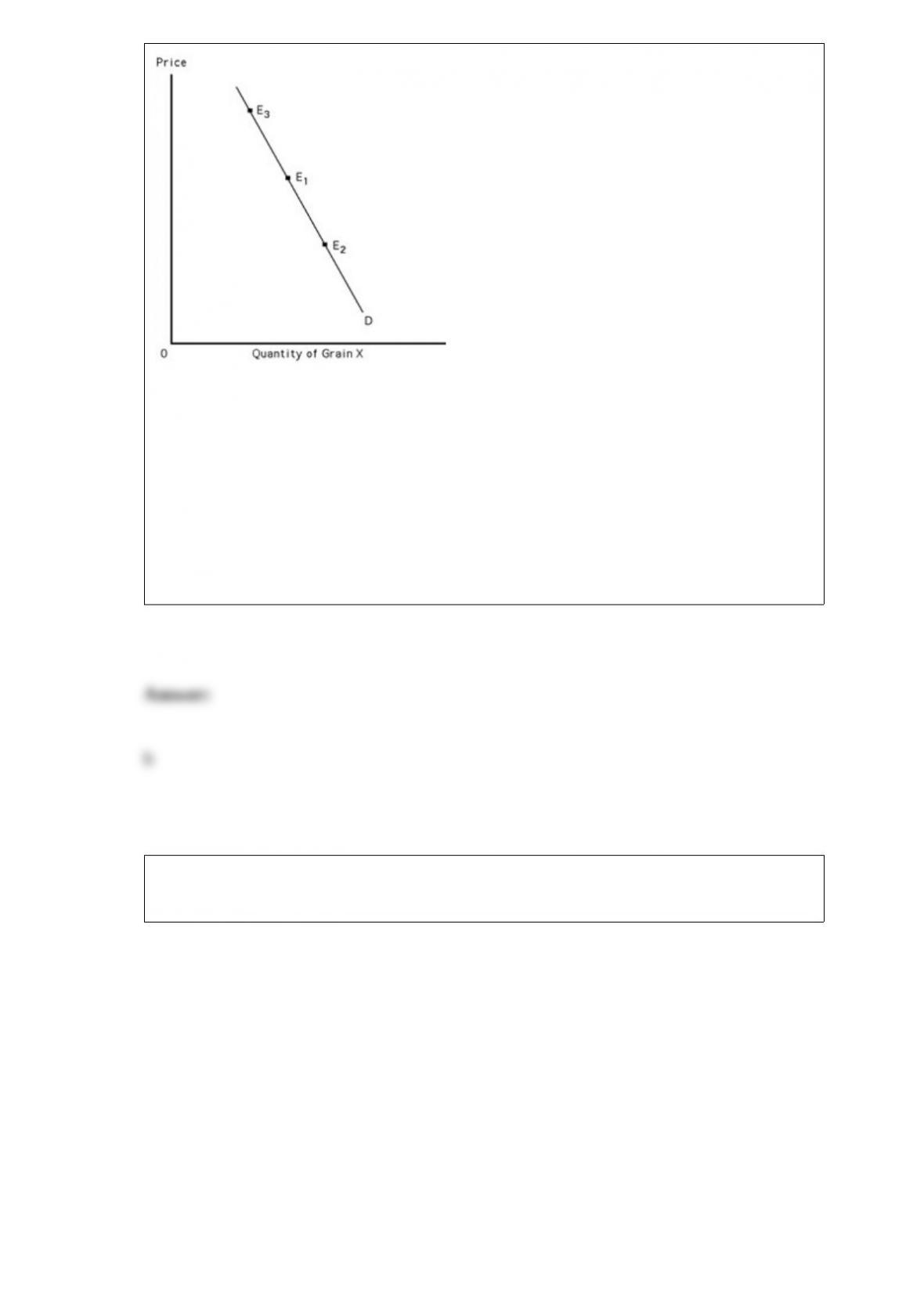
a. the supply curve shifts leftward.
b. the equilibrium quantity increases.
c. the equilibrium price rises.
d. all of the above
e. a and c
Refer to Exhibit 24-10. The area that is subject to socially wasteful rent seeking is
Exhibit 24-10
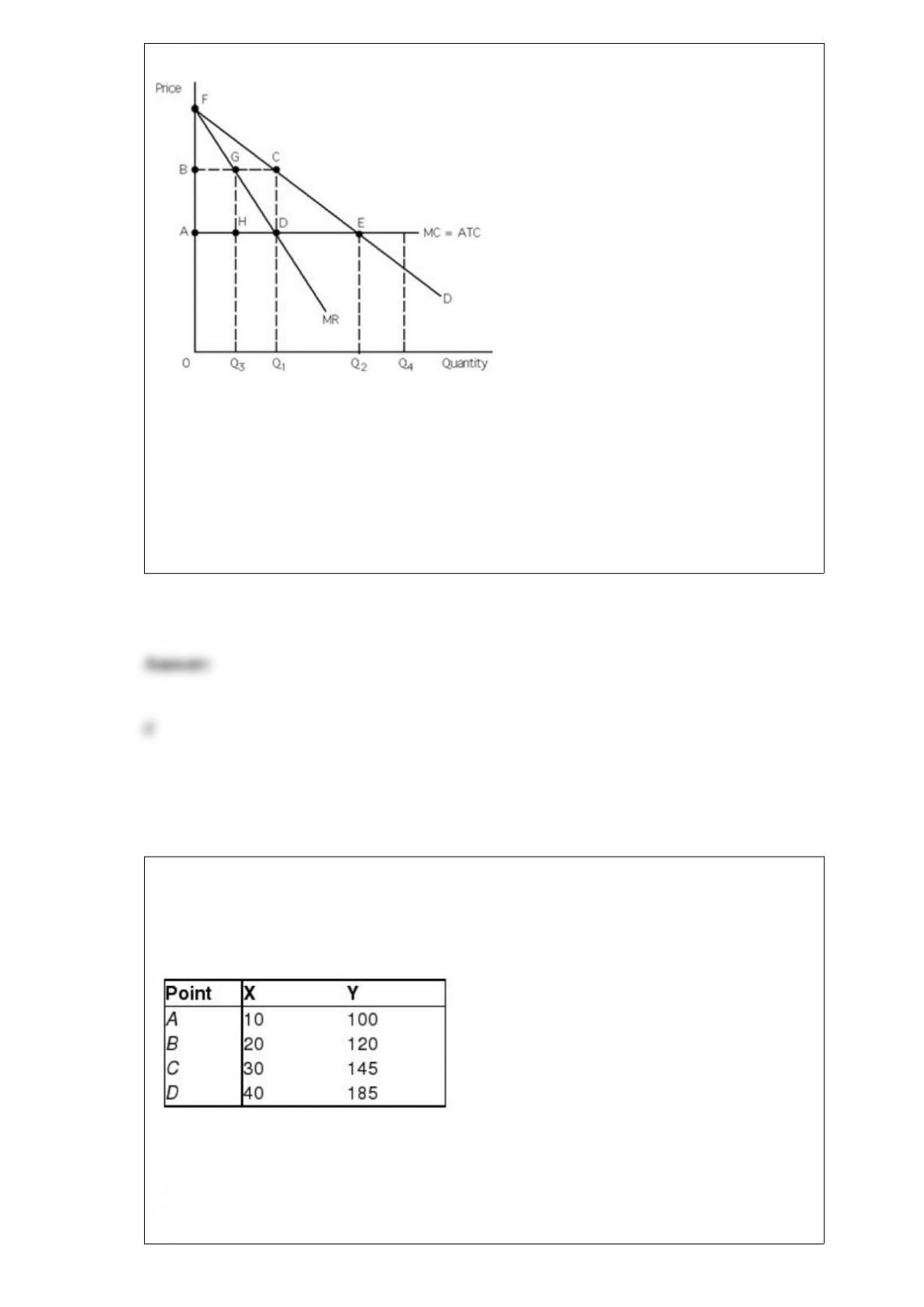
a. ABGH
b. HGCD
c. DCE
d. ABCD
e. AFD
Refer to Exhibit 1-2.Based on the data provided in this table,if these data were plotted
in a two-variable diagram the result would be a ______________ sloping
____________________.
Exhibit 1-2
a. downward; (nonlinear) curve.
b. downward; (straight) line.

c. upward; (nonlinear) curve.
d. upward; (straight) line.
e. none of the above
Barriers to entry include all of the following except
a. exclusive ownership of a scarce resource.
b. patents.
c. public franchises.
d. diseconomies of scale.
e. government licenses.
A perfectly competitive firm that maximizes profit exhibits resource allocative
efficiency because it produces where price
a. equals minimum average total cost.
b. equals marginal revenue.
c. equals marginal cost.
d. is greater than minimum average variable cost.

Which of the following government agricultural policies is not aimed at restricting
supply?
a. price supports
b. acreage allotments
c. market quotas
d. paying farmers not to produce
Dumping refers to a country
a. imposing a retaliatory tariff against the subsidized products of a foreign country.
b. selling a good abroad at a price that is below its cost and lower than the price charged
in the domestic market.
c. selling a good abroad at a price that is above its cost and higher than the price
charged in the domestic market.
d. a and c
e. all of the above
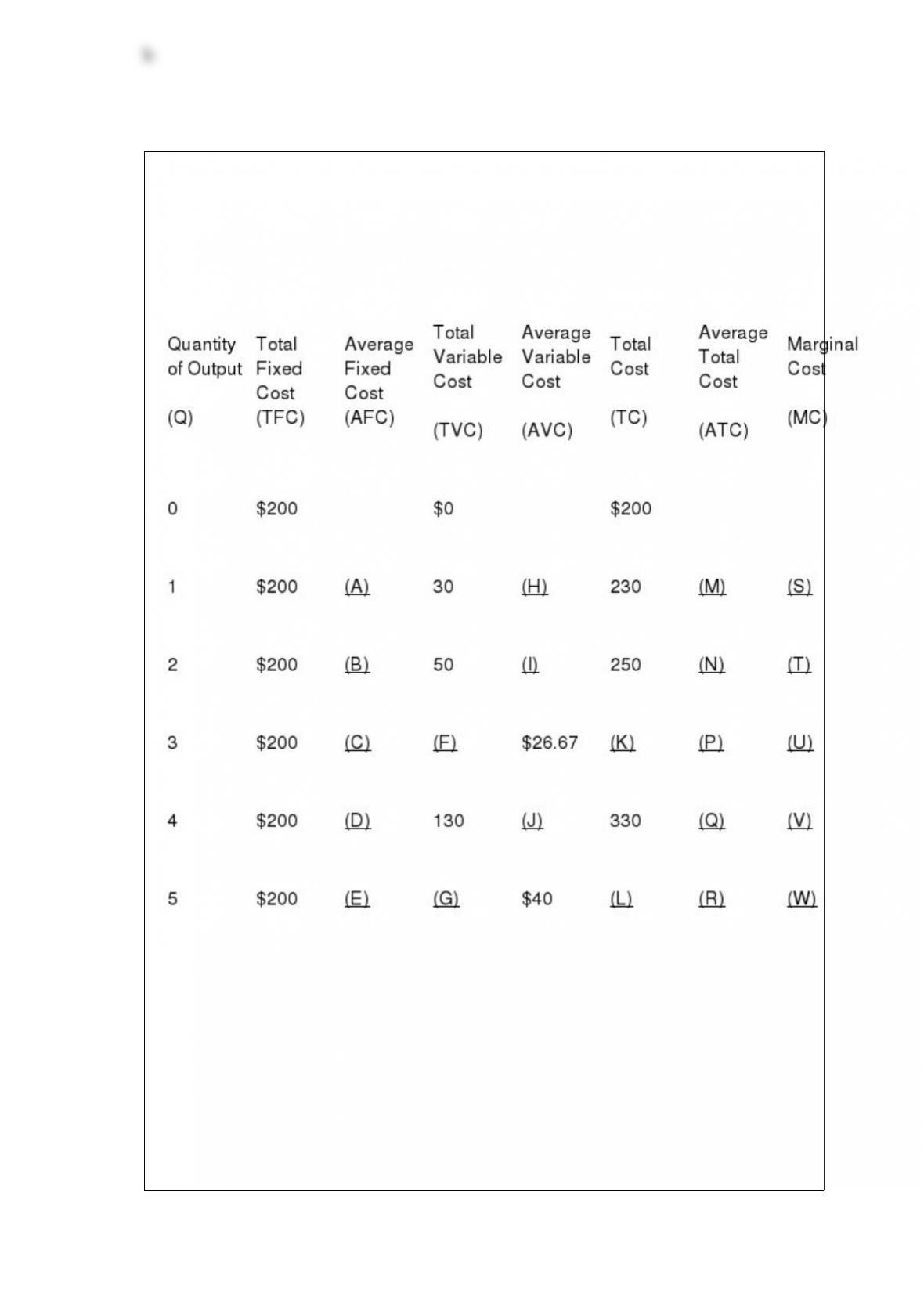
Refer to Exhibit 22-13.What dollar amounts go in blanks (V) and (W), respectively?
Exhibit 22-13 Quantity of Output (Q) Total Fixed Cost (TFC) Average Fixed Cost
(AFC) Total Variable Cost
a. $50; $70
b. $12.50; $14
c. $140; $150
d. $82.50; $80
e. There is not enough information to answer this question.
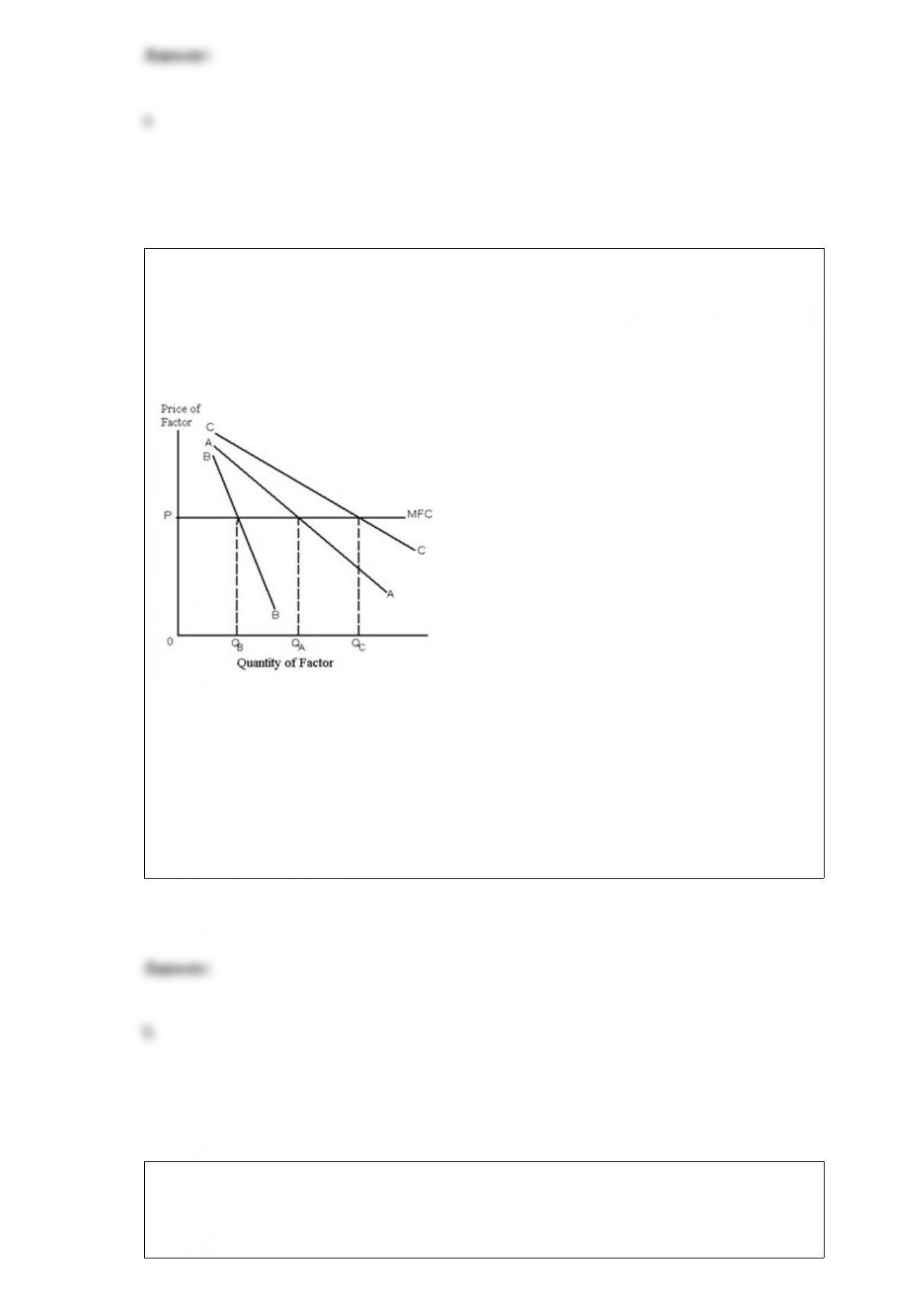
Refer to Exhibit 27-6. Let AA represent the value marginal product curve of an
oligopolist. Which of the following could represent his marginal revenue product
curve?
Exhibit 27-6
a. AA
b. BB
c. CC
d. any of the above
Refer to Exhibit 4-5. If a free market were allowed in the transplanted kidney market,
then the equilibrium price would be P2. The number of kidneys transplanted would
increase by _________ compared to the number transplanted at a price ceiling of P= $0.
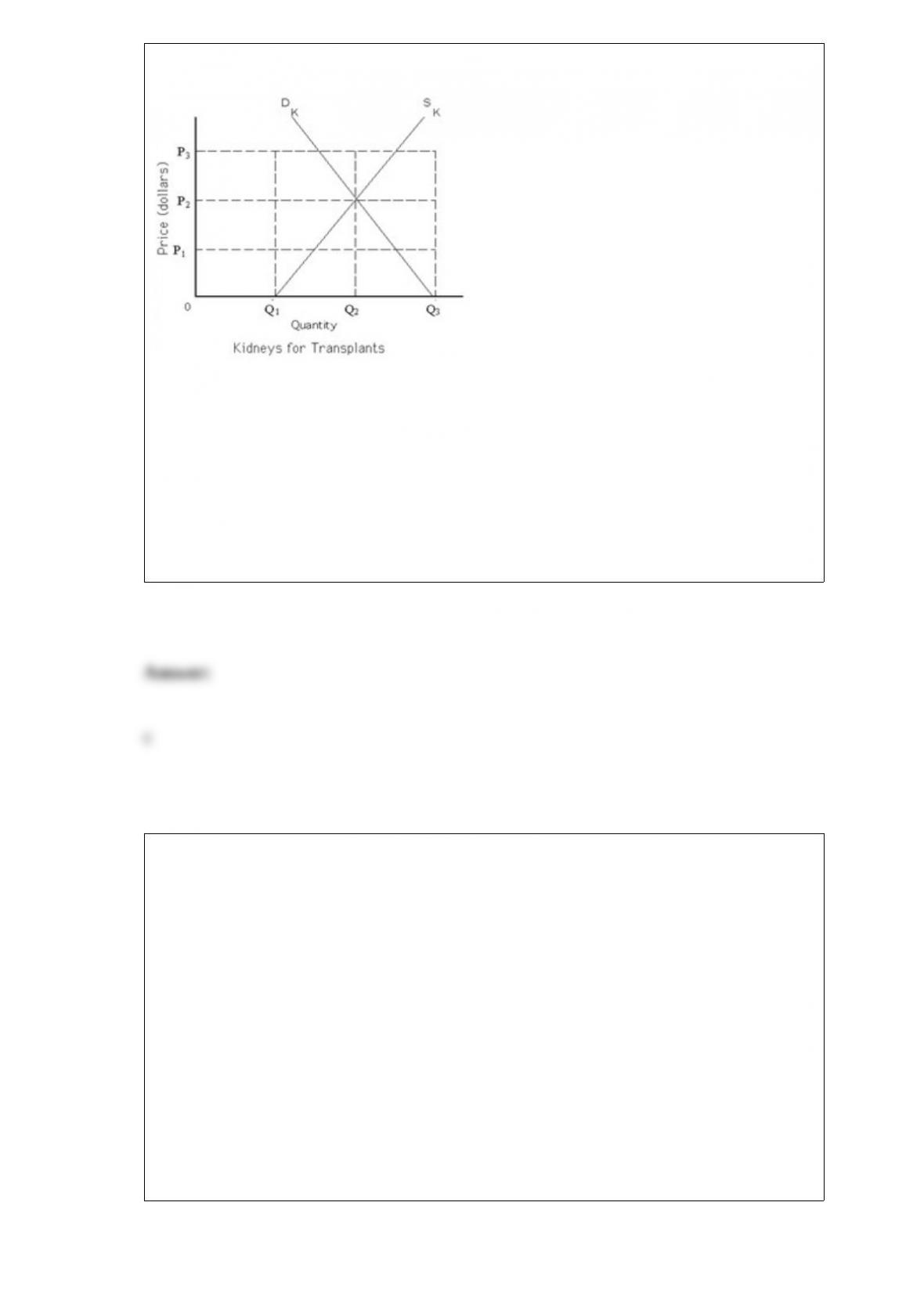
Exhibit 4-5
a. (Q3 – Q1)
b. (Q3 – Q2)
c. (Q2 – Q1)
d. Q2
Consider the following data: equilibrium price = $8.50, quantity of output produced =
100 units, average total cost = $10, and average variable cost = $9. What will the firm
do and why?
a. Shut down in the short run, because price is below average variable cost.
b. Shut down in the short run, because it will be taking a loss of $100.
c. Continue to produce in the short run, because price is greater than average variable
cost.
d. Continue to produce in the short run, because firms are always stuck with having to
produce in the short run.
e. none of the above

A constant-cost industry is characterized by
a. an upward-sloping long-run supply curve.
b. a downward-sloping long-run supply curve.
c. a perfectly elastic long-run supply curve.
d. perfectly elastic short-run and long-run supply curves.
e. a perfectly elastic short-run supply curve and an upward-sloping long-run supply
curve.
What is the definition of producers’ surplus?
a. price received minus maximum selling price
b. maximum selling price minus price received
c. price received minus minimum selling price
d. highest price minus lowest price
e. none of the above