
What is the relationship between the elasticity of demand for a product and the
elasticity of demand for labor (that is used in producing the product)?
a. The higher the price of the product, the higher the elasticity of demand for labor.
b. The higher the price of the product, the lower the elasticity of demand for labor.
c. The higher the elasticity of demand for the product, the lower the elasticity of
demand for the product.
d. The lower the elasticity of demand for the product, the lower the elasticity of demand
for the product.
e. There is not enough information to answer the question.
The yield of a stock is the
a. dividend divided by the closing price per share.
b. dividend divided by the average daily price of the stock.
c. closing price divided by the 52-week low price.
d. dividend divided by the opening price per share.
Refer to Exhibit 5-3 which shows the demand and supply of a college athlete.Suppose
that NCAA rules limit the amount that the college can pay this athlete, such that their
payment cannot exceed the cost of attending the college (currently, $8,000).What is the
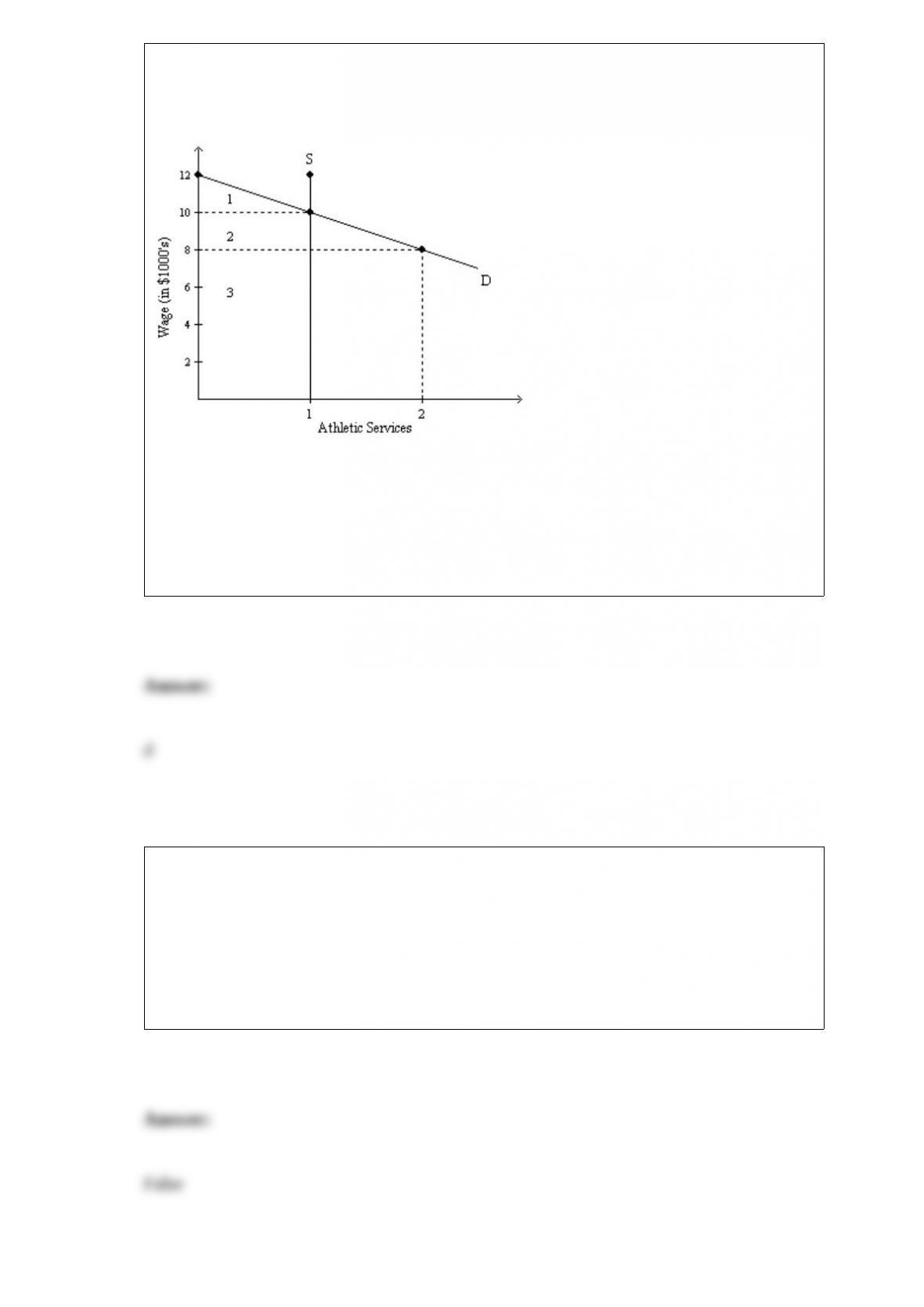
consumers’ surplus for the college (with respect to this one athlete)?
Exhibit 5-3
a. area 1
b. area 2
c. area 1 + 2+ 3
d. area 1 + 2
Special interest groups are very unlikely to push for policies that increase the size of
their slice of the economic pie if it means that the overall size of the economic pie will
shrink.
a. True
b. False

If it takes 118 Japanese yen to buy one dollar, then how many dollars does it take to buy
one euro?
a. $0.0085
b. $1.18
c. $0.85
d. $0.01286
e. There is not enough information to answer the question.
The type of merger most likely to reduce competition in an industry is a(n) __________
merger.
a. horizontal
b. vertical
c. conglomerate
d. international
Which of the following statements is false?
a. Government can remove individuals from a prisoner’s dilemma setting and make
them better off.

b. In a prisoner’s dilemma setting, it is impossible for the government to define and
enforce property rights that the individuals involved in the setting want to have defined
and enforced.
c. As long as government charges each individual in a prisoner’s dilemma setting a tax
that is less than the gain received by being removed from the setting, then government
has made the individuals better off.
d. Depending upon the amount of the tax charged to each individual in a prisoner’s
dilemma setting, the government can make both persons better off, both persons worse
off, or one person better off and the other person worse off.
If the purchase and sale of marijuana becomes legalized
a. the equilibrium price and quantity will both rise.
b. the equilibrium price will fall, but the change in equilibrium quantity depends upon
whether the demand curve shifts rightward more or the supply curve shifts rightward
more.
c. the equilibrium quantity will rise, but the change in equilibrium price depends upon
whether the demand curve shifts rightward more or the supply curve shifts rightward
more.
d. the equilibrium price and quantity will both fall.
If the bid value of a Treasury bond is listed as “112:16”, it means that the buyer is
willing to pay $1,125 for the bond.

a. True
b. False
Modern Justice Department guidelines evaluate mergers according to how they would
change the industry’s
a. Herfindahl index.
b. four-firm concentration ratio.
c. eight-firm concentration ratio.
d. twelve-firm concentration ratio.
When economists speak of scarcity, they are referring to the
a. condition in which society is not employing all its resources in an efficient way.
b. condition in which people’s wants outstrip the limited resources available to satisfy
those wants.
c. economic condition that exists in only very poor countries of the world.
d. condition in which society produces too many frivolous goods and not enough
socially desirable goods.

Public choice theory assumes that those involved in the public sector are generally
motivated by
a. public spirit.
b. altruism.
c. the desire to achieve allocative efficiency.
d. the same factors involved in the private sector.
e. a and b
The eight-firm concentration ratio for an industry is 0.80. If the top four firms in the
industry account for $45 million in sales, what do total sales equal?
a. $56.25 million
b. $45 million
c. $11 million
d. $20 million
e. There is not enough information to answer the question.

If the wage rate increases from $12 to $13 and, as a result, the quantity demanded of
labor decreases from 400 workers to 380 workers, then the absolute value of the
elasticity of demand for labor is
a. 0.78.
b. 2.30.
c. 0.435.
d. 0.64.
e. 1.56.
Which of the following statements is true?
a. In the short run, there are no fixed costs, only variable costs.
b. In the short run, there are fixed and variable costs, but in the long run there are only
fixed costs.
c. In the short run, there are fixed and variable costs, but fixed costs are the only costs a
firm is concerned with.
d. In the long run, there are no costs, fixed or variable.
e. none of the above

Congressman A promises to vote for a bill that Congressmen B and C are sponsoring,
and in return both B and C promise to vote for a future bill that A is sponsoring. This
practice is called
a. cutting “red tape.”
b. chasing the median voter.
c. rational ignorance.
d. logrolling.
The longer the period of time consumers have to adjust to price changes, the
__________ the __________ elasticity of demand.
a. lower, price
b. lower, income
c. higher, price
d. higher, income
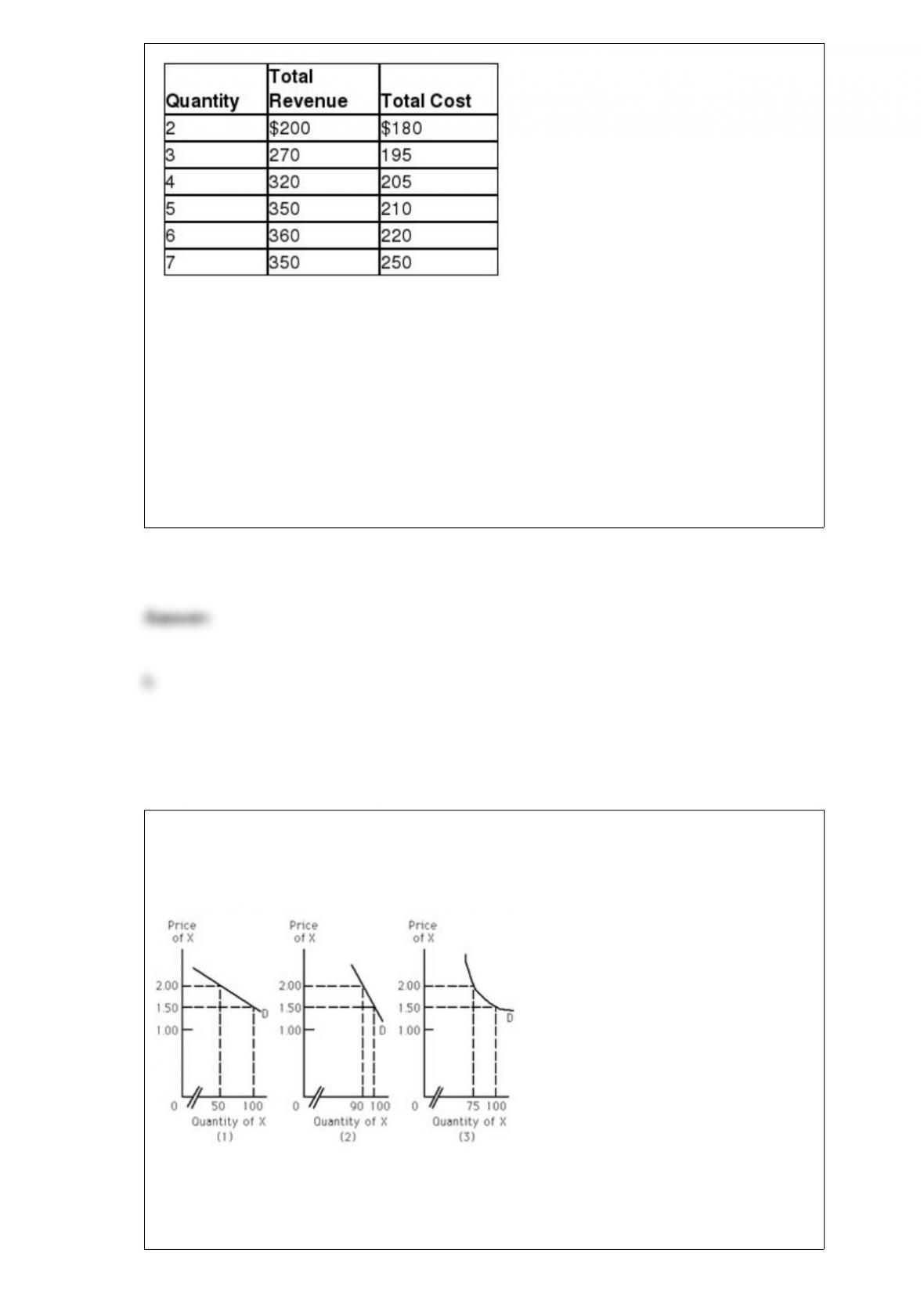
Refer to Exhibit 25-8. Assuming that total fixed costs are $30, the average variable cost
of producing 2 units of output is
Exhibit 25-8
a. $35.
b. $75.
c. $45.
d. $55.
e. There is not enough information given to answer this question.
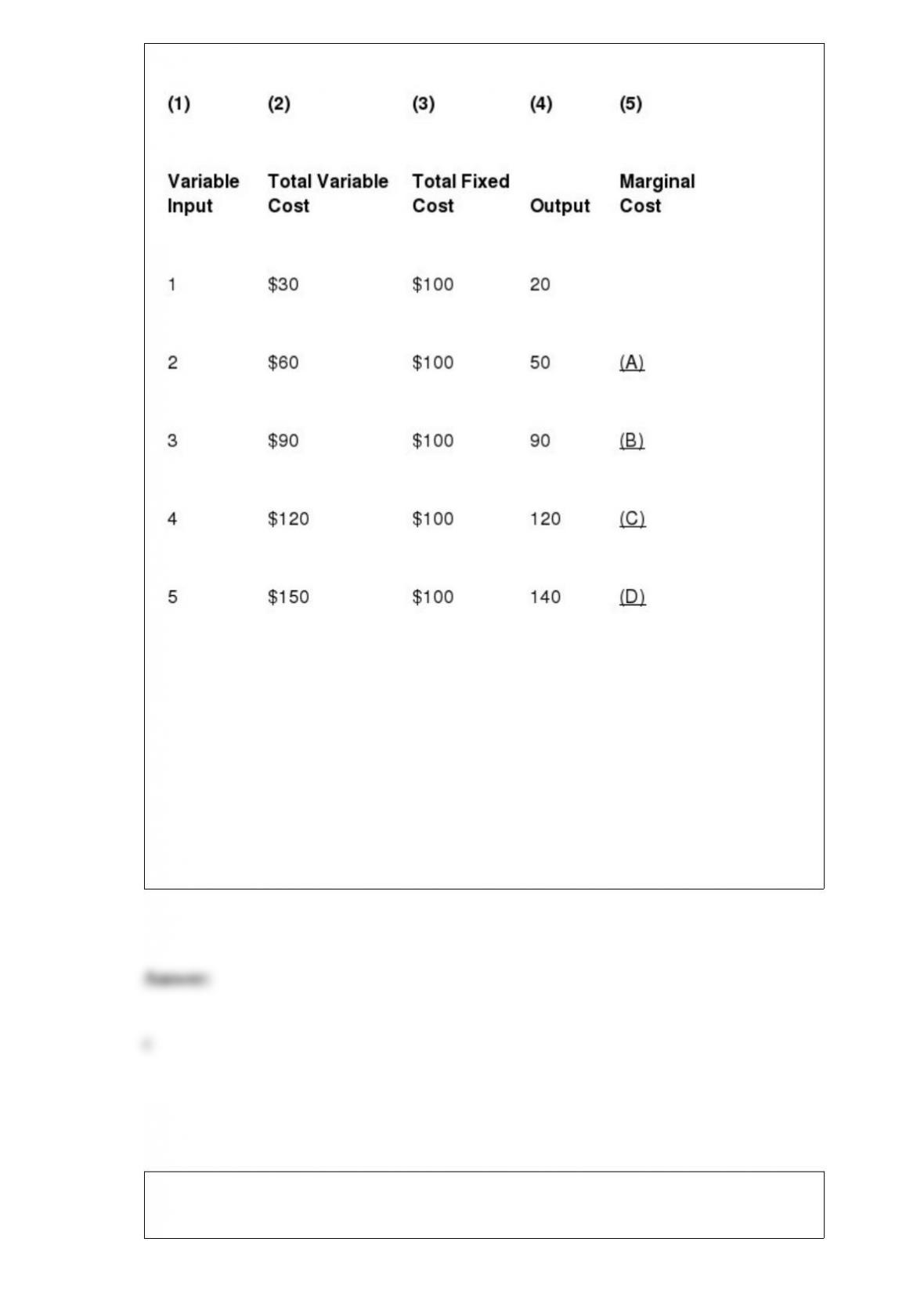
Refer to Exhibit 20-5. Which of the graphs represents a greater percentage change in
quantity demanded than the percentage change in price?
Exhibit 20-5
a. (1)
b. (2)

c. (3)
d. (2) and (3)
The answer is: “A geographic area in which exchange rates can be fixed or a common
currency used without sacrificing domestic economic goals.”What is the question?
a. What is a flexible exchange rate system?
b. What is a managed float area?
c. What is a purchasing power parity area?
d. What is an optimal currency area?
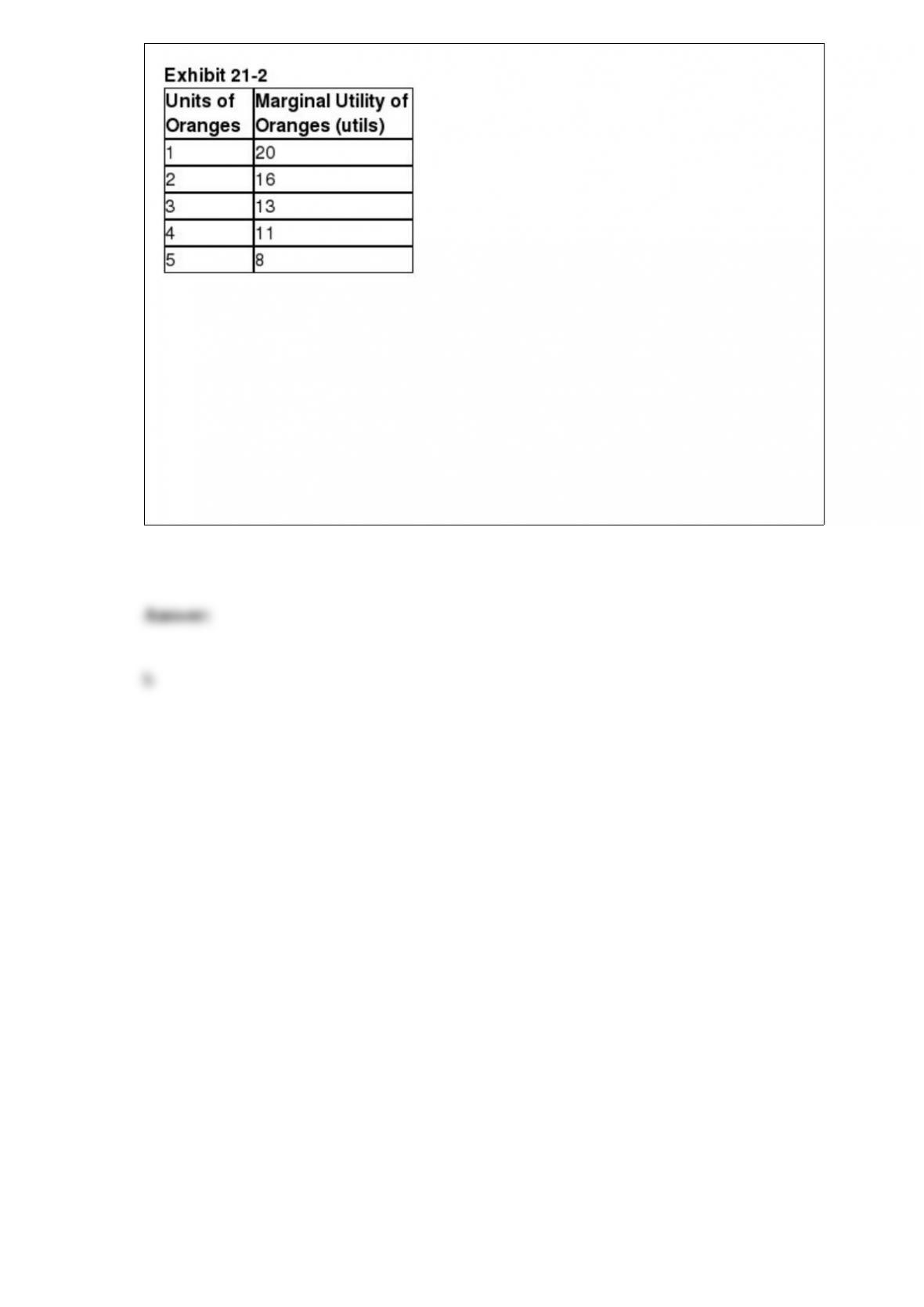
Refer to Exhibit 22-2. The dollar amounts that go in blanks (A) and (B), respectively,
are
Exhibit 22-2
a. $30.00 and $40.00.
b. $3.33 and $2.50.
c. $1.00 and $0.75.
d. $10.00 and $10.00.
e. $6.67 and $5.00.
Refer to Exhibit 21-2. Total utility for the first four oranges is
a. 11 utils.
b. 60 utils.
c. 52 utils.
d. 15 utils.
e. 40 utils.