
A firm that is a price taker can sell
a. any quantity of product it wants at any price.
b. less of its product at a higher price than at a lower price.
c. any quantity of product it can produce at the market equilibrium price.
d. more of its product at a higher price than at a lower price.
e. none of the above
A public choice theorist would be most likely to say that government failure is a
consequence of the
a. actions of selfish and corrupt politicians.
b. rational behavior of the participants of the political process.
c. irrational behavior of voters.
d. irrational behavior of special interest groups.
A public choice theorist believes that
a. men and women in the market sector are fundamentally different people than men

and women in the public sector.
b. government is likely to be composed of better people than the market sector.
c. high fixed costs in government influence the behavior of government workers.
d. government workers are generally lazy.
e. none of the above
One implication of the median voter model is that a candidate is likely to label himself
__________ and his or her opponent as __________.
a. moderate; too far right or too far left (whichever makes more sense)
b. a member of one of the political wings; moderate or mainstream
c. as a member of the political right; moderate
d. as a member of the political left; moderate
e. none of the above
Suppose the optimal amount of X is 100 units and that the market provides 123 units.
This situation is descriptive of
a. externality provision.
b. market failure.

c. asymmetric information.
d. a public goods problem.
e. the free-rider dilemma.
Which of the following statements is false?
a. There are always opportunity costs to making choices.
b. Because of scarcity, choices must be made.
c. Elementary education at public schools is free.
d. When government builds a new highway, taxpayers end up with less of some of the
things they would otherwise have.
Which of the following statements is true?
a. To an economist, demand is different from quantity demanded.
b. A demand schedule is the numerical tabulation of the law of demand.
c. A demand curve is the graphical representation of the direct relationship between
price and quantity demanded.
d. a and b

e. a, b, and c
Which of the following statements is false?
a. There are fewer farms in this country today than there were earlier in this century.
b. In 2000, there were 8 million farms in the United States.
c. Bad weather reduces the supply of foodstuffs and leads to greater farmer total
revenue, assuming demand for the foodstuffs is inelastic.
d. b and c
When it comes to network goods, being one of the first companies in a market seems to
really pay off.
a. True
b. False

In the United States, the average household in the top quintile (of total money income)
contains fewer persons than the average household in the bottom quintile.
a. True
b. False
Which of the following statements is false?
a. Money must change hands before a cost can be incurred.
b. No monetary payment takes place when an implicit cost is incurred.
c. Costs may be either explicit costs or implicit costs.
d. Cost implies that a sacrifice has been made.
In a perfectly competitive market, if a resource that one firm utilizes is superior to
resources used by other firms, and, as a result, lowers unit costs for the firm, that firm is
likely to earn __________ in the short run. In time, however, the firm’s __________
curve will rise to reflect the superior-quality of the resource it employs and the firm will
then earn __________.
a. normal profit; ATC; positive economic profit
b. positive economic profit; ATC; normal profit

c. positive economic profit; marginal revenue; zero profit
d. losses; ATC; positive economic profit
e. none of the above
The marginal productivity theory states that
a. as variable inputs are added to a fixed quantity of other inputs eventually the
additional output produced by each additional variable input will decrease.
b. inputs will be used most efficiently when the additional output gained from each type
of input is exactly the same.
c. firms in perfectly competitive product and factor markets will pay factors their
marginal revenue products.
d. marginally productive inputs (that is, inputs that are not particularly productive) will
not be heavily utilized.
Large firms may be more likely to innovate because
a. the risks of failure are less to them than to small firms.
b. they can attract the capital needed more easily.
c. they can more easily attract the scientists and engineering staff they need.
d. a, b and c
A share of stock is
a. a claim on the assets of the corporation that gives the purchaser an ownership right in
the corporation.
b. the share of profits distributed to stockholders.
c. a promise to pay for the use of someone else’s money.
d. a promise to loan money to someone.
e. a and b
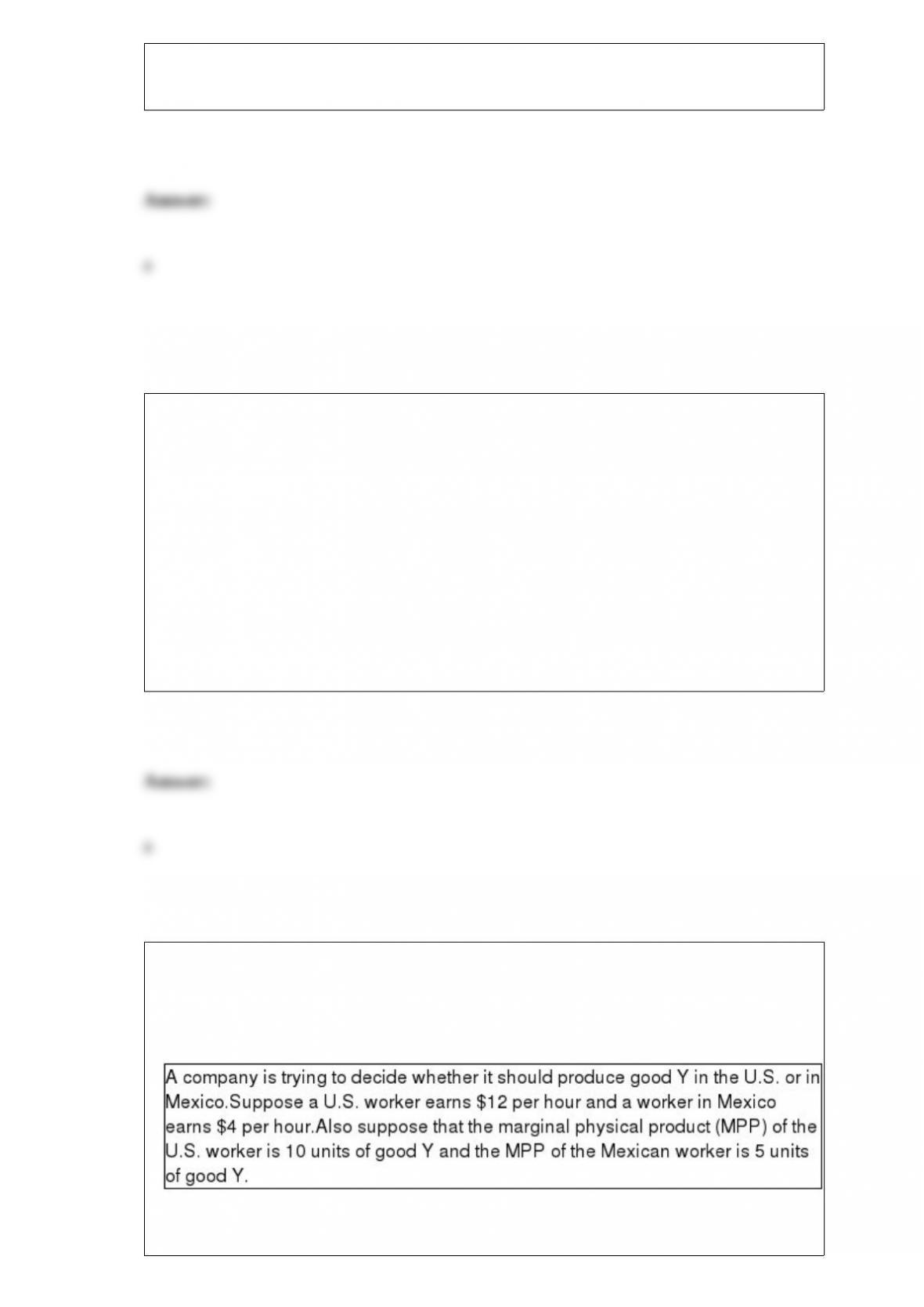
Refer to Situation 27-2. If good Y is produced in the United States, the output per $1 of
cost would be ___________________ than if good Y were produced in Mexico, thus it
would be best to produce good Y in ____________________.
Situation 27-2
a. higher; Mexico.

b. lower; Mexico.
c. higher; the United States.
d. lower; the United States.
Maria lives next door to Alice. Alice regularly plays loud music, which often disturbs
Maria. Maria went over to Alice’s house yesterday and asked her to turn down her
music because loud music adversely affects her. Alice has complied. Which of the
following best describes the economists’ view of what has happened?
a. The marginal social benefits of loud music were greater than the marginal private
costs of loud music and the problem was solved by Maria persuading Alice to
internalize her (Maria’s) external costs.
b. The marginal social costs of loud music were greater than the marginal private costs
of loud music and the problem was solved by Maria persuading Alice to internalize her
(Maria’s) external costs.
c. The marginal social costs of loud music were greater than the marginal private costs
of loud music and the problem was solved through a reassignment of property rights.
d. The marginal social costs of loud music were greater than the marginal social
benefits of loud music and the problem was solved by Maria persuading Alice to
internalize her (Maria’s) external costs.
e. none of the above

Which of the following statements is false?
a. Ham has a higher price elasticity of demand than meat.
b. Peaches have a higher price elasticity of demand than fruit.
c. Soap has a higher price elasticity of demand than Ivory brand soap.
d. Carrots have a higher price elasticity of demand than vegetables.
A productive efficient society
a. produces at a point on its PPF.
b. can produce more of one good only by giving up some of another good.
c. cannot produce unlimited amounts of a good.
d. still has to make choices.
e. all of the above
The buyer of a good has less information than the seller of the good. This is a case of
a. externality information.
b. free ridership.

c. asymmetric information.
d. biased information.
e. a public good not being a private good.
Universities A and B are substitutes in the minds of many college students.Initially the
student tuition at each university is the same and far below the equilibrium tuition.Then,
the tuition at A is raised and B is not.As a result of a rising tuition at A, some students
who would have applied and enrolled in A, apply to B instead.Based on the logic
presented in one of the theories discussed in the textbook, we would expect that
a. instructors at B will begin to be less nearly punctual for office hours than they were
previously.
b. instructors at A will begin to be more nearly punctualfor office hours than they were
previously.
c. instructors at B will be more nearly punctual for office hours than they were
previously.
d. a and b
e. b and c
Which of the following statements is true?
a. The motivation to try to explain something is at the heart of building a theory.

b. If a theory makes people uncomfortable then it should be discarded or ignored.
c. In order for a theory to be valid it must be a perfect description of reality.
d. Building a theory and evaluating a theory are the same thing.
Consider the following information about a business Diane opened last year: price =
$15, quantity sold = 25,000; implicit cost = $155,000; explicit cost = $260,000. What
was Diane’s economic profit?
a. $40,000
b. $115,000
c. -$40,000
d. $220,000
e. There is not enough information provided to answer this question.