Total revenue is defined as
a. price minus quantity sold.
b. price multiplied by quantity sold.
c. price divided by quantity sold.
d. quantity divided by price sold.
e. price plus quantity sold.
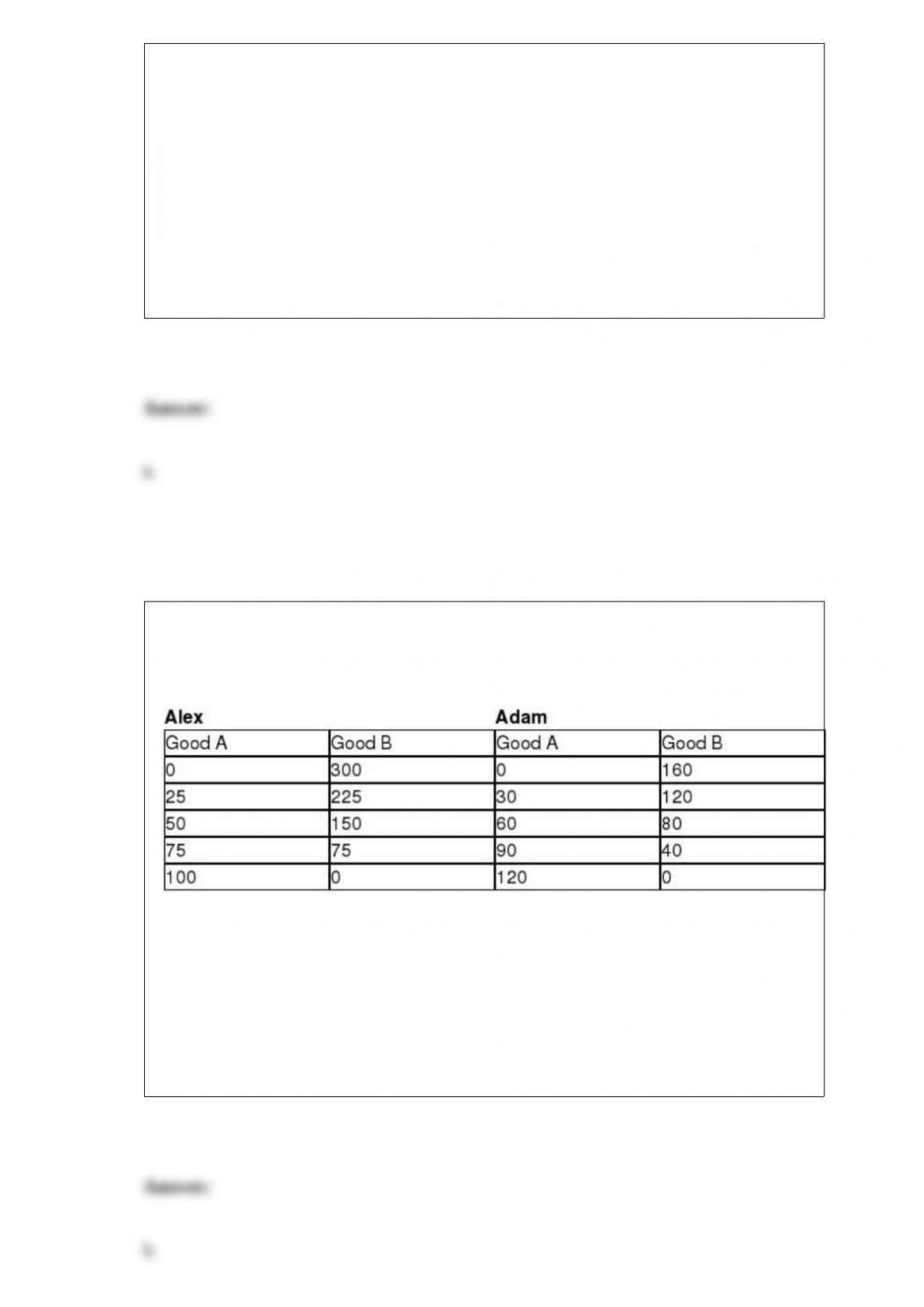
Refer to Exhibit 2-9. For Alex, the opportunity cost of producing one unit of good B is
____________ unit(s) of good A.
Exhibit 2-9
a. 3.00
b. 0.33
c. 0.75
d. 1.33

When a person is making a decision at the margin he or she is comparing the additional
benefit of that activity to the additional cost of the proposed action.
a. True
b. False
Economist Charles Kindleberger (a proponent of fixed exchange rates mentioned in the
text) would agree with which of the following statements?
a. It is better to leave the international value of the domestic currency to the free market
forces than to have to sacrifice domestic economic goals in order to support a certain
predetermined value of the currency.
b. There is too great a chance that the supported exchange rates will diverge
significantly from the equilibrium exchange rates, which would create persistent
problems and lead to an overall decrease in international trade.
c. With no certainty of what one nation’s currency will be worth in terms of other
nations’ currencies, international trade is held below what it could be.
d. a and b
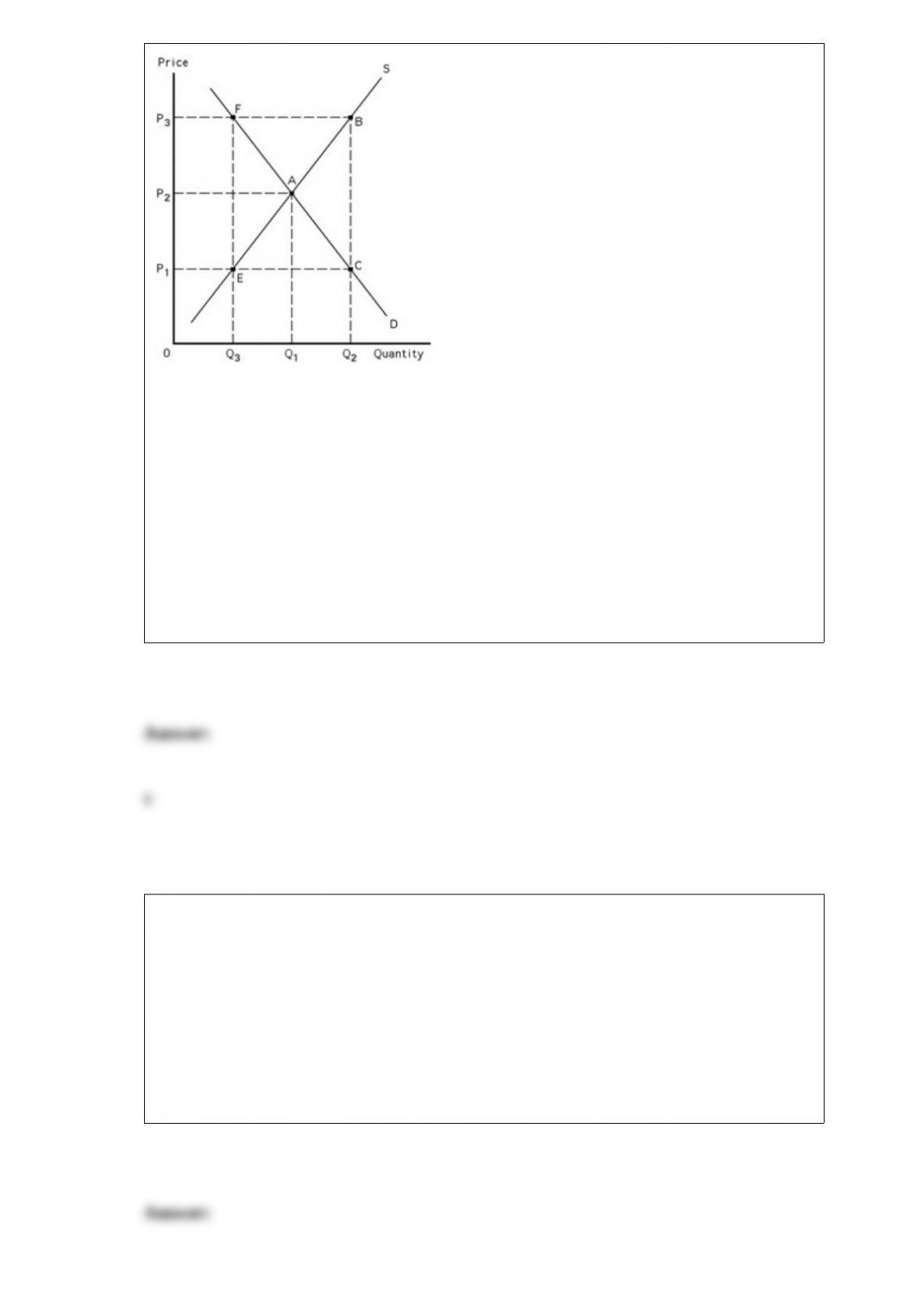
Refer to Exhibit 39-3. If P3 is a target price, the price at which output will be purchased
is
Exhibit 39-3
a. P1.
b. P2.
c. P3.
d. P3 – P2.
e. P1 – P2.
What is the Herfindahl index of a monopoly?
a. 10
b. 100
c. 1,000
d. 10,000

Maximizing total revenue turns out to be the same as maximizing profit only when
a. average fixed cost declines continually as output rises.
b. a firm has no fixed costs.
c. a firm has no variable costs.
d. a firm has both variable and fixed costs.
Consumer equilibrium exists when
a. marginal utility for all goods is the same.
b. total utility is constant.
c. prices for all goods are the same.
d. total utility for all goods is the same.
e. the MU/P ratio for all goods is the same.

The __________ one’s income, the __________ one’s budget constraint.
a. smaller; further away from the origin
b. larger; closer to the origin
c. larger; further away from the origin
d. smaller; steeper the slope of
e. larger; steeper the slope of
Which of the following is not an effect of an agricultural price support?
a. a surplus
b. fewer exchanges
c. higher prices paid by consumers
d. government purchase and storage of surplus
e. higher-quality products
Something that motivates or encourages people to take an action is referred to as a(n)
a. utility.
b. abstract.
c. market.
d. incentive.
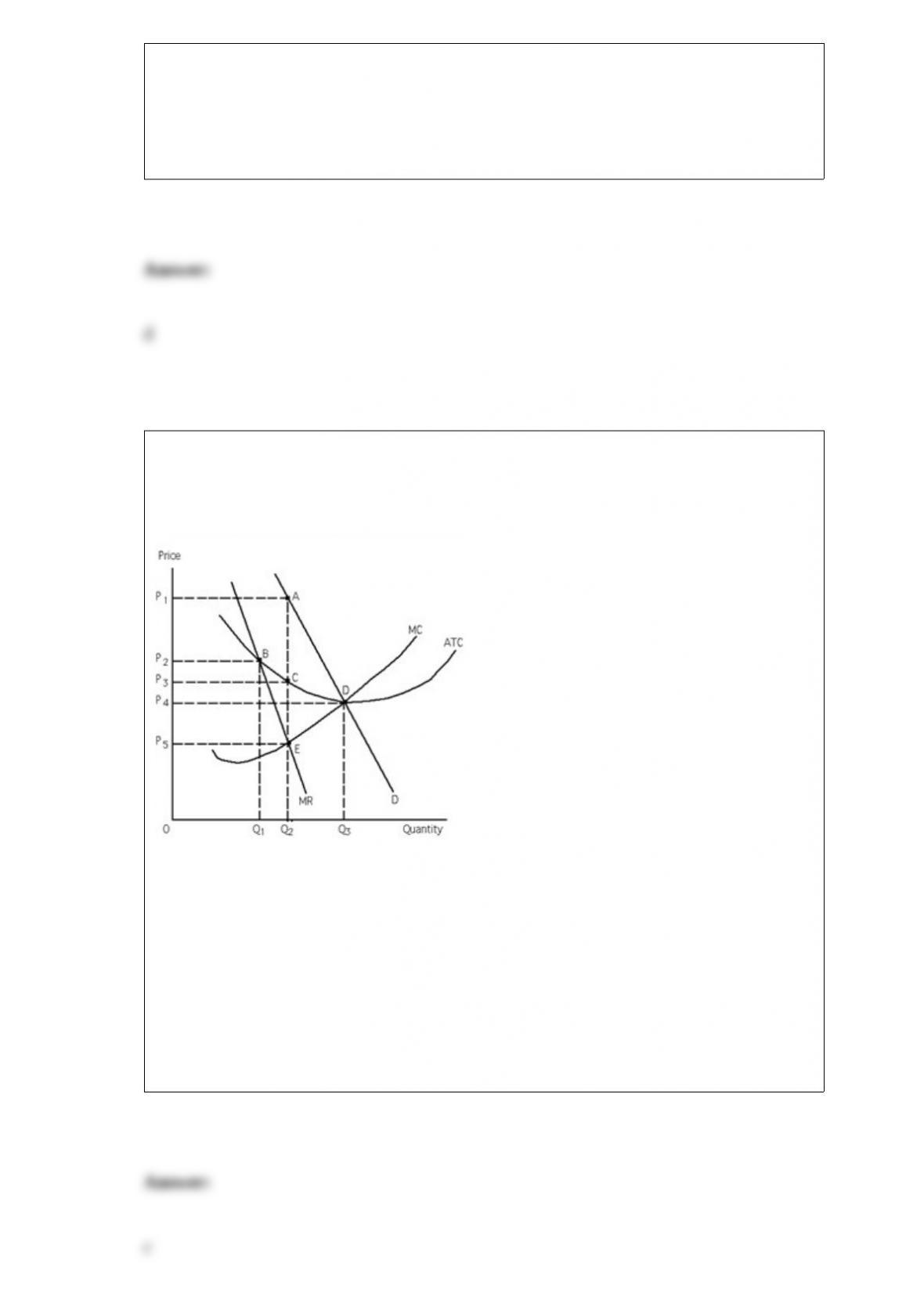
Refer to Exhibit 25-3. For this profit maximizing monopolistic competitor profit is
represented by the area
Exhibit 25-3
a. 0P4DQ3.
b. P5P3CE.
c. P3P1AC.
d. 0Q1 times P2P4.
e. 0Q1 times P2P5.
As long as there are advancements in technology, some workers will be temporarily
displaced.
a. True
b. False
In a perfectly competitive market, the market demand curve is perfectly elastic.
a. True
b. False
Refer to Exhibit 34-1. Considering the data, which of the following terms of trade
would both countries agree to?
Exhibit 34-1
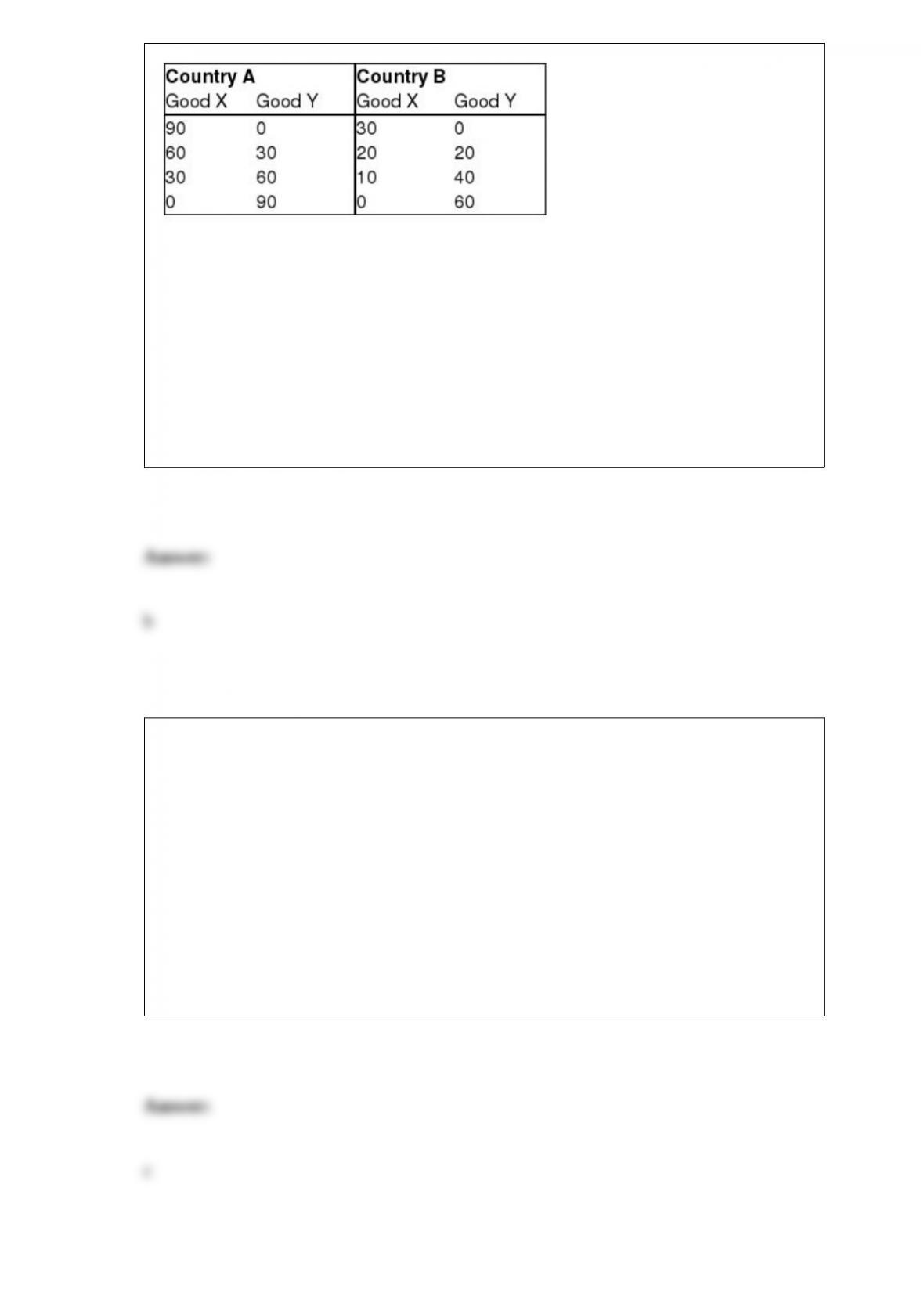
a. 1 unit of Y for 1 unit of X
b. 1 unit of Y for 0.75 units of X
c. 1 unit of Y for 0.25 units of X
d. 1 unit of Y for 1.50 units of X
e. all of the above
A monopsony, as compared to a perfectly competitive firm, pays __________ wage and
hires __________ labor.
a. a higher; less
b. a higher; more
c. a lower; less
d. a lower; more
e. the same; the same amount of

It has been argued that as a result of not producing the quantity of output where unit
cost is minimized, the monopolistic competitive firm charges to __________ a price
and produces too __________ output.
a. high; little
b. low; little
c. high; much
d. low; much
As the marginal physical product of a variable input __________, the marginal cost
__________.
a. increases; increases
b. increases; decreases
c. decreases; increases
d. b and c
A person is in consumer equilibrium, and then the price rises for one of the goods she
purchases. If she wants to restore herself to consumer equilibrium, she will (most

likely)
a. buy less of the good whose price has risen and more of the relatively lower priced
goods.
b. try to increase the marginal utility she receives from the good whose price has risen.
c. try to decrease the marginal utility she receives from the goods whose prices did not
rise.
d. buy more of both the good whose price has risen and of the goods whose prices have
not risen.
e. There is not enough information to answer the question.