
One reads the following in a newspaper: “Today the president and Congress agreed to
impose new restrictive quotas on Japanese cars coming into the country.” As a result, an
economist would predict that the
a. supply of cars in the country will remain the same and the (average) price of cars will
fall.
b. supply of cars in the country will fall and the (average) price of cars will rise.
c. supply of cars in the country will rise and the (average) price of cars will fall.
d. demand for cars in the country will fall and the (average) price of cars will rise.
e. demand for cars in the country will rise and the (average) price of cars will rise.
If a firm is a monopsony, then it
a. can pay any price it wants for the factors that it hires.
b. will have to pay the same price to each factor owner that supplies its factor.
c. will have to pay a higher price to purchase additional units of a factor.
d. need not lower the price of its product to induce buyers to purchase additional
quantities.
If for a given individual, between a wage rate of $30 and $35 the
____________________ effect outweighs the ________________ effect, the
individual’s supply curve of labor curve between those two wages will be
_________________.
a. substitution; income; vertical
b. substitution; income; downward sloping
c. income; substitution; downward sloping
d. income; substitution; vertical
e. income; substitution; upward sloping
Refer to Exhibit 2-2. If PPF2 is the relevant production possibilities frontier, then point
__________ illustrates productive inefficiency.
Exhibit 2-2
a. A
b. B
c. C
d. J
e. a, b, or c

A “decrease in the quantity demanded” means that
a. the demand curve has shifted to the right.
b. the supply curve has shifted to the left.
c. price has declined and consumers therefore want to purchase more of the good.
d. price has increased and consumers therefore want to purchase less of the good.
Suppose there are only two countries in the world, Mexico and the United States. In the
foreign exchange market, it follows that the
a. demand for pesos is linked to the demand for dollars.
b. demand for pesos is linked to the supply of pesos.
c. supply of pesos is linked to the demand for dollars
d. supply of pesos is linked to the supply of dollars.
e. none of the above
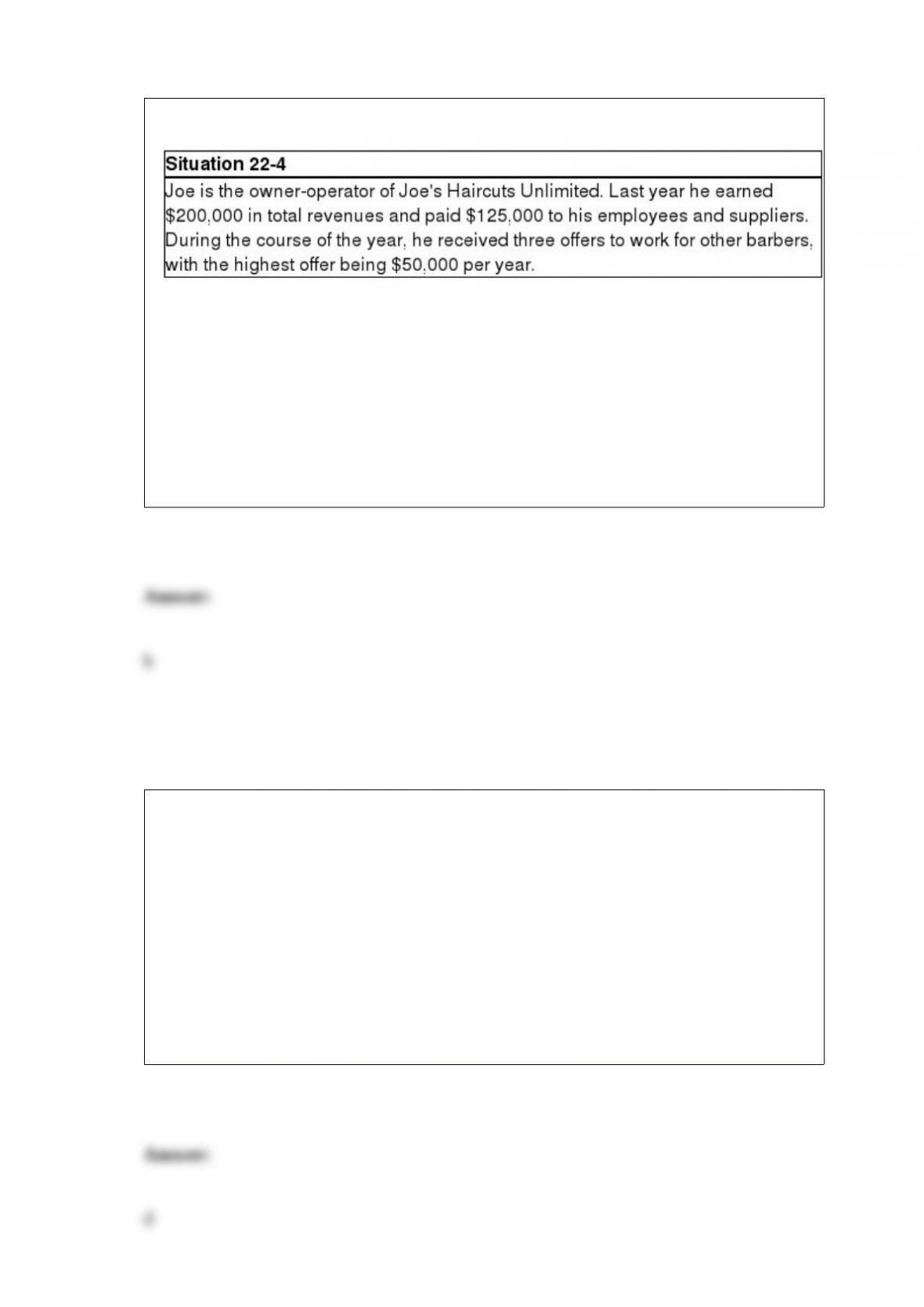
Refer to Situation 22-4.What are Joe’s economic profits?
a. $0
b. $25,000
c. -$25,000
d. $40,000
e. $75,000
The marginal cost curve passes through the __________ curve at its lowest point.
a. average variable cost
b. average total cost
c. average fixed cost
d. a and b
e. a, b, and c
If a monopolist is a factor price taker, at the profit-maximizing factor quantity
a. VMP > MRP.
b. MRP = MFC.
c. MFC = factor price.
d. b and c
e. all of the above
Refer to Exhibit 5-2. If the tuition is set at $70 there will be
Exhibit 5-2
a. a shortage at 10 a.m. and a surplus at 8
a.m.
b. a surplus at 10 a.m. and a shortage at 8 a.m.
c. equilibrium at 10 a.m. and a surplus of seats at 8 a.m.
d. equilibrium at 10 a.m. and a shortage of seats at 8 a.m.

Which of the following statements is false?
a. When the value of a country’s imports is greater than the value of its exports, the
country’s net exports will be a positive value.
b. A country is running a trade deficit when the value of its imports is greater than the
value of its exports.
c. A country is running a trade surplus when the value of its exports is greater than the
value of its imports.
d. Net exports are sometimes referred to as the balance of trade.
The Lorenz curve is a graphical representation of
a. the income to poverty ratio.
b. economic growth.
c. the percentage of total income left to spend after taxes.
d. the distribution of income.

Joe is currently in consumer equilibrium by consuming cheese and crackers, such that
the last cracker consumed yielded 8 utils and the last piece of cheese consumed yielded
12 utils. Assume the price of crackers is two cents per cracker and the price of cheese is
three cents per piece. If the price of crackers increases to four cents, Joe should
__________ his consumption of crackers and his marginal utility from crackers will
__________ and also __________ his consumption of cheese and his marginal utility
from cheese will __________.
a. increase; increase; increase; increase
b. increase; increase; decrease; decrease
c. increase; decrease; increase; decrease
d. decrease; increase; decrease; increase
e. decrease; increase; increase; decrease
The Lorenz curve is a graph of the __________ of the population.
a. age distribution
b. income distribution
c. wealth distribution
d. racial composition

If a negative externality exists, then there is a __________ when society produces the
market output instead of the socially optimal output. This exists because the
__________ to sellers and third parties are __________ the __________ derived by
buyers.
a. net social benefit; costs; greater than; benefits
b. net social cost; benefits; less than; costs
c. net social cost; costs; greater than; benefits
d. net social cost; costs; less than; benefits
e. none of the above
If an industry consists of 20 firms holding equal market shares, the Herfindahl index is
a. 500.
b. 400.
c. 1,800.
d. 2,500.
e. This cannot be determined without further information.