
Which of the following founders of the United States used the infant-industry argument
to support trade restrictions?
a. Thomas Jefferson
b. Alexander Hamilton
c. James Madison
d. John Jay
Ceteris paribus, the more risk associated with a loan,
a. the lower the interest rate.
b. the higher the interest rate.
c. the more likely the loan will be granted.
d. the bigger the loan.
A decreasing-cost industry is characterized by
a. an upward-sloping long-run supply curve.
b. a downward-sloping long-run supply curve.
c. a perfectly elastic long-run supply curve.

d. perfectly elastic short-run and long-run supply curves.
e. a perfectly elastic short-run supply curve and an upward-sloping long-run supply
curve.
The public interest theory of regulation holds that
a. regulators are seeking to do and will do through regulation what is in the best interest
of the public.
b. over time, natural monopolies will wither away.
c. regulators are uninformed on specific matters that relate to regulation and therefore
are often swayed by false information.
d. natural monopolies manipulate the public into buying particular products.
The efficient number of gifts that a gift-giver wants to give is the number at which the
marginal benefits of giving a gift are__________________ the marginal costs of giving
a gift.
a. greater than
b. less than
c. equal to
d. less than or equal to
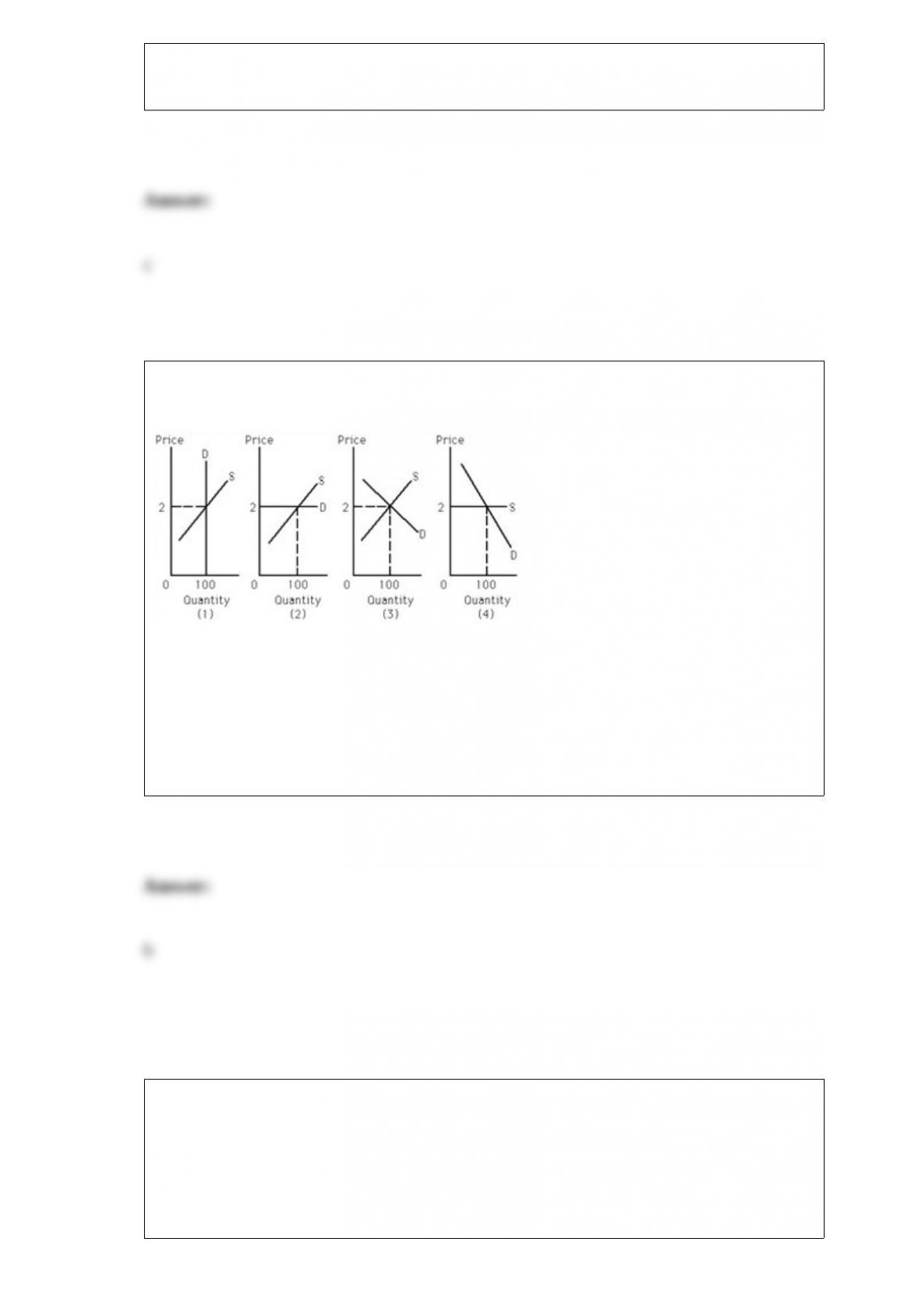
Refer to Exhibit 20-7. Which of the graphs shows a perfectly elastic demand curve?
Exhibit 20-7
a. (1)
b. (2)
c. (3) and (4)
d. none of the above
Wikipedia is an example of a project that follows the pattern of unstructured
collaboration.
a. True
b. False

All economists agree that the European Union is an example of a true a optimal
currency area.
a. True
b. False
International trade exists because countries
a. can make themselves better off through trade.
b. want to be neighborly with each other.
c. want to be political allies.
d. want to improve diplomatic relations with each other.
e. want to avoid war with each other.
Which of the following statements is true?
a. The higher the labor cost-total cost ratio, the lower the elasticity of demand for labor.
b. The lower the labor cost-total cost ratio, the higher the elasticity of demand for labor.
c. The more substitutes for labor, the higher the elasticity of demand for labor.
d. The fewer substitutes for labor, the higher the elasticity of demand for labor.
e. b and c
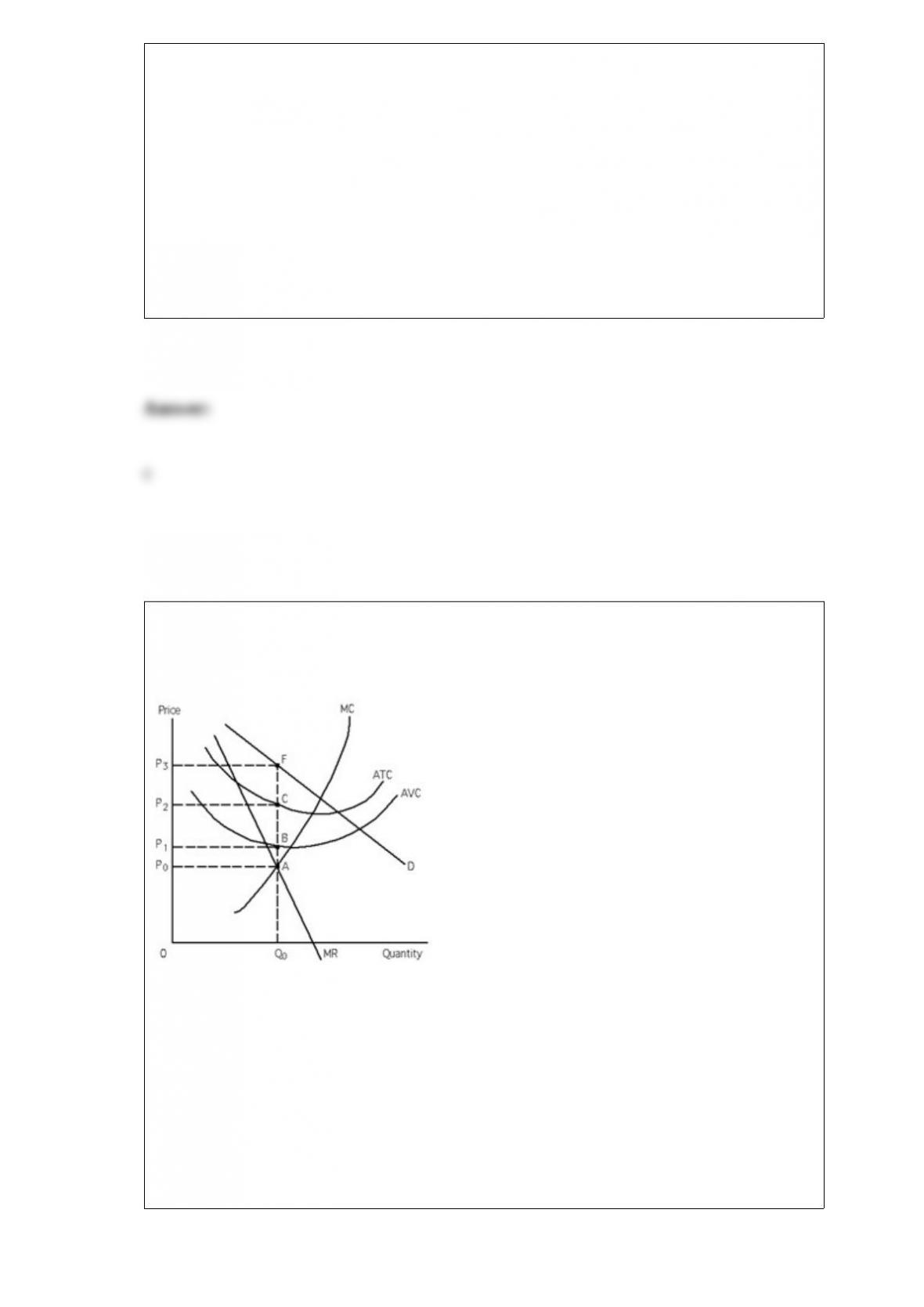
Refer to Exhibit 24-2. This monopolist is earning
Exhibit 24-2
a. an economic loss of area P0P3FA.
b. an economic loss of area P0P2CA.
c. an economic profit of area P2P3FC.
d. an economic profit of area P0P2CA.

If the supply curve and the demand curve for lettuce both shift to the left by an equal
amount, what can we say about the resulting changes in equilibrium price and quantity?
a. The price will increase, but the quantity may increase or decrease.
b. The price will increase, and the quantity will increase.
c. The price will decrease, and the quantity will increase.
d. The price will stay the same, but the quantity will increase.
e. The price will stay the same, but the quantity will decrease.
Society as a whole is made worse off by rent seeking behavior by producers.
a. True
b. False
Consumers receive more consumers’ surplus when tariffs exist than when they do not
exist.

a. True
b. False
Within the perfectly competitive market structure, consider a labor union that manages
to obtain higher wages for its members. At the time the union obtains higher wages, the
perfectly competitive firms are earning positive economic profits. It follows that
a. initially higher wages will reduce profits.
b. in the long run product prices will be higher because of higher wages.
c. in the long run the firms in the industry will earn below normal profits.
d. in the short run the firms in the industry will necessarily earn below normal profits.
e. a and b
If the interest rate increases, then
a. households will decrease their level of saving.
b. the supply of loanable funds will fall because it now costs more to borrow funds and
people who were supplying the funds will realize that fewer people will be willing to
borrow their funds.
c. households will consume less and save more.

d. government will consume more because it now costs more to borrow funds to buy
goods.
e. a, b, and d
When the price of a good rises, the demand for its complements will tend to rise.
a. True
b. False
Wage discrimination exists when individuals of __________ are paid different wage
rates.
a. varying ability and productivity
b. different ethnic origins
c. different religions
d. equal ability and productivity
e. b, c, and d

If economies of scale are so pronounced in an industry that only one firm can survive in
the industry, this firm is called a(n) __________ monopoly.
a. financial
b. natural
c. structured
d. independent