
If the price of a good rises and as a result total revenue falls, then it must be true that
a. cross elasticity of demand for the good is negative.
b. price elasticity of demand for the good is less than 1.
c. income elasticity of demand for the good is positive.
d. b and c
e. none of the above
Suppose you just finished your third plateful of Thanksgiving dinner and it yielded zero
units of additional satisfaction. Should you go back for more?
a. Why not? Since the third plateful gave you zero units, the fourth can’t give you any
less than zero.
b. No way. You could get negative utility from the fourth plateful.
c. Yes or no. It won’t make any difference because your total utility is at its peak.
d. Yes. If you received zero units of satisfaction from the third, then obviously the law
of diminishing marginal utility is not working in this case.

The main difference between the short run and the long run is that
a. firms earn losses in the long run, but not in the short run.
b. the long run always refers to a time period of one year or longer.
c. in the long run, only one input can be fixed.
d. in the short run, one or more inputs are fixed.
e. none of the above
In the case of a negative externality, in order to achieve efficiency the government must
set the _________________ equal to the marginal ____________________.
a. tax; external costs
b. tax; external benefits
c. subsidy; external costs
d. subsidy; external benefits
e. tax; private costs
Ceteris paribus means
a. one variable too many.

b. the correct relationship specified.
c. assuming economic motives.
d. all other things held constant or nothing else changes.
The monopolistic competitive firm faces a(n) __________ demand curve.
a. horizontal
b. vertical
c. downward-sloping
d. upward-sloping
Refer to Exhibit 24-9. A single-price monopolist earns a total profit of __________
when it produces and sells 20 units of its good.

a. $80.
b. $100.
c. $30.
d. $61.
e. $49.
An individual’s income equals
a. labor income + wages + asset income.
b. labor income + asset income.
c. labor income + asset income – taxes.
d. labor income – taxes.
e. labor income + asset income + transfer payments – taxes.

The average-marginal rule states that if the marginal magnitude is
a. less than the average magnitude, the average magnitude falls.
b. greater than the average magnitude, the average magnitude falls.
c. rising, the average magnitude is necessarily above it.
d. falling, the average magnitude is necessarily below it.
e. c and d
A price floor (set above the equilibrium price) on rice will
a. force otherwise profitable farmers out of business.
b. result in a shortage of rice.
c. result in a surplus of rice.
d. clear the market for rice.
e. both a and b

Tariffs and quotas are often imposed when a government is more responsive to
__________ interests, and the benefits of those trade restrictions are often __________.
a. consumer; concentrated
b. consumer; widely dispersed
c. producer; concentrated
d. producer; widely dispersed
Suppose that when the price of water rises by 30 percent, the quantity demanded falls
by 10 percent. The price elasticity of demand for water is ____________, making water
an _______________ good (in this example).
a. 0.33; inelastic
b. 3.0; elastic
c. 1.0; unit elastic
d. 0.33; elastic
Which of the following is a normative macroeconomics statement?
a. The central bank should increase the nation’s money supply.

b. The increase in the nation’s money supply helped push the nation’s unemployment
rate down in the short run.
c. Ford Motor Company’s new advertising campaign ended up hurting General Motors’
sales.
d. The local government ought to spend more on recreational facilities.
In moving along a demand curve, everything is held constant except buyers’ income.
a. True
b. False
If a labor union specifies that certain jobs can only be done by certain people (for
example, only electricians can do electrical work), it is likely trying to
a. affect the elasticity of demand for its labor.
b. reduce the availability of substitute factors for its labor.
c. increase the marginal physical product of its members.
d. a and b
e. none of the above

Productive efficiency implies that
a. it is impossible to obtain gains in one area without losses in another.
b. it is possible to obtain gains in one area without losses in another.
c. there are too many resources available.
d. there are too few resources available.
Don receives 100 utils from consuming two oranges. The utility he derives from
consuming the second orange equals 30 utils. Which of the following conclusions is
derived from the law of diminishing marginal utility?
a. The marginal utility Don receives from consuming the third orange will be less than
30 utils.
b. The marginal utility Don receives from consuming the third orange will be less than
100, but greater than 30 utils.
c. If the price of oranges decreases, Don will buy fewer oranges, ceteris paribus.
d. The total utility Don receives from consuming the first orange is less than the
marginal utility from consuming the first orange.
The Gini coefficient would be
a. 1 if there were perfect income equality.
b. zero if there were perfect income equality.
c. -l if there were complete income inequality.
d. zero if there were complete income inequality.
e. a and d
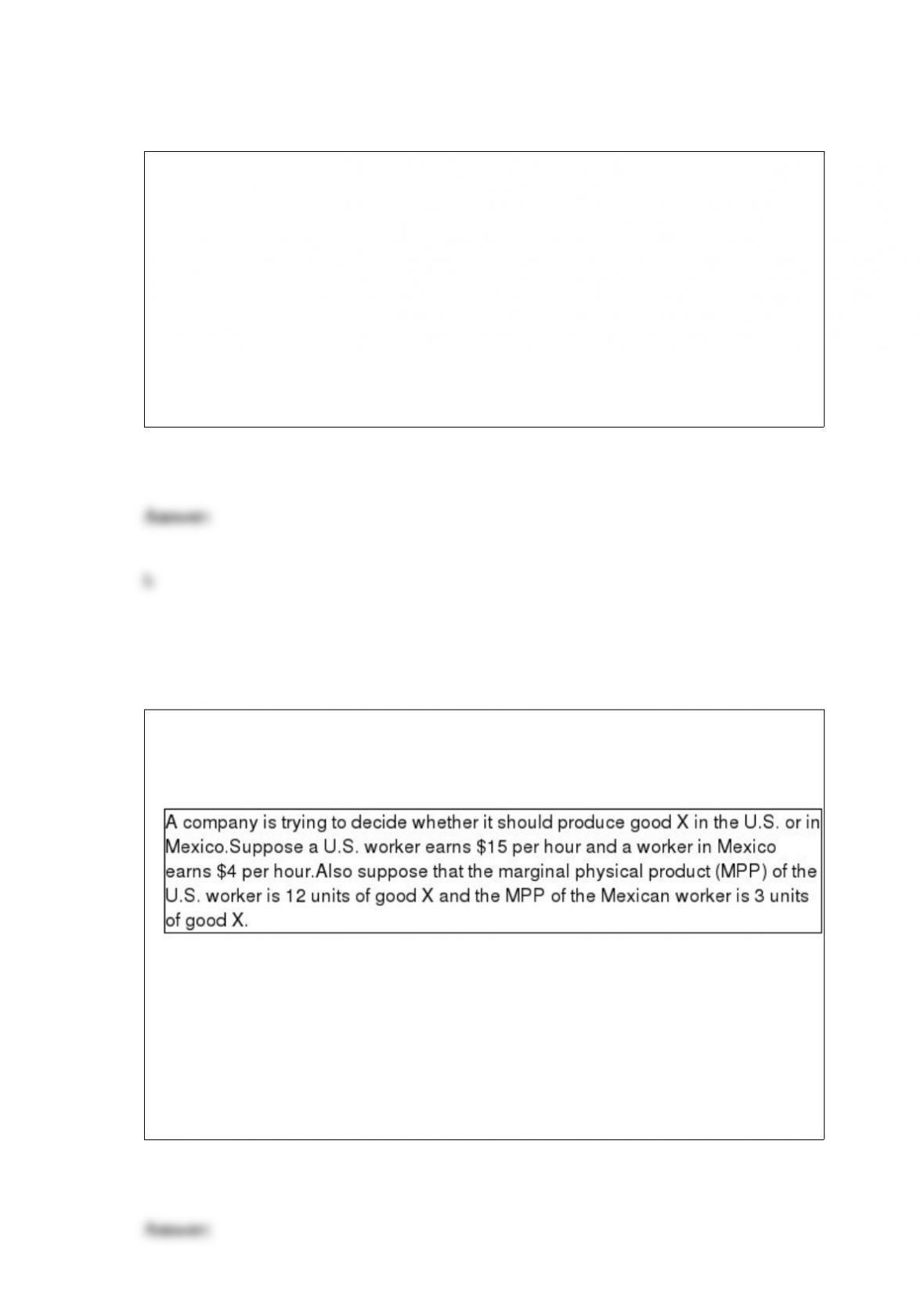
Refer to Situation 27-1. The output produced per $1 of cost in the U.S. is
Situation 27-1
a. 0.80 units of good X.
b. 1.25 units of good X.
c. 180 units of good X.
d. 3 units of good X.

A mandatory seatbelt law ends up raising the number of traffic fatalities if it lowers
fatalities per accident from 0.11 to 0.08 while raising the number of accidents per
period from 100,000 to any more than
a. 108,000.
b. 111,111.
c. 137,500.
d. 110,000.
Which of the following statements is false?
a. The Dow Jones Industrial Average went down by 40 percent during the decade of the
1930s.
b. Based on data from the period between 1926 and 2004, the probability of having a
positive return on an investment in the stocks contained in the Dow Jones Industrial
Average would have been 97.1 percent if the stocks had been held for 10 years.
c. When reading the stock market page of a newspaper, if the column marked “Div.” is
blank, it means that the company does not currently pay out dividends.
d. A stock that yields 4 percent is better than a stock that yields 5 percent, all else being
the same.

The quantity demanded of good A rises as income rises. It follows that income elasticity
of demand is __________than 0, and good A is a(n) __________ good.
a. greater; inferior
b. greater; normal
c. greater; substitute
d. greater; complementary
e. less; normal
One unintended consequence of the various attempts to restrict farm acreage was that
a. output generally decreased, price increased, and farmers earned higher incomes.
b. individual farmers intensified their efforts to harvest crops from the land still under
cultivation.
c. farmers’ incomes remained constant in real terms.
d. the land that was set aside became less productive.
Suppose an industry is made up of 16 firms. Three firms each sell 12 percent of the
industry’s total output; another three firms each sell 8 percent; another five firms each

sell 5 percent; and the last five firms each sell 3 percent. What is the eight-firm
concentration ratio in this industry?
a. 0.85
b. 0.50
c. 0.40
d. 0.70
e. 1.40
Which of the following statements is false?
a. For a price taker, P = MR, but for a price searcher, P > MR.
b. A monopoly firm’s demand curve lies above its marginal revenue curve.
c. A single-price monopolist charges the same price for all units of its product.
d. If a single-price monopolist sells the first unit of its product for $11, it cannot sell two
units of its product for $11 each.
e. none of the above