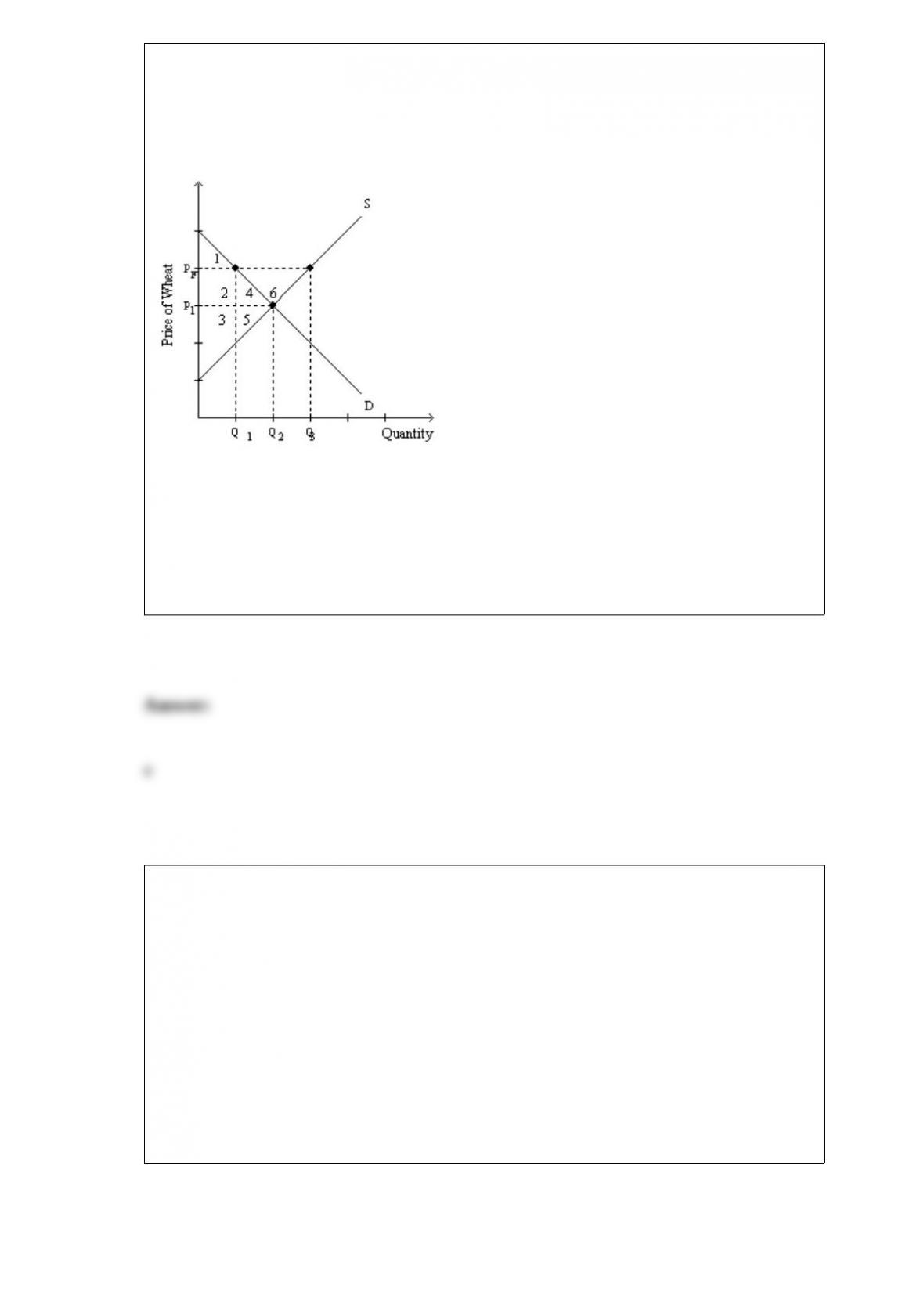
Refer to Exhibit 4-8.Suppose that wheat producerslobby the government for a price
floor and receive one.This price floor is set at PF.What is the size of the total surplus at
PF?
Exhibit 4-8
a. area 1 + 2 + 3
b. area 1 + 2 + 3 + 4
c. area 1 + 2 + 3 + 4 + 5
d. area 1 + 2 + 3 + 4 + 5 + 6
If firms are earning zero economic profits, they must be producing at an output level at
which
a. price equals marginal cost.
b. price equals average total cost.
c. price equals average variable cost.
d. marginal revenue equals marginal cost.
e. none of the above
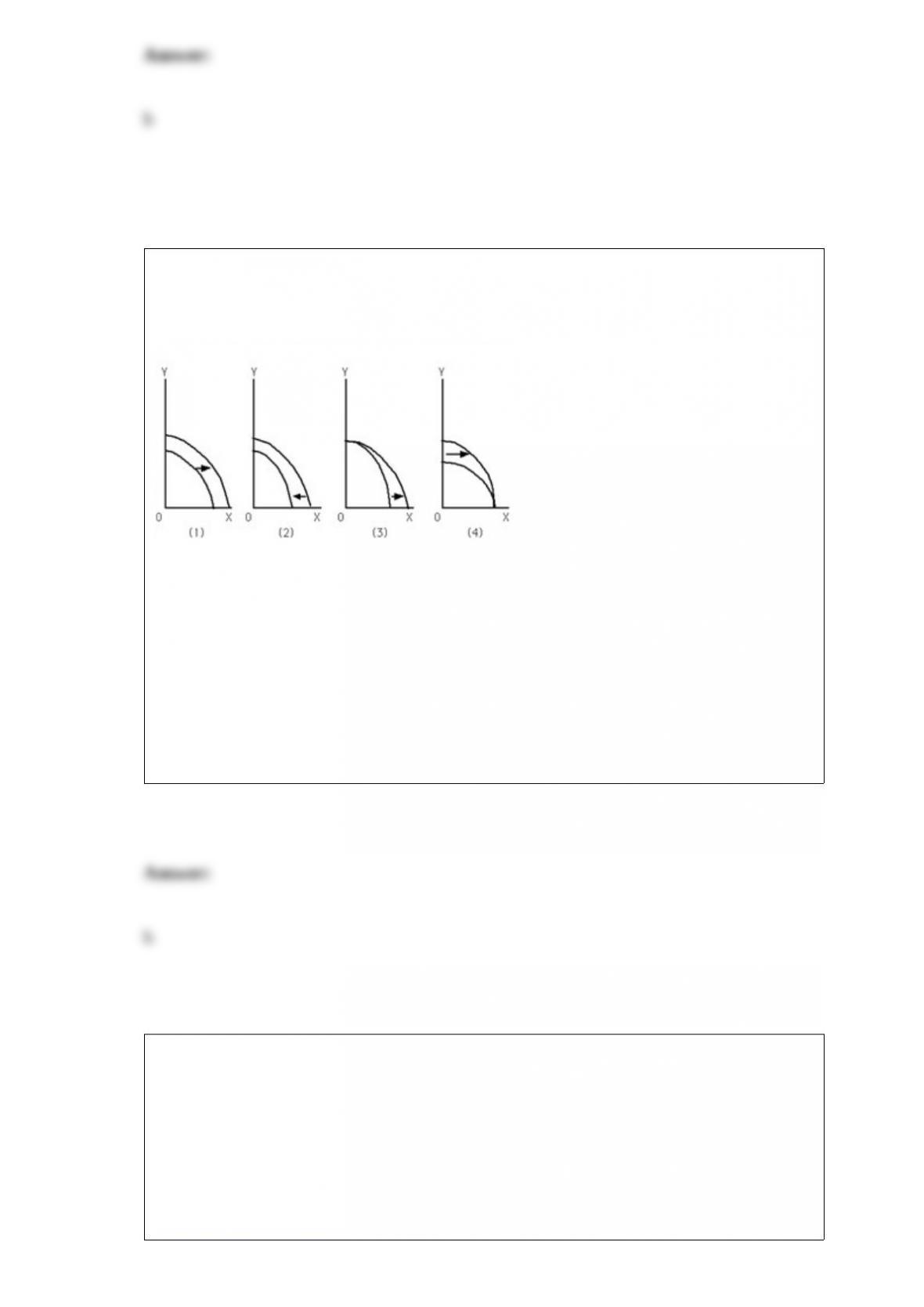
Refer to Exhibit 2-6. Which graph best depicts the consequence of a large-scale natural
disaster?
Exhibit 2-6
a. (1)
b. (2)
c. (3)
d. (4)
e. none of the above
It seems quite possible that cigarette companies concealed information about the effects
of smoking on health, causing cigarette prices to be __________ and cigarette sales to
be __________ than would have been the case under symmetric information.
a. higher; higher
b. higher; lower

c. lower; higher
d. lower; lower
The closer the Gini coefficient is to 1, the
a. greater the degree of income inequality.
b. less the degree of income inequality.
c. greater the degree of discrimination.
d. less the degree of discrimination.
Which of the following can a homebuyer pay for indirectly when purchasing a home?
a. good weather
b. a good school district
c. a nice view
d. all of the above

When exports of American goods increase, this __________ the demand for U.S.
dollars and at the same time __________ foreign currencies.
a. increases; increases the supply of
b. decreases; increases the supply of
c. increases; decreases the supply of
d. increases; increases the demand for
e. none of the above
By adhering to the MR = MC rule, a single-price monopoly
a. will always have an above-zero profit.
b. will always have a normal profit.
c. maximizes its profit, which may in some cases mean minimizing its losses.
d. is not earning as large a profit as it can by setting MR = (MC – P).

To engage in price discrimination, it is necessary that
a. a seller be a price searcher.
b. there be no arbitrage.
c. a seller incur different costs for servicing different customers.
d. a and b
e. all of the above
Which of the following is not a theory of the source of profit as discussed in the
textbook?
a. Uncertainty is a source of profits.
b. Profit is the reward for alertness to arbitrage opportunities.
c. Profit is the return to the entrepreneur as innovator.
d. Profit is the return to those who are fortunate enough to own resources.
Which of the following conditions makes it most likely for a quota to be imposed?
a. The benefits of the quota are spread over many and the costs are concentrated on a
few.

b. The benefits of the quota are spread over many and the costs are spread over many.
c. The benefits of the quota are spread over few and the costs are spread over many.
d. The benefits of the quota are spread over few and the costs are spread over few.
e. There is not enough information to answer the question.
If price elasticity of demand is 0.5, it follows that a _______ percent decrease in price
would cause a _______ percent increase in quantity demanded.
a. 50; 1
b. 0.5; 1
c. 0.5; 0.5
d. 100; 500
e. 2; 1
The percentage of sales accounted for by X number of firms in the industry is called the
a. concentration ratio.
b. oligopoly rate.
c. interdependence rate.
d. market power index.
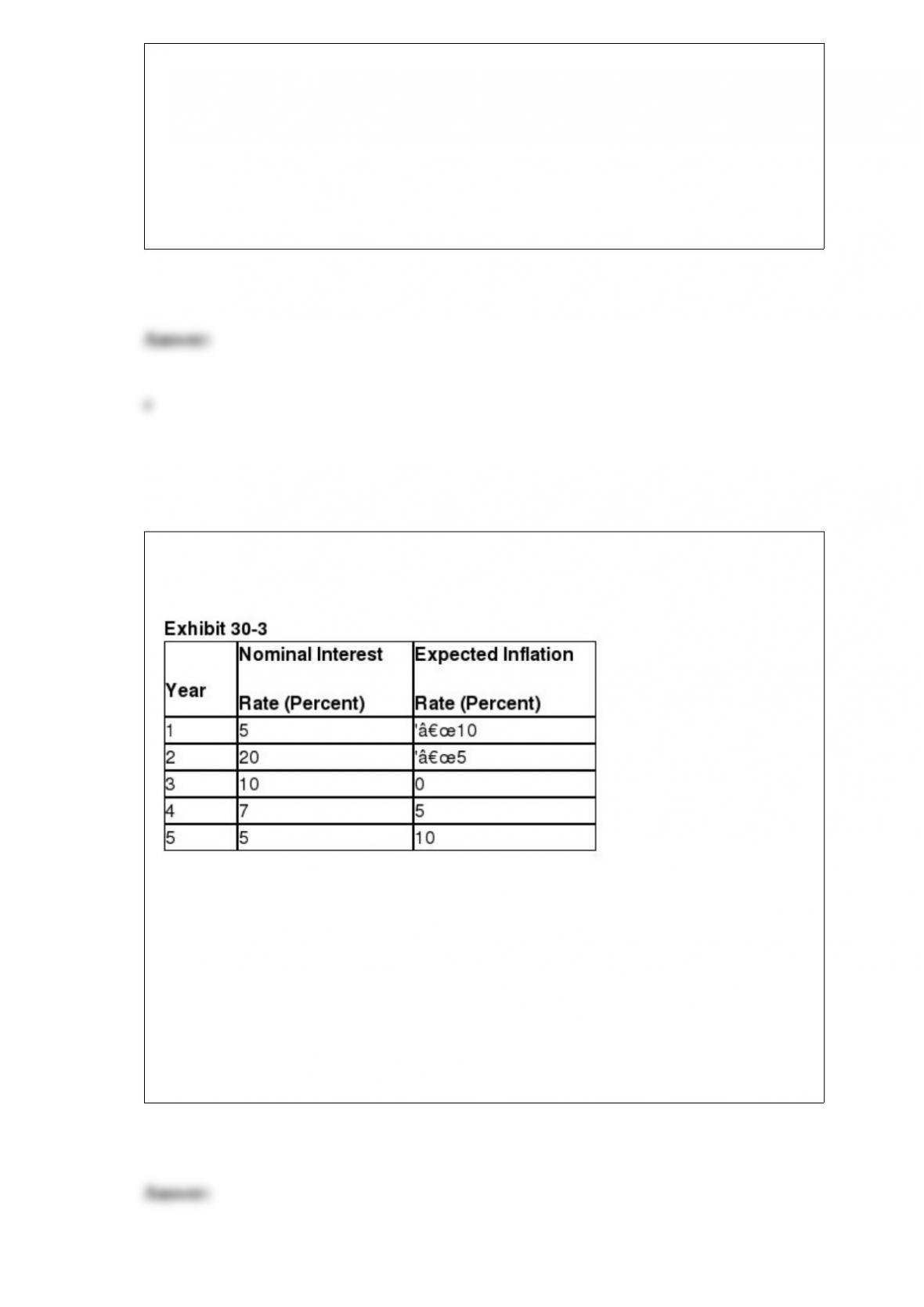
Refer to Exhibit 30-3. The real interest rate in year 1 is
a. 10 percent.
b. -5 percent.
c. 15 percent.
d. -15 percent.
e. 5 percent.

The capture theory of regulation contends that
a. the public “captures” the benefits of regulation through lower prices.
b. natural monopolies “capture” high profits through the reduction of output.
c. the regulatory agency is eventually “captured” by the special interests of the industry
being regulated.
d. large corporations “capture” high profits by regulating the tastes and preferences of
the buying public.
When the official dollar price of a foreign currency is set below its equilibrium level,
the dollar
a. has been appreciated.
b. is overvalued.
c. is undervalued.
d. is devalued.
e. is revalued.
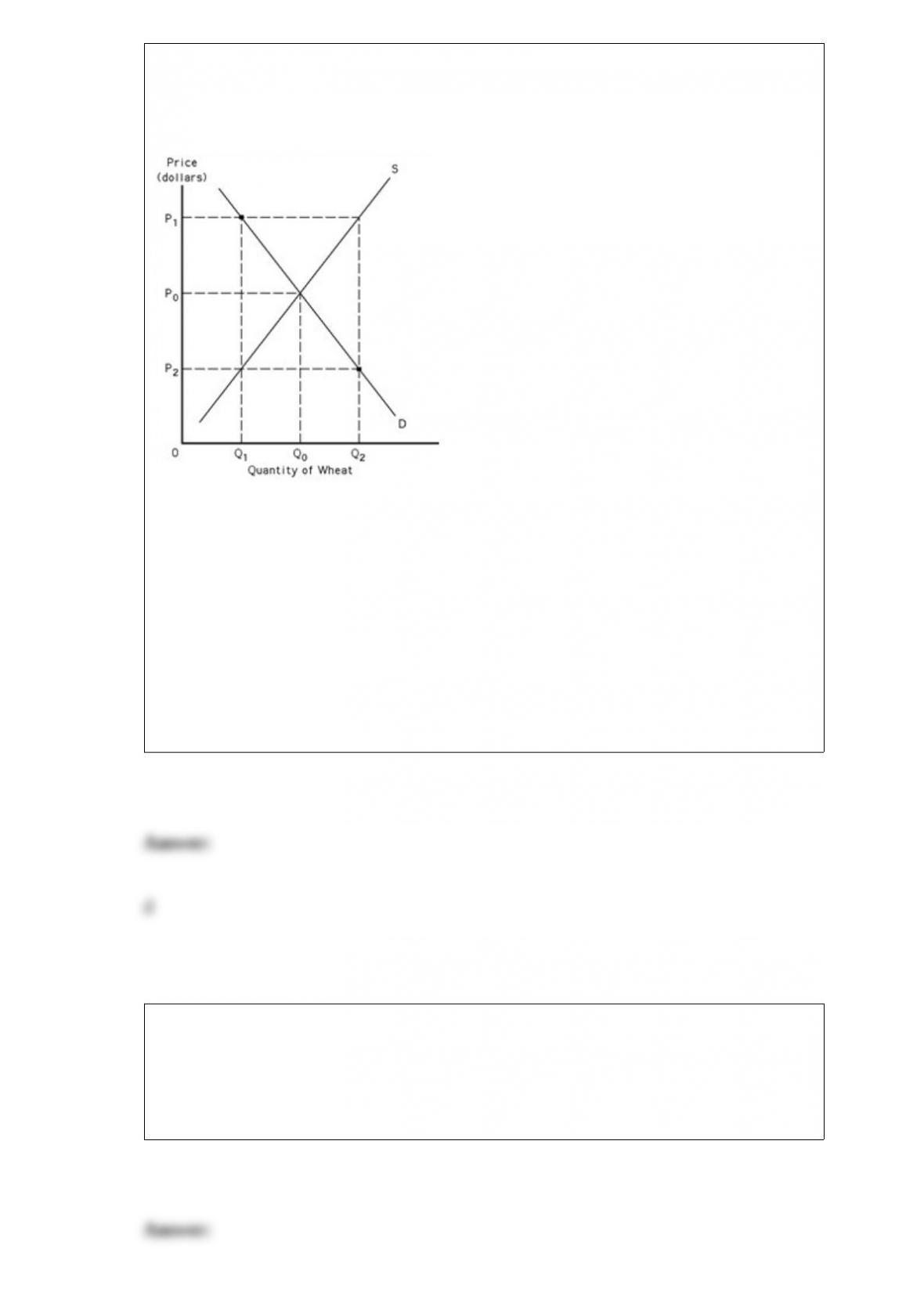
Refer to Exhibit 39-2. If P1 is a price support, the cost of the price support program to
the government is
Exhibit 39-2
a. P1 x Q2.
b. P1 x (Q2 – Q0).
c. P1 x (Q0 – Q1).
d. P1 x (Q2 – Q1).
e. none of the above
Economists assume that the goal of consumers is to maximize total utility.
a. True
b. False

The __________ hand is the metaphor used to refer to market coordination, whereas the
__________ hand is the metaphor used to refer to managerial coordination.
a. visible; fast
b. invisible; visible
c. fast; lazy
d. lazy; fast
e. none of the above
The perfectly competitive firm’s short-run supply curve is the
a. upward-sloping portion of its average total cost curve.
b. horizontal portion of its marginal revenue curve.
c. portion of its average variable cost curve that lies above the average fixed cost curve.
d. upward-sloping portion of its marginal cost curve.
e. portion of its marginal cost curve that lies above its average variable cost curve.

Which of the following is not a condition of a contestable market?
a. There is easy entry into the market.
b. There is costless exit from the market.
c. New firms entering the market can produce the product at lower cost than current
firms.
d. Firms exiting the market can easily dispose of their fixed assets by selling them
elsewhere.
e. None of the above; that is, all of the above are conditions of a contestable market.
Which of the following persons is most likely to become informed on the National
Endowment for the Arts?
a. an attorney
b. a mayor of a city
c. a farmer
d. a student of agriculture
e. a sculptor