
The law of comparative advantage can be used to explain why many couples divide up
their household duties along gender lines.
a. True
b. False
The Alchian and Demsetz theory of why business firms exist suggests that
a. there are only advantages to team production.
b. disadvantages of team production may outweigh the disadvantages of individual
production.
c. individual production is more efficient than team production.
d. the sum of team production is sometimes greater than the sum of individual
production.
Which of the following statements is true?
a. Larger loans are likely to be cheaper to process (per dollar) than smaller loans;
therefore, larger loans will carry a lower interest rate than smaller loans, ceteris paribus.
b. Larger loans are likely to be more expensive to process (per dollar) than smaller
loans; therefore, larger loans will carry a higher interest rate than smaller loans, ceteris
paribus.
c. Larger loans are likely to be cheaper to process (per dollar) than smaller loans;
therefore, larger loans will carry a higher interest rate than smaller loans, ceteris
paribus.
d. Larger loans are likely to be more expensive to process (per dollar) than smaller
loans; therefore, larger loans will carry a lower interest rate than smaller loans, ceteris
paribus.
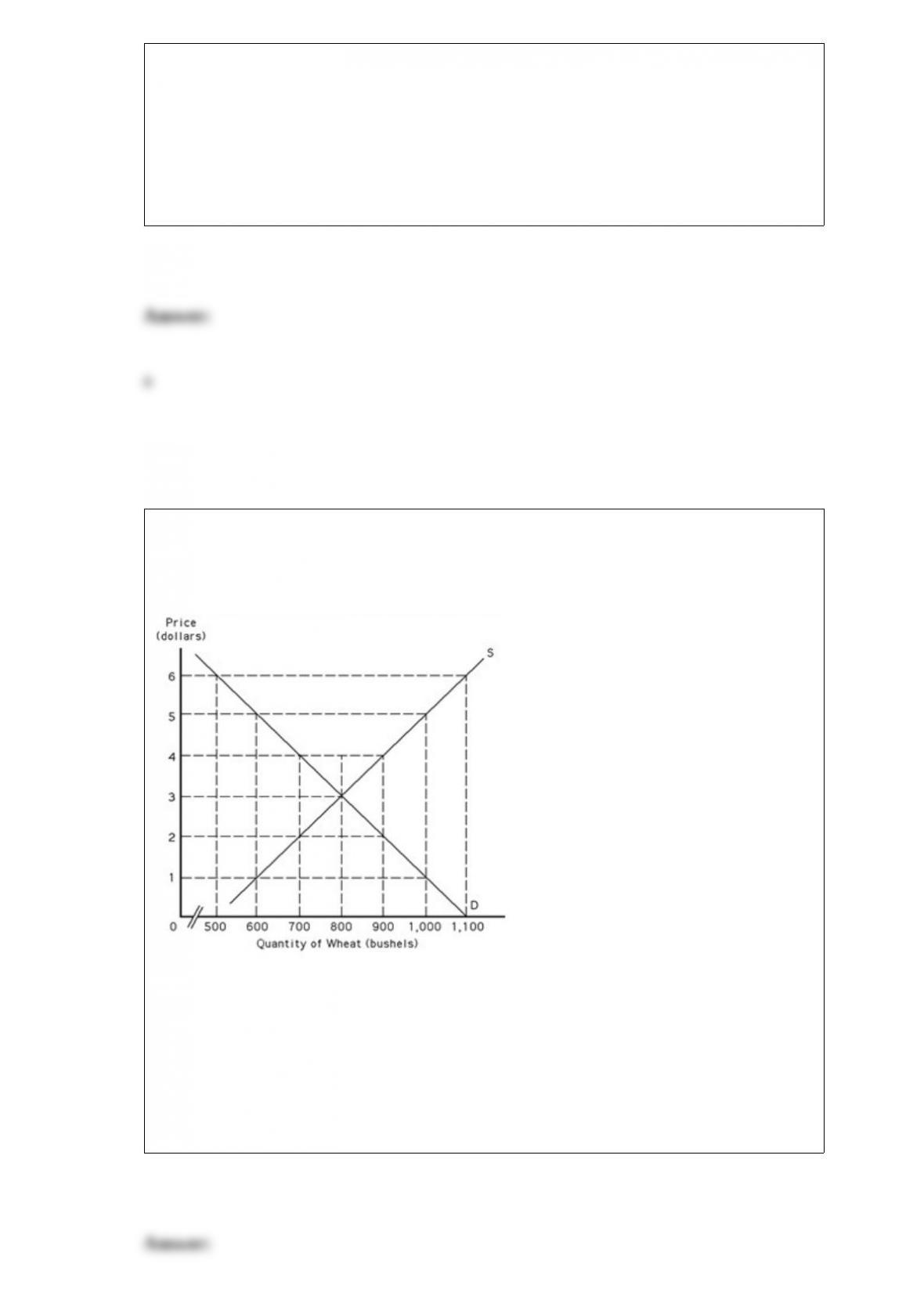
Refer to Exhibit 39-4. Under a price support program of $4 per bushel, how many
bushels of surplus wheat does the government purchase?
Exhibit 39-4
a. 0
b. 200
c. 700
d. 900

Loanable funds are
a. another term for capital.
b. a particular type of investment fund that companies such as Merrill Lynch offer to
consumers.
c. funds that someone borrows with a promise to pay interest for the use of the funds.
d. funds that someone lends with the requirement that interest be paid for the use of the
funds.
e. c and d
Agriculture productivity has increased more rapidly in the U.S. than has nonagriculture
productivity.
a. True
b. False
If the Gini coefficient is zero (0), this means that

a. there is complete income inequality.
b. there is some income inequality.
c. there is perfect income equality.
d. the area between the line of perfect income equality and the actual Lorenz curve is
very large.
e. a and d
Which of the following is an example of an oligopoly market in which the firms
produce a homogeneous product?
a. aluminum
b. soap
c. breakfast cereals
d. tires
e. all of the above
Public franchises, patents, and government licenses are examples of __________
barriers to entry.

a. social
b. legal
c. cultural
d. geographic
You turn to the Treasury bond market page of a newspaper and look under the column
headed “Ask” and see that it says, “128:16” this indicates that
a. the price that the buyer is willing to pay for this bond is $128.16.
b. the price that the buyer is willing to pay for this bond is $1,280.16.
c. the price that the seller is willing to sell this bond for is $1,285.
d. the price that the seller is willing to sell this bond for is $128.16.
Five months ago Wilson opened up a health club. Which of the following is an implicit
cost related to the health club?
a. Wilson paid $120 for an outside laundry service to clean the towels used at the club.
b. Wilson paid $100 for the pest control exterminator to spray the health club.
c. Wilson previously worked as an accountant, earning $3,000 a month.

d. Wilson usually eats four hamburgers a day, priced at $3 each.
A theory is a perfect description of reality.
a. True
b. False
Which of the following statements is true?
a. The market demand for labor is the horizontal “addition” of the firms’ demand curves
for labor.
b. The elasticity of demand for labor is the percentage change in quantity demanded of
labor divided by the percentage change in wage rate.
c. The factor demand curve will shift to the right if the price rises for the good the factor
goes to produce.
d. b and c
e. a, b, and c

Suppose that the exchange rate between the U.S. dollar and the Mexican peso starts out
at $0.11 per peso.If the exchange rate then changes to $0.13 per peso, there will be a(n)
__________ in the quantity demanded of dollars by Mexicans, and therefore there will
be a(n) __________in the quantity supplied of pesos to the foreign exchange market.
a. decrease; decrease
b. decrease; increase
c. increase; decrease
d. increase; increase
If an economy is operating on its production possibilities frontier (PPF), are there any
unemployed resources in the economy?
a. Yes, because if there weren’t any unemployed resources the economy would be
producing beyond its PPF.
b. No, because if there were any unemployed resources the economy would be
producing below its PPF.
c. It depends on whether the economy’s PPF is a concave (downward-sloping) curve or
a straight line.
d. Yes, because there are always some natural resources that are unemployed.
e. The answer is “yes,” but not for any of the reasons specified in answers a through d.

Refer to Exhibit 22-10. Paul’s marginal productivity of the fourth hour of studying is
Exhibit 22-10
a. 4 problems.
b. 5 problems.
c. 14 problems.
d. 19 problems.
e. 23 problems.
Consumer equilibrium exists when an individual
a. can be made better off by buying more of a normal good and less of an inferior good.
b. is receiving the same total utility from each of the goods he or she purchases.
c. is receiving the same marginal utility from each of the goods he or she purchases.
d. has the same MU/P ratio for each of the goods he or she purchases.
e. none of the above
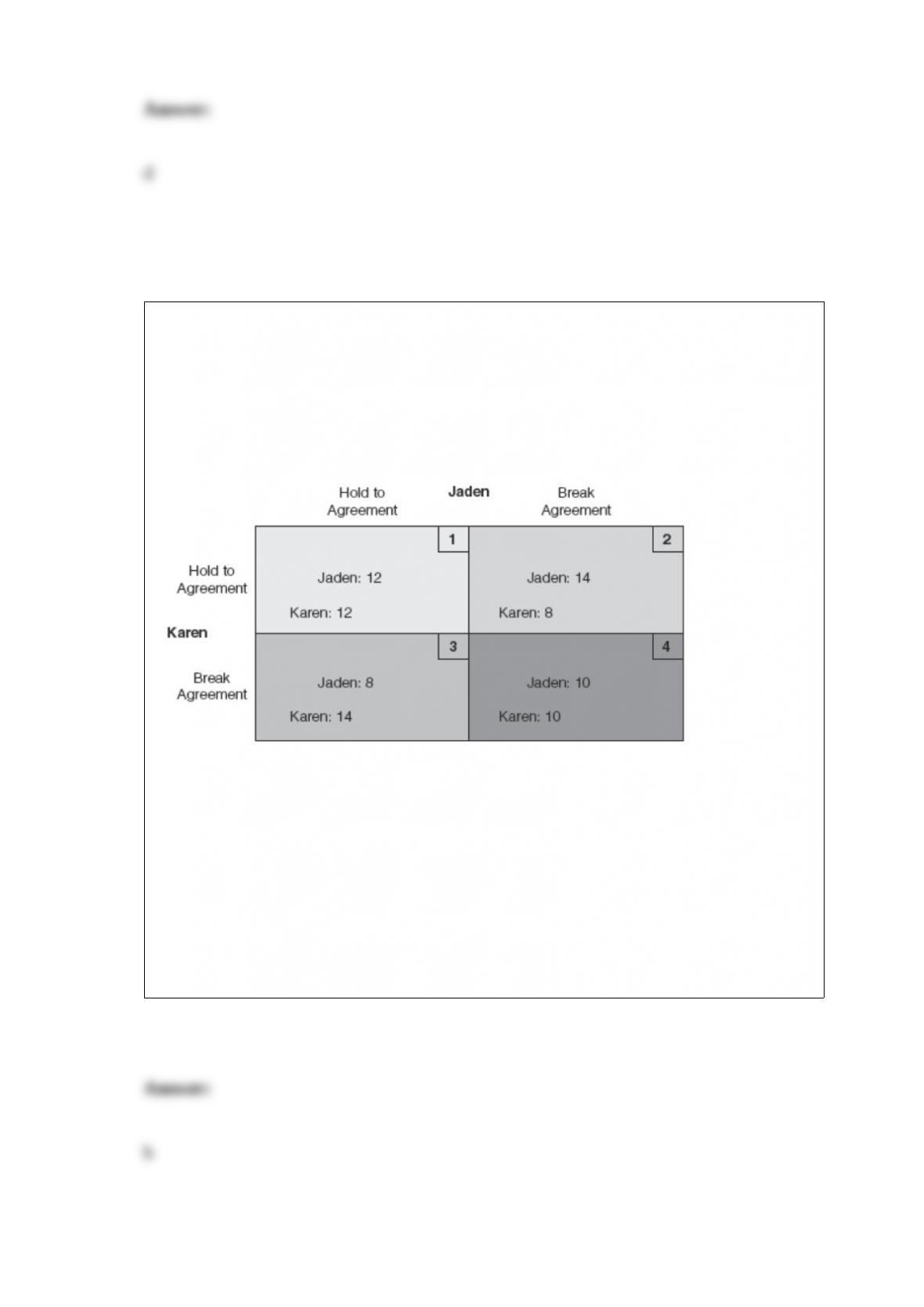
Refer to Exhibit 37-1, where the higher the number, the better the position for the
person to whom the number is connected.Jaden and Karen are currently in box 4, each
receiving 10.they would like to move to box1, where each receives 12.Without someone
to ________________ their agreement, moving from box 4 is
______________________.
Exhibit 37-1
a.enforce; likely
b. enforce; unlikely
c. break; unlikely
d. break; likely
e. There is not enough information to answer the question.

Minimum efficient scale refers to the
a. minimum size plant in any given industry.
b. minimum point on the short-run average total cost curve.
c. output level when economies of scale first set in.
d. output level when diseconomies of scale first set in.
e. lowest output level at which average total costs are minimized.
Which of the following statements is false?
a. The market demand curve in a perfectly competitive market is downward sloping.
b. The firm’s demand curve in a perfectly competitive market is horizontal.
c. The firm’s demand curve in a perfectly competitive market is perfectly elastic.
d. Marginal revenue is equal to the change in total revenue divided by the change in
quantity of output.
e. none of the above
A farmer has 500 acres on which he has previously grown corn. His yield per acre is
100 bushels of corn. If his production flexibility contract payment is $21,250, then what

is the corn payment rate?
a. $0.45
b. $0.67
c. $0.50
d. $0.10
e. There is not enough information to answer the question.
A monopolist practicing (perfect) price discrimination has
a. a larger deadweight loss triangle than a single-price monopolist has.
b. the same deadweight loss triangle as a single-price monopolist.
c. a deadweight loss triangle one-half the size of what it would be with uniform pricing.
d. no deadweight loss triangle.
When a perfectly competitive firm incurs losses, it follows that price
a. must be below average total cost.
b. must be below average variable cost.

c. is less than marginal cost.
d. is less than marginal revenue.
The term “roundabout methods of production” refers to
a. Firm A purchasing a product from Firm B and reselling it to consumers.
b. firms first producing capital goods and then using those capital goods to produce
consumer goods.
c. firms selling unassembled products so that the consumer completes the production
process.
d. banks and other financial institutions making loans available to producers so that the
producers can make goods available to consumers; thus in a roundabout way the banks
are making the goods available to consumers.
Suppose the production of a good results in positive externalities. If output occurs at the
intersection of the marginal social benefits curve and the supply curve, then
a. output will be at the socially optimal level.
b. the price of the product will be the same as it was when all benefits were not taken
into account.
c. more output will be produced than if all benefits were not taken into account.

d. a and c
e. a, b, and c