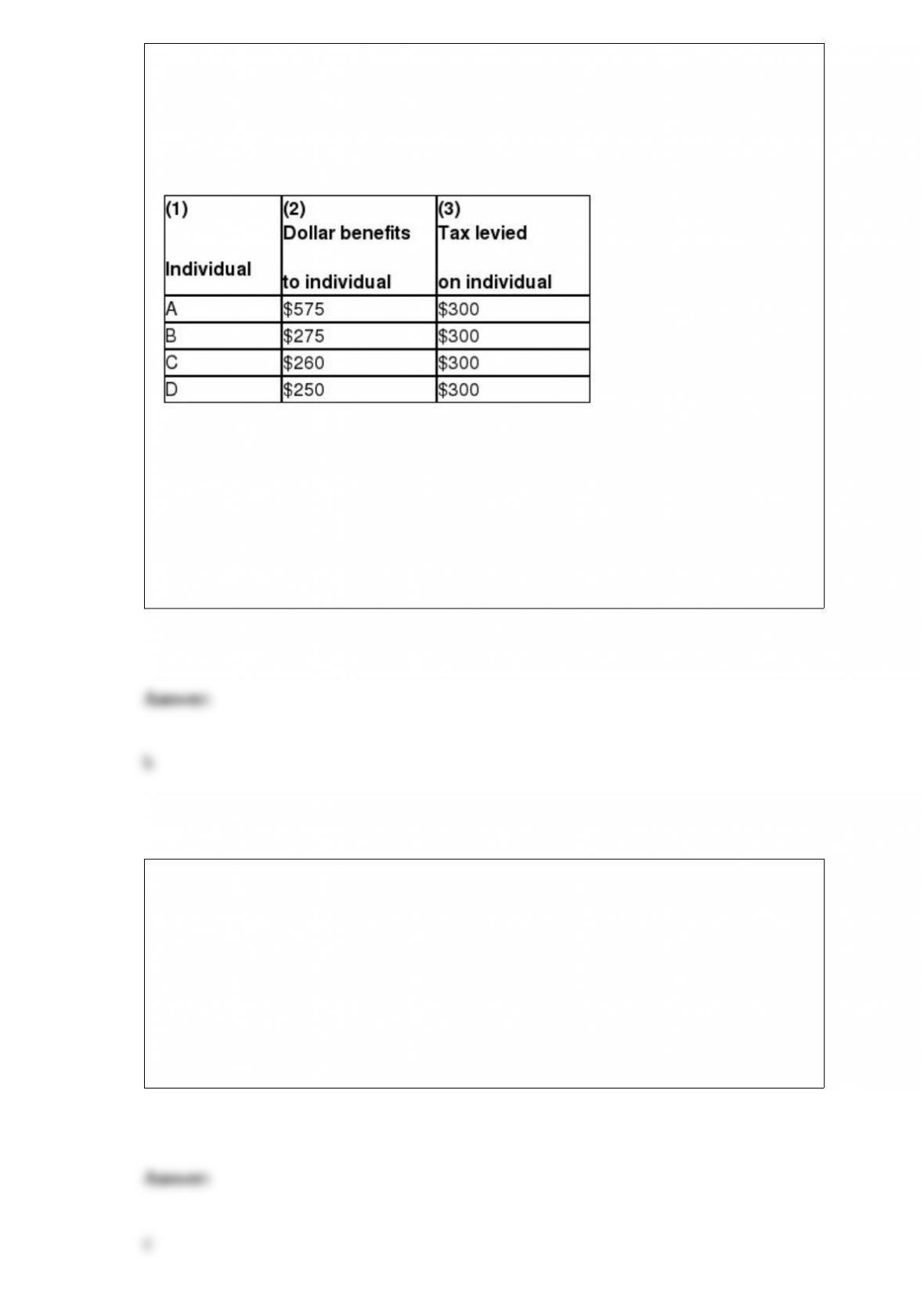
Refer to Exhibit 32-l. The exhibit shows the breakdown of benefits and costs for a
four-person town of a proposed $1,200 addition in books to the public library. The
members of the community get to vote on the project at hand, and the majority rules.
Given the data, the $1,200 will
Exhibit 32-l
a. be spent, even though the total benefits are less than the total costs.
b. not be spent, since more persons are against the project than are for it.
c. be spent, since the total benefits are greater than the total costs.
d. not be spent, since the total benefits are less than the total costs.
Which of the following is not an argument for trade restrictions?
a. the national defense argument
b. the infant industry argument
c. the comparative advantage argument
d. the antidumping argument

Indifference curves are convex to the origin if
a. a person’s marginal rate of substitution declines as he or she consumes more of a
good.
b. a person’s marginal rate of substitution increases as he or she consumes more of a
good.
c. the law of diminishing marginal utility holds.
d. a and c
e. none of the above
The short-run industry supply curve is the
a. horizontal summation of the short-run supply curves for all firms in the industry.
b. vertical summation of the short-run supply curves for all firms in the industry.
c. average of the short-run supply curves for all firms in the industry.
d. same as that of the typical firm in the industry.
In the burglary crime model presented in the textbook, as the anguish cost of
committing a burglary rises, the prediction is that
a. more people will commit burglary.
b. the same number of people will commit burglary.
c. fewer people will commit burglary.
d. There is not enough information to answer this question.
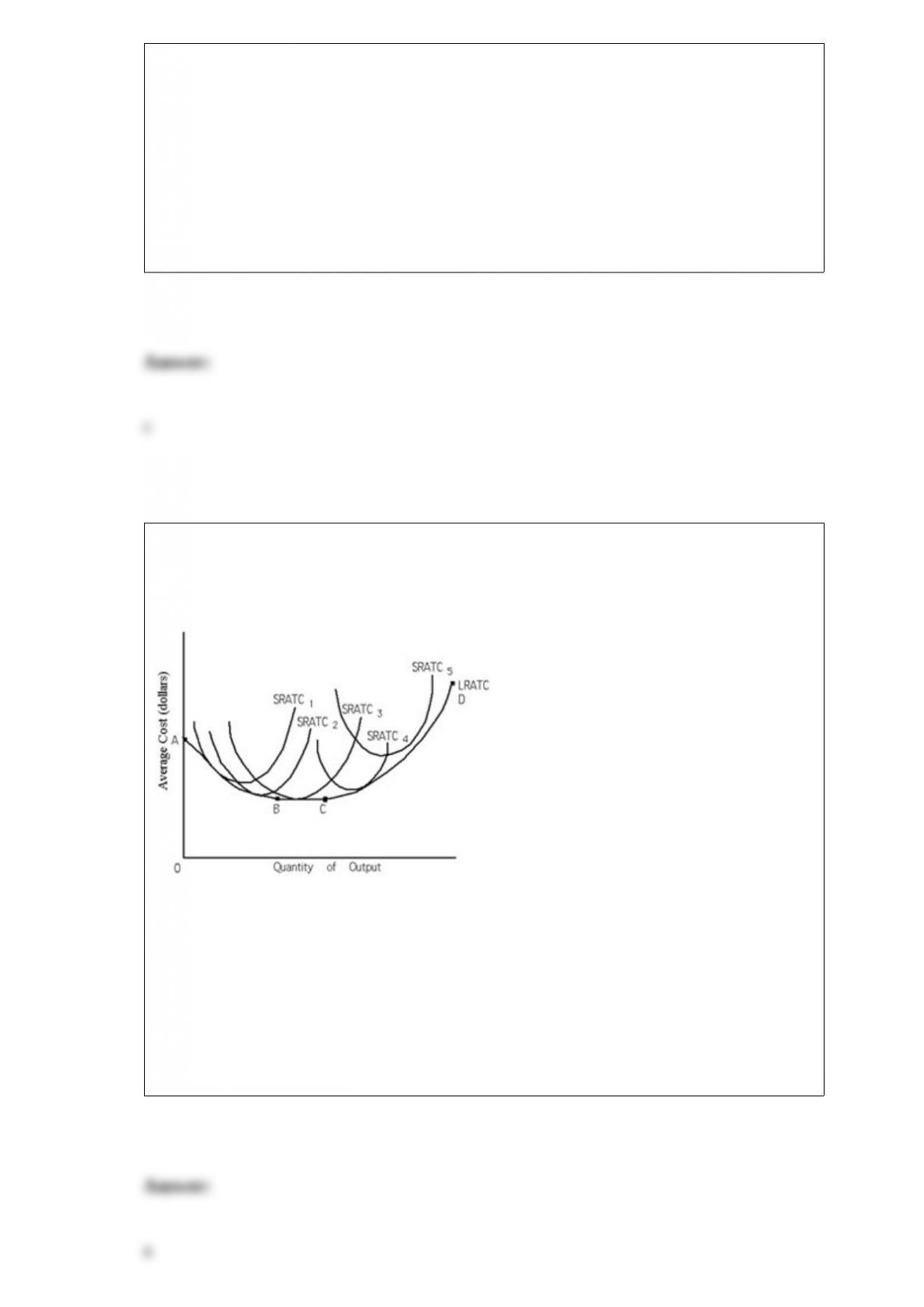
Refer to Exhibit 22-5. Economies of scale are present between
Exhibit 22-5
a. points A and B.
b. points A and C.
c. points B and C.
d. points B and D.
e. points C and D.

The Robinson-Patman Act of 1936 was passed in an attempt to
a. strengthen unions’ powers to deal with businesses during the Great Depression.
b. close the loophole that remained in the Clayton Act with respect to mergers.
c. decrease the failure rate of small businesses.
d. protect consumers from large retailers who were receiving price discounts from their
suppliers but were not passing on the price savings to the consumers.
e. protect all U.S. businesses from foreign competition during the Great Depression.
Entrepreneurship is
a. the talent for organizing the use of land, labor and capital, among other things.
b. skill in influencing government regulators and legislators.
c. accumulated technical knowledge in using labor and capital.
d. knowledge of the particular natural resources to be found in a given area.
Rational ignorance is

a. a result of our educational system.
b. the curtain, or wall, of knowledge between the persons that are educated and those
that are not.
c. the curtain behind which people choose to hide to avoid knowledge about poverty
and, in general, the unequal distribution of income.
d. the curtain separating educated voters from uneducated voters.
e. none of the above
Production possibilities curves can shift outward but they do not shift inward.
a. True
b. False
Suppose that for a given good demand increases and supply increases at the same
time.If demand increases by a lesser amount than supply increases, then equilibrium
price __________ and equilibrium quantity __________ for that good.
a. rises; falls
b. falls; falls
c. rises; rises
d. falls; rises

The act that made exclusive dealing illegal was the
a. Sherman Act.
b. Federal Trade Commission Act.
c. Robinson-Patman Act.
d. Clayton Act.
e. none of the above
“Pure economic rent” is a payment
a. in excess of opportunity costs.
b. in excess of opportunity costs when opportunity costs are zero.
c. for the use of land.
d. in excess of opportunity costs when opportunity costs are positive.
e. to a pure monopolist for the monopolist’s product.

Monopolists are guaranteed to earn a positive economic profit because they are the only
seller in their industry.
a. True
b. False
If government removes two people from a prisoner’s dilemma setting (and, in the
process, requires that the two persons pay taxes for the service that government
provides), itholds that on net
a. each of the two persons is better off.
b. each of the two persons is worse off.
c. one person is better off and the other person is worse off.
d. a, b, or c
e. none of the above
A firm that is the sole buyer in a factor market is known as a

a. monopolist.
b. public employee union.
c. monopsonist.
d. perfect competitor.
What is the approximatevalue of a future income stream of three $1,000 payments to be
received one, two, and three years from today if the interest rate is 5 percent?
a. $864
b. $1,633
c. $2,723
d. $5,062
The antitrust act that says, “Every contract, combination in the form of trust or
otherwise, or conspiracy, in restraint of trade or commerce among the several states, or
with foreign nations, is hereby declared to be illegal” is the
a. Sherman Act.
b. Clayton Act.

c. Federal Trade Commission Act.
d. Robinson-Patman Act.
Suppose that the annual dividend per share of stock is $1.40 and the closing price of the
stock is $22.00, the yield on the stock would be approximately
a. 6.36%
b. 15.71%
c. 21.60%
d. 9.70%
Assume that the buyers of good Z fall into two groups: buyers that have elastic demand
and buyers that have inelastic demand.If the firm selling good Z can charge different
prices to different groups of people, the firm would prefer to ______________ the price
charged to the elastic group and _______________ the price charged to the inelastic
group.
a. raise; lower
b. lower; lower
c. lower; raise
d. raise; raise
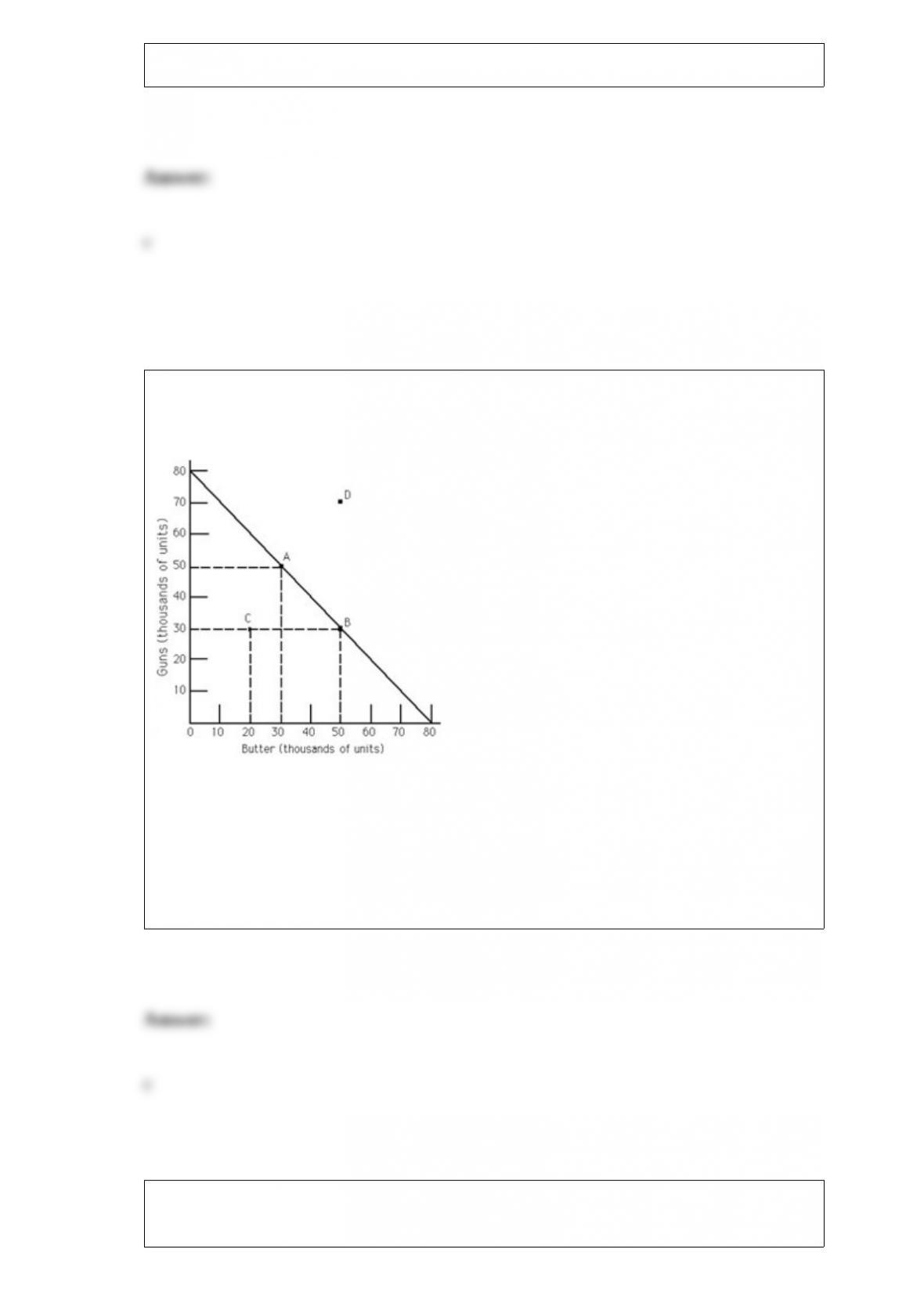
Refer to Exhibit 2-1. Scarcity exists
Exhibit 2-1
a. at point C but not at point A.
b. neither at point C nor at point A.
c. at both point C and at point A.
d. at point A but not at point C.
In the theory of the firm (as put forth by Alchian and Demsetz), trade or exchange pops
up in the following situation:

a. when individuals choose to form a team
b. when the monitor fires an employee
c. when individuals in a team shirk
d. a and c