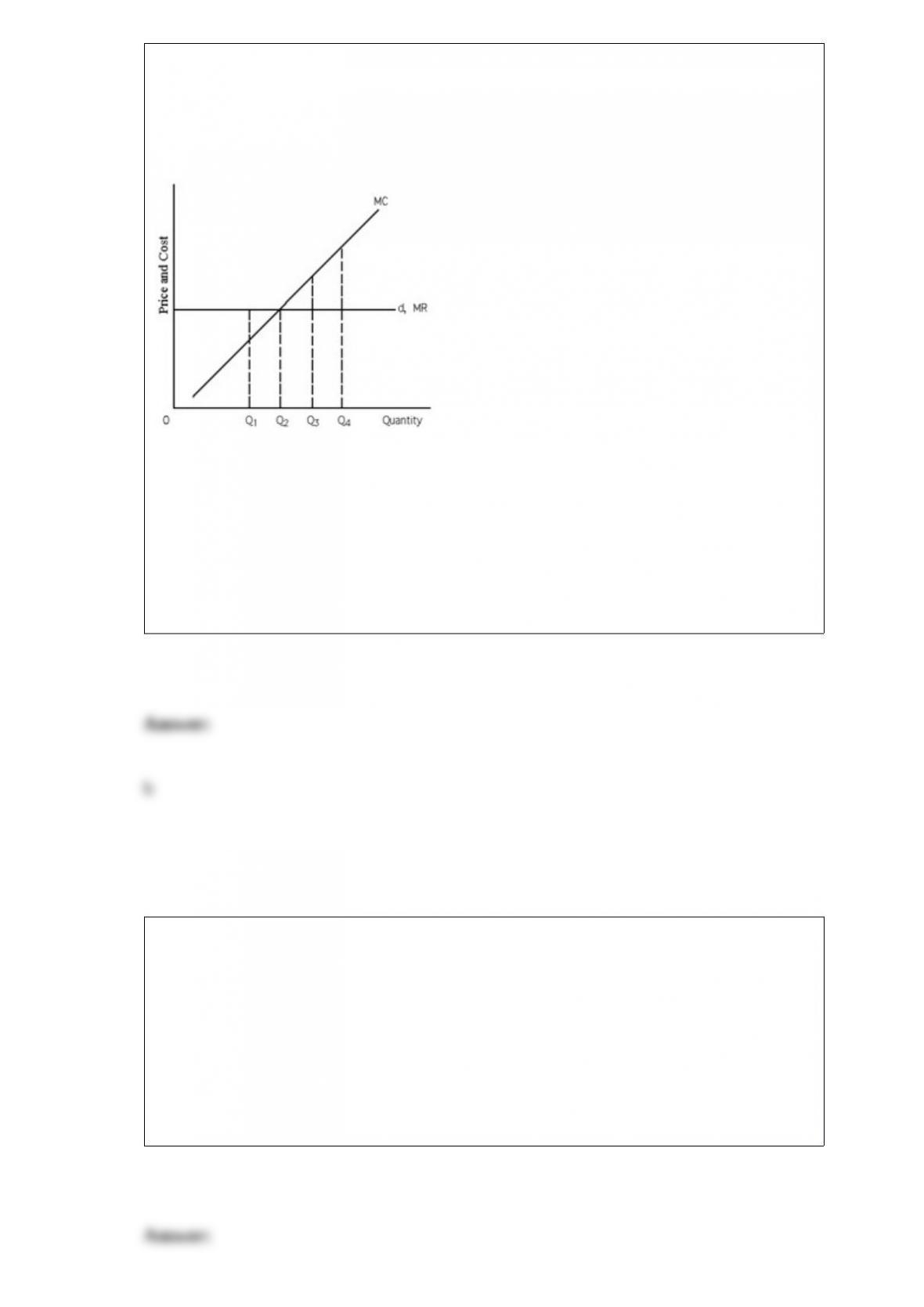
Refer to Exhibit 23-2. What quantity of output does the profit-maximizing (or
loss-minimizing) firm produce?
Exhibit 23-2
a. Q1, where marginal cost is less than marginal
revenue.
b. Q2, where marginal cost is equal to marginal revenue.
c. Q3, where marginal cost is greater than marginal revenue.
d. Q4, which maximizes the difference between marginal cost and marginal revenue.
Which of the following is not a necessary condition for the contestable market theory?
a. There are no barriers to entry.
b. Exit from an industry is costless.
c. All firms in an industry have the same costs of production.
d. All of the above are necessary conditions.

“Dumping” refers to
a. the sale of goods abroad at a price below their cost and below the price charged in the
domestic market.
b. unloading of foreign goods on domestic docks.
c. government actions to remedy “unfair” trade practices.
d. buying goods at low prices in foreign countries and selling them at high prices in the
United States.
In general, a dry cleaner in a small town is ______________ likely to be unethical in
his business practices than a dry cleaner in a large city.This is because the larger a
percentage of the population one person is, the _____________likely that person will
have to further engage with people he encounters.
a. more; less
b. less; less
c. more; more
d. less; more

A perfectly competitive firm can produce its current level of output at an average total
cost of $10 and a marginal cost of $8.If the market price of the product is currently $8,
what should the firm do?
a. The firm should definitely shut down since average total cost exceeds price.
b. The answer depends upon the relationship between price and average variable
cost.The firm should shut down if average variable cost is $8 or greater, but the firm
should continue to produce the current level of output if average variable cost is less
than $8.
c. The firm should increase production in order to increase profit.
d. The firm should continue to produce, but they should decrease production in order to
increase profit.
If, at a particular wage rate in a competitive market, the quantity supplied of labor
exceeds the quantity demanded of labor, then
a. the supply curve will shift to the left, the demand curve will shift to the right, and the
surplus of labor will be eliminated.
b. since wages are so high, the quantity supplied of workers will increase further, and
the quantity demanded will decrease further.
c. some workers will begin to accept lower wages and, as a result, employers will begin
to hire more workers.
d. the supply curve will shift to the right, the demand curve will shift to the left, and the
shortage of labor will be eliminated.

The coupon rate is the percentage of
a. profits distributed to bondholders.
b. profits distributed to stockholders.
c. the face value of the bond that is paid out regularly to the bondholder.
d. the assets of the corporation that is paid out regularly to each stockholder.
Buyers always prefer lower prices to higher prices.
a. True
b. False
Consider two labor markets, A and B. Wages in labor market A rise. This could be due
to
a. decreasing wages in labor market B.
b. an increase in the negative nonpecuniary aspects of working in labor market A.
c. an increase in the number of people who can do the work that is done in labor market
A.
d. a decrease in the demand for the product that employees in labor market A produce.

e. a and d
Economic growth causes the PPF to
a. shift leftward.
b. shift rightward.
c. remain constant.
d. go from a straight line to a curve.
If a perfectly competitive firm is a factor price taker, at the profit- maximizing factor
quantity
a. VMP = MRP.
b. MRP = MFC.
c. MFC = factor price.
d. both a and b
e. all of the above

Smith and Jones are different when it comes to taking risk. Smith will assume much
more risk than Jones. It follows that
a. Smith will earn more income than Jones.
b. Jones will earn more income than Smith.
c. Smith has a higher probability than Jones of earning a higher income.
d. Smith has a higher probability than Jones of earning a lower income.
e. c and d
The Clayton Act of 1914
a. made conspiracy in the restraint of trade illegal.
b. made price discrimination, exclusive dealing, tying contracts, and the acquisition of
competing companies’ stock illegal when they ‘substantially lessen competition or tend
to create a monopoly.”
c. declared “unfair methods of competition in commerce” illegal.
d. attempted to decrease the failure rate of small businesses by protecting them from the
competition of large and growing chain stores.
e. banned anticompetitive mergers that occurred as a result of one company acquiring
the physical assets of another company.

If the absolute price of a computer is $500 and the relative price of a dining room table
is 3 computers, it follows that the absolute price of a dining room table is
a. $167.
b. $750.
c. $3,000.
d. $30,000.
e. none of the above
The “voluntary bumping plan” used by airlines to resolve the problem of overbooked
flights was developed by economist
a. Adam Smith.
b. John Maynard Keynes.
c. Alan Greenspan.
d. Julian Simon.
Suppose the production of a good results in negative externalities. If all costs are taken
into account, then
a. output will be at a lower level than if all costs are not taken into account.
b. output will be at a lower level than the socially optimal level.
c. the marginal private cost curve will lie above and to the left of the marginal social
cost curve.
d. a and b
e. a, b, and c
Jose has one evening in which to prepare for two exams and can employ one of two
possible strategies:
The opportunity cost of receiving a 94 on the economics examis __________ points on
the statistics exam.
a. 79
b. 17
c. 11
d. 90
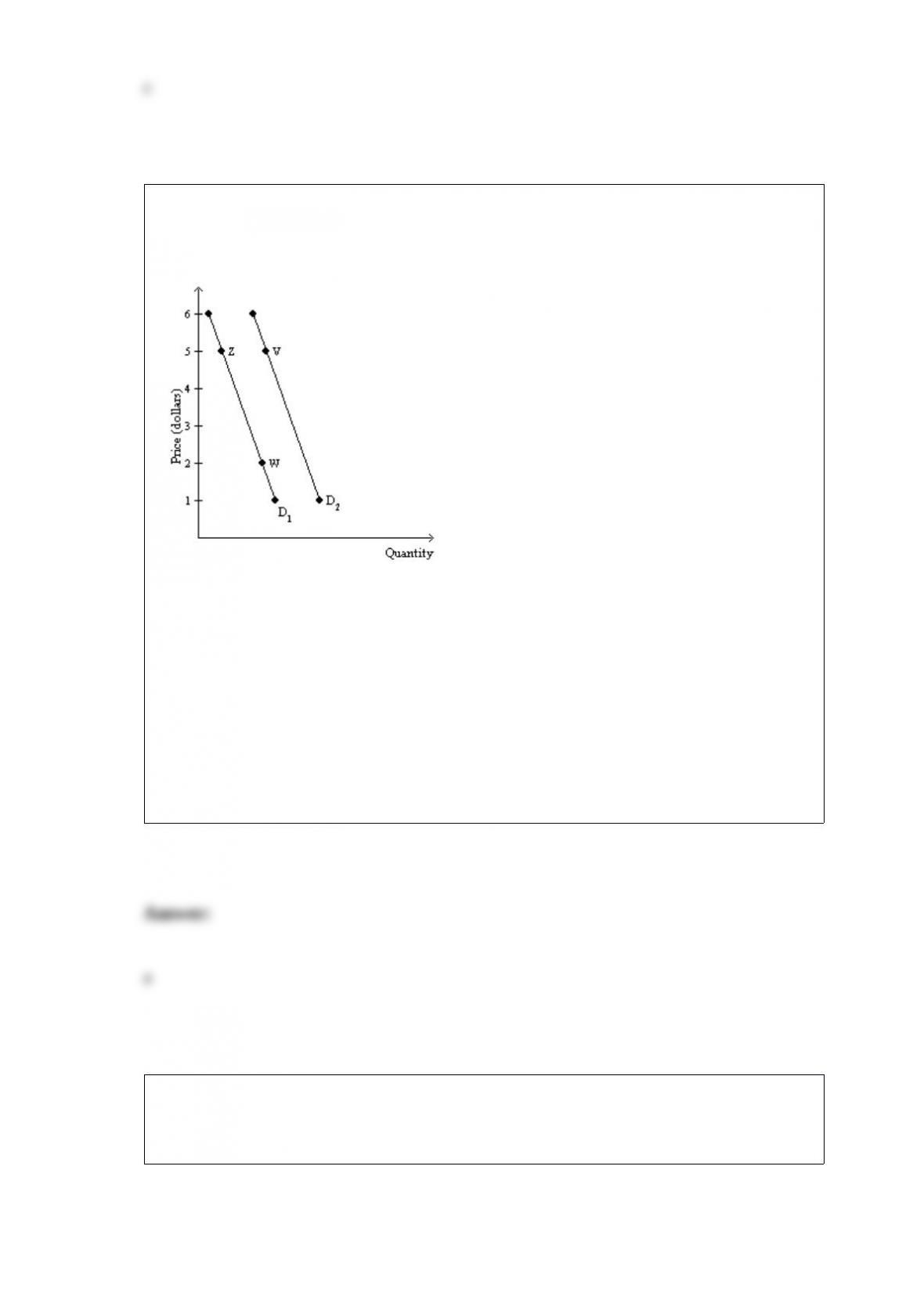
Refer to Exhibit 3-3. A movement from point Z to point W would have been the result
of
Exhibit 3-3
Good Y
a. a reduction in the price of good Y.
b. an increase in taxes paid by the producers of good Y.
c. a decline in technology in the production of good Y.
d. an increase in the number of buyers of good Y.
Refer to Exhibit 20-5. For graph (3), if the seller of X raises the price from $1.50 to
$2.00, the total revenue the seller receives will
Exhibit 20-5
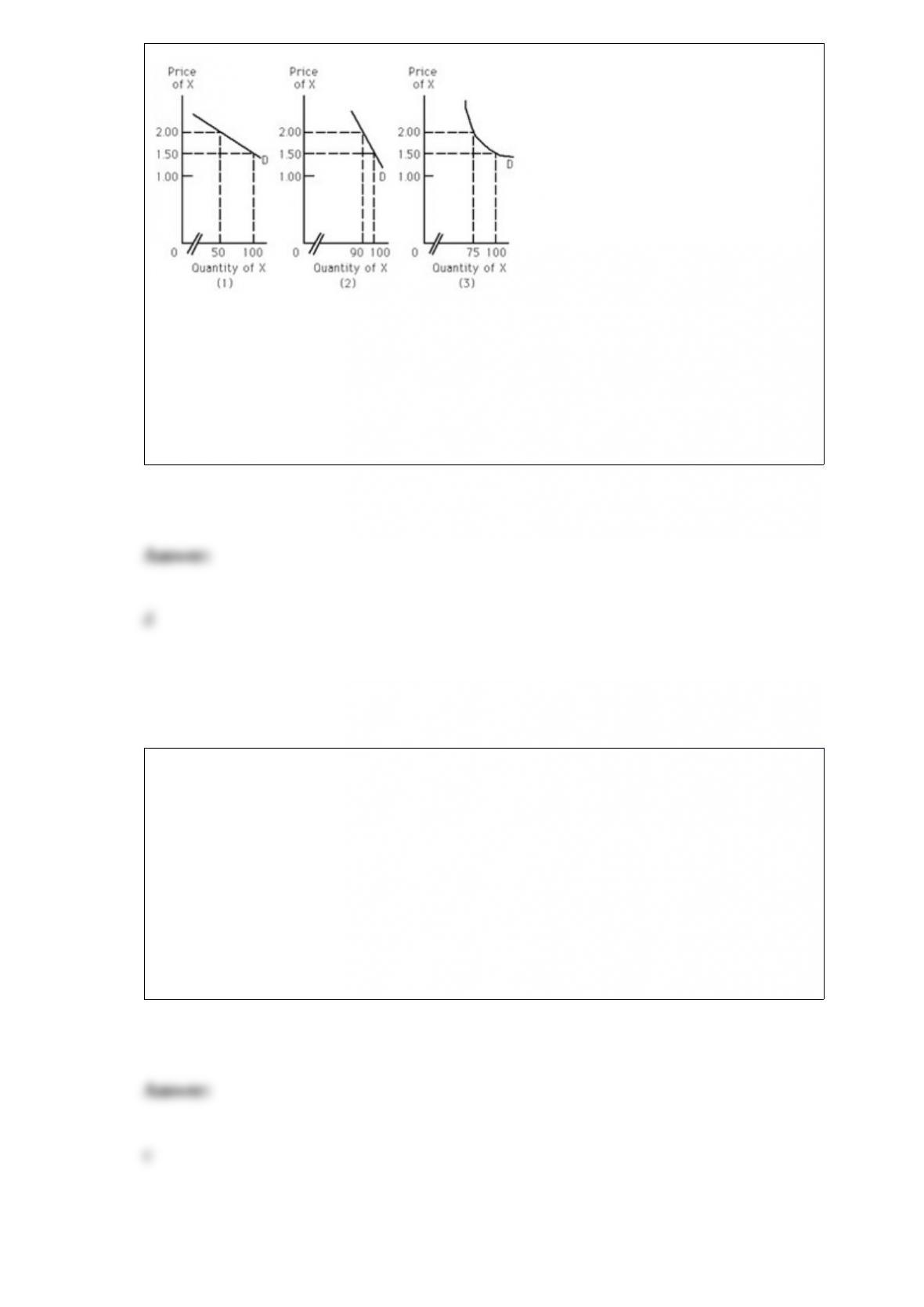
a. decrease by $30.
b. increase by $30.
c. decrease by $5.
d. not change.
Which of the following statements is false?
a. The issuer of a bond is a borrower.
b. The person who buys a bond is a lender.
c. Interest earned on corporate bonds is exempt from federal income taxes.
d. The coupon rate on a bondis the percentage of the face value that the bondholder
receives annually until the bond matures.

A government agricultural policy in which a mandated minimum price is set is the
a. marketing quota system.
b. acreage allotment program.
c. price support program.
d. target price system.
e. paying farmers not to produce system.