
If people value clean air over dirty air, and if the air in city A is cleaner than the air in
city B (by a wide margin), then we would expect that ____________________, all else
equal between the two cities.
a. comparable houses in the two cities will sell for the same price.
b. comparable house in A will be more expensive than comparable house in B.
c. comparable house in B will be more expensive than comparable house in A.
d. There is not enough information to answer the question.
Which of the following statements is false?
a. Another term for a Treasury bill is a T-bill.
b. Treasury notes mature in 2 to 10 years.
c. Treasury bonds are considered very safe investments, but Treasury bills are
considered to be a more risky investment.
d. It is unlikely the federal government will default on its bond obligations.
When an industry is described as a decreasing-cost, increasing-cost, or constant-cost
industry, the “cost” that is being referred to is
a. marginal cost.
b. average total cost.

c. average variable cost.
d. sunk cost.
e. fixed cost.
If government regulators want a natural monopolist to earn only zero economic profits,
then they will set a price
a. equal to average total cost (ATC).
b. equal to marginal cost.
c. such that marginal revenue equals marginal cost.
d. none of the above
Demand increases in an increasing-cost industry that is initially in long-run competitive
equilibrium. After full adjustment, price will be
a. equal to its original level.
b. below its original level.
c. above its original level.
d. There is not enough information to answer the question.

Constitutional economists
a. assert that within a given set of institutions, constraints, laws and rules, outcomes
might be the same no matter who is elected to office.
b. study the type of constraints that individuals might seek to place upon themselves in
order to achieve some objective that doesn’t seem achievable in a non-constrainable
environment.
c. assert that better outcomes arise from changing the political party in power at any
given point in time than from changing institutions and constraints.
d. b and c
e. a and b
Economists often assert that a person who receives an in-kind transfer payment (from
government) has a higher income as a result. But an in-kind transfer is not money
income, so what are economists thinking?
a. They are thinking that an additional in-kind benefit, like more money income, makes
a person better off and thus they are equating being better off (in the sense of having
more goods and services) with a higher income.
b. They are thinking that persons who receive in-kind benefits end up selling them,
receiving money in exchange.
c. They are thinking that the individuals who receive the in-kind benefits equate more
in-kind benefits with more money income.

d. They are thinking that individuals who receive in-kind benefits would prefer to
receive them over receiving additional money income, so that in-kind benefits are worth
at least their monetary value.
e. none of the above
A “decrease in demand” means that
a. the demand curve has shifted to the left.
b. price has declined and consumers want to purchase more of the good.
c. the demand curve has shifted to the right.
d. the price of the good can be expected to decline, assuming supply stays constant.
Which of the following is an example of human capital?
a. a computer
b. an electronic calculator
c. education
d. stocks and bonds
e. all of the above
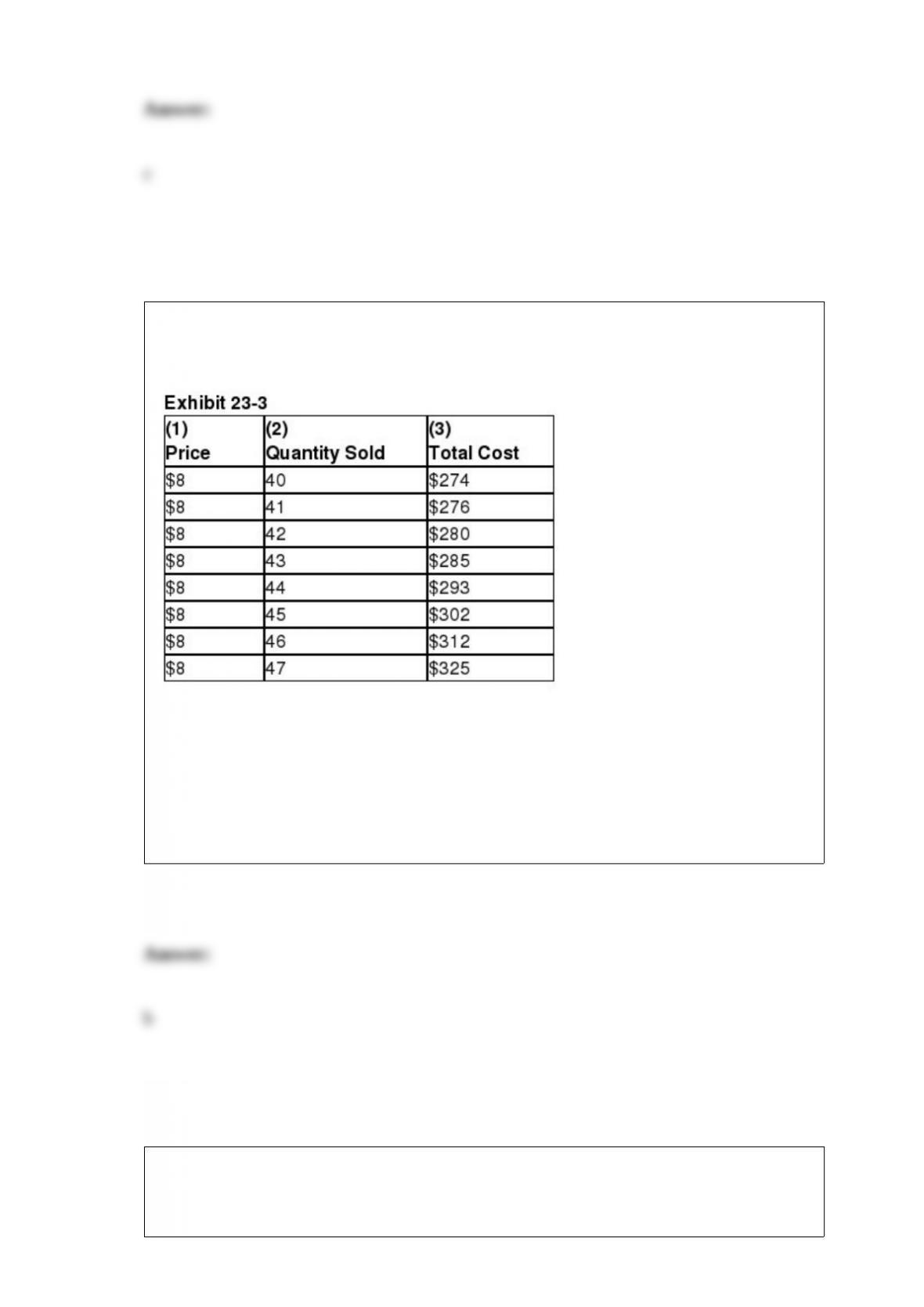
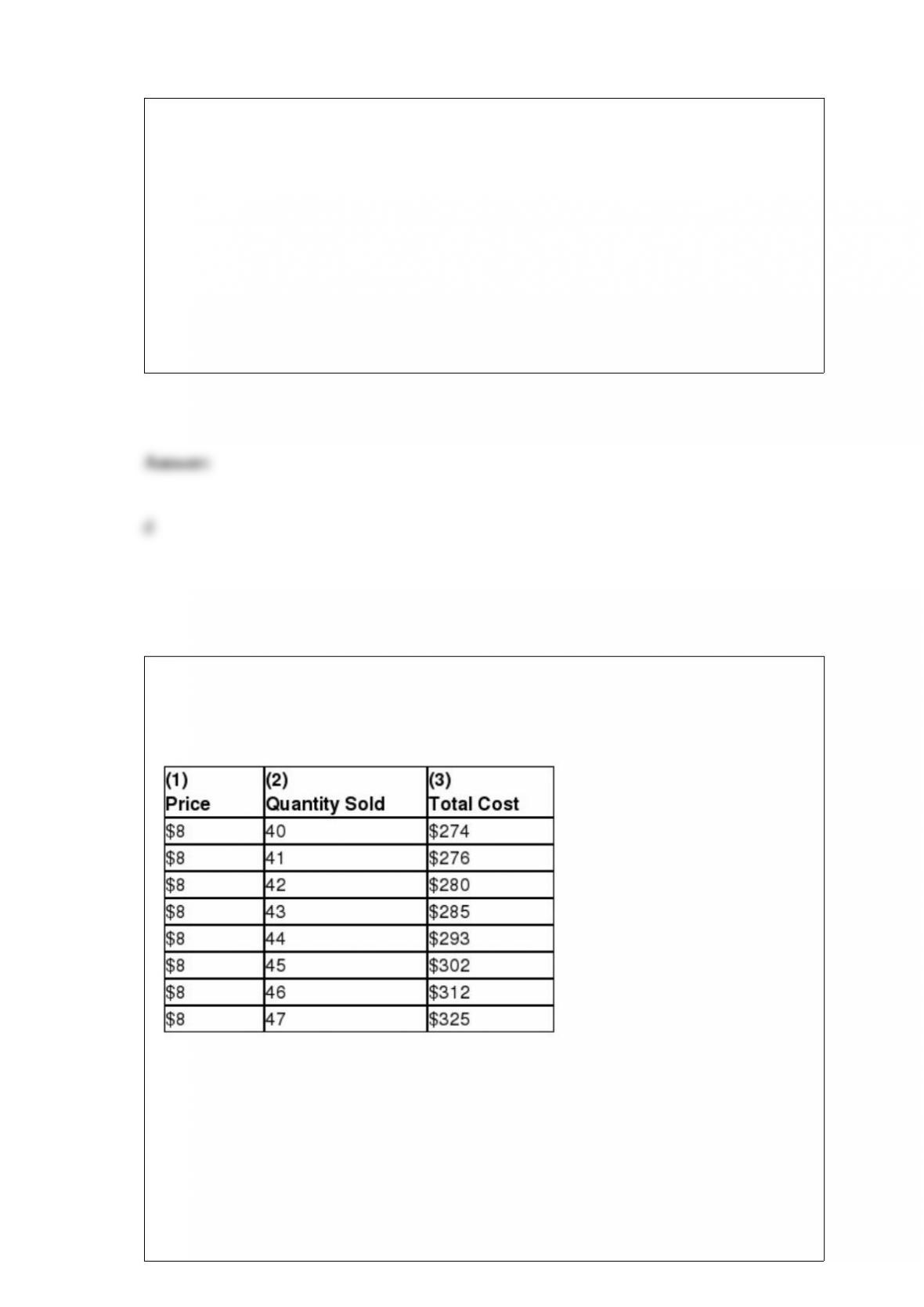
Refer to Exhibit 23-3. What is the maximum profit?
a. $65
b. $59
c. $20
d. $376
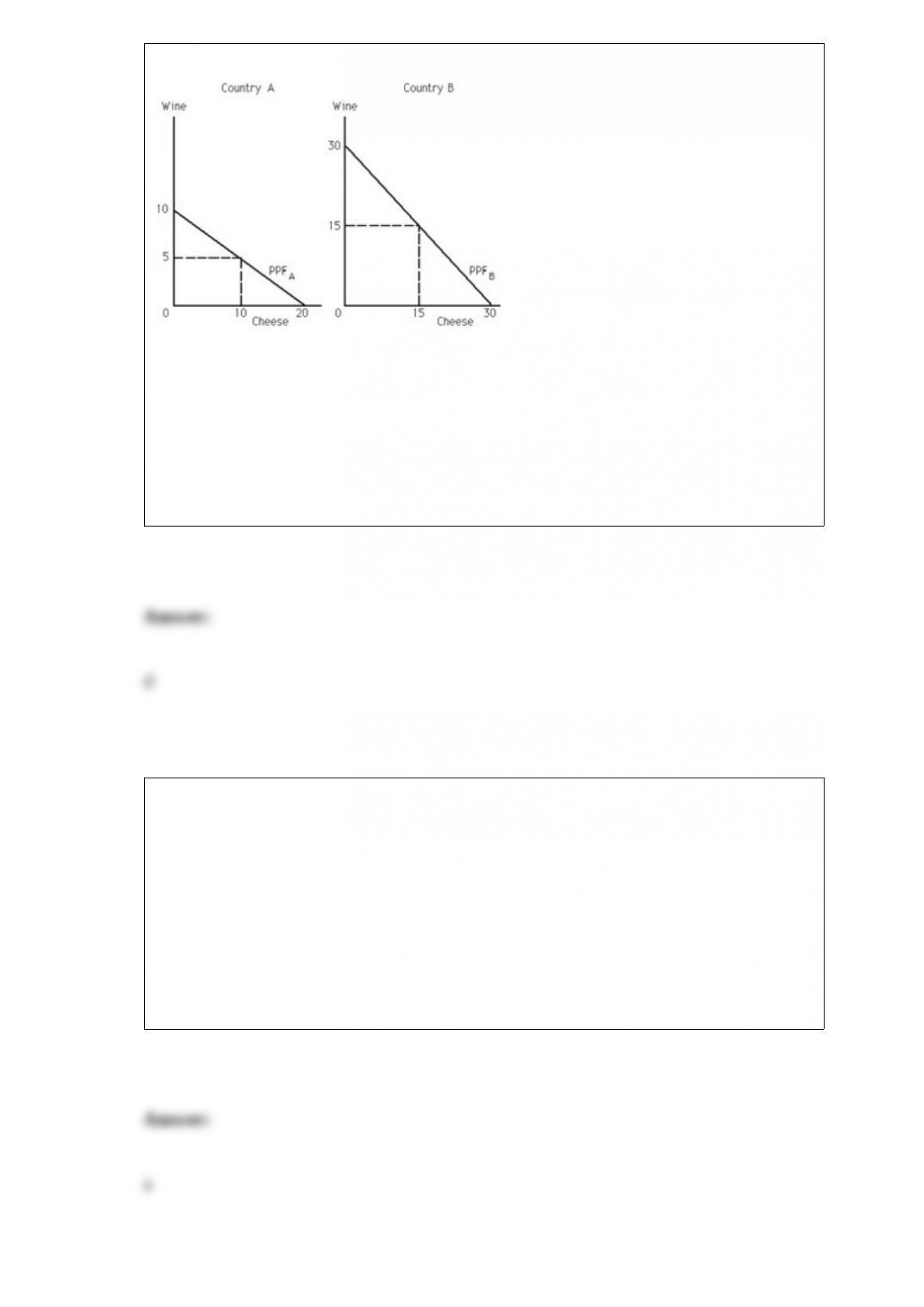
Refer to Exhibit 34-6. The opportunity cost of 1 unit of wine in terms of units of cheese
is __________ for country B.
Exhibit 34-6
a. 15
b. 10
c. 5
d. 1
Which of the following is one of the assumptions upon which the theory of
monopolistic competition is built?
a. There are many sellers.
b. There are few buyers.
c. It is difficult to enter the industry.
d. Each firm in the industry produces a homogeneous product.
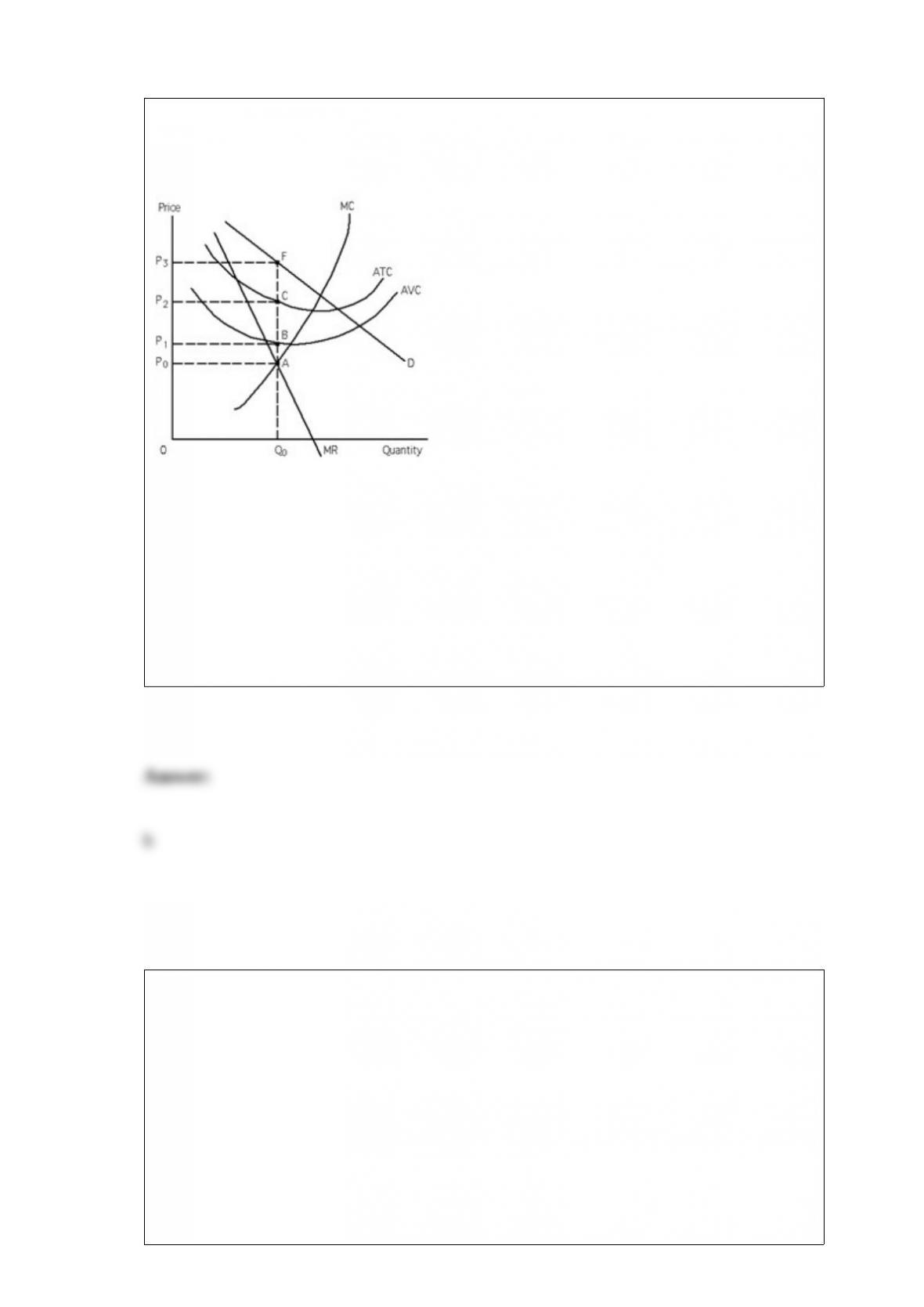
Refer to Exhibit 24-2. Total revenue at the profit-maximizing quantity of output is the
Exhibit 24-2
a. area 0P0AQ0.
b. area 0P3FQ0.
c. distance from Q0 to A.
d. distance from Q0 to D.
e. none of the above
Which of the following is a characteristic of perfect competition?
a. many sellers and few buyers
b. many buyers and few sellers
c. a heterogeneous product
d. buyers and sellers having all relevant information
e. high barriers to entry and exit

A person has a comparative advantage in the production of a good when they can
produce the product at a(n) ________ opportunity cost compared to another person.
a. higher
b. increasing
c. lower
d. equal
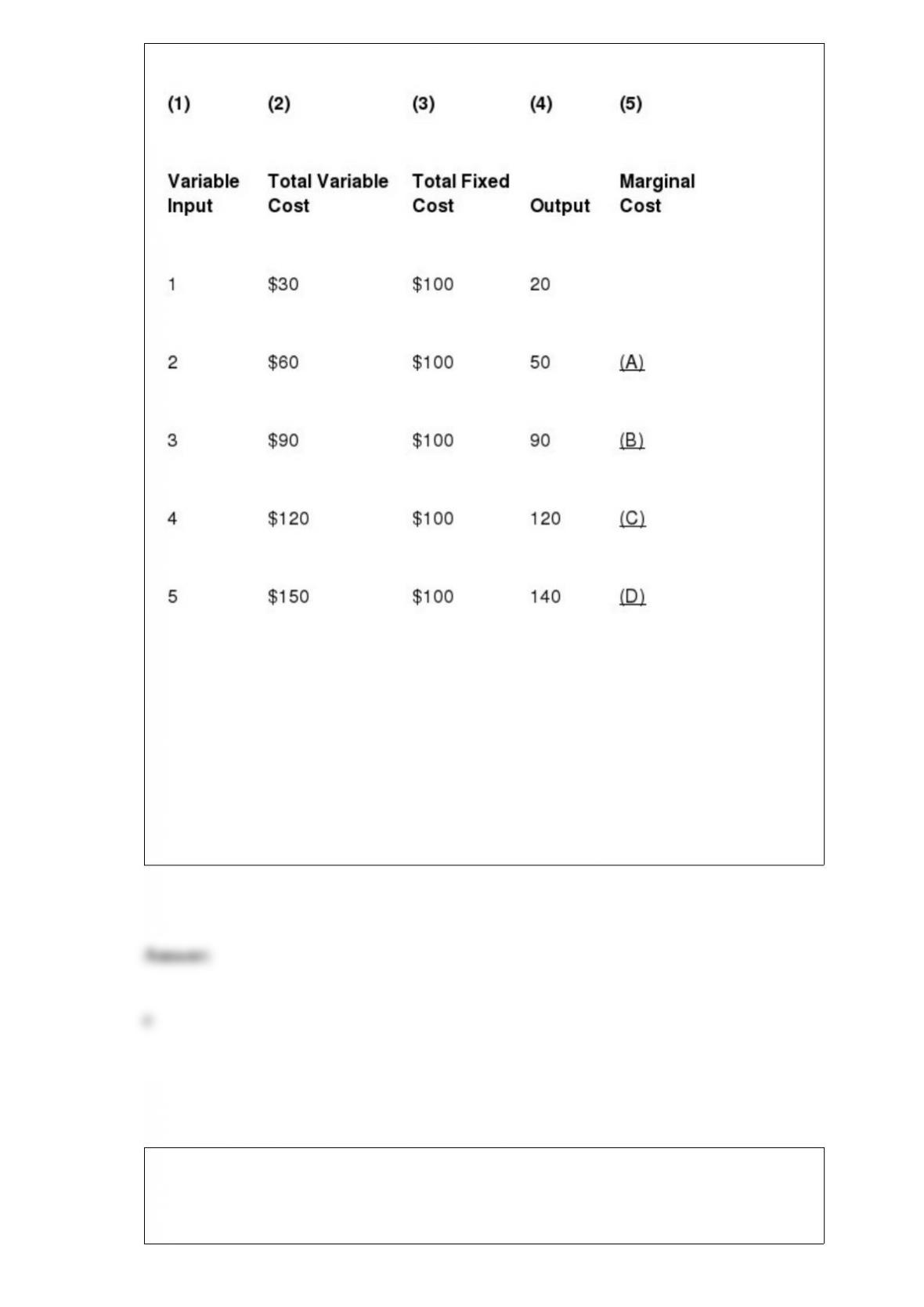
Refer to Exhibit 22-2. The dollar amounts that go in blanks (C) and (D), respectively,
are
Exhibit 22-2
a. $10.00 and $1.00.
b. $30.00 and $34.00.
c. $3.00 and $4.00.
d. $6.67 and $10.00.
e. $1.00 and $1.50.
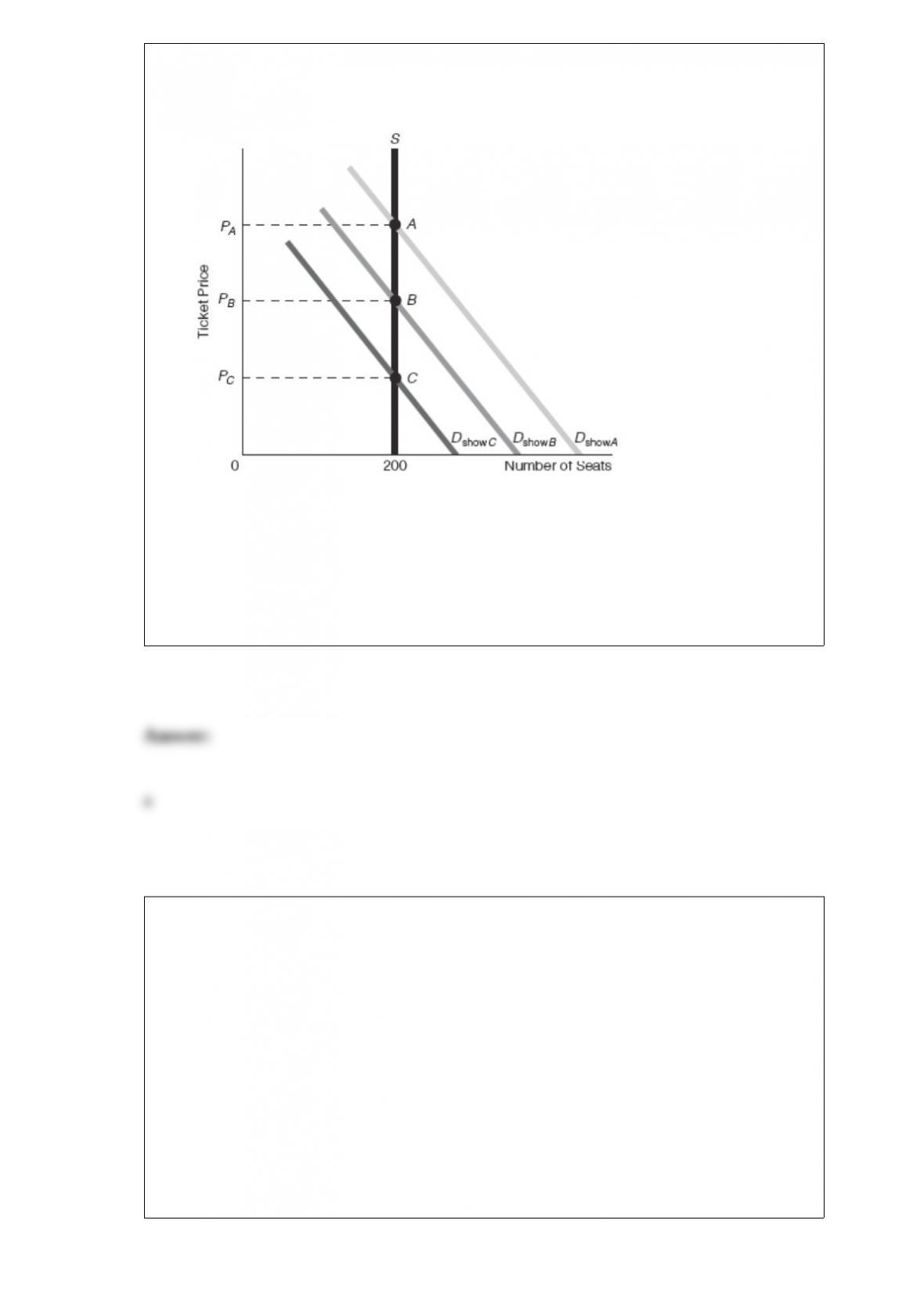
Refer to Exhibit 5-4.If television studio executives choose to charge a price of PB to
view the taping of all shows, they will find that there is a shortage of tickets to view the
taping of show ___________ and a surplus of tickets to view the taping of show
______________.
Exhibit 5-4
a. A; C
b. C; A
c. B; A
d. B; C
There is a monitorless team (firm) of 10 persons. The 10 persons agree to work together
and split the revenue (they earn) equally. In this setting, the cost of shirking to an
individual is
a. higher than it would be if the individual worked alone.
b. the same as it would be if the individual worked alone.
c. lower than it would be if the individual worked alone.
d. necessarily greater than the benefits of shirking.
e. necessarily less than the benefits of shirking.

In the short run, the best policy for a perfectly competitive firm is to
a. shut down its operation if price ever falls below average total cost.
b. produce and sell its product as long as price is greater than average variable cost.
c. shut down its operation if price falls between average total cost and average variable
cost.
d. a and c
e. none of the above
A public good is
a. a good that government provides to the public, such as roads, education, etc.
b. a good that is consumed in public, such as at a restaurant or ball park.
c. a good that if consumed by one person can be consumed by other persons to the same
degree and the consumption of which cannot be denied to anyone.
d. a good that benefits the public more than it costs the public.
e. none of the above

For a certain good, when the good’s price falls from $14 to $12, its quantity demanded
rises from 1,200 to 1,400 units. The price elasticity of demand for this good is
a. 2.55.
b. 0.66.
c. 0.39.
d. 0.20.
e. 1.00
An increase in the expected price of corn would likely do the following to the current
supply and demand for corn:
a. increase both the demand and the supply.
b. decrease both the demand and the supply.
c. increase the demand, but decrease the supply.
d. increase the supply, but decrease the demand.
Marginal revenue is equal to __________ divided by __________.
a. total revenue; the quantity of output
b. marginal cost; wages
c. the change in total revenue; the quantity of output
d. the change in total revenue; the change in quantity of output
e. the change in quantity of output; the change in total revenue
Refer to Exhibit 23-3. What is the increase in profit that would result from producing 43
units of the product rather than producing 40 units?
Exhibit 23-3
a. $60
b. $48
c. $28
d. $16

e. $13