
If MRP = VMP = MFC = wages, then the firm is
a. selling its product in a perfectly competitive market and is hiring its labor in a
perfectly competitive labor market.
b. selling its product in a perfectly competitive market but is not hiring its labor in a
perfectly competitive labor market.
c. not selling its product in a perfectly competitive market but is hiring its labor in a
perfectly competitive labor market.
d. neither selling its product in a perfectly competitive market nor hiring its labor in a
perfectly competitive labor market.
A Broadway play company can only charge one price for tickets to a given performance
of its play.The company manager notices that the company earns greater total revenue
when they charge a higher ticket price and its theater is three-quarters full than when
they charge a lower ticket price and the theater is completely full. It follows that
demand for this play is
a. elastic.
b. unit elastic.
c. perfectly inelastic.
d. perfectly elastic.
e. inelastic.

The existence of substitutes for a good and the percentage of one’s budget spent on the
good are among the factors that determine how elastic the demand for the good will be.
a. True
b. False
Labor union A faces a greater cutback in labor for a given wage increase than does
labor union B. It follows that the
a. demand for workers in labor union A is greater than the demand for workers in labor
union B.
b. elasticity of demand for workers in labor union B is greater than the elasticity of
demand for workers in labor union A.
c. demand for workers in labor union B is greater than the demand for workers in labor
union A.
d. elasticity of demand for workers in labor union A is greater than the elasticity of
demand for workers in labor union B.
e. a and d
An IOU that promises to pay a certain amount at maturity, and also to pay periodic

fixed amounts until that date, is called a(n)
a. stock.
b. equity.
c. bond.
d. futures contract.
The price of a foodstuff falls and the total revenue (received by farmers for selling the
foodstuff) rises. What could explain this?
a. Increased supply and elastic demand.
b. Real income rises and the foodstuff is an inferior good.
c. Real income rises and the foodstuff is a normal good.
d. Increased supply and inelastic demand.
e. none of the above
Refer to Exhibit 26-3. The four-firm concentration ratio for this industry is
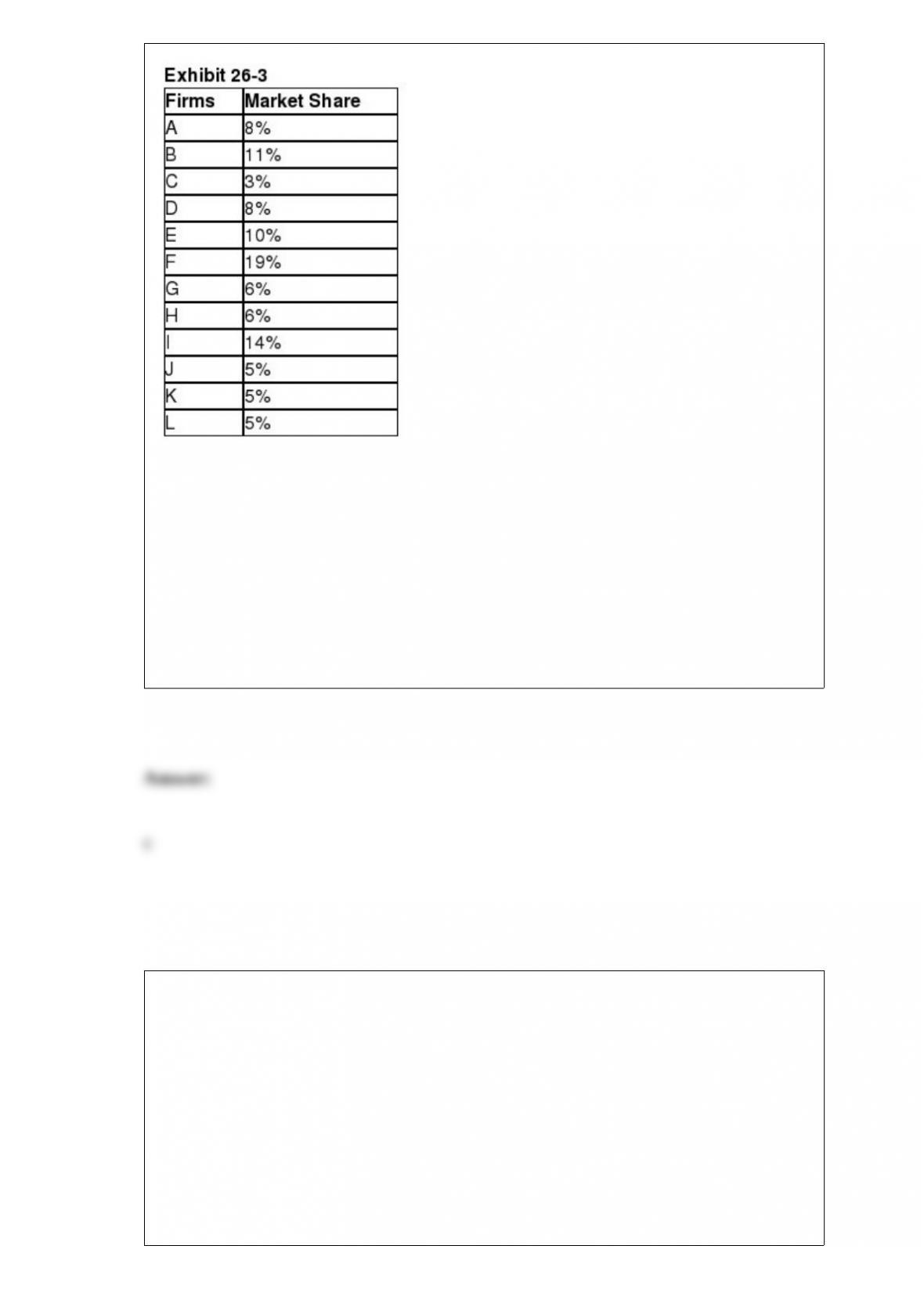
a. 46 percent.
b. 49 percent.
c. 54 percent.
d. 696 percent.
e. This cannot be determined without further information.
When a positive externality exists,
a. external benefits are necessarily greater than private benefits.
b. social benefits are greater than private benefits.
c. social benefits are less than private benefits.
d. social benefits equal private benefits.
e. none of the above

People may vote in a presidential election if
a. they feel it is their civic duty to vote.
b. they believe their vote will matter.
c. the costs of doing so are greater than the benefits received from voting.
d. a or b
e. a, b, or c
The answer is, “This is principally used to exhibit changes in data over time.” The
question is,
a. What is a pie chart?
b. What is a 45-degree line?
c. What is a tangent line?
d. What is a line graph?
e. b and d

Given the choice between a sure-thing option and a gamble option with the same
expected payoff, a____________ person will choose gamble.
a. risk averse
b. risk loving
c. risk neutral
d. risk avoiding
e. none of the above
For a monopoly firm, marginal revenue equals marginal cost at 100 units (of output). At
100 units, price is above marginal cost. It follows that the monopoly firm
a. earns profits.
b. takes losses.
c. faces some close substitutes for its product.
d. faces no substitutes for its product.
e. is not resource-allocative efficient.
An economy can produce either of these two combinations of goods X and Y: 1,000X
and 0Y or 400Y and 0X. Furthermore, the opportunity cost between the two goods is
always constant. Which of the following combinations of the two goods, X and Y, is it
possible for the economy to produce?
a. 700 units of X and280 units of Y
b. 600 units of X and250 units of Y
c. 400 units of X and 150 units of Y
d. 100 units of X and600 units of Y
e. 300 units of X and280 units of Y
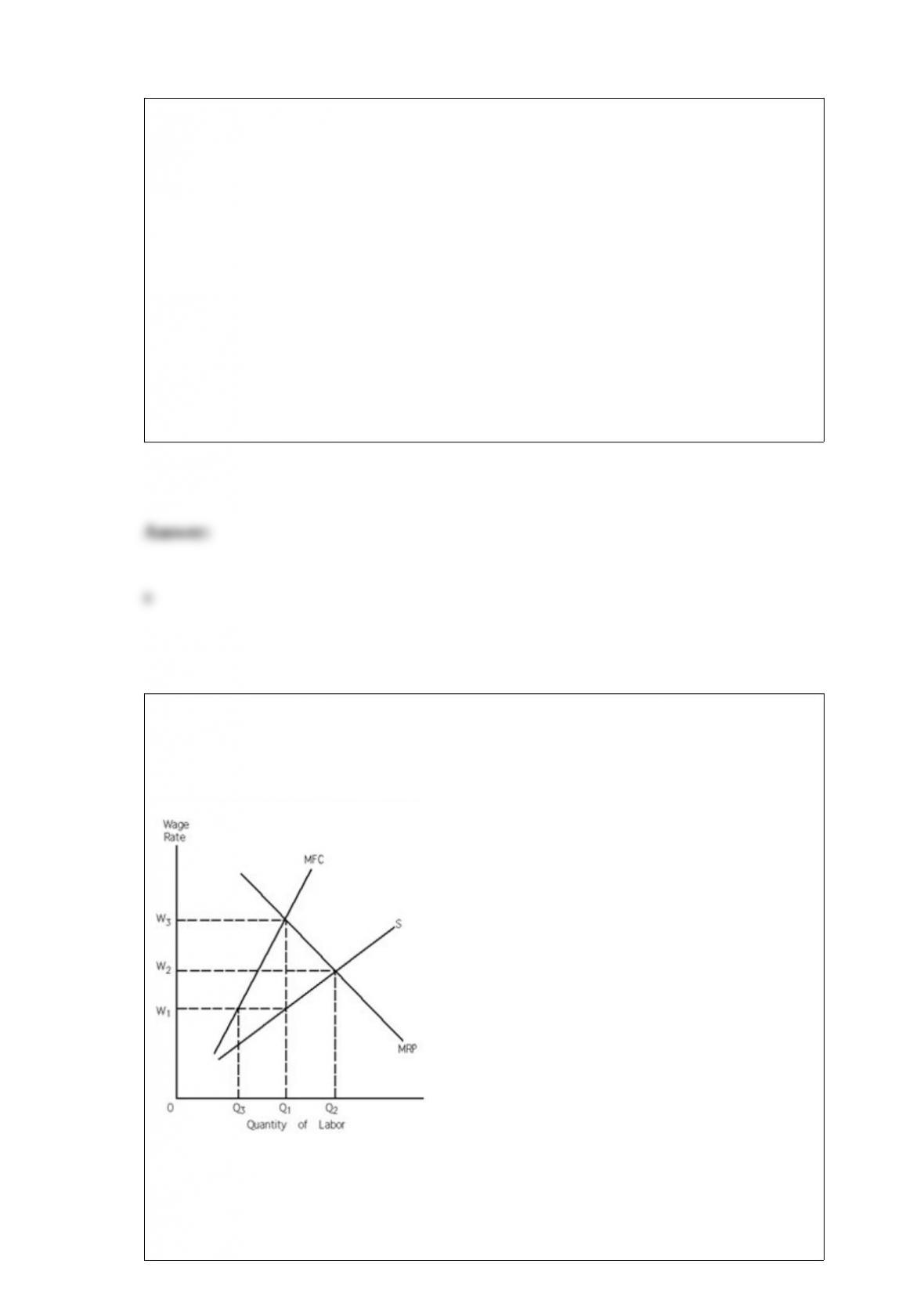
Refer to Exhibit 28-3. Consider the monopsony setting. In the absence of collective
bargaining, what wage rate does the profit-maximizing monopsonist pay?
Exhibit 28-3
a. W1
b. W2
c. W3

d. none of the above
The major way that the government supports crop prices is by granting nonrecourse
loans to farmers.
a. True
b. False
Legal barriers to entry include patents, government licenses and economies of scale.
a. True
b. False