Jimmy borrowed $30,000 to add a room to his house. He financed the loan over 3 years
at 8 percent per year. He expects a 2 percent inflation rate each year for the next 3
years. It follows that he expects to pay an annual real interest rate of
a. 8 percent.
b. 9 percent.
c. 11 percent.
d. 6 percent.
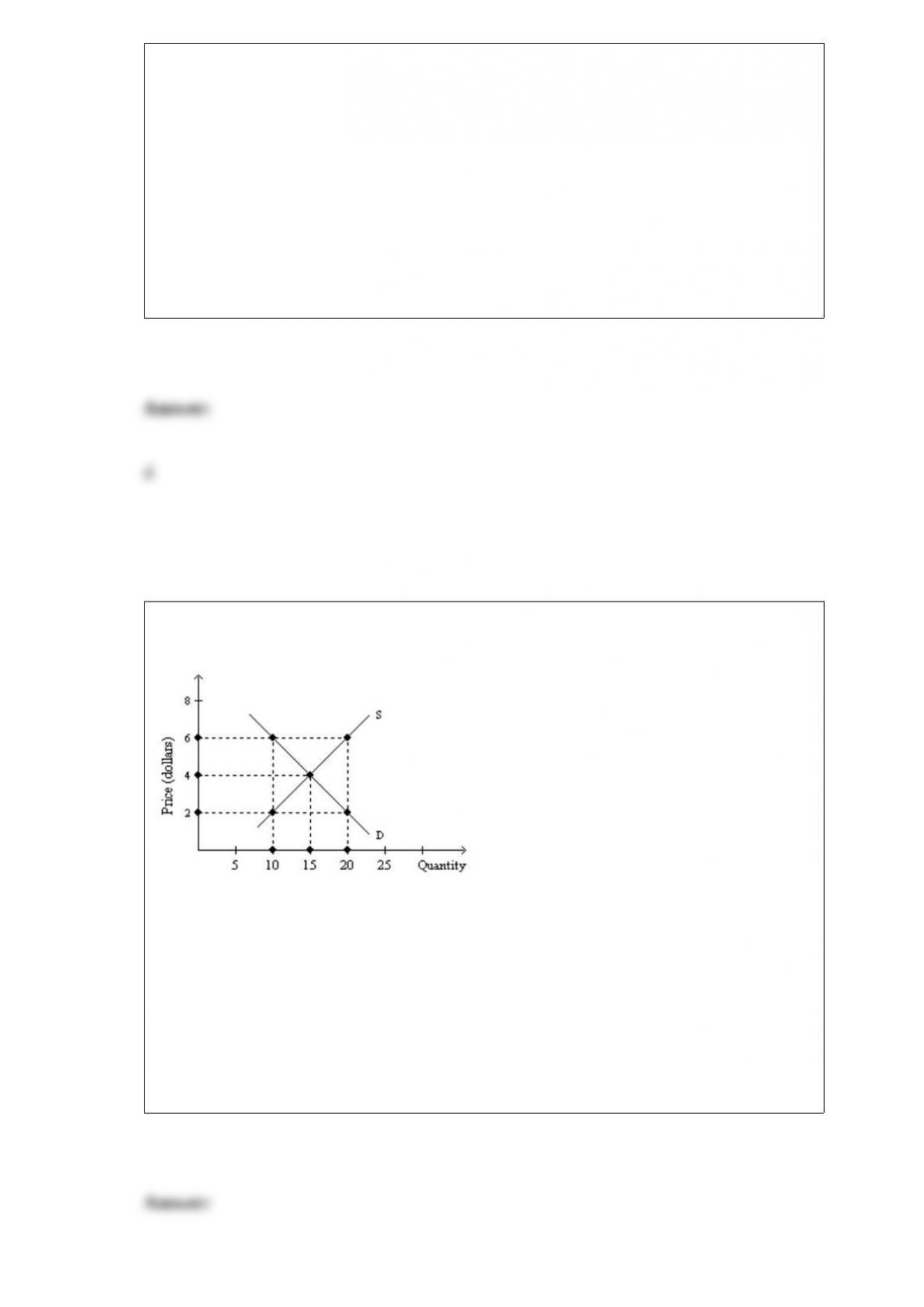
Refer to Exhibit 3-4. A price of $4 in the market will result in a
Exhibit 3-4
a. shortage of 10 units.
b. surplus of 10 units.
c. surplus of 5 units.
d. shortage of 5 units.
e. none of the above

The lower the price of medical care in general, the higher the
____________________________ medical care and the ______________________
specific items that make up medical care (such as x-rays).The result will be a
_______________ price for the specific items that make up medical care.
a. quantity demanded of; higher the demand for; higher
b. demand for; higher the demand for; higher
c. quantity demanded of; lower the demand for; lower
d. demand for; higher the quantity demanded of; higher
A cost that is incurred when an actual monetary payment is made is a(n) __________
cost.
a. explicit
b. implicit
c. positive
d. expressed

To an economist, it is preferable to
a. assume that all criminals are rational.
b. assume that all criminals are irrational.
c. build a theory based on a rational criminal and then check the evidence.
d. a or b
Suppose that there are two cities that are alike in every way except that one city has
significantly better weather than the other city.Call the city with good weather
Good-Weather City (GWC) and the other Bad-Weather City (BWC).Assume that the
median price of a home in the two cities is originally the same.If the marginal utility of
living in GWC is 500 and the marginal utility of living in BWC is 300, to make
themselves better off economic theory tells us that
a. at least some people will move from BWC to GWC, which will make housing prices
rise in GWC and BWC.
b. at least some people will move from GWC to BWC, which make housing prices rise
in BWC and GWC.
c. at least some people will move from BWC to GWC, which will make housing prices
rise in GWC and fall in BWC.
d. at least some people will move from GWC to BWC, which will make housing prices
rise in BWC and fall in GWC.

The act which empowered the Federal Trade Commission to deal with false and
deceptive acts or practices was the
a. Wheeler-Lea Act.
b. Federal Trade Commission Act.
c. Robinson-Patman Act.
d. Sherman Act.
e. Clayton Act.
Today, the Dow Jones Industrial Average
a. consists of 30 stocks.
b. is a set group of stocks that remains constant over time.
c. contains stocks that are widely held by institutional investors and individuals.
d. contains both stocks and bonds of large American companies.
e. a and c
Which of the following statements is false?
a. There are no special nonpecuniary aspects to any job.

b. Nonpecuniary aspects of a job refer to the nonmoney aspects of a job.
c. A change in the wage rate can change the quantity demanded and quantity supplied of
labor.
d. A change in the supply of labor can affect the wage rate.
Rich has $100,000 and Poore has $1,000. Which of these statements is most strongly
supported by the theory of consumer choice?
a. An extra dollar given to Rich is worth less to him than his 100,000th dollar.
b. An extra dollar is worth less to Rich than it is to Poore.
c. An extra dollar is worth less to Poore than it is to Rich.
d. Rich’s 1,000th dollar is worth more to Rich than Poore’s 1,000th dollar is worth to
Poore.
e. Rich’s 100,000th dollar is worth to Rich exactly what Poore’s 1,000th dollar is worth
to Poore.
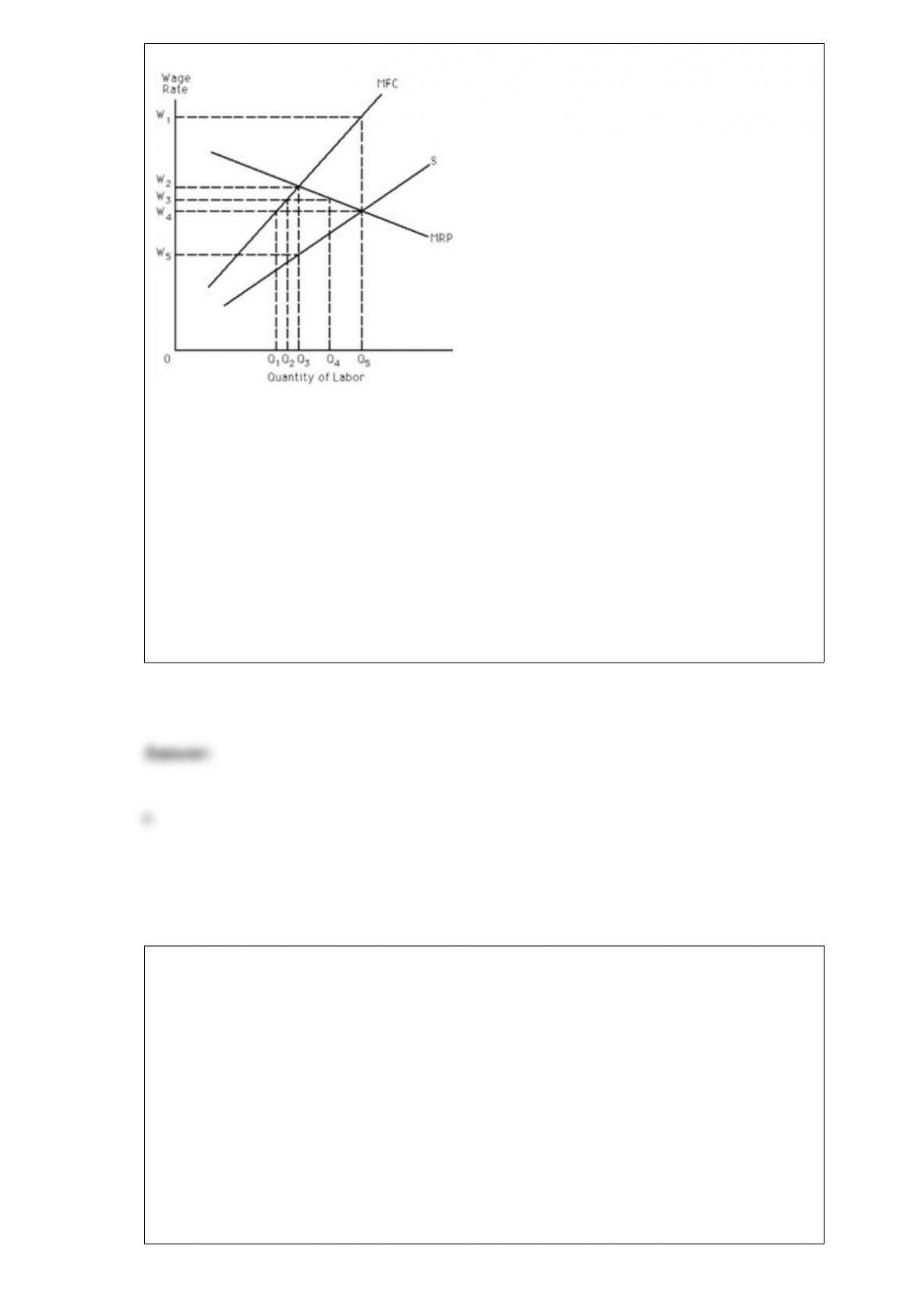
Refer to Exhibit 28-8. In the absence of collective bargaining, what wage rate would the
profit-maximizing monoposonist pay?
Exhibit 28-8
a. W1
b. W2
c. W3
d. W4
e. W5
Which of the following assumptions applies to both perfect competition and
monopolistic competition?
a. many buyers and sellers
b. easy entry into and exit from the market
c. profit is maximized at the level of output for which MR = MC
d. a and c
e. all of the above

The Wheeler-Lea Act of 1938 empowered the Federal Trade Commission to
a. deal with anticompetitive mergers that occurred as a result of one company acquiring
the physical assets of another company.
b. deal with false and deceptive advertising.
c. deal with unfair methods of competition and to determine which actions taken by
businesses were too aggressive.
d. regulate the trucking and railroad industries.
e. decrease the failure rate of small businesses by protecting them from competition
from large and growing chain stores.
Some economists have found that U.S. imports of Chinese goods and resources
a. lower the price of goods for U.S. consumers.
b. lower the cost of inputs for U.S. firms.
c. increase the variety of products in U.S. markets.
d. may enhance productivity of U.S. firms.
e. all of the above

There are 200 firms in a perfectly competitive industry. Half of the firms supply 100
units at $3 per unit and the other half of the firms supply 130 units at $3 per unit. One
point on the market supply curve is
a. 23,000 units at $3.
b. 10,000 units at $3.
c. 13,000 units at $3.
d. 23,000 units at $6.
e. none of the above
“Economic rent” is
a. what an individual pays for the use of land or buildings.
b. a payment in excess of the producer’s explicit costs of production.
c. a payment in excess of opportunity costs.
d. a payment for capital goods.
e. none of the above
The absolute value of the slope of the budget constraint is also known as the marginal
rate of substitution.
a. True
b. False
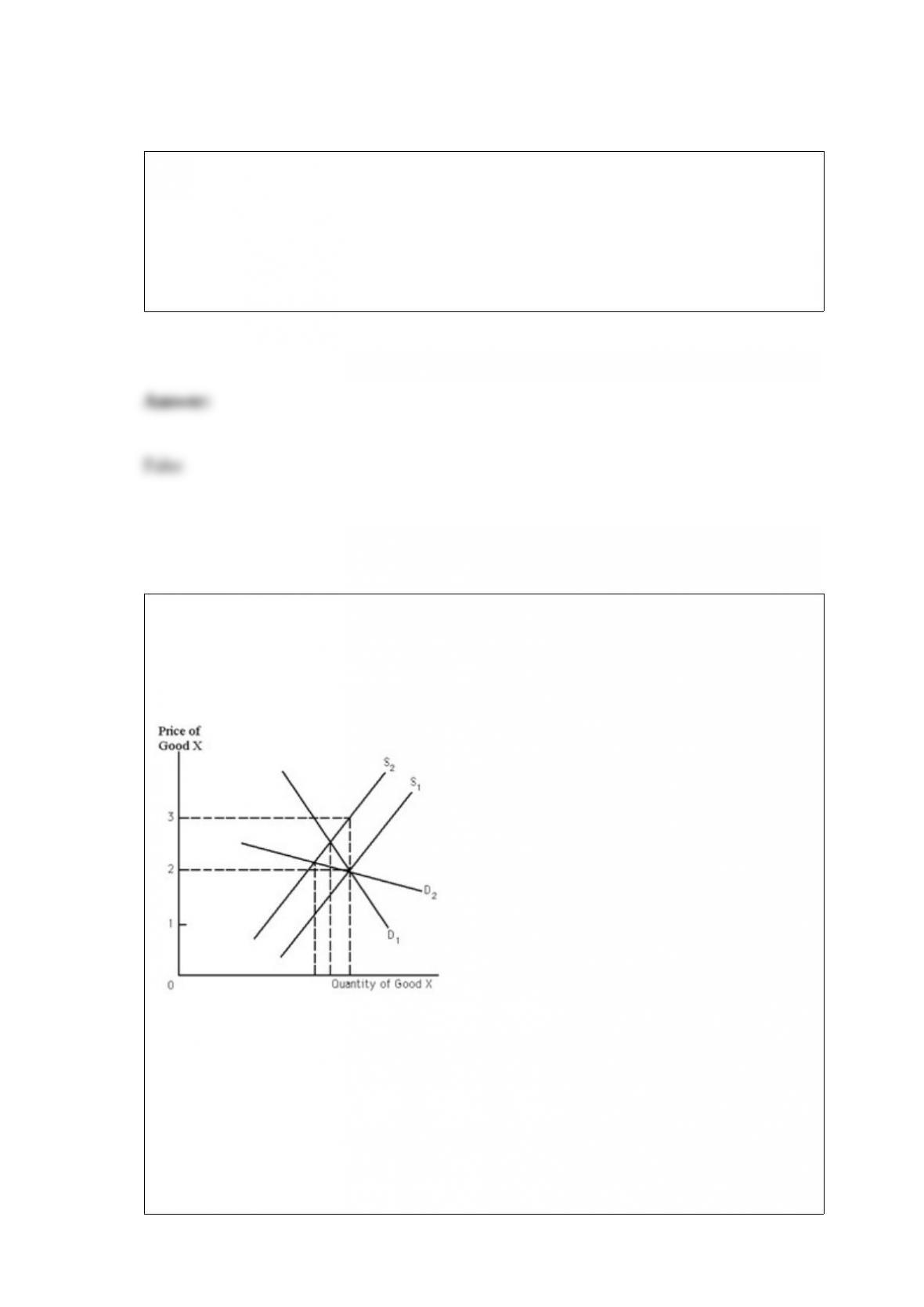
Refer to Exhibit 20-6. Suppose the three equilibrium quantities are 700, 800, and 900,
and the two other equilibrium prices are $2.20 and $2.75. What is the change in total
revenue when a per-unit tax shifts S1 to S2, given that D2 is the relevant demand curve?
Exhibit 20-6
a. $260
b. -$260
c. $900
d. $700
e. -$200

The capture theory of regulation implicitly holds that
a. the members of a regulated industry have a stronger incentive to attend regulatory
meetings than taxpayers and consumers.
b. regulators will always do what they think is in the public’s best interest.
c. regulatory lag is often longer than most people think.
d. b and c
e. a, b, and c
Which of the following statements is true?
a. The administrative costs per dollar are greater for a large loan than a small loan.
b. The risk on a long-term loan is likely to be less than on a short-term loan, ceteris
paribus.
c. a and b
d. none of the above

One of the effects of a price floor (set above equilibrium price) is
a. a surplus.
b. higher-quality goods are produced.
c. more satisfied customers.
d. all of the above
e. none of the above